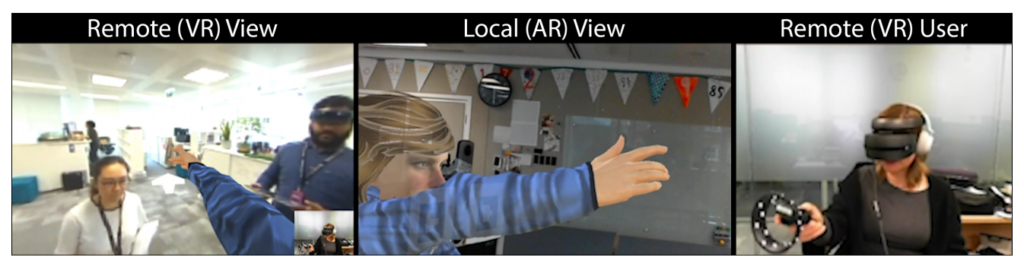
Publications

104 publications

Hover over a dot to see details · Click to open the paper
2026

Tools for Thought: Understanding, Protecting, and Augmenting Human Cognition with Generative AI — From Vision to Implementation

Zelun Tony Zhang, Nick von Felten, Leon Reicherts, Lev Tankelevitch, Zhitong Guan, Sean Rintel, Yue Fu, Jessica He, Kenneth Holstein, Advait Sarkar, Gonzalo Ramos, Anuschka Schmitt, Anjali Singh, Haotian Li, Srishti Palani, Peter Dalsgaard
Abstract & BibTeX
Building on the first Tools for Thought (TfT) workshop at CHI 2025, we invite researchers, designers, and practitioners to further operationalise approaches for the design, usage, and evaluation of Generative Artificial Intelligence (GenAI) as a TfT. The first goal of the workshop is to put into focus which outcomes a TfT should help people achieve to effectively augment their cognition while avoiding its erosion. Secondly, we will explore how to achieve these outcomes through design and usage strategies. Third, the workshop will also address what a TfT needs for its successful adoption and integration into people’s flow, so that they can benefit from the tools’ potential in their own terms. By focussing on these three research goals, the workshop aims to further develop and advance the multidisciplinary TfT community interested in exploring research frameworks, theories, methods, and approaches to conceptualising, designing, and researching GenAI as a TfT.
@inproceedings{zhang2026tools,
author = {Zhang, Zelun Tony and von Felten, Nick and Reicherts, Leon and Tankelevitch, Lev and Guan, Zhitong and Rintel, Sean and Fu, Yue and He, Jessica and Holstein, Kenneth and Sarkar, Advait and Ramos, Gonzalo and Schmitt, Anuschka and Singh, Anjali and Li, Haotian and Palani, Srishti and Dalsgaard, Peter},
title = {Tools for Thought: Understanding, Protecting, and Augmenting Human Cognition with Generative AI — From Vision to Implementation},
booktitle = {CHI 2026},
year = {2026},
month = {April},
publisher = {ACM},
url = {https://www.microsoft.com/en-us/research/publication/tools-for-thought-understanding-protecting-and-augmenting-human-cognition-with-generative-ai-from-vision-to-implementation/},
}
Nudging Attention to Workplace Meeting Goals: A Large-Scale, Preregistered Field Experiment

Lev Tankelevitch, Payod Panda, Sean Rintel
Abstract & BibTeX
Ineffective meetings are pervasive. Thinking ahead explicitly about meeting goals may improve effectiveness, but current collaboration platforms lack integrated support. We tested a lightweight goal-reflection intervention in a preregistered field experiment in a global technology company (361 employees, 7196 meetings). Over two weeks, workers in the treatment group completed brief pre-meeting surveys in their collaboration platform, nudging attention to goals for upcoming meetings. To measure impact, both treatment and control groups completed post-meeting surveys about meeting effectiveness. While the intervention impact on meeting effectiveness was not statistically significant, mixed-methods findings revealed improvements in self-reported awareness and behaviour across both groups, with post-meeting surveys unintentionally functioning as an intervention. We highlight the promise of supporting goal reflection, while noting challenges of evaluating and supporting workplace reflection for meetings, including workflow and collaboration norms, and attitudes and behaviours around meeting preparation. We conclude with implications for designing technological support for meeting intentionality
@inproceedings{tankelevitch2026nudging,
author = {Tankelevitch, Lev and Scott, Ava Elizabeth and Challakere, Nagaravind and Panda, Payod and Rintel, Sean},
title = {Nudging Attention to Workplace Meeting Goals: A Large-Scale, Preregistered Field Experiment},
booktitle = {CHI 2026},
year = {2026},
month = {April},
publisher = {ACM},
url = {https://www.microsoft.com/en-us/research/publication/nudging-attention-to-workplace-meeting-goals-a-large-scale-preregistered-field-experiment/},
}
2025

New Future of Work Report 2025

Jenna Butler, Sonia Jaffe, Rebecca Janssen, Nancy Baym, Jake Hofman, Brent Hecht, Sean Rintel, Bahar Sarrafzadeh, Abigail Sellen, Mihaela Vorvoreanu, Jaime Teevan, Scott Counts, Madeleine Daepp, Daniel G. Goldstein, Mary L. Gray, Javier Hernandez, Eric Horvitz, Nicole Immorlica, Kori Inkpen, Shamsi Iqbal, Siân Lindley, Brendan Lucier, Mercy Muchai, Alexandra Olteanu, Jacki O'Neill, Christian Poelitz, Nathalie Henry Riche, Advait Sarkar, Sunayana Sitaram, John Tang, Lev Tankelevitch, Kiran Tomlinson, Adam D. Troy, Gaurav Verma, Jack Williams, Ben Zorn, Rebecca, Janßen
MSR-TR-2025-58
Abstract & BibTeX
Note from Chief Scientist and editor Jaime Teevan:As you sit down to read the 2025 New Future of Work report, it’s worth pausing to consider the thread that ties the past five years of reports together. Theinaugural New Future of Work report(opens in new tab), published in 2021, focused on new ways people could work without relying on colocation as a key productivity tool.The second, in 2022(opens in new tab), centered on the reintroduction of physical offices and the emergence of hybrid work.In 2023(opens in new tab), we explored how large language models could reshape everyday work, and,in 2024(opens in new tab), how those advances moved from promise to real‑world impact.
@techreport{butler2025new,
author = {Butler, Jenna and Jaffe, Sonia and Janssen, Rebecca and Baym, Nancy and Hofman, Jake and Hecht, Brent and Rintel, Sean and Sarrafzadeh, Bahar and Sellen, Abigail and Vorvoreanu, Mihaela and Teevan, Jaime and Alsobay, Mohammed and Ankrah, Liz and Beers, Stephanie and Benzing, Megan and Bruch, Mia and Buçinca, Zana and Carpanelli, Mar and Cole, Amelia and Counts, Scott and Daepp, Madeleine and Edwards, Justin and Farach, Alex and Goldstein, Daniel G. and Gray, Mary L. and Hernandez, Javier and Horvitz, Eric and Immorlica, Nicole and Inkpen, Kori and Iqbal, Shamsi and Jagadeesh, Manasa and Lindley, Siân and Lucier, Brendan and Muchai, Mercy and Nand, Ambrita and Olteanu, Alexandra and O'Neill, Jacki and Peterschmidt, Max and Poelitz, Christian and Rabeeza,  and Henry Riche, Nathalie and Sarkar, Advait and Sitaram, Sunayana and Snellinger, Amanda and Suh, Jina and Tang, John and Tankelevitch, Lev and Tomlinson, Kiran and Trapasso, Anne and Troy, Adam D. and Verma, Gaurav and Williams, Jack and Zorn, Ben and Young, Jordana},
title = {New Future of Work Report 2025},
institution = {Microsoft},
year = {2025},
month = {December},
url = {https://www.microsoft.com/en-us/research/publication/new-future-of-work-report-2025/},
number = {MSR-TR-2025-58},
}

Effects of LLM Use and Note-Taking On Reading Comprehension and Memory: A Randomised Experiment in Secondary Schools

Jake Hofman, Abigail Sellen, Sean Rintel, Daniel G. Goldstein, David Rothschild, Lev Tankelevitch
Abstract & BibTeX
Students’ rapid uptake of Generative Artificial Intelligence tools, particularly large language models (LLMs), raises urgent questions about their effects on learning. We compared the impact of LLM use to that of traditional note-taking, or a combination of both, on secondary school students’ reading comprehension and retention. We conducted a pre-registered, randomised controlled experiment with within- and between-participant design elements in schools in England. 405 students, aged 14-15 years, studied two text passages and completed comprehension and retention tests three days later. Quantitative results demonstrated that both note-taking alone and combined with LLM use had significant positive effects on retention and comprehension compared to using the LLM alone. Yet, most students preferred using the LLM over note-taking, and perceived it as more helpful. Qualitative results revealed that many students valued the LLM for making complex material more accessible and reducing cognitive load, while they appreciated note-taking for promoting deeper engagement and aiding memory. Additionally, we identified “archetypes” of prompting behaviour, offering insights into the different ways students interacted with the LLM. Overall, our findings suggest that, while note-taking promotes cognitive engagement and long-term comprehension and retention, LLMs may facilitate initial understanding and student interest. The study reveals the continued importance of traditional learning activities, the benefits of combining LLM use with traditional learning over using LLMs alone, and the AI skills that students need to maximise those benefits.
@article{kreijkes2025effects,
author = {Kreijkes, Pia and Kewenig, Viktor and Kuvalja, Martina and Lee, Mina and Hofman, Jake and Vitello, Sylvia and Sellen, Abigail and Rintel, Sean and Goldstein, Daniel G. and Rothschild, David and Tankelevitch, Lev and Oates, Tim},
title = {Effects of LLM Use and Note-Taking On Reading Comprehension and Memory: A Randomised Experiment in Secondary Schools},
year = {2025},
month = {November},
url = {https://www.microsoft.com/en-us/research/publication/effects-of-llm-use-and-note-taking-on-reading-comprehension-and-memory-a-randomised-experiment-in-secondary-schools/},
journal = {Computers & Education},
}

Avatars in mixed-reality meetings: A longitudinal field study of realistic versus cartoon facial likeness effects on communication, task satisfaction, presence, and emotional perception

Marta Wilczkowiak, Sean Rintel
Abstract & BibTeX
We conducted a within-subjects study to examine how realistic faces and cartoon faces on avatars affect communication, task satisfaction, sense of presence, and mood perception in mixed reality meetings. Over the course of two weeks, six groups of co-workers (14 people) held recurring meetings using Microsoft HoloLens2 devices, each person embodying a personal full-body avatar with either a realistic face or cartoon face. Half of the groups started with the realistic face avatar and switched to the cartoon face version halfway through (RC condition), and the other half with the cartoon-face avatar first (CR condition). Results showed that participants in the RC condition may have had higher expectations and more errors in perceiving their colleagues’ moods. Participants in the CR condition reported that the avatars’ appearance mattered less over time and experienced increased comfort and improved identification of their colleagues. Participants rated words, tone of voice, and movement as the most useful cues for perceiving colleagues’ moods, regardless of avatar rendering style. In the RC condition, participants rated gaze as more useful than facial expressions, while in the CR condition, both gaze and facial expressions were rated as the least useful. Results also suggested that participants had more errors when perceiving negative moods in their colleagues, with this trend appearing for most moods, but depending on conditions. Implications of these findings for mixed and virtual reality meetings are discussed. This work contributes to the field of remote collaboration by providing insights from longitudinal data on the impact of avatar appearance on various aspects of work meetings in virtual environments.
@article{dobre2025avatars,
author = {Dobre, Georgiana Cristina and Wilczkowiak (SHE/HER), Marta and Gillies, Marco and Pan, Xueni and Rintel, Sean},
title = {Avatars in mixed-reality meetings: A longitudinal field study of realistic  versus cartoon facial likeness effects on communication, task satisfaction,  presence, and emotional perception},
year = {2025},
month = {November},
url = {https://www.microsoft.com/en-us/research/publication/avatars-in-mixed-reality-meetings-a-longitudinal-field-study-of-realistic-versus-cartoon-facial-likeness-effects-on-communication-task-satisfaction-presence-and-emotional-perception/},
journal = {International Journal of Human-Computer Studies},
volume = {205},
}

Nods of Agreement: Webcam-Driven Avatars Improve Meeting Outcomes and Avatar Satisfaction Over Audio-Driven or Static Avatars in All-Avatar Work Videoconferencing

Lev Tankelevitch, Payod Panda, Lohit Petikam, Sean Rintel, Marta Wilczkowiak
Abstract & BibTeX
Avatars are edging into mainstream videoconferencing, but evaluation of how avatar animation modalities contribute to work meeting outcomes has been limited. We report a within-group videoconferencing experiment in which 68 employees of a global technology company, in 16 groups, used the same stylized avatars in three modalities (static picture, audio-animation, and webcam-animation) to complete collaborative decision-making tasks. Quantitatively, for meeting outcomes, webcam-animated avatars improved meeting effectiveness over the picture modality and were also reported to be more comfortable and inclusive than both other modalities. In terms of avatar satisfaction, there was a similar preference for webcam animation as compared to both other modalities. Our qualitative analysis shows participants expressing a preference for the holistic motion of webcam animation, and that meaningful movement outweighs realism for meeting outcomes, as evidenced through a systematic overview of ten thematic factors. We discuss implications for research and commercial deployment and conclude that webcam-animated avatars are a plausible alternative to video in work meetings.
@inproceedings{ma2025nods,
author = {Ma, Fang and Zhang,  Ju and Tankelevitch, Lev and Asadi, Torang and Hewitt, Charlie and Panda, Payod and Petikam, Lohit and Gillies, Marco and Pan, Xenui and Rintel, Sean and Wilczkowiak (SHE/HER), Marta},
title = {Nods of Agreement: Webcam-Driven Avatars Improve Meeting Outcomes and Avatar Satisfaction Over Audio-Driven or Static Avatars in All-Avatar Work Videoconferencing},
booktitle = {CSCW 2025},
year = {2025},
month = {October},
publisher = {ACM},
url = {https://www.microsoft.com/en-us/research/publication/nods-of-agreement-webcam-driven-avatars-improve-meeting-outcomes-and-avatar-satisfaction-over-audio-driven-or-static-avatars-in-all-avatar-work-videoconferencing/},
}

Designing Interfaces that Support Temporal Work Across Meetings with Generative AI

Payod Panda, Lev Tankelevitch, Sean Rintel
Abstract & BibTeX
Temporal work is an essential part of the modern knowledge workplace, where multiple threads of meetings and projects are connected across time by the acts of looking back (retrospection) and ahead (prospection). As we develop Generative AI interfaces to support knowledge work, this lens of temporality can help ground design in real workplace needs. Building upon research in routine dynamics and cognitive science, and an exploratory analysis of real recurring meetings, we develop a framework and a tool for the synergistic exploration of temporal work and the capabilities of Generative AI. We then use these to design a series of interface concepts and prototypes to better support work that spans multiple scales of time. Through this approach, we demonstrate how the design of new Generative AI tools can be guided by our understanding of how work really happens across meetings and projects.
@inproceedings{vanukuru2025designing,
author = {Vanukuru, Rishi and Panda, Payod and Chen, Xinyue and Scott, Ava Elizabeth and Tankelevitch, Lev and Rintel, Sean},
title = {Designing Interfaces that Support Temporal Work Across Meetings with Generative AI},
booktitle = {DIS2025},
year = {2025},
month = {July},
publisher = {ACM},
url = {https://www.microsoft.com/en-us/research/publication/designing-interfaces-that-support-temporal-work-across-meetings-with-generative-ai/},
}

Dynamic Prompt Middleware: Contextual Prompt Refinement Controls for Comprehension Tasks

Jack Williams, Advait Sarkar, Nicholas Wilson, Sean Rintel, Payod Panda
Abstract & BibTeX
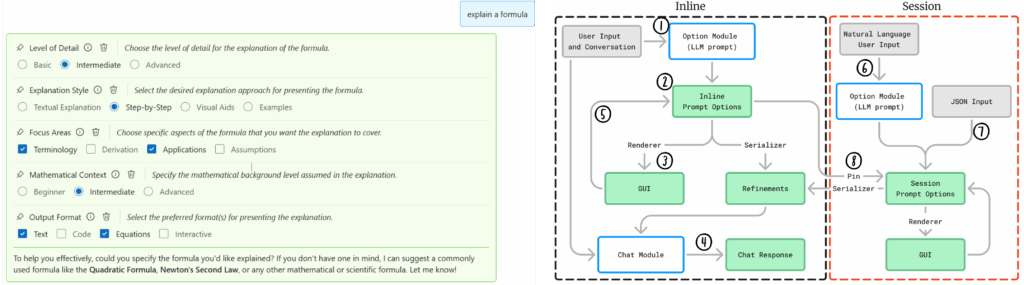
Effective prompting of generative AI is challenging for many users, particularly in expressing context for comprehension tasks such as explaining spreadsheet formulas, Python code, and text passages. Prompt middleware aims to address this barrier by assisting in prompt construction, but barriers remain for users in expressing adequate control so that they can receive AI-responses that match their preferences. We conduct a formative survey (n=38) investigating user needs for control over AI-generated explanations in comprehension tasks, which uncovers a trade-off between standardized but predictable support for prompting, and adaptive but unpredictable support tailored to the user and task. To explore this trade-off, we implement two prompt middleware approaches: Dynamic Prompt Refinement Control (Dynamic PRC) and Static Prompt Refinement Control (Static PRC). The Dynamic PRC approach generates context-specific UI elements that provide prompt refinements based on the user’s prompt and user needs from the AI, while the Static PRC approach offers a preset list of generally applicable refinements. We evaluate these two approaches with a controlled user study (n=16) to assess the impact of these approaches on user control of AI responses for crafting better explanations. Results show a preference for the Dynamic PRC approach as it afforded more control, lowered barriers to providing context, and encouraged exploration and reflection of the tasks, but that reasoning about the effects of different generated controls on the final output remains challenging. Drawing on participant feedback, we discuss design implications for future Dynamic PRC systems that enhance user control of AI responses. Our findings suggest that dynamic prompt middleware can improve the user experience of generative AI workflows by affording greater control and guide users to a better AI response.
@inproceedings{drosos2025dynamic,
author = {Drosos, Ian and Williams, Jack and Sarkar, Advait and Wilson, Nicholas and Rintel, Sean and Panda, Payod},
title = {Dynamic Prompt Middleware: Contextual Prompt Refinement Controls for Comprehension Tasks},
booktitle = {CHIWORK 2025},
year = {2025},
month = {June},
publisher = {ACM},
url = {https://www.microsoft.com/en-us/research/publication/dynamic-prompt-middleware-contextual-prompt-refinement-controls-for-comprehension-tasks/},
note = {Microsoft Foundry Labs},
}

What Does Success Look Like? Catalyzing Meeting Intentionality with AI-Assisted Prospective Reflection

Lev Tankelevitch, Payod Panda, Sean Rintel
Abstract & BibTeX
Despite decades of HCI and Meeting Science research, complaints about ineffective meetings are still pervasive. We argue that meeting technologies lack support for prospective reflection, that is, thinking about why a meeting is needed and what might happen. To explore this, we designed a Meeting Purpose Assistant (MPA) technology probe to coach users to articulate their meeting’s purpose and challenges, and act accordingly. The MPA used Generative AI to support personalized and actionable prospective reflection across the diversity of meeting contexts. Using a participatory prompting methodology, 18 employees of a global technology company reflected with the MPA on upcoming meetings. Observed impacts were: clarifying meeting purposes, challenges, and success conditions; changing perspectives and flexibility; improving preparation and communication; and proposing changed plans. We also identify perceived social, temporal, and technological barriers to using the MPA. We present system and workflow design considerations for developing AI-assisted reflection support for meetings. KEYWORDS: videoconferencing, meetings, goals, purpose, intentionality, workplace, prospective reflection, generative AI, participatory prompting
@inproceedings{scott2025what,
author = {Scott, Ava Elizabeth and Tankelevitch, Lev and Panda, Payod and Vanukuru, Rishi and Chen,  Xinyue and Rintel, Sean},
title = {What Does Success Look Like? Catalyzing Meeting Intentionality with AI-Assisted Prospective Reflection},
booktitle = {CHIWORK 2025},
year = {2025},
month = {June},
publisher = {ACM},
url = {https://www.microsoft.com/en-us/research/publication/what-does-success-look-like-catalyzing-meeting-intentionality-with-ai-assisted-prospective-reflection/},
}

Are We On Track? AI-Assisted Active and Passive Goal Reflection During Meetings

Lev Tankelevitch, Payod Panda, Sean Rintel
Abstract & BibTeX
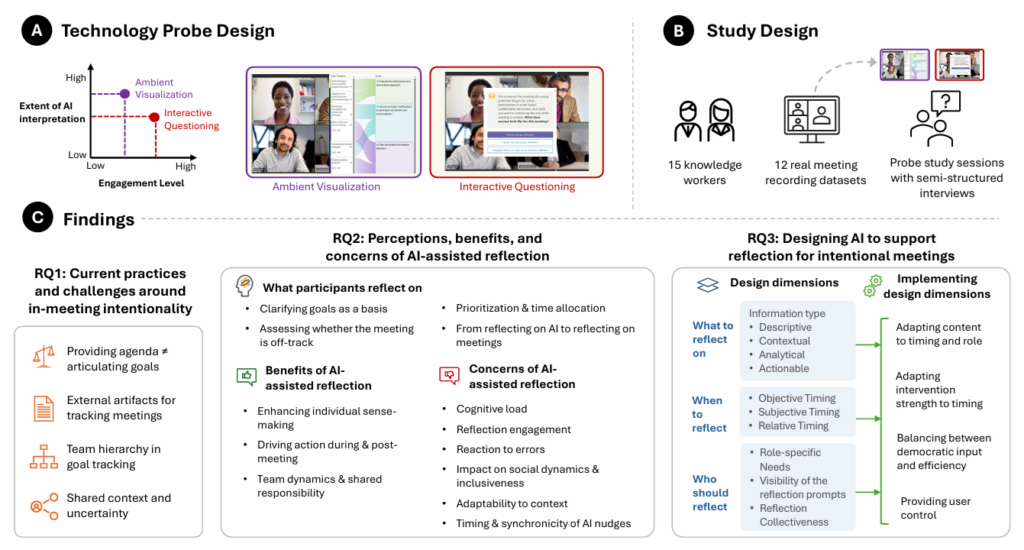
Meetings often suffer from a lack of intentionality, such as unclear goals and straying off-topic. Identifying goals and maintaining their clarity throughout a meeting is challenging, as discussions and uncertainties evolve. Yet meeting technologies predominantly fail to support meeting intentionality. AI-assisted reflection is a promising approach. To explore this, we conducted a technology probe study with 15 knowledge workers, integrating their real meeting data into two AI-assisted reflection probes: a passive and active design. Participants identified goal clarification as a foundational aspect of reflection. Goal clarity enabled people to assess when their meetings were off-track and reprioritize accordingly. Passive AI intervention helped participants maintain focus through non-intrusive feedback, while active AI intervention, though effective at triggering immediate reflection and action, risked disrupting the conversation flow. We identify three key design dimensions for AI-assisted reflection systems, and provide insights into design trade-offs, emphasizing the need to adapt intervention intensity and timing, balance democratic input with efficiency, and offer user control to foster intentional, goal-oriented behavior during meetings and beyond. KEYWORDS: videoconferencing, meeting, goal, intentionality, generative AI, probe, active, passive, intervention, interruption
@inproceedings{chen2025are,
author = {Chen, Xinyue and Tankelevitch, Lev and Vanukuru, Rishi and Scott, Ava Elizabeth and Panda, Payod and Rintel, Sean},
title = {Are We On Track? AI-Assisted Active and Passive Goal Reflection During Meetings},
booktitle = {CHI 2025},
year = {2025},
month = {April},
publisher = {ACM},
url = {https://www.microsoft.com/en-us/research/publication/are-we-on-track-ai-assisted-active-and-passive-goal-reflection-during-meetings/},
}

The Impact of Generative AI on Critical Thinking: Self-Reported Reductions in Cognitive Effort and Confidence Effects From a Survey of Knowledge Workers

Advait Sarkar, Lev Tankelevitch, Sean Rintel, Richard Banks, Nicholas Wilson
Abstract & BibTeX
The rise of Generative AI (GenAI) in knowledge workflows raises questions about its impact on critical thinking skills and practices. We survey 319 knowledge workers to investigate 1) when and how they perceive the enaction of critical thinking when using GenAI, and 2) when and why GenAI affects their effort to do so. Participants shared 936 first-hand examples of using GenAI in work tasks. Quantitatively, when considering both task- and user-specific factors, a user’s task-specific self-confidence and confidence in GenAI are predictive of whether critical thinking is enacted and the effort of doing so in GenAI-assisted tasks. Specifically, higher confidence in GenAI is associated with less critical thinking, while higher self-confidence is associated with more critical thinking. Qualitatively, GenAI shifts the nature of critical thinking toward information verification, response integration, and task stewardship. Our insights reveal new design challenges and opportunities for developing GenAI tools for knowledge work.
@inproceedings{lee2025the,
author = {Lee, Hao-Ping (Hank) and Sarkar, Advait and Tankelevitch, Lev and Drosos, Ian and Rintel, Sean and Banks, Richard and Wilson, Nicholas},
title = {The Impact of Generative AI on Critical Thinking: Self-Reported Reductions in Cognitive Effort and Confidence Effects From a Survey of Knowledge Workers},
booktitle = {CHI 2025},
year = {2025},
month = {April},
url = {https://www.microsoft.com/en-us/research/publication/the-impact-of-generative-ai-on-critical-thinking-self-reported-reductions-in-cognitive-effort-and-confidence-effects-from-a-survey-of-knowledge-workers/},
}

YES AND: A Generative AI Multi-Agent Framework for Enhancing Diversity of Thought in Individual Ideation for Problem-Solving Through Confidence-Based Agent Turn-Taking

Pratik Ghosh, Sean Rintel
Abstract & BibTeX
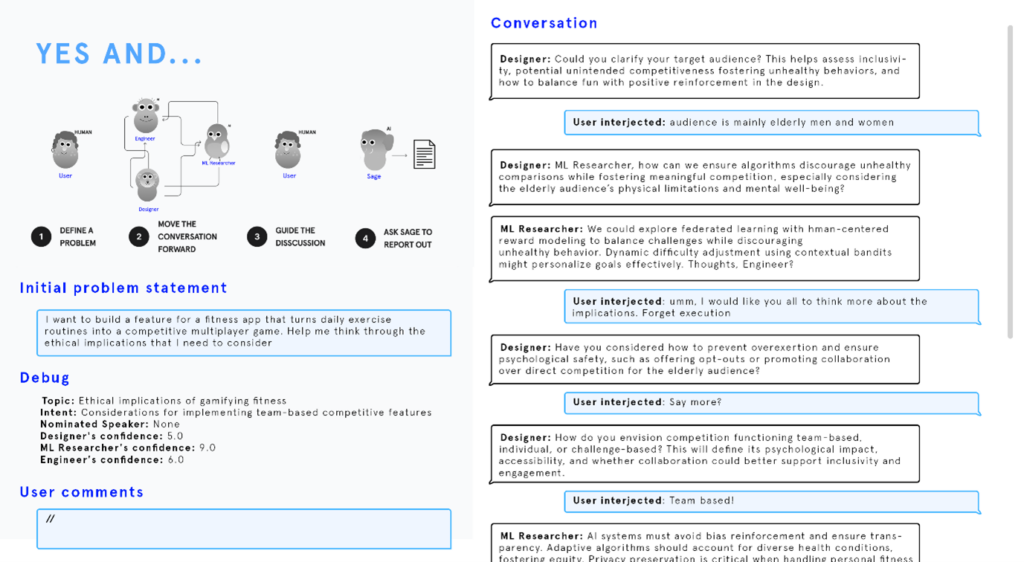
Diversity of thought is crucial in ideation for problem-solving, yet professionals in organisational settings often face challenges such as limited access to varied expertise and resource constraints which hinder the ideation process. To address this issue, we propose YES AND, a Generative AI based multi-agent framework that simulates diverse perspectives through AI agents for ideation with a single user. Leveraging a unique confidence-based turn-taking model, these agents organically take turns as they build on ideas, pose clarification questions to the user for improved contextual understanding, and allow the user to interject and steer the conversation. Beyond addressing the limitations of traditional ideation, this framework offers a novel approach to leveraging Generative AI for ideation, moving away from the rigidity of pre-defined interaction rules towards a more dynamic and creative process that enables serendipitous development of ideas.
@inproceedings{ghosh2025yes,
author = {Ghosh, Pratik and Rintel, Sean},
title = {YES AND: A Generative AI Multi-Agent Framework for Enhancing Diversity of Thought in Individual Ideation for Problem-Solving Through Confidence-Based Agent Turn-Taking},
booktitle = {CHI 2025},
year = {2025},
month = {April},
publisher = {ACM},
url = {https://www.microsoft.com/en-us/research/publication/yes-and-a-generative-ai-multi-agent-framework-for-enhancing-diversity-of-thought-in-individual-ideation-for-problem-solving-through-confidence-based-agent-turn-taking/},
}

The New Calculator? Practices, Norms, and Implications of Generative AI in Higher Education

Abigail Sellen, Sean Rintel, Lev Tankelevitch
arxiv, 2025
Abstract & BibTeX
Generative AI (GenAI) has introduced myriad opportunities and challenges for higher education. Anticipating this potential transformation requires understanding students’ contextualised practices and norms around GenAI. We conducted semi-structured interviews with 26 students and 11 educators from diverse departments across two universities. Grounded in Strong Structuration Theory, we find diversity in students’ uses and motivations for GenAI. Occurring in the context of unclear university guidelines, institutional fixation on plagiarism, and inconsistent educator communication, students’ practices are informed by unspoken rules around appropriate use, GenAI limitations and reliance strategies, and consideration of agency and skills. Perceived impacts include changes in confidence, and concerns about skill development, relationships with educators, and plagiarism. Both groups envision changes in universities’ attitude to GenAI, responsible use training, assessments, and integration of GenAI into education. We discuss socio-technical implications in terms of current and anticipated changes in the external and internal structures that contextualise students’ GenAI use.
@article{simkute2025the,
author = {Simkute, Auste and Kewenig, Viktor and Sellen, Abigail and Rintel, Sean and Tankelevitch, Lev},
title = {The New Calculator? Practices, Norms, and Implications of Generative AI in Higher Education},
year = {2025},
month = {January},
url = {https://www.microsoft.com/en-us/research/publication/the-new-calculator-practices-norms-and-implications-of-generative-ai-in-higher-education/},
journal = {arxiv},
}
2024

Microsoft New Future of Work Report 2024

Jenna Butler, Mihaela Vorvoreanu, Rebecca Janssen, Abigail Sellen, Nicole Immorlica, Brent Hecht, Jaime Teevan, Adam Troy, Advait Sarkar, Alex Farach, Alex Chouldechova, Alexandra Olteanu, Alexia Cambon, Arjun Radhakrishna, Asta Roseway, Ben Zorn, Dan Goldstein, Dave Brown, Dhruv Joshi, Ed Cutrell, Emre Kiciman, Gonzalo Ramos, Gustavo Soares, Hanna Wallach, Hugo Romat, Ian Drosos, Jack Williams, Jacki O Neill, Jake Hofman, Javier Hernandez, Jennifer Wortman Vaughan, Jina Suh, John Tang, Justin Edwards, Kalika Bali, Ken Hinckley, Kori Inkpen, Krishna Madhavan, Laylah Bulman, Leon Reicherts, Lev Tankelevitch, Longqi Yang, Martez Mott, Michael Bentley, Millicent Ochieng, Muchai Mercy, Nancy Baym, Najeeb Abdulhamid, Nicolai Marquardt, Nathalie Henry Riche, Samuel Maina, Sean Rintel, Shamsi Iqbal, Sian Lindley, Stephanie Nyairo, Su Lin Blodgett, Sumit Gulwani, Sunayana Sitaram
MSR-TR-2024-43
Abstract & BibTeX
As Microsoft approaches its 50th anniversary, the landscape of work continues to evolve at an unprecedented pace. The past year has marked a pivotal shift, moving from predictions and controlled lab studies to the real-world implementation and impact of new technologies. These advancements, built on decades of research and development, are beginning to yield tangible results, offering a clearer view of how generative AI is reshaping the way work gets done. This fourth edition builds on the foundation of the previous reports but is distinct in its emphasis on lessons learned from real-world applications. Over the past year, organizations have begun deploying generative AI at scale, revealing both its promise and its challenges.

Hybridge: Bridging Spatiality for Inclusive and Equitable Hybrid Meetings

Payod Panda, Lev Tankelevitch, Kori Inkpen, John Tang, Sasa Junuzovic, Pat Sweeney, Andrew D. Wilson, Abigail Sellen, Sean Rintel
Abstract & BibTeX
Hybrid meetings limit inclusion for remote participants. The Hybridge experimental system provides different interfaces for remote and room endpoints, focusing on improving inclusion via shared spatiality and remote agency. In-room participants see remotes on displays around a table, and remotes see video integrated into a digital twin. Remotes can choose where to appear and from where they view the room. We tested Hybridge in a within-subjects study of group survival tasks. An in-person condition was followed by a counterbalanced order of hybrid traditional videoconferencing (“Gallery”) and Hybridge. We found that co-presence and agency differences between in-room and remotes were alleviated in Hybridge but remained in Gallery. Physical presence for remotes was higher in Hybridge than Gallery. Conversation flow was better in Hybridge than Gallery, but ease of awareness was not different. We argue that asymmetry should be embraced when designing hybrid meeting systems, with inclusivity achieved by tailoring features for the needs of different endpoints.
@inproceedings{panda2024hybridge,
author = {Panda, Payod and Tankelevitch, Lev and Spittle, Becky and Inkpen, Kori and Tang, John and Junuzovic, Sasa and Qi, Qianqian and Sweeney, Pat and Wilson, Andrew D. and Buxton, Bill and Sellen, Abigail and Rintel, Sean},
title = {Hybridge: Bridging Spatiality for Inclusive and Equitable Hybrid Meetings},
booktitle = {CSCW 2024},
year = {2024},
month = {November},
publisher = {ACM},
url = {https://www.microsoft.com/en-us/research/publication/hybridge-bridging-spatiality-for-inclusive-and-equitable-hybrid-meetings/},
}

TableBot: Getting a Handle on Hybrid Collaboration by Negotiating Control of a Tabletop Telepresence Robot

Sean Rintel
Abstract & BibTeX
Mobile Remote telePresence robots (MRPs) have been explored as a promising approach to strengthen the agency and presence of remote participants in hybrid work settings. Despite the need and interest in how they might better support hybrid collaboration, substantial challenges remain in terms of their price, availability, and successful application in meeting room contexts. In response to these challenges, this paper explores the opportunities for designing lightweight telepresence robots supporting negotiation of control in hybrid meeting contexts. This paper describes a serial Research-through-Design process, exploring three iterations of design and evaluation of TableBot, a novel tabletop telepresence robot. Based on this work, we present the design of TableBot, and articulate the design space of telepresence robots for hybrid meetings in terms of three trade-offs and a framework for analysing telepresence systems regarding negotiation of control.
@inproceedings{dybboe2024tablebot,
author = {Dybboe, Maja and Ellemose, Johannes and Vastrup, Alexander Langagergaard and Boudouraki, Andriana and Rintel, Sean and Petersen,  Marianne Graves and Grønbæk, Jens Emil Sloth and Klokmose, Clemens Nylandsted},
title = {TableBot: Getting a Handle on Hybrid Collaboration by Negotiating Control of a Tabletop Telepresence Robot},
booktitle = {NordiCHI 2024},
year = {2024},
month = {October},
publisher = {ACM},
url = {https://www.microsoft.com/en-us/research/publication/tablebot-getting-a-handle-on-hybrid-collaboration-by-negotiating-control-of-a-tabletop-telepresence-robot/},
}

Ironies of Generative AI: Understanding and Mitigating Productivity Loss in Human-AI Interaction

Lev Tankelevitch, Abigail Sellen, Sean Rintel
Abstract & BibTeX
Generative AI (GenAI) systems offer opportunities to increase user productivity in many tasks, such as programming and writing. However, while they boost productivity in some studies, many others show that users are working ineffectively with GenAI systems and losing productivity. Despite the apparent novelty of these usability challenges, these ‘ironies of automation’ have been observed for over three decades in Human Factors research on the introduction of automation in domains such as aviation, automated driving, and intelligence. We draw on this extensive research alongside recent GenAI user studies to outline four key reasons for productivity loss with GenAI systems: a shift in users’ roles from production to evaluation, unhelpful restructuring of workflows, interruptions, and a tendency for automation to make easy tasks easier and hard tasks harder. We then suggest how Human Factors research can also inform GenAI system design to mitigate productivity loss by using approaches such as continuous feedback, system personalization, ecological interface design, task stabilization, and clear task allocation. Thus, we ground developments in GenAI system usability in decades of Human Factors research, ensuring that the design of human-AI interactions in this rapidly moving field learns from history instead of repeating it.
@article{simkute2024ironies,
author = {Simkute, Auste and Tankelevitch, Lev and Kewenig, Victor and Scott, Ava Elizabeth and Sellen, Abigail and Rintel, Sean},
title = {Ironies of Generative AI: Understanding and Mitigating Productivity Loss in Human-AI Interaction},
year = {2024},
month = {October},
url = {https://www.microsoft.com/en-us/research/publication/ironies-of-generative-ai-understanding-and-mitigating-productivity-loss-in-human-ai-interaction/},
journal = {International Journal of Human–Computer Interaction},
}

Commentary: Productivity implications for generative AI role-based prompts as a networked hermeneutic

Sean Rintel
Abstract & BibTeX
Commentary forMembership categorisation, sociological description and role prompt engineering with ChatGPT – William Housley, Patrik Dahl, 2024(opens in new tab)
@article{rintel2024commentary,
author = {Rintel, Sean},
title = {Commentary: Productivity implications for generative AI role-based prompts as a networked hermeneutic},
year = {2024},
month = {August},
url = {https://www.microsoft.com/en-us/research/publication/productivity-implications-for-generative-ai-role-based-prompts-as-a-networked-hermeneutic/},
journal = {Discourse & Communication},
}

The CoExplorer Technology Probe: A Generative AI-Powered Adaptive Interface to Support Intentionality in Planning and Running Video Meetings

Payod Panda, Lev Tankelevitch, Sean Rintel
Abstract & BibTeX
Effective meetings are effortful, but traditional videoconferencing systems offer little support for reducing this effort across the meeting lifecycle. Generative AI (GenAI) has the potential to radically redefine meetings by augmenting intentional meeting behaviors. CoExplorer, our novel adaptive meeting prototype, preemptively generates likely phases that meetings would undergo, tools that allow capturing attendees’ thoughts before the meeting, and for each phase, window layouts, and appropriate applications and files. Using CoExplorer as a technology probe in a guided walkthrough, we studied its potential in a sample of participants from a global technology company. Our findings suggest that GenAI has the potential to help meetings stay on track and reduce workload, although concerns were raised about users’ agency, trust, and possible disruption to traditional meeting norms. We discuss these concerns and their design implications for the development of GenAI meeting technology. KEYWORDS: video meetings, effectiveness, effort, design, adaptive user interface, windowing system, speech recognition; intent recognition, technology probe
@inproceedings{park2024the,
author = {Park, Gun Woo (Warren) and Panda, Payod and Tankelevitch, Lev and Rintel, Sean},
title = {The CoExplorer Technology Probe: A Generative AI-Powered Adaptive Interface to Support Intentionality in Planning and Running Video Meetings},
booktitle = {DIS 2024},
year = {2024},
month = {July},
publisher = {ACM},
url = {https://www.microsoft.com/en-us/research/publication/the-coexplorer-technology-probe-a-generative-ai-powered-adaptive-interface-to-support-intentionality-in-planning-and-running-video-meetings/},
}

Virtual Voices: Exploring Individual Differences in Written and Verbal Participation in Meetings

Lev Tankelevitch, Sean Rintel
Abstract & BibTeX
Part of special issue "Technology and the Changing Nature of Work." Edited by Dr. Tara Behrend (Purdue University, West Lafayette, Indiana, United States of America), Dr. Daniel Ravid (University of New Mexico School of Medicine, Albuquerque, New Mexico, United States of America), Dr. Cort W. Rudolph (Saint Louis University, Saint Louis, Missouri, United States of America).
@article{kreamer2024virtual,
author = {Kreamer, Liana and Rogelberg, Steven G. and Tankelevitch, Lev and Rintel, Sean},
title = {Virtual Voices: Exploring Individual Differences in Written and Verbal Participation in Meetings},
year = {2024},
month = {July},
url = {https://www.microsoft.com/en-us/research/publication/virtual-voices-exploring-individual-differences-in-written-and-verbal-participation-in-meetings/},
journal = {Journal of Vocational Behavior},
volume = {152},
note = {Part of special issue "Technology and the Changing Nature of Work." Edited by Dr. Tara Behrend (Purdue University, West Lafayette, Indiana, United States of America), Dr. Daniel Ravid (University of New Mexico School of Medicine, Albuquerque, New Mexico, United States of America), Dr. Cort W. Rudolph (Saint Louis University, Saint Louis, Missouri, United States of America).},
}

“It’s like a rubber duck that talks back”: Understanding Generative AI-Assisted Data Analysis Workflows through a Participatory Prompting Study

Advait Sarkar, Sean Rintel, Lev Tankelevitch
Abstract & BibTeX
Generative AI tools can help users with many tasks. One such task is data analysis, which is notoriously challenging for non-expert end-users due to its expertise requirements, and where AI holds much potential, such as finding relevant data sources, proposing analysis strategies, and writing analysis code. To understand how data analysis workflows can be assisted or impaired by generative AI, we conducted a study (n=15) using Bing Chat via participatory prompting. Participatory prompting is a recently developed methodology in which users and researchers reflect together on tasks through co-engagement with generative AI. In this paper we demonstrate the value of the participatory prompting method. We found that generative AI benefits the information foraging and sensemaking loops of data analysis in specific ways, but also introduces its own barriers and challenges, arising from the difficulties of query formulation, specifying context, and verifying results.
@inproceedings{drosos2024its,
author = {Drosos, Ian and Sarkar, Advait and Xu,   Xiaotong and Negreanu, Carina and Rintel, Sean and Tankelevitch, Lev},
title = {"It's like a rubber duck that talks back": Understanding Generative AI-Assisted Data Analysis Workflows through a Participatory Prompting Study},
booktitle = {CHIWORK 2024},
year = {2024},
month = {June},
publisher = {ACM},
url = {https://www.microsoft.com/en-us/research/publication/its-like-a-rubber-duck-that-talks-back-understanding-generative-ai-assisted-data-analysis-workflows-through-a-participatory-prompting-study/},
}

An Equal Seat at the Table: Exploring Videoconferencing with Shared Spatial Context combined with 3D Video Representations

Antonio Criminisi, Payod Panda, Lev Tankelevitch, Sean Rintel
Abstract & BibTeX
Work video meetings in the traditional grid interface have inclusion,effectiveness, and fatigue problems, due in part to the difficulty ofdirecting or communicating attention. Virtual 3D meeting spaceshave value, but representing people in them is a challenge. Avatarsface resistance, and 2D video is limited to near-frontal views, constraining the spatial layout. We present a novel experimental systemfor virtual meeting rooms that predicts 3D video of users in real-time from a standard webcam, positions them in a shared 3D space,and renders a controllable first-person view. We report study results comparing this system to a traditional grid, and to 2D videoof people in the same 3D space. While spatial layouts fared better in terms of attention and co-presence, the traditional grid wasmore comfortable and professional. This is likely due to unsettled3D design, the need for manual control, and a preference for thefamiliar.
@inproceedings{cashman2024an,
author = {Cashman, Tom and Hutton, Tim and Gorce, Martin de La and Takács, Tibor and Criminisi, Antonio and Ðorđević, Milica and Dubajić, Goran and Marjanović, Ðorđe and Okošanović, Milena and Ranković, Vukašin and Razumenić, Ivan and Roško, Bojan and Šarkić, Teo and Skakun, Marko and Stojanović, Miloš and Veličković, Nikola and Jovanović, Predrag and Panda, Payod and Tankelevitch, Lev and Rintel, Sean},
title = {An Equal Seat at the Table: Exploring Videoconferencing with Shared Spatial Context combined with 3D Video Representations},
booktitle = {CHI EA 2024},
year = {2024},
month = {May},
publisher = {ACM},
url = {https://www.microsoft.com/en-us/research/publication/an-equal-seat-at-the-table-exploring-videoconferencing-with-shared-spatial-context-combined-with-3d-video-representations/},
}

CoExplorer: Generative AI Powered 2D and 3D Adaptive Interfaces to Support Intentionality in Video Meetings

Payod Panda, Lev Tankelevitch, Sean Rintel
Abstract & BibTeX
Current online meeting technologies lack holistic support for reducing the effort of planning and running meetings. We presentCoExplorer2D and CoExplorerVR, generative AI (GenAI)-driventechnology probes for exploring the significant transformative potential of GenAI to augment these aspects of meetings. In eachsystem, before the meeting, these systems generate tools that allow Current online meeting technologies lack holistic support for reducing the effort of planning and running meetings. We present CoExplorer2D and CoExplorerVR, generative AI (GenAI)-driven technology probes for exploring the significant transformative potential of GenAI to augment these aspects of meetings. In each system, before the meeting, these systems generate tools that allow synthesis and ranking of attendees’ key issues for discussion, and likely phases that a meeting would require to cover these issues. During the meeting, these systems use speech recognition to generate 2D or VR window layouts with appropriate  applications and files for each phase, and recognize the attendees’ progress through the meeting’s phases. We argue that these probes show the potential of GenAI to contribute to reducing the effort required for planning and running meetings, providing participants with a more engaging and effective meeting experiences.
@inproceedings{park2024coexplorer,
author = {Park, Gun Woo (Warren) and Panda, Payod and Tankelevitch, Lev and Rintel, Sean},
title = {CoExplorer: Generative AI Powered 2D and 3D Adaptive Interfaces to Support Intentionality in Video Meetings},
booktitle = {CHI EA 2024},
year = {2024},
month = {May},
publisher = {ACM},
url = {https://www.microsoft.com/en-us/research/publication/coexplorer-generative-ai-powered-2d-and-3d-adaptive-interfaces-to-support-intentionality-in-video-meetings/},
}

Comparing the Agency of Hybrid Meeting Remote Users in 2D and 3D Interfaces of the Hybridge System

Payod Panda, Lev Tankelevitch, Kori Inkpen, John Tang, Sasa Junuzovic, Pat Sweeney, Andrew D. Wilson, Abigail Sellen, Sean Rintel
Abstract & BibTeX
Hybridge is an experimental system for exploring the design of remote inclusion for hybrid meetings. In-room users see remote participants on individual displays positioned around a table, and remotes see video feeds from the room integrated into a digital twin of the meeting room. Remotes can choose where to appear in and view the meeting room from. We designed two digital interfaces for remote attendees, one using a 2D canvas, and the other using a 3D digital twin of the room as the medium of interaction. To decide which interface to use for future evaluation, we conducted a within-subjects comparison of 24 groups completing survival tasks. We found that 3D outperformed 2D in the participants’ perceived sense of awareness, sense of agency, and physical presence. Majority of participants also subjectively preferred 3D over 2D. We discuss design recommendations based on usage patterns and participant comments, and plans for further research.
@inproceedings{spittle2024comparing,
author = {Spittle, Becky and Panda, Payod and Tankelevitch, Lev and Inkpen, Kori and Tang, John and Junuzovic, Sasa and Qi, Qianqian and Sweeney, Pat and Wilson, Andrew D. and Buxton, Bill and Sellen, Abigail and Rintel, Sean},
title = {Comparing the Agency of Hybrid Meeting Remote Users in 2D and 3D Interfaces of the Hybridge System},
booktitle = {CHI EA 2024},
year = {2024},
month = {May},
publisher = {ACM},
url = {https://www.microsoft.com/en-us/research/publication/comparing-the-agency-of-hybrid-meeting-remote-users-in-2d-and-3d-interfaces-of-the-hybridge-system/},
}

Mental Models of Meeting Goals: Supporting Intentionality in Meeting Technologies

Lev Tankelevitch, Sean Rintel
Abstract & BibTeX
Ineffective meetings due to unclear goals are major obstacles to productivity, yet support for intentionality is surprisingly scant in ourmeeting and allied workflow technologies. To design for intentionality, we need to understand workers’ attitudes and practices aroundgoals. We interviewed 21 employees of a global technology company and identified contrasting mental models of meeting goals:meetings as a means to an end, and meetings as an end in themselves. We explore how these mental models impact how meetinggoals arise, goal prioritization, obstacles to considering goals, and how lack of alignment around goals may create tension betweenorganizers and attendees. We highlight the challenges in balancing preparation, constraining scope, and clear outcomes, with theneed for intentional adaptability and discovery in meetings. Our findings have implications for designing systems which increaseeffectiveness in meetings by catalyzing intentionality and reducing tension in the organisation of meetings.KEYWORDS: videoconferencing, meeting, goal, agenda, intentionality, calendar, teams, workflows
@inproceedings{scott2024mental,
author = {Scott, Ava Elizabeth and Tankelevitch, Lev and Rintel, Sean},
title = {Mental Models of Meeting Goals: Supporting Intentionality in Meeting Technologies},
booktitle = {CHI 2024},
year = {2024},
month = {May},
publisher = {ACM},
url = {https://www.microsoft.com/en-us/research/publication/mental-models-of-meeting-goals-supporting-intentionality-in-meeting-technologies/},
}

The Metacognitive Demands and Opportunities of Generative AI

Best Paper
Lev Tankelevitch, Advait Sarkar, Abigail Sellen, Sean Rintel
CHI '24, 2024
Abstract & BibTeX
Generative AI (GenAI) systems offer unprecedented opportunities for transforming professional and personal work, yet present challenges around prompting, evaluating and relying on outputs, and optimizing workflows. We argue that metacognition – the psychological ability to monitor and control one’s thoughts and behavior – offers a valuable lens to understand and design for these usability challenges. Drawing on research in psychology and cognitive science, and recent GenAI user studies, we illustrate how GenAI systems impose metacognitive demands on users, requiring a high degree of metacognitive monitoring and control. We propose these demands could be addressed by integrating metacognitive support strategies into GenAI systems, and by designing GenAI systems to reduce their metacognitive demand by targeting explainability and customizability. Metacognition offers a coherent framework for understanding the usability challenges posed by GenAI, enabling us to offer research and design directions to advance human-GenAI interaction.
@inproceedings{tankelevitch2024the,
author = {Tankelevitch, Lev and Kewenig, Viktor and Simkute, Auste and Scott, Ava Elizabeth and Sarkar, Advait and Sellen, Abigail and Rintel, Sean},
title = {The Metacognitive Demands and Opportunities of Generative AI},
booktitle = {CHI '24},
year = {2024},
month = {May},
publisher = {ACM},
url = {https://www.microsoft.com/en-us/research/publication/the-metacognitive-demands-and-opportunities-of-generative-ai/},
}

Avatars in mixed reality meetings: A field study of avatar facial realism on felt and perceived emotion

Best PaperBest Paper Runner-Up
Sean Rintel
EMRN 2024: A Metaverse For Good
Abstract & BibTeX
We conducted a within-subjects study to examine how realistic faces and cartoon faces on avatars effect communication, task satisfaction, sense of presence, and emotional state perception in mixed reality meetings. Over the course of two weeks, six groups of co-workers (14people) held recurring meetings using Microsoft HoloLens2 devices, each person embodying a personal full-body avatar with either a realistic face or cartoon face. Half of the groups started with the realistic face avatar and switched to the cartoon face version halfway through (RC condition), and the other half with the cartoon-face avatar first (CR condition). For this paper, we focus on our results of emotion felt and perceived. We found that participants reported more positive emotions with the realistic face avatar but only in the RC condition. This positive emotion also seemed to have reduced over time. The realistic face avatar also caused more error in judgement of their colleagues emotions, and again this was worse in the RC condition.
@inproceedings{dobre2024avatars,
author = {Dobre,  Georgiana Cristina and Wilczkowiak, Marta and Gillies, Marco and Pan, Sylvia Xueni and Rintel, Sean},
title = {Avatars in mixed reality meetings: A field study of avatar facial realism on felt and perceived emotion},
organization = {European Metaverse Research Network},
booktitle = {EMRN 2024: A Metaverse For Good},
year = {2024},
month = {April},
url = {https://www.microsoft.com/en-us/research/publication/avatars-in-mixed-reality-meetings-a-field-study-of-avatar-facial-realism-on-felt-and-perceived-emotion/},
}

Ecological Validity and the Evaluation of Avatar Facial Animation Noise

Marta Wilczkowiak, Sean Rintel
Abstract & BibTeX
Facial animation noise levels affect the acceptance of avatars in communication systems. However, there is no standard for evaluation, especially with regard to ecological validity. We investigate low and high ecological validity on two within-subjects experiments conducted in Augmented Reality on a Hololens2. We simulated facial-expression noise introduced on stylized cartoon avatars, and found that in the high ecological validity experiment, subjects were less sensitive to noise parameters, but their judgement was more influenced by empathy scores and gender biases. This highlights the importance of considering both technical parameters and user experience when designing communication systems. We make some general recommendations for evaluating issues of avatar acceptance given the trade-offs between the approaches, and propose the ‘Triple C’ factors of Context, Culture and Character as an important set of ecological factors to consider.
@inproceedings{wilczkowiaksheher2024ecological,
author = {Wilczkowiak (SHE/HER), Marta and Jakubzak, Ken and Clemoes,  James and Treptow, Cornelia and Read, Kerry and Porubanova, Michaela and McDuff, Daniel and Kuznetsova, Marina and Rintel, Sean and Gonzalez-Franco, Mar},
title = {Ecological Validity and the Evaluation of Avatar Facial Animation Noise},
organization = {IEEE Virtual Reality 2024},
booktitle = {Workshop Series on Animation in Virtual and Augmented Environments (ANIVAE 2024)},
year = {2024},
month = {March},
url = {https://www.microsoft.com/en-us/research/publication/ecological-validity-and-the-evaluation-of-avatar-facial-animation-noise/},
}

Ironies of Generative AI: Understanding and mitigating productivity loss in human-AI interactions

Lev Tankelevitch, Abigail Sellen, Sean Rintel
2024
Abstract & BibTeX
Generative AI (GenAI) systems offer opportunities to increase user productivity in many tasks, such as programming and writing. However, while they boost productivity in some studies, many others show that users are working ineffectively with GenAI systems and losing productivity. Despite the apparent novelty of these usability challenges, these ‘ironies of automation’ have been observed for over three decades in Human Factors research on the introduction of automation in domains such as aviation, automated driving, and intelligence. We draw on this extensive research alongside recent GenAI user studies to outline four key reasons for productivity loss with GenAI systems: a shift in users’ roles from production to evaluation, unhelpful restructuring of workflows, interruptions, and a tendency for automation to make easy tasks easier and hard tasks harder. We then suggest how Human Factors research can also inform GenAI system design to mitigate productivity loss by using approaches such as continuous feedback, system personalization, ecological interface design, task stabilization, and clear task allocation. Thus, we ground developments in GenAI system usability in decades of Human Factors research, ensuring that the design of human-AI interactions in this rapidly moving field learns from history instead of repeating it.
@misc{simkute2024ironies,
author = {Simkute, Auste and Tankelevitch, Lev and Kewenig, Viktor and Scott, Ava Elizabeth and Sellen, Abigail and Rintel, Sean},
title = {Ironies of Generative AI: Understanding and mitigating productivity loss in human-AI interactions},
howpublished = {arXiv},
year = {2024},
month = {February},
url = {https://www.microsoft.com/en-us/research/publication/ironies-of-generative-ai-understanding-and-mitigating-productivity-loss-in-human-ai-interactions/},
}
2023

Microsoft New Future of Work Report 2023

Jenna Butler, Sonia Jaffe, Nancy Baym, Shamsi Iqbal, Kate Nowak, Sean Rintel, Abigail Sellen, Mihaela Vorvoreanu, Najeeb G. Abdulhamid, James Brand, Dean Carignan, Scott Counts, Madeleine Daepp, Adam Fourney, Daniel G. Goldstein, Aaron L Halfaker, Javier Hernandez, Jake Hofman, Siân Lindley, Jennifer Neville, Stephanie Nyairo, Jacki O'Neill, David Rothschild, Tara Safavi, Neha Parikh Shah, Siddharth Suri, Lev Tankelevitch, Mengting Wan, Ryen W. White, Longqi Yang, Brent Hecht, Jaime Teevan
MSR-TR-2023-34
Abstract & BibTeX
In the past three years, there have been not one but two generational shifts in how work gets done, both of which were only possible because of decades of research and development. The first shift occurred when COVID made us realize how powerful remote and hybrid work technologies had become, as well as how much science was available to guide us in how to (and how not to) use these technologies. The second arrived this year, as it became clear that, at long last, generative AI had advanced to the point where it could be valuable to huge swaths of the work people do every day.
@techreport{butler2023microsoft,
author = {Butler, Jenna and Jaffe, Sonia and Baym, Nancy and Czerwinski, Mary and Iqbal, Shamsi and Nowak, Kate and Rintel, Sean and Sellen, Abigail and Vorvoreanu, Mihaela and Abdulhamid, Najeeb G. and Amores, Judith and Andersen, Reid and Awori, Kagonya and Axmed, Maxamed and boyd, danah and Brand, James and Buscher, Georg and Carignan, Dean and Chan, Martin and Coleman, Adam and Counts, Scott and Daepp, Madeleine and Fourney, Adam and Goldstein, Daniel G. and Gordon, Andy and Halfaker, Aaron L and Hernandez, Javier and Hofman, Jake and Lay-Flurrie, Jenny and Liao, Vera and Lindley, Siân and Manivannan, Sathish and Mcilwain, Charlton and Nepal, Subigya and Neville, Jennifer and Nyairo, Stephanie and O'Neill, Jacki and Poznanski, Victor and Ramos, Gonzalo and Rangan, Nagu and Rosedale, Lacey and Rothschild, David and Safavi, Tara and Sarkar, Advait and Scott, Ava and Shah, Chirag and Shah, Neha Parikh and Shapiro, Teny and Shaw, Ryland and Simkute, Auste and Suh, Jina and Suri, Siddharth and Tanase, Ioana and Tankelevitch, Lev and Troy, Adam and Wan, Mengting and White, Ryen W. and Yang, Longqi and Hecht, Brent and Teevan, Jaime},
title = {Microsoft New Future of Work Report 2023},
institution = {Microsoft},
year = {2023},
month = {December},
url = {https://www.microsoft.com/en-us/research/publication/microsoft-new-future-of-work-report-2023/},
number = {MSR-TR-2023-34},
}

Perspectives: Creating Inclusive and Equitable Hybrid Meeting Experiences

John Tang, Kori Inkpen, Sasa Junuzovic, Andrew D. Wilson, Sean Rintel, Tony Carbary, Abigail Sellen
Abstract & BibTeX
With the shift to hybrid meetings in work spaces, there is an increasing need to create a more inclusive hybrid meeting experience where people meeting together in a room interact with those joining remotely. This paper describes a design exploration, implementation, and evaluation of Perspectives, a novel hybrid meeting system that aimed to create an inclusive and equitable space for hybrid meetings. Perspectives digitally composites everyone into a virtual room so that each person has a unique but spatially consistent viewpoint into the meeting. The user study compared Perspectives with three commercially available UX designs for hybrid meetings: Gallery, Together Mode, and Front Row. Results from this study revealed key benefits of Perspectives, including supporting natural interactions, creating a strong sense of co-presence, and reducing cognitive load. Results from the study also helped iterate on the design principles of Perspectives, which offer important insights on supporting hybrid meetings.
@inproceedings{tang2023perspectives,
author = {Tang, John and Inkpen, Kori and Junuzovic, Sasa and Mallari, Keri and Wilson, Andrew D. and Rintel, Sean and Cupala, Shiraz and Carbary, Tony and Sellen, Abigail and Buxton, Bill},
title = {Perspectives: Creating Inclusive and Equitable Hybrid Meeting Experiences},
booktitle = {CSCW 2023},
year = {2023},
month = {October},
publisher = {ACM},
url = {https://www.microsoft.com/en-us/research/publication/perspectives-creating-inclusive-and-equitable-hybrid-meeting-experiences/},
}

Mobility and Utility in Robot Mediated Interaction: An Interactive Workshop for the Identification of Use Cases and Affordances of Telepresence Robots

Sean Rintel
Abstract & BibTeX
In recent years virtual meetings have become the predominant alternative to face-to-face meetings. Ongoing efforts in the design of telepresence robots promise remote access to physical settings and a greater sense of presence, leading to improved remote collaboration. However, a comparable sense of physical presence and utility has yet to be achieved. Mobile telepresence still provides limited ways to interact with remote users (e.g., with the environment and other people). This workshop aims to re-imagine telepresence robots, moving away from the decades-old ‘iPad-on-a-stick’ paradigm. Using interactive activities involving existing telepresence robots and a hybrid workshop format, we hope to ideate ways of expanding the capabilities of mobile telepresence robots through a range of mechanisms (e.g., mobile and wearable technology, Augmented Reality, Internet of Things, etc.) and to inform the future design of these devices to provide additional affordances. In doing so, we plan to identify use cases for which mobile telepresence robots can provide additional value through their locomotive capabilities compared to current screen-based remote interactions. Lastly, we aim to identify scenarios for future research in Mobile HCI using use cases and affordances identified during the workshop to support more equitable participation for remote users.
@inproceedings{schneiders2023mobility,
author = {Schneiders, Eike and Boudouraki, Andriana and Reyes-Cruz, Gisela and Avila, Juan Pablo Martinez and Elmimouni, Houda and Grønbæk,  Jens Emil Sloth and Rintel, Sean and Joshi, Swapna},
title = {Mobility and Utility in Robot Mediated Interaction: An Interactive Workshop for the Identification of Use Cases and Affordances of Telepresence Robots},
booktitle = {Mobile HCI 2023},
year = {2023},
month = {September},
publisher = {ACM},
url = {https://www.microsoft.com/en-us/research/publication/mobility-and-utility-in-robot-mediated-interaction-an-interactive-workshop-for-the-identification-of-use-cases-and-affordances-of-telepresence-robots/},
}

Participatory prompting: a user-centric research method for eliciting AI assistance opportunities in knowledge workflows

Advait Sarkar, Sean Rintel, Jack Williams, Ben Zorn
Abstract & BibTeX
Proceedings of the 34th Annual Conference of the Psychology of Programming Interest Group (PPIG 2023)|August 2023
@inproceedings{sarkar2023participatory,
author = {Sarkar, Advait and Drosos, Ian and DeLIne, Robert and Gordon, Andy and Negreanu, Carina and Rintel, Sean and Williams, Jack and Zorn, Ben},
title = {Participatory prompting: a user-centric research method for eliciting AI assistance opportunities in knowledge workflows},
booktitle = {Proceedings of the 34th Annual Conference of the Psychology of Programming Interest Group (PPIG 2023)},
year = {2023},
month = {August},
url = {https://www.microsoft.com/en-us/research/publication/participatory-prompting-a-user-centric-research-method-for-eliciting-ai-assistance-opportunities-in-knowledge-workflows/},
}

Beyond Audio: Towards a Design Space of Headphones as a Site for Interaction and Sensing

Best PaperBest Paper Award
Payod Panda, Michel Pahud, Sean Rintel, Jaron Lanier
Abstract & BibTeX
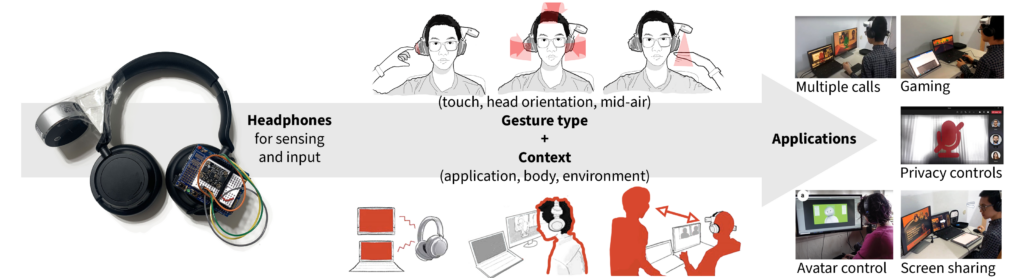
Via Research through Design (RtD), we explore the potential of headphones as a general-purpose input device for both foreground motion-gestures as well as background sensing of user activity. As a familiar wearable device, headphones offer a compelling site for head-situated interaction and sensing. Using emerging sensing modalities such as inertial motion, capacitive touch sensing, and depth cameras, our implemented prototypes explore sensing and interaction techniques that offer a range of compelling capabilities.
@inproceedings{panda2023beyond,
author = {Panda, Payod and Nicholas, Molly Jane and Nguyen, David and Ofek, Eyal and Pahud, Michel and Rintel, Sean and Franco, Mar Gonzalez and Hinckley, Ken and Lanier, Jaron},
title = {Beyond Audio: Towards a Design Space of Headphones as a Site for Interaction and Sensing},
booktitle = {DIS'23: ACM Designing Interactive Systems Conference 2023},
year = {2023},
month = {July},
publisher = {ACM},
url = {https://www.microsoft.com/en-us/research/publication/beyond-audio-towards-a-design-space-of-headphones-as-a-site-for-interaction-and-sensing/},
}

“There is a Bit of Grace Missing”: Understanding Non-use of Mobile Robotic Telepresence in a Global Technology Company

Sean Rintel
Abstract & BibTeX
Mobile robotic telepresence technology may be a potential solution to hybrid communication as it allows remote attendees embodied movement in space. Yet, there is little exploration into how its affordances fit with the practices and needs of workplaces. This paper presents findings from interviews conducted following a discontinued deployment of telepresence robots at the offices of a global technology company. The findings indicate that in this case 1) The knowledge workers were equipped to manage hybrid work, 2) the robots offered limited perceived value, and 3) the robots were a poor fit to the knowledge workers’ physically distributed workflows. Drawing workflows and non-use literature, we explore how features of the technology failed to align with the office’s work practices and needs, and discuss the implications for evaluating the low use of robotic telepresence.
@inproceedings{boudouraki2023there,
author = {Boudouraki, Andriana and Reeves, Stuart and Fischer, Joel and Rintel, Sean},
title = {“There is a Bit of Grace Missing”: Understanding Non-use of Mobile Robotic Telepresence in a Global Technology Company},
booktitle = {TAS 2023},
year = {2023},
month = {July},
publisher = {ACM},
url = {https://www.microsoft.com/en-us/research/publication/there-is-a-bit-of-grace-missing-understanding-non-use-of-mobile-robotic-telepresence-in-a-global-technology-company/},
}

Hear We Are: Spatial Audio Benefits Perceptions of Turn-Taking and Social Presence in Video Meetings

Honorable Mention
Kate Nowak, Lev Tankelevitch, John Tang, Sean Rintel
Abstract & BibTeX
Relative to in-person meetings, conversations in video meetings have long been reported as stilted. Spatial audio in video meetings can simulate the way we hear the world by separating audio streams based on speakers’ virtual locations. We report on a within-subject experiment in which 75 employees of a global technology company completed two group survival tasks with spatial audio enabled or disabled. Spatial audio increased perceptions of interactivity, shared space, and ease of understanding. Women experienced effects for social presence while men experienced effects for turn-taking. We discuss implications for inclusion, task performance, fatigue, and future research.
@inproceedings{nowak2023hear,
author = {Nowak, Kate and Tankelevitch, Lev and Tang, John and Rintel, Sean},
title = {Hear We Are: Spatial Audio Benefits Perceptions of Turn-Taking and Social Presence in Video Meetings},
booktitle = {CHIWORK 2023},
year = {2023},
month = {June},
publisher = {ACM},
url = {https://www.microsoft.com/en-us/research/publication/hear-we-are-spatial-audio-benefits-perceptions-of-turn-taking-and-social-presence-in-video-meetings/},
}

Is a Return To Office a Return To Creativity? Requiring Fixed Time In Office To Enable Brainstorms and Watercooler Talk May Not Foster Research Creativity

Advait Sarkar, Sean Rintel
Abstract & BibTeX
In the aftermath of the Covid-19 pandemic, many professionals, including researchers, have transitioned into hybrid work. One concern arising from this transition is the cost to creativity in an environment of variable co-presence. We interviewed 24 researchers fromseveral disciplines and varying levels of seniority, across 7 research labs in academia and industry about their hybrid work patterns and sources of creativity. Co-present ‘brainstorming’ and serendipitous ‘watercooler’ conversations are both often cited as argumentsfor mandating co-located work patterns in research organisations. Contrary to the dominant account which associates co-presence with increased creativity, we find that the flexibility of hybrid work, and carefully managed co-present interactions punctuating a regime of focused individual work, is the main catalyst of creativity. We find that the ‘problem-oriented discussion’ over time is a more powerful pattern for researcher collaboration than the ‘brainstorm’, that these discussions benefit greatly from the freedom to choose work locations afforded by hybrid work. We also find that serendipitous ‘watercooler’ conversations, while reported as valuable for collegiality, are reported as less valued for their contribution to creativity. We suggest that scheduling time in office should extend temporalities beyond the weekly cadence, and that tools and timing for serendipitous productivity and serendipitous collegiality do not necessarily have to be coupled.
@inproceedings{xu2023is,
author = {Xu, Tianna and Sarkar, Advait and Rintel, Sean},
title = {Is a Return To Office a Return To Creativity? Requiring Fixed Time In Office To Enable Brainstorms and Watercooler Talk May Not Foster Research Creativity},
booktitle = {CHIWORK 2023},
year = {2023},
month = {June},
publisher = {ACM},
url = {https://www.microsoft.com/en-us/research/publication/is-a-return-to-office-a-return-to-creativity-requiring-fixed-time-in-office-to-enable-brainstorms-and-watercooler-talk-may-not-foster-research-creativity/},
}

Reflecting on Hybrid Events: Learning from a Year of Hybrid Experiences

Sean Rintel
Abstract & BibTeX
The COVID-19 pandemic led to a sudden shift to virtual work and events, with the last two years enabling an appropriated and rather simulated togetherness—the hybrid mode. As we return to in-person events, it is important to reflect on not only what we learned about technologies and social justice, but about the types of events we desire, and how to re-design them accordingly. This SIG aims to reflect on hybrid events and their execution: scaling them across sectors, communities, and industries; considering trade-offs when choosing technologies; studying best practices and defining measures of “success” for hybrid events; and finally, identifying and charting the wider social, ethical, and legal implications of hybrid formats. This SIG will consolidate these topics by inviting participants to collaboratively reflect on previous hybrid experiences and what can be learned from them.
@inproceedings{ansah2023reflecting,
author = {Ansah, Alberta A and Zhong, Sailin and Vivacqua, Adriana S and Boll, Susanne and Constantinides, Marios and Verma, Himanshu and Ali, Abdallah El and Lushnikova, Alina and Alavi, Hamed and Rintel, Sean and Kun, Andrew L and Shaer, Orit and Cox, Anna L. and Gerling, Kathrin and Muller, Michael and Rusnak, Vit and Machado, Leticia Santos and Kosch, Thomas and Collective, CHIWORK and Committee, SIGCHI Executive},
title = {Reflecting on Hybrid Events: Learning from a Year of Hybrid Experiences},
organization = {ACM},
booktitle = {CHI 2023},
year = {2023},
month = {April},
url = {https://www.microsoft.com/en-us/research/publication/reflecting-on-hybrid-events-learning-from-a-year-of-hybrid-experiences/},
note = {SIGCHI Event},
}

Your Mileage May Vary: Case Study of a Robotic Telepresence Pilot Roll-out for a Hybrid Knowledge Work Organisation

Sean Rintel
Abstract & BibTeX
Organisations wishing to maintain employee satisfaction for hybrid collaboration need to explore flexible solutions that provide value for both remote and on-site employees. In this case study, we report on the roll-out of a telepresence robot pilot at Microsoft Research Cambridge UK to test whether robots would provide enjoyable planned and unplanned encounters between remote and on-site employees. We describe the work that was undertaken to prepare for the roll-out, including the Occupational Health and Safety assessment, systems for safety and security, and the information for employees on safe and effective use practices. The pilot ended after three months, and robot use has been discontinued after weighing the opportunities against low adoption and other challenges. We discuss the pros and cons within this organisational setting, and make suggestions for future work and roll-outs.
@inproceedings{boudouraki2023your,
author = {Boudouraki, Andriana and Fischer, Joel E. and Reeves, Stuart and Rintel, Sean},
title = {Your Mileage May Vary: Case Study of a Robotic Telepresence Pilot Roll-out for a Hybrid Knowledge Work Organisation},
booktitle = {CHI 2023},
year = {2023},
month = {April},
publisher = {ACM},
url = {https://www.microsoft.com/en-us/research/publication/your-mileage-may-vary-case-study-of-a-robotic-telepresence-pilot-roll-out-for-a-hybrid-knowledge-work-organisation/},
}

“Being In On The Action” in Mobile Robotic Telepresence: Rethinking Presence in Hybrid Participation

Sean Rintel
Abstract & BibTeX
Mobile Robotic Telepresence (MRP) systems afford remote communication with an embodied physicality and autonomous mobility, which is thought to be useful for creating a sense of presence in hybrid activities. In this paper, drawing on phenomenology, we interviewed seven long term users of MRP to understand the lived experience of participating in hybrid spaces through a telepresence robot. The users’ accounts show how the capabilities of the robot impact interactions, and how telepresence differs from in-person presence. Whilst not feeling as if they were really there, users felt present when they were being able to participate in local action and be treated as present. They also report standing out and being subject to behaviour amounting to ‘othering’. We argue that these experiences point to a need for future work on telepresence to focus on giving remote users the means to exercise autonomy in ways that enable them to participate — to be ‘in on the action’ — rather than in ways that simply simulate being in-person.
@inproceedings{boudouraki2023being,
author = {Boudouraki, Andriana and Fischer, Joel E. and Reeves, Stuart and Rintel, Sean},
title = {"Being In On The Action" in Mobile Robotic Telepresence: Rethinking Presence in Hybrid Participation},
organization = {ACM},
booktitle = {HRI 2023},
year = {2023},
month = {March},
url = {https://www.microsoft.com/en-us/research/publication/being-in-on-the-action-in-mobile-robotic-telepresence-rethinking-presence-in-hybrid-participation/},
}
2022

Semi-Automated Analysis of Collaborative Interaction: Are We There Yet?

Sean Rintel
Abstract & BibTeX
In recent years, research on collaborative interaction has relied on manual coding of rich audio/video recordings. The fine-grained analysis of such material is extremely time-consuming and labor-intensive. This is not only difficult to scale, but, as a result, might also limit the quality and completeness of coding due to fatigue, inherent human biases, (accidental or intentional), and inter-rater inconsistencies. In this paper, we explore how recent advances in machine learning may reduce manual effort and loss of information while retaining the value of human intelligence in the coding process. We present ACACIA (AI Chain for Augmented Collaborative Interaction Analysis), an AI video data analysis application which combines a range of advances in machine perception of video material for the analysis of collaborative interaction. We evaluate ACACIA’s abilities, show how far we can already get, and which challenges remain. Our contribution lies in establishing a combined machine and human analysis pipeline that may be generalized to different collaborative settings and guide future research.
@inproceedings{neumayr2022semi-automated,
author = {Neumayr, Thomas and Augstein, Mirjam and Schönböck, Johannes and Rintel, Sean and Leeb, Helmut and Teichmeister, Thomas},
title = {Semi-Automated Analysis of Collaborative Interaction: Are We There Yet?},
organization = {ACM},
booktitle = {ISS 2022},
year = {2022},
month = {December},
url = {https://www.microsoft.com/en-us/research/publication/semi-automated-analysis-of-collaborative-interaction-are-we-there-yet/},
}

Collaboration, Invisible Work, and the Costs of Macrotask Freelancing

Srihari Hulikal Muralidhar, Sean Rintel, Siddharth Suri
Abstract & BibTeX
Online labour platforms promise efficient, low-friction matching of workers with clients at scale and on-demand. Prior studies on Upwork have shown that the combination of specialized knowledge and expertise, high autonomy, and extent of client-worker engagement makes macrotasks a unique category of ‘on-demand’ work. However, there is a need to unpack the nature of macrotask work from the freelancers’ perspective. Based on a qualitative study of 21 freelancers on Upwork, this paper fills this important gap by delineating how freelancers reason about accomplishing macrotasks, their interaction with clients, the key challenges that they face in various stages of the work process, and the strategies they devise to mitigate the costs and overhead. This paper shows that freelancers perceive accomplishing macrotasks as a collaborative achievement with the client. It also demonstrates that the skill-intensive nature of tasks implies that matching freelancer with the task/client is of enormous importance. It describes three programmatic solutions that the platform offers to facilitate the matching process along with their benefits and limitations. It, then, shows how freelancers seek to minimize the costs and work associated with matching and collaboration through repeat hiring along the benefits they result in. Lastly, the paper highlights how the same set of core issues is mirrored for both the freelancer and client sides of the market, which need to be addressed in order to enhance the ease and effectiveness of client-freelancer collaboration.
@inproceedings{hulikalmuralidhar2022collaboration,
author = {Hulikal Muralidhar, Srihari and Rintel, Sean and Suri, Siddharth},
title = {Collaboration, Invisible Work, and the Costs of Macrotask Freelancing},
booktitle = {CSCW 2022},
year = {2022},
month = {November},
publisher = {ACM},
url = {https://www.microsoft.com/en-us/research/publication/collaboration-invisible-work-and-the-costs-of-macrotask-freelancing/},
}

Meeting (the) Pandemic: Videoconferencing Fatigue and Evolving Tensions of Sociality in Enterprise Video Meetings During COVID-19

Sean Rintel, Nancy Baym, Advait Sarkar, Abigail Sellen
Abstract & BibTeX
When COVID-19 led to mandatory working from home, significant blind spots in supporting the sociality of working life—in the moment and over time—were revealed in enterprise video meetings, and these were a key factor in reports about videoconferencing fatigue. Drawing on a large study (N = 849) of one global technology company’s employees’ experiences of all-remote video meetings during the COVID-19 pandemic, we use a dialectic method to explore the tensions expressed by employees around effectiveness and sociality, as well as their strategies to cope with these tensions. We argue that videoconferencing fatigue arose partly due to work practices and technologies designed with assumptions of steady states and taken-for-granted balances between task and social dimensions of work relationships. Our analysis offers a social lens on videoconferencing fatigue and suggests the need to reconceptualize ideas around designing technologies and practices to enable both effectiveness and sociality in the context of video meetings.
@article{bergman2022meeting,
author = {Bergman, Rachel and Rintel, Sean and Baym, Nancy and Sarkar, Advait and Borowiec, Damian and Wong, Priscilla and Sellen, Abigail},
title = {Meeting (the) Pandemic: Videoconferencing  Fatigue and Evolving Tensions of Sociality  in Enterprise Video Meetings During  COVID-19},
year = {2022},
month = {November},
url = {https://www.microsoft.com/en-us/research/publication/meeting-the-pandemic-videoconferencing-fatigue-and-evolving-tensions-of-sociality-in-enterprise-video-meetings-during-covid-19/},
journal = {Computer-Supported Cooperative Work},
}

Making Space for Social Time: Supporting Conversational Transitions Before, During, and After Video Meetings

John Tang, Advait Sarkar, Sean Rintel
Abstract & BibTeX
Unlike meetings in person, it is a well known but still unsolved problem that in traditional videoconferencing people just appear and disappear  [56]. The lack of Conversational Transitions (CTs) is unnatural and also limits the both ritualistic and spontaneous small talk of collegiality and productivity that happen in transitional moments. We report a design investigation of the pros and cons of a CT-Space UI that that intertwines spatial and temporal metaphors to support a range of conversational transitions before, during, and after meetings, but, crucially, might also fit into standard periodic workplace practices rather than require all-day connection. We explore the comprehensibility of visual transitions in space, how spatial audio supports transitions, blending spatial and temporal metaphors, and fluid and visible group clustering. We argue that CTs should be a standard requirement for videoconferencing services.
@inproceedings{diaz2022making,
author = {Diaz, Carlos Gonzalez and Tang, John and Sarkar, Advait and Rintel, Sean},
title = {Making Space for Social Time: Supporting Conversational Transitions Before, During, and After Video Meetings},
organization = {ACM},
booktitle = {CHIWORK 2022},
year = {2022},
month = {June},
url = {https://www.microsoft.com/en-us/research/publication/making-space-for-social-time-supporting-conversational-transitions-before-during-and-after-video-meetings/},
}

Microsoft New Future of Work Report 2022

Jaime Teevan, Nancy Baym, Jenna Butler, Brent Hecht, Sonia Jaffe, Kate Nowak, Abigail Sellen, Longqi Yang, Scott Counts, Aaron L Halfaker, Brian Houck, Kori Inkpen, Shamsi Iqbal, Siân Lindley, Jennifer Neville, Jacki O'Neill, Sean Rintel, Neha Parikh Shah, Siddharth Suri, Adam D. Troy, Mengting Wan
MSR-TR-2022-3
Abstract & BibTeX
Due to the “Great Remote Work Experiment” that began in March 2020 when workplaces around the world rapidly shut down, work is changing faster than it has in a generation. As many people now return to the workplace and begin to experiment with hybrid work, a range of different outcomes is possible. Thankfully, researchers at Microsoft and from around the world have been investigating evolving hybrid work practices and developing technologies that will address the biggest new challenges while taking advantage of the biggest new opportunities.​
@techreport{teevan2022microsoft,
author = {Teevan, Jaime and Baym, Nancy and Butler, Jenna and Hecht, Brent and Jaffe, Sonia and Nowak, Kate and Sellen, Abigail and Yang, Longqi and Ash, Marcus and Awori, Kagonya and Bruch, Mia and Choudhury, Piali and Coleman, Adam and Counts, Scott and Cupala, Shiraz and Czerwinski, Mary and Doran, Ed and Fetterolf, Elizabeth and Gonzalez Franco, Mar and Gupta, Kunal and Halfaker, Aaron L and Hadley, Constance and Houck, Brian and Inkpen, Kori and Iqbal, Shamsi and Knudsen, Eric and Levine, Stacey and Lindley, Siân and Neville, Jennifer and O'Neill, Jacki and Pollak, Rick and Poznanski, Victor and Rintel, Sean and Shah, Neha Parikh and Suri, Siddharth and Troy, Adam D. and Wan, Mengting},
title = {Microsoft New Future of Work Report 2022},
institution = {Microsoft},
year = {2022},
month = {May},
url = {https://www.microsoft.com/en-us/research/publication/microsoft-new-future-of-work-report-2022/},
number = {MSR-TR-2022-3},
}

Social Presence in Virtual Event Spaces

Nicole Immorlica, Sean Rintel
Abstract & BibTeX
It is generally acknowledged that the virtual event platforms of today do not perform satisfactorily at what is arguably their most important function: providing attendees with a sense of social presence. Social presence is the “sense of being with another” and can include ways of knowing who is in the virtual space, how others are reacting to what is happening in the space, an awareness of others’ activities and availability, and an idea of how to connect with them. Issues around presence and awareness have been perennial topics in the CHI and CSCW communities for decades. Nevertheless, the time feels ripe for a new effort with a special focus on larger-scale virtual events, given the accelerated pace of change in the socio-technological landscape and the tremendous potential impact that new insights could now have. The goal of this workshop is to bring together researchers and developers from academia and industry with a shared interest in improving the experience of virtual events to exchange insights and hopefully energize an ongoing community effort in this area.
@inproceedings{bietz2022social,
author = {Bietz, Matthew J. and Goyal, Nitesh and Immorlica, Nicole and MacIntyre, Blair and Monroy-Hernández, Andrés and Pierce, Benjamin C. and Rintel, Sean and Wohn, Donghee Yvette},
title = {Social Presence in Virtual Event Spaces},
organization = {ACM},
booktitle = {CHI 2022},
year = {2022},
month = {May},
url = {https://www.microsoft.com/en-us/research/publication/social-presence-in-virtual-event-spaces/},
note = {Matthew J. Bietz, Nitesh Goyal, Nicole Immorlica, Blair MacIntyre, Andrés Monroy-Hernández, Benjamin C. Pierce, Sean Rintel, and Donghee Yvette Wohn. 2022. Social Presence in Virtual Event Spaces. In CHI Conference on Human Factors in Computing Systems Extended Abstracts (CHI EA '22). Association for Computing Machinery, New York, NY, USA, Article 106, 1–5. https://doi.org/10.1145/3491101.3503713},
}

Automated mapping of competitive and collaborative overlapping talk in video meetings

Sean Rintel, Abigail Sellen
Abstract & BibTeX
Video meetings are notorious for difficulties with conversational turn-taking, which has impacts on inclusion and outcomes. We present a scalable automatic process to categorize turn-taking patterns in remote meetings based on eyes-off analysis of meeting transcripts. Drawing on a series of remote meetings (10 series, 34 total meetings) recorded in July-August 2021 by employees of a global technology company, we identified and parametrized patterns of cooperative and competitive overlaps of turns. The results show initial success characterizing people’s behaviours as either likely to continue or cede turns based on either the amount of overlap that they produce during other’s turns or the amount of overlap they experience in their own turns. With further development and validation, this method could be used to measure inclusion in remote and hybrid meetings.
@inproceedings{margariti2022automated,
author = {Margariti, Eleni and Rintel, Sean and Murphy, Brendan and Sellen, Abigail},
title = {Automated mapping of competitive and collaborative overlapping talk in video meetings},
organization = {ACM},
booktitle = {CHI 2022},
year = {2022},
month = {April},
url = {https://www.microsoft.com/en-us/research/publication/automated-mapping-of-competitive-and-collaborative-overlapping-talk-in-video-meetings/},
note = {CHI ’22 Extended Abstracts},
}

Mediated Visits: Longitudinal Domestic Dwelling with Mobile Robotic Telepresence

Sean Rintel
Abstract & BibTeX
Mobile Robotic Telepresence (MRP) systems are remotely controlled, mobile videoconferencing devices that allow the remote user to move independently and have a physical presence in the environment. This paper presents a longitudinal study of MRP use in the home, where the first author used an MRP to connect with family, her partner, and friends over a six-month period. Taking an ethnomethodological approach, we present video recorded fragments to explore the phenomenon of ‘visiting’ where MRP users drop into the home for a period of time. We unpack the more ‘procedural’ elements—arriving and departing—alongside ways of ‘dwelling’ together during a visit, and the qualities of mobility, autonomous presence and spontaneity that emerge.
@inproceedings{boudouraki2022mediated,
author = {Boudouraki, Andriana and Reeves, Stuart and Fischer, Joel E. and Rintel, Sean},
title = {Mediated Visits: Longitudinal Domestic Dwelling with Mobile Robotic Telepresence},
organization = {ACM},
booktitle = {CHI 2022},
year = {2022},
month = {April},
url = {https://www.microsoft.com/en-us/research/publication/mediated-visits-longitudinal-domestic-dwelling-with-mobile-robotic-telepresence/},
}

Nice is Different than Good: Longitudinal Communicative Effects of Realistic and Cartoon Avatars in Real Mixed Reality Work Meetings

Marta Wilczkowiak, Sean Rintel
Abstract & BibTeX
We report a within-subjects study of the effect of realistic and cartoon avatars on communication, task satisfaction, and perceived sense of presence in mixed reality meetings. For 2 − 3 weeks, six groups of co-workers (14 people) held a recurring real work meeting using Microsoft HoloLens2 devices. Each person embodied a personalised full-body avatar with a realistic face and another with a cartoon face. Half the groups started in the realistic condition and the other half started in the cartoon condition; all groups switched conditions half-way. Initial results show that, overall, participants found the realistic avatars’ nonverbal behaviour more appropriate for the interaction and more useful for understanding their colleagues compared to the cartoon one. Regarding the  results over time, we identify different insights for cartoon and realistic avatars based on the type of avatar was embodied first. We discuss the implications of these results for mixed and virtual  reality meetings.
@inproceedings{dobre2022nice,
author = {Dobre, Georgiana Cristina and Wilczkowiak (SHE/HER), Marta and Gillies, Marco and Pan, Xueni and Rintel, Sean},
title = {Nice is Different than Good: Longitudinal Communicative Effects of Realistic and Cartoon Avatars in Real Mixed Reality Work Meetings},
booktitle = {CHI 2022},
year = {2022},
month = {April},
publisher = {ACM},
url = {https://www.microsoft.com/en-us/research/publication/nice-is-different-than-good-longitudinal-communicative-effects-of-realistic-and-cartoon-avatars-in-real-mixed-reality-work-meetings/},
}

Bridging social distance during social distancing: Exploring social talk and remote collegiality in video conferencing

Sean Rintel
Abstract & BibTeX
Video conferencing systems have long facilitated work-related conversations among remote teams. However, social distancing due to the COVID-19 pandemic has forced colleagues to use video conferencing platforms to additionally fulfil social needs. Social talk, or informal talk, is an important workplace practice that is used to build and maintain bonds in everyday interactions among colleagues. Currently, there is a limited understanding of how video conferencing facilitates multiparty social interactions among colleagues. In our paper, we examine social talk practices during the COVID-19 pandemic among remote colleagues through semi-structured interviews. We uncovered three key themes in our interviews, discussing 1) the changing purposes and opportunities afforded by using video conferencing for social talk with colleagues,2) how the nature of existing relationships and status of colleagues influences social conversations and 3) the challenges and changing conversational norms around politeness and etiquette when using video conferencing to hold social conversations. We discuss these results in relation to the impact that video conferencing tools have on remote social talk between colleagues and outline design and best practice considerations for multiparty videoconferencing social talk in the workplace.
@article{bleakley2022bridging,
author = {Bleakley, Anna and Rough, Daniel and Edwards, Justin and Doyle, Philip and Dumbleton, Odile and Clark, Leigh and Rintel, Sean and Wade, Vincent and Cowan, Benjamin R.},
title = {Bridging social distance during social distancing: Exploring social talk and remote collegiality in video conferencing},
year = {2022},
month = {February},
url = {https://www.microsoft.com/en-us/research/publication/bridging-social-distance-during-social-distancing-exploring-social-talk-and-remote-collegiality-in-video-conferencing/},
pages = {404-432},
journal = {Human–Computer Interaction},
volume = {37},
number = {5},
}

The Future of Remote Work: Responses to the Pandemic

Sean Rintel, Abigail Sellen
Abstract & BibTeX
The goal of this special issue on The New Future of Work is to provide a forum to explore where we have come from and to suggest future directions if we are to meet these challenges. This issue showcases timely and novel research on currently disrupted or evolving work practices that can enable us to reflect on how past findings shed light on our current situation, to help us prepare for a world in which work may be done very differently.
@article{mark2022the,
author = {Mark, Gloria and Rintel, Sean and Kun, Andrew L. and Sellen, Abigail},
title = {The Future of Remote Work: Responses to the Pandemic},
year = {2022},
month = {February},
url = {https://www.microsoft.com/en-us/research/publication/the-future-of-remote-work-responses-to-the-pandemic/},
pages = {397-403},
journal = {Human-Computer Interaction},
volume = {37},
number = {5},
}
2021

What was Hybrid? A Systematic Review of Hybrid Collaboration and Meetings Research

Sean Rintel
2021
Abstract & BibTeX
Interest in hybrid collaboration and meetings (HCM), where several co-located participants engage in coordinated work with remote participants, is gaining unprecedented momentum after the rapid shift in working from home due to the COVID-19 pandemic. However, while the interest is new, researchers have been exploring HCM phenomena for decades, albeit dispersed across diverse research traditions, using different terms, definitions, and frameworks. In this article, we present a systematic literature review of the contexts and tools of HCM in the ACM Digital Library. We obtained approximately 1,200 results, which were narrowed down to 62 key articles. We report on the terms, citations, venues, authors, domains, study types, and data of these publications and present a taxonomic overview based on their reported hybrid settings’ actual characteristics. We discuss why the SLR resulted in a relatively small number of publications, and then as a corollary, discuss how some excluded high-profile publications flesh out the SLR findings to provide important additional concepts. The SLR itself covers the ACM until November 2019, so our discussion also includes relevant 2020 and 2021 publications. The end result is a baseline that researchers and designers can use in shaping the post-COVID-19 future of HCM systems.
@unpublished{neumayr2021what,
author = {Neumayr, Thomas and Saatci, Banu and Rintel, Sean and Klokmose, Clemens Nylandsted and Augstein, Mirjam},
title = {What was Hybrid? A Systematic Review of Hybrid Collaboration and Meetings Research},
year = {2021},
month = {November},
url = {https://www.microsoft.com/en-us/research/publication/what-was-hybrid-a-systematic-review-of-hybrid-collaboration-and-meetings-research/},
note = {arXiv},
}

XRmas: Extended Reality Multi-Agency Spaces for a Magical Remote Christmas

Sean Rintel
2021
Abstract & BibTeX
The COVID-19 pandemic has raised attention toward remote and hybrid communications. Currently, one highly-studied solution lets a remote user use virtual reality (VR) to enter an immersive view of a local space, and local users use augmented reality (AR) to see the remote user’s representation and digital contents. Such systems give the remote user a sense of ‘being there’, but we identify two more challenges to address. First, current systems provide remote users with limited agency to control objects and influence the local space. It is necessary to further explore the relationship between users, virtual objects, and physical objects, and how they can play a role in providing richer agency. Second, current systems often try to replicate in-person experiences, but hardly surpass them. We propose XRmas: an AR/VR telepresence system that (1) provides a multi-agency space that allows a remote user to manipulate both virtual and physical objects in a local space, and (2) introduces three family activities in a Christmas context that adopt holographic animation effects to create a ‘magical’ experience that takes users beyond merely the feeling of ‘being there’. We report on preliminary insights from the use of such a system in a remote family communication context.
@unpublished{zhang2021xrmas,
author = {Zhang, Yaying and Jones, Brennan and Rintel, Sean and Neustaedter, Carman},
title = {XRmas: Extended Reality Multi-Agency Spaces for a Magical Remote Christmas},
year = {2021},
month = {October},
url = {https://www.microsoft.com/en-us/research/publication/xrmas-extended-reality-multi-agency-spaces-for-a-magical-remote-christmas/},
}

Large Scale Analysis of Multitasking Behavior During Remote Meetings

Honorable Mention
Shamsi Iqbal, Sean Rintel, Brent Hecht, Jaime Teevan, Longqi Yang
Abstract & BibTeX
Virtual meetings are critical for remote work because of the need for synchronous collaboration in the absence of in-person interactions. In-meeting multitasking is closely linked to people’s productivity and wellbeing. However, we currently have limited understanding of multitasking in remote meetings and its potential impact. In this paper, we present what we believe is the most comprehensive study of remote meeting multitasking behavior through an analysis of a large-scale telemetry dataset collected from February to May 2020 of U.S. Microsoft employees and a 715-person diary study. Our results demonstrate that intrinsic meeting characteristics such as size, length, time, and type, significantly correlate with the extent to which people multitask, and multitasking can lead to both positive and negative outcomes. Our findings suggest important best-practice guidelines for remote meetings (e.g., avoid important meetings in the morning) and design implications for productivity tools (e.g., support positive remote multitasking).
@inproceedings{cao2021large,
author = {Cao, Hancheng and Lee, Chia-Jung and Iqbal, Shamsi and Czerwinski, Mary and Wong, Priscilla and Rintel, Sean and Hecht, Brent and Teevan, Jaime and Yang, Longqi},
title = {Large Scale Analysis of Multitasking Behavior During Remote Meetings},
organization = {ACM},
booktitle = {CHI 2021},
year = {2021},
month = {May},
url = {https://www.microsoft.com/en-us/research/publication/large-scale-analysis-of-multitasking-behavior-during-remote-meetings/},
}

MeetingCoach: An Intelligent Dashboard for Supporting Effective and Inclusive Meetings

Robert Sim, Javier Hernandez, Sean Rintel, Kevin Moynihan
Abstract & BibTeX
Video-conferencing is essential for many companies, but its limitations in conveying social cues can lead to ineffective meetings. We present MeetingCoach, an intelligent post-meeting feedback dashboard that summarizes contextual and behavioral meeting information. Through an exploratory survey (N=120), we identified important signals (e.g., turn taking, sentiment) and used these insights to create a wireframe dashboard. The design was evaluated with in situ participants (N=16) who helped identify the components they would prefer in a post-meeting dashboard. After recording video-conferencing meetings of eight teams over four weeks, we developed an AI system to quantify the meeting features and created personalized dashboards for each participant. Through interviews and surveys (N=23), we found that reviewing the dash-board helped improve attendees’ awareness of meeting dynamics, with implications for improved effectiveness and inclusivity. Based on our findings, we provide suggestions for future feedback system designs of video-conferencing meetings.
@inproceedings{samrose2021meetingcoach,
author = {Samrose, Samiha and McDuff, Daniel and Sim, Robert and Suh, Jina and Rowan, Kael and Hernandez, Javier and Rintel, Sean and Moynihan, Kevin and Czerwinski, Mary},
title = {MeetingCoach: An Intelligent Dashboard for Supporting Effective and Inclusive Meetings},
booktitle = {CHI 2021},
year = {2021},
month = {May},
url = {https://www.microsoft.com/en-us/research/publication/meetingcoach-an-intelligent-dashboard-for-supporting-effective-inclusive-meetings/},
}

The Promise and Peril of Parallel Chat in Video Meetings for Work

Advait Sarkar, Sean Rintel, Nancy Baym, Abigail Sellen
Abstract & BibTeX
We report the opportunities and challenges of parallel chat in work related video meetings, drawing on a study of Microsoft employees’ remote meeting experiences during the COVID-19 pandemic. We find that parallel chat allows groups to communicate flexibly without interrupting the main conversation, coordinate action around shared resources, and also improves inclusivity. On the other hand, parallel chat can also be distracting, overwhelming, and cause information asymmetries. Further, we find that whether an individual views parallel chat as a net positive in meetings is subject to the complex interactions between meeting type, personal habits, and intentional group practices. We suggest opportunities for tools and practices to capitalise on the strengths of parallel chat and mitigate its weaknesses.
@inproceedings{sarkar2021the,
author = {Sarkar, Advait and Rintel, Sean and Borowiec, Damian and Bergmann, Rachel and Gillett, Sharon and Bragg, Danielle and Baym, Nancy and Sellen, Abigail},
title = {The Promise and Peril of Parallel Chat in Video Meetings for Work},
organization = {ACM},
booktitle = {CHI 2021},
year = {2021},
month = {May},
url = {https://www.microsoft.com/en-us/research/publication/the-promise-and-peril-of-parallel-chat-in-video-meetings-for-work/},
}

Belonging There: VROOM-ing into the Uncanny Valley of XR Telepresence

Sean Rintel
Abstract & BibTeX
The world is entering a new normal of hybrid organisations, in which it will be common that some members are co-located and others are remote. Hybridity is rife with asymmetries that affect our sense of belonging in an organisational space. This paper reports a study of an XR Telepresence technology probe to explore how remote workers might present themselves and be perceived as an equal and unique embodied being in a workplace. VROOM (Virtual Robot Overlay for Online Meetings) augments a standard Mobile Robotic Telepresence experience by (1) adding a virtual avatar overlay of the remote person to the local space, viewable through a HoloLens worn by the local user, through which the remote user can gesture and express themselves, and (2) giving the remote user an immersive 360° view of the local space, captured by a 360° camera on the robot, which they can view through a VR headset. We ran a study to understand how pairs of participants (one local and one remote) collaborate using VROOM in a search and word-guessing game. Our findings illustrate that there is much potential for a system like VROOM to support dynamic collaborative activities in which embodiment, gesturing, mobility, spatial awareness, and non-verbal expressions are important. However, there are also challenges to be addressed, specifically around proprioception, the mixing of a physical robot body with a virtual human avatar, uncertainties of others’ views and capabilities, fidelity of expressions, and the appearance of the avatar. We conclude with further design suggestions and recommendations for future work.
@inproceedings{jones2021belonging,
author = {Jones, Brennan and Yaying Zhang (yaying-zhang) and Wong, Priscilla N. Y. and Rintel, Sean},
title = {Belonging There: VROOM-ing into the Uncanny Valley of XR Telepresence},
booktitle = {2021 Conference on Computer Supported Cooperative Work},
year = {2021},
month = {April},
publisher = {ACM},
url = {https://www.microsoft.com/en-us/research/publication/belonging-there-vroom-ing-into-the-uncanny-valley-of-xr-telepresence/},
}

Parallel Meeting Chat Guide for Moderators and Participants

Nancy Baym, Advait Sarkar, Sean Rintel, Abigail Sellen
2021-02-FOW-SIM2
Abstract & BibTeX
This report provides guidelines for meeting moderators and meeting participants using parallel chat in video meetings for work. It draws on a large-scale (N=849) study of Microsoft employees’ experiences of all-remote meetings during COVID-19. The report covers chat issues before, during, and after the meeting. There is an emphasis on accessibility practices for ensuring that parallel chat is inclusive of people with a range of abilities.
@techreport{gillett2021parallel,
author = {Gillett, Sharon and Bragg, Danielle and Baym, Nancy and Bergmann, Rachel and Sarkar, Advait and Rintel, Sean and Sellen, Abigail},
title = {Parallel Meeting Chat Guide for Moderators and Participants},
institution = {Microsoft Research},
year = {2021},
month = {February},
url = {https://www.microsoft.com/en-us/research/publication/parallel-meeting-chat-guide-for-moderators-and-participants/},
number = {2021-02-FOW-SIM2},
}

Collaboration and Meetings – Chapter 1 of the 2021 New Future of Work report

Nancy Baym, Sean Rintel, Abigail Sellen
Abstract & BibTeX
Perhaps the most obvious change that information workers experienced when moving to remote work as a result of COVID-19 was that the meetings they had previously attended in-person shifted to being remote, resulting in many new kinds of ‘meetings’ and other collaborative practices that attempted to make up for the loss of the full range of social interaction people had previously relied on at work. Thus, we begin by looking at the way collaboration and meeting practices evolved over the course of the pandemic. In addition to how meetings and other forms of collaboration have changed, we also discuss how remote work affected inclusion and the collaborative connections people form, and what changes people hope or expect will continue post-COVID.
@inbook{baym2021collaboration,
author = {Baym, Nancy and Bergmann, Rachel and Coleman, Adam and Fernandez, Ricardo Reyna and Rintel, Sean and Sellen, Abigail and Smith, Tiffany},
title = {Collaboration and Meetings - Chapter 1 of the 2021 New Future of Work report},
booktitle = {The New Future of Work: Research from Microsoft on the Impact of the Pandemic on Work Practices},
year = {2021},
month = {January},
publisher = {Microsoft},
url = {https://www.microsoft.com/en-us/research/publication/collaboration-and-meetings/},
}

The New Future of Work: Research from Microsoft into the Pandemic’s Impact on Work Practices

Jaime Teevan, Brent Hecht, Sonia Jaffe, Nancy Baym, Jenna Butler, Brian Houck, Shamsi Iqbal, Sean Rintel, Abigail Sellen, Siddharth Suri, Longqi Yang
MSR-TR-2021-1
Abstract & BibTeX
The coronavirus pandemic not only caused a public health crisis, it also caused technological, social, and cultural disruption. This past year, people across the globe experienced a rapid shift to remote work that upended their existing practices and will have long-term implications for how work gets done in the future. Looking forward, we expect that some of those who used to work from offices will continue to work remotely, while others will adopt hybrid models that will involve a combination of working from the office and working remotely. The current moment presents a unique opportunity to understand the nature of work itself, to improve remote support for a range of work practices, and to use what we have learned through remote work to improve in-office and hybrid practices.
@techreport{teevan2021the,
author = {Teevan, Jaime and Hecht, Brent and Jaffe, Sonia and Baym, Nancy and Bergmann, Rachel and Brodsky, Matt and Buxton, Bill and Butler, Jenna and Coleman, Adam and Czerwinski, Mary and Houck, Brian and Hudson, Ginger and Iqbal, Shamsi and Maddila, Chandra and Nowak, Kate and Peloquin, Emily and Fernandez, Ricardo Reyna and Rintel, Sean and Sellen, Abigail and Smith, Tiffany and Storey, Margaret-Anne and Suri, Siddharth and Wolf, Hana and Yang, Longqi},
title = {The New Future of Work: Research from Microsoft into the Pandemic’s Impact on Work Practices},
institution = {Microsoft},
year = {2021},
month = {January},
url = {https://www.microsoft.com/en-us/research/publication/the-new-future-of-work-research-from-microsoft-into-the-pandemics-impact-on-work-practices/},
number = {MSR-TR-2021-1},
}
2020

(Re)Configuring Hybrid Meetings: Moving from User-Centered Design to Meeting-Centered Design

Best Paper
Sean Rintel
Abstract & BibTeX
Despite sophisticated technologies for representational fidelity in hybrid meetings, in which co-located and remote participants collaborate via video or audio, meetings are still often disrupted by practical problems with trying to include remote participants. In this paper, we use micro-analysis of three disruptive moments in a hybrid meeting from a global software company to unpack blended technological and conversational practices of inclusion and exclusion. We argue that designing truly valuable experiences for hybrid meetings requires moving from the traditional, essentialist, and perception-obsessed user-centered design approach to a phenomenological approach to the needs of meetings themselves. We employ the metaphor of ‘configuring the meeting’ to propose that complex ecologies of people, technology, spatial, and institutional organization must be made relevant in the process of design.
@article{saati2020re,
author = {Saatçi, Banu and Akyüz, Kaya and Rintel, Sean and Klokmose, Clemens Nylandsted},
title = {(Re)Configuring Hybrid Meetings: Moving from User-Centered Design to Meeting-Centered Design},
year = {2020},
month = {November},
url = {https://www.microsoft.com/en-us/research/publication/reconfiguring-hybrid-meetings-moving-from-user-centered-design-to-meeting-centered-design/},
pages = {769-794},
journal = {Computer Supported Cooperative Work (CSCW)},
volume = {29},
}

Methodology and Participation for 2020 Diary Study of Microsoft Employees Experiences in Remote Meetings During COVID-19

Sean Rintel, Advait Sarkar, Abigail Sellen
2020-10-FOW-SIM1
Abstract & BibTeX
This report explains the project data collection methodology and participation demographics for a diary study of Microsoft employees coping with all-remote meetings during the COVID-19 pandemic from April through August 2020.
@techreport{rintel2020methodology,
author = {Rintel, Sean and Wong, Priscilla and Sarkar, Advait and Sellen, Abigail},
title = {Methodology and Participation for 2020 Diary Study of Microsoft Employees Experiences in Remote Meetings During COVID-19},
institution = {Microsoft Research},
year = {2020},
month = {October},
url = {https://www.microsoft.com/en-us/research/publication/methodology-and-participation-for-2020-diary-study-of-microsoft-employees-experiences-in-remote-meetings-during-covid-19/},
number = {2020-10-FOW-SIM1},
}

Everyday time travel: Temporal mobility and multitemporality with smartphones

Sean Rintel, Abigail Sellen
Abstract & BibTeX
How have you last checked the time? Chances are that you did not need a specialized technology, such as a watch or a clock, because the device you are using to read this text on might display the time on one corner of the screen or another. These days it is almost impossible to not know the time. Most, if not all, digital technologies, from fitness trackers to smart TVs, have an incorporated time feature that shows the satellite-determined exact time. This chapter argues that while situating everyday life in relation to a globally precise time, digital technologies can also be creatively employed to unsettle time—to jump from present to past and future, or to juxtapose moments to create unique temporal experiences. The accounts discussed here focus on the temporal experiences of people in full-time employment working in the fast-paced sector of technology. In these contexts, the tool that is specifically employed to navigate and manipulate time is the smartphone.
@inbook{firth2020everyday,
author = {Firth, Roxana Morosanu and Rintel, Sean and Sellen, Abigail},
title = {Everyday time travel: Temporal mobility and multitemporality with smartphones},
booktitle = {Making Time for Digital Lives: Beyond Chronotopia},
year = {2020},
month = {September},
publisher = {Rowman & Littlefield},
url = {https://www.microsoft.com/en-us/research/publication/everyday-time-travel-temporal-mobility-and-multitemporality-with-smartphones/},
pages = {103-116},
chapter = {6},
isbn = {9781786612977},
edition = {1},
}

“I can’t get round”: Recruiting Assistance in Mobile Robotic Telepresence

Honorable Mention
Sean Rintel
Abstract & BibTeX
Via audiovisual communications and a controllable physical embodiment, Mobile Robotic telePresence (MRP) systems aim to support enhanced collaboration between remote and local members of a given setting. But MRP systems also put the remote user in positions where they frequently rely on the help of local partners. Getting or ‘recruiting’ such help can be done with various verbal and embodied actions ranging in explicitness. In this paper, we look at how such recruitment occurs in video data drawn from an experiment where pairs of participants (one local, one remote) performed a timed searching task. We find a prevalence of implicit recruitment methods and outline obstacles to effective recruitment that emerge due to communicative asymmetries that are built into MRP design. In a future where remote work becomes widespread, assistance through remote work technology like MRPs needs close examination at a fundamental interactional level, taking into account how communicative asymmetries are at play in everyday use of such technologies.
@inproceedings{boudouraki2020i,
author = {Boudouraki, Andriana and Fischer, Joel E. and Reeves, Stuart and Rintel, Sean},
title = {“I can’t get round”: Recruiting Assistance in Mobile Robotic Telepresence},
organization = {ACM},
booktitle = {CSCW 2020},
year = {2020},
month = {August},
url = {https://www.microsoft.com/en-us/research/publication/i-cant-get-round-recruiting-assistance-in-mobile-robotic-telepresence/},
}

Stuck in the middle with you: The transaction costs of corporate employees hiring freelancers

Sean Rintel, Siddharth Suri
Abstract & BibTeX
Corporations are increasingly empowering employees to hire on-demand workers via freelance platforms. We interviewed full-time employees of a global technology company who hired freelancers as part of their job responsibilities. While there has been prior work describing freelancers’ perspectives there has been little research on those that hire them, the “clients”, especially in the corporate context. We found that while freelance platforms reduce many administrative burdens, there are number of conditions in which using freelance platforms in a corporate context creates high transaction costs and power asymmetries that make it difficult for clients to negotiate work rights and responsibilities. This leads corporate employee clients to feel “stuck in the middle” between their employer, the platform, and the freelancer. Ultimately, these transactions costs are a potential barrier to wider adoption. If corporations want to leverage the value of the freelance economy then better guardrails, guidelines, and perhaps even creative technology solutions will be needed.
@inproceedings{lustig2020stuck,
author = {Lustig, Caitlin and Rintel, Sean and Scult, Liane and Suri, Siddharth},
title = {Stuck in the middle with you: The transaction costs of corporate employees hiring freelancers},
organization = {ACM SIGCHI},
booktitle = {CSCW2020},
year = {2020},
month = {May},
publisher = {ACM},
url = {https://www.microsoft.com/en-us/research/publication/stuck-in-the-middle-with-you-the-transaction-costs-of-corporate-employees-hiring-freelancers/},
}

Classification of Functional Attention in Video Meetings

Sean Rintel
Abstract & BibTeX
Participants in video meetings have long struggled with asymmetrical attention levels, especially when participants are distributed unevenly. While technological advances offer exciting opportunities to augment remote users’ attention, the phenomenological complexity of attention means that to design attention-fostering features we must first  understand what aspects of it are functionally meaningful to support. In this paper, we present a functional classification of observable attention for video meetings. The classification was informed by two studies on sense-making and selectiveness of attention in work meetings. It includes categories of attention accessible for technological support, their functions in a meeting process, and meeting-related activities that correspond to these functions. This classification serves as a multi-level representation of attention and informs the design of features aiming to support remote participants’ attention in video meetings.
@inproceedings{kuzminykh2020classification,
author = {Kuzminykh, Anastasia and Rintel, Sean},
title = {Classification of Functional Attention in Video Meetings},
organization = {ACM},
booktitle = {CHI 2020},
year = {2020},
month = {April},
url = {https://www.microsoft.com/en-us/research/publication/classification-of-functional-attention-in-video-meetings/},
}

Low Engagement As a Deliberate Practice of Remote Participants in Video Meetings

Sean Rintel
Abstract & BibTeX
Video meeting research has long reported that technological constraints can lead to low engagement levels of remote participants. Under-reported, however, are the ways in which remote participants can choose their level of engagement, with the technology framing but not determining their social action. This paper presents preliminary research into the engagement practices of experienced video meeting users, which propose that the constraints of remote participation can be used to set personal and group expectations for engagement. Future video meeting systems should include a spectrum of engagement levels for remote meeting participants.
@inproceedings{kuzminykh2020low,
author = {Kuzminykh, Anastasia and Rintel, Sean},
title = {Low Engagement As a Deliberate Practice of Remote Participants in Video Meetings},
organization = {ACM},
booktitle = {CHI 2020},
year = {2020},
month = {April},
url = {https://www.microsoft.com/en-us/research/publication/low-engagement-as-a-deliberate-practice-of-remote-participants-in-video-meetings/},
note = {CHI 2020 Extended Abstracts},
}

VR-Enabled Telepresence as a Bridge for People, Environments, and Experiences

Sean Rintel
Abstract & BibTeX
Rather than thinking of Virtual Reality (VR) as enabling geo-distant people to go to a common place, we have a more expansive view of VR as a bridge between people, environments, and experiences. We are interested in using VR and the related technology of Augmented Reality (AR), as tools to(1)bring a distant part of the physical world to someone, and (2) bring someone to a distant part of the physical world. This workshop paper discusses two design explorations we conducted to explore these subtle but important distinctions. We first discuss a unidirectional VR robotic telepresence interface that immerses a remote user in a distant environment, which was investigated for its value in outdoor exploration. We then discuss a bi-directional asymmetric VR-AR system that adds a photorealistic avatar for the remote user on to VR robotic telepresence. The avatar is viewed in third person by the local user as superimposed over the robot, and viewed in first person by the remote user. While the underlying technologies still need much development, we see promise in the ‘VR as bridge’ concept as a way to open up the design space to a critical need for flexible, diverse, and inclusive user needs.
@inproceedings{jones2020vr-enabled,
author = {Jones, Brennan and Zhang, Yaying and Wong, Priscilla N. Y. and Rintel, Sean and Heshmat, Yasamin},
title = {VR-Enabled Telepresence as a Bridge for People, Environments, and Experiences},
organization = {ACM},
booktitle = {CHI 2020},
year = {2020},
month = {April},
url = {https://www.microsoft.com/en-us/research/publication/vr-enabled-telepresence-as-a-bridge-for-people-environments-and-experiences/},
note = {Workshop on Social VR Workshop},
}

VROOM: Virtual Robot Overlay for Online Meetings

Sean Rintel
Abstract & BibTeX
Telepresence robots allow remote users to freely explore a space they are not in, and provide a physical embodiment in that space. However, they lack a compelling representation of the remote user in the local space. We present VROOM (Virtual Robot Overlay for Online Meetings), a two-way system for exploring how to improve the social experience of robotic telepresence. For the local user, an augmented-reality (AR) interface shows a life-size avatar of the remote user overlaid on a telepresence robot. For the remote user, a head-mounted virtual-reality (VR) interface presents an immersive 360° view of the local space with mobile autonomy. The VR system tracks the remote user’s head pose and hand movements, which are applied to the avatar. This allows the local user to see the remote’s head direction and hand gestures, and the remote user to identify with the robot as an identifiable embodiment of self.
@inproceedings{jones2020vroom,
author = {Jones, Brennan and Zhang, Yaying and Priscilla Wong and Rintel, Sean},
title = {VROOM: Virtual Robot Overlay for Online Meetings},
organization = {ACM},
booktitle = {CHI 2020},
year = {2020},
month = {April},
url = {https://www.microsoft.com/en-us/research/publication/vroom-virtual-robot-overlay-for-online-meetings/},
note = {CHI 2020 Extended Abstracts},
}
2019

The ‘interrogative gaze’: Making video calling and messaging ‘accountable’

Sean Rintel
Abstract & BibTeX
This paper identifies salient properties of how talk about video communication is organised interactionally, and how this interaction invokes an implied order of behaviour that is treated as ‘typical’ and ‘accountably representative’ of video communication. This invoked order will be called aninterrogative gaze. This is an implied orientation to action, one that is used as a jointly managed interpretative schema that allows video communication to be talked about and understood as rationally, purposively and collaboratively undertaken in particular, ‘known in common’ ways. This applies irrespective of whether the actions in question are prospective (are about to happen) or have been undertaken in the past and are being accounted for in the present or are ‘generally the case’ – in current talk. The paper shows how this constitutive device also aids in sense making through such things as topic management in video-mediated interaction, and in elaborating the salience of the relationship between this and the patterned governance of social affairs – viz, mother-daughter, friend-friend – as normatively achieved outcomes. It will be shown how the interrogative gaze is variously appropriate and consequentially invoked not just in terms of what is done in a video call or making such calls accountable, but in helping articulate different orders of connection between persons, and how these orders have implications for sensible and appropriate behaviour in video calling and hence, for the type of persons who are involved. This, in turn, explains how a decision to avoid using video communication is made an accountably reasonable thing to do. The relevance of these findings for the sociology of everyday life and the philosophy of action are explored.
@inbook{harper2019the,
author = {Harper, Richard and Rintel, Sean and Watson, Rod and O'Hara, Kenton},
title = {The ‘interrogative gaze’: Making video calling and messaging ‘accountable’},
booktitle = {Skyping the Family: Interpersonal video communication and domestic life},
year = {2019},
month = {October},
publisher = {John Benjamins},
url = {https://www.microsoft.com/en-us/research/publication/the-interrogative-gaze-making-video-calling-and-messaging-accountable/},
pages = {19-50},
isbn = {9789027203496},
}

Hybrid Meetings in the Modern Workplace: Stories of Success and Failure

Sean Rintel
Abstract & BibTeX
Hybrid meetings, in which co-located and remote participants connect via video or/audio, have become ubiquitous in the globalized modern workplace. Despite, or perhaps because of this ubiquity, conducting hybrid meetings is not straightforward. In this paper, we investigate the opportunities and challenges of hybrid meetings. We conducted a multi-site study of hybrid meetings in two global software companies in Europe, using participant observation, semi-structured interviews and video-analysis. Our findings show that there is a significant diversity in formats and requirements for hybrid meetings in different working environments. Further, hybrid meeting participants perceive and handle a range of both expected and emergent problems. While some problems can be attributed to difficulties or failures of technical infrastructure, others arise out of asymmetries of interaction and social and cultural context across the co-located and remote settings. We argue that managing these asymmetries is key to a successful hybrid meeting.
@inproceedings{saatci2019hybrid,
author = {Saatci, Banu and Rädle, Roman and Rintel, Sean and O'Hara, Kenton and Klokmose, Clemens Nylandsted},
title = {Hybrid Meetings in the Modern Workplace: Stories of Success and Failure},
editor = {Nakanishi H., Egi H., Chounta IA., Takada H., Ichimura S., Hoppe U.},
booktitle = {CollabTech 2019},
year = {2019},
month = {August},
publisher = {Springer, Cham},
url = {https://www.microsoft.com/en-us/research/publication/hybrid-meetings-in-the-modern-workplace-stories-of-success-and-failure/},
pages = {45-61},
note = {Cite as: Saatçi B., Rädle R., Rintel S., O’Hara K., Nylandsted Klokmose C. (2019) Hybrid Meetings in the Modern Workplace: Stories of Success and Failure. In: Nakanishi H., Egi H., Chounta IA., Takada H., Ichimura S., Hoppe U. (eds) Collaboration Technologies and Social Computing. CRIWG+CollabTech 2019. Lecture Notes in Computer Science, vol 11677. Springer, Cham https://doi.org/10.1007/978-3-030-28011-6_4},
}

Meeting in the Middle: The Interpretation Gap Between People and Machines

Sean Rintel
Abstract & BibTeX
Effectively bridging the fields of HCI and AI requires operationalizing what human users treat as meaningful in the stream of environmental and content information. Research has yet to systematically address the significant gap between levels of granularity and interpretation of machine labels and of human comprehension. To illustrate the problem, we provide some preliminary results from our study on using machine vision to make work meetings more inclusive, particularly for visually impaired participants.
@inproceedings{kuzminykh2019meeting,
author = {Kuzminykh, Anastasia and Rintel, Sean},
title = {Meeting in the Middle: The Interpretation Gap Between People and Machines},
organization = {ACM},
booktitle = {CHI 2019},
year = {2019},
month = {May},
url = {https://www.microsoft.com/en-us/research/publication/meeting-in-the-middle-the-interpretation-gap-between-people-and-machines/},
note = {CHI 2019 Workshop on Where is the Human? Bridging the Gap Between AI and HCI},
}

Politeness Strategies in the Design of Voice Agents for Mental Health

Sean Rintel, Anja Thieme
Abstract & BibTeX
There is growth in the development of conversational agents or chatbots to support (self-)management in mental health. Previous work has shown how perceptions of conversational agents as caring or polite both can contribute to a sense of empathy and aid disclosure of sensitive information; but also risk inviting misperceptions of their emotional capabilities. Recent research suggests that we need to better understand how the design of dialogue systems may impact people’s perceptions of a conversational agent, and through this their readiness to engage or to openly disclose about their mental health. In this paper, we suggest the use of Brown and Levinson’ politeness strategies to create dialogue templates for a mental health ‘mood log’, which has been shown to be beneficial way for technology to support mental health self-management, as a theoretical underpinning to the design of conversational dialogue structure.
@inproceedings{newbold2019politeness,
author = {Newbold, Joseph and Doherty, Gavin and Rintel, Sean and Thieme, Anja},
title = {Politeness Strategies in the Design of Voice Agents for Mental Health},
booktitle = {CHI 2019 Workshop},
year = {2019},
month = {May},
url = {https://www.microsoft.com/en-us/research/publication/politeness-strategies-in-the-design-of-voice-agents-for-mental-health/},
}
2018

Beyond presentation: Shared slideware control as a resource for collocated collaboration

Sean Rintel
Abstract & BibTeX
Traditional models of slideware assume that one presenter controls attention through slide navigation and on-screen pointing while a passive audience views the action. This paradigm limits group interactions, curtailing opportunities for attendees to use slides to participate in a collaborative discourse. However, as slideware permeates contexts beyond simple one-to-many presentations, there are growing efforts to shift the dynamics of collocated interactions. Technologies exist to shift the one-to-many information control paradigm to variations that extend functions to multiple attendees. But there is limited detailed research on how to design such multi-person attentional control and facilitate collocated  interactions without disrupting existing work practices. This article reports on a detailed naturalistic case of using a presentation in a design meeting. In the meeting, participants used Office Social, an experimental slideware technology that enabled open access to attentional control across multiple devices. We explore the extent to which the design of Office Social supported informal collaboration. Our video-based analyses reveal how the orderly structures of conversational turn-taking and bodily conduct were used in conjunction with the affordances of the socio-technical ecosystem in the room to organize collective activity. We suggest that supporting collocated interactions should take account of the existing conversational methods for achieving orderly collaboration rather than superimposing prescriptive technological methods of order.
@article{chattopadhyay2018beyond,
author = {Chattopadhyay, Debaleena and Salvadori, Francesca and O'Hara, Kenton and Rintel, Sean},
title = {Beyond presentation: Shared slideware control as a resource for collocated collaboration},
year = {2018},
month = {January},
url = {https://www.microsoft.com/en-us/research/publication/beyond-presentation-shared-slideware-control-resource-collocated-collaboration/},
pages = {455-498},
journal = {Human-Computer Interaction},
volume = {33},
number = {5-6},
}
2017

The ‘interrogative gaze’: Making video calling and messaging ‘accountable’

Sean Rintel
Abstract & BibTeX
This paper identifies salient properties of how talk about video communication is organised interactionally, and how this interaction invokes an implied order of behaviour that is treated as ‘typical’ and ‘accountably representative’ of video communication. This invoked order will be called aninterrogative gaze. This is an implied orientation to action, one that is used as a jointly managed interpretative schema that allows video communication to be talked about and understood as rationally, purposively and collaboratively undertaken in particular, ‘known in common’ ways. This applies irrespective of whether the actions in question are prospective (are about to happen) or have been undertaken in the past and are being accounted for in the present or are ‘generally the case’ – in current talk. The paper shows how this constitutive device also aids in sense making through such things as topic management in video-mediated interaction, and in elaborating the salience of the relationship between this and the patterned governance of social affairs – viz, mother-daughter, friend-friend – as normatively achieved outcomes. It will be shown how the interrogative gaze is variously appropriate and consequentially invoked not just in terms of what is done in a video call or making such calls accountable, but in helping articulate different orders of connection between persons, and how these orders have implications for sensible and appropriate behaviour in video calling and hence, for the type of persons who are involved. This, in turn, explains how a decision to avoid using video communication is made an accountably reasonable thing to do. The relevance of these findings for the sociology of everyday life and the philosophy of action are explored.
@article{harper2017the,
author = {Harper, Richard and Rintel, Sean and Watson, Rod and O'Hara, Kenton},
title = {The 'interrogative gaze': Making video calling and messaging 'accountable'},
year = {2017},
month = {October},
url = {https://www.microsoft.com/en-us/research/publication/interrogative-gaze-making-video-calling-messaging-accountable/},
pages = {319-350},
journal = {Pragmatics},
volume = {27},
number = {3},
}

Membership Categorisation Analysis. Technologies of social action

Sean Rintel
Abstract & BibTeX
The origin of this special issue was a panel organised at the International Institute of Ethnomethodology and Conversation Analysis (IIEMCA) on Membership Categorisation Analysis (MCA), held at Kolding in Denmark in 2015. The panel, in memory of Stephen Hester who died in 2014, brought together a number of researchers to discuss the current state of the field and present new directions in research in MCA. Building on the pioneering work of Harvey Sacks and the later work of Hester and others the special issue highlights the contemporary development of MCA as a rigorous empirical approach to the study of situated identity within the flow of social interaction. The papers, placed at the intersection between pragmatics and sociology in examining multiple sequentially organised layers of category work, examine the organisation of social knowledge and knowledge entitlement, of moral ordering and the deployment of social norms, but also new and emergent areas of interest around spatial and embodied social action within the frame of technology and technologies of interaction.
@article{fitzgerald2017membership,
author = {Fitzgerald, Richard and Housely, William and Rintel, Sean},
title = {Membership Categorisation Analysis. Technologies of social action},
year = {2017},
month = {August},
url = {https://www.microsoft.com/en-us/research/publication/membership-categorisation-analysis-technologies-social-action/},
pages = {51-55},
journal = {Journal of Pragmatics},
volume = {118},
}
2016

Office Social: Presentation Interactivity for Nearby Devices

Sean Rintel
Abstract & BibTeX
Slide presentations have long been stuck in a one-to-many paradigm, limiting audience engagement. Based on the concept of smartphone-based remote control of slide navigation, we presentOffice Social—a PowerPoint plugin and companion smartphone app that allows audience members qualified access to slides for personal review and, when the presenter enables it, public control over slide navigation. We studied the longitudinal use of Office Social across four meetings of a workgroup. We found that shared access and regulated control facilitated various forms of public and personal audience engagement. We discuss how enabling ad-hoc aggregation of co-proximate devices reduces ‘interaction costs’ and leads to both opportunities and challenges for presentation situations.
@inproceedings{chattopadhyay2016office,
author = {Chattopadhyay, Debaleena and O'Hara, Kenton and Rintel, Sean and Radle, Roman},
title = {Office Social: Presentation Interactivity for Nearby Devices},
organization = {ACM},
booktitle = {CHI 2016},
year = {2016},
month = {May},
url = {https://www.microsoft.com/en-us/research/publication/office-social-presentation-interactivity-for-nearby-devices/},
}

The Tyranny of the Everyday in Mobile Video Messaging

Sean Rintel
Abstract & BibTeX
This paper reports on how asynchronous mobile video messaging presents users with a challenge to doing ‘being ordinary’. 53 participants from three countries were recruited to try Skype Qik at launch for two weeks. Some participants embraced Skype Qik as a gift economy, emphasizing a special relationship enacted through crafted self-presentation. However, gift exchange makes up only a small proportion of conversation. Many participants struggled with the self-presentation obligations of video when attempting more everyday conversation. Faced with the ‘tyranny of the everyday’, many participants reverted to other systems where content forms reflected more lightweight exchange. We argue that designing for fluid control of the obligations of turn exchange is key to mobile applications intended to support everyday messaging.
@inproceedings{rintel2016the,
author = {Rintel, Sean and Harper, Richard and O'Hara, Kenton},
title = {The Tyranny of the Everyday in Mobile Video Messaging},
organization = {ACM},
booktitle = {CHI 2016},
year = {2016},
month = {May},
url = {https://www.microsoft.com/en-us/research/publication/the-tyranny-of-the-everyday-in-mobile-video-messaging/},
}

Ripples of mediatization: Social media and the exposure of the pool interview

Sean Rintel
Abstract & BibTeX
During the 2011 UK public sector protests, controversy ignited over the “Miliband Loop”, an unedited video from a pool interview showing Labour leader Ed Miliband to have provided largely the same answer in response to six questions. The interviewer subsequently complained in a TwitLonger that the incident epitomized the clash of public relations and journalism. In this paper we unpack the practical production of the pool interview as a delamination of the interview-as-lived from the interview-asmedia-production-mechanism. We then explore professional and public understanding (or lack thereof) of exposure of this delamination issue and its relation to politics. While the controversy did not directly affect Miliband’s position as leader, it is clear that the Internet is a dangerous place for the old rules of mediatization.
@article{rintel2016ripples,
author = {Rintel, Sean and Angus, Daniel and Fitzgerald, Richard},
title = {Ripples of mediatization: Social media and the exposure of the pool interview},
year = {2016},
month = {March},
url = {https://www.microsoft.com/en-us/research/publication/ripples-of-mediatization-social-media-and-the-exposure-of-the-pool-interview/},
pages = {50-64},
journal = {Discourse, Context, and Media},
volume = {11},
}

Reorienting categories as a members’ phenomena

Sean Rintel
Abstract & BibTeX
Edwards’ paper, ‘Categories are for talking’ (1991), is a critical dissection of the static role of categories as conceived in traditional Cognitive Psychology and the then-recent work of Lakoff’sWomen, Fire and Dangerous Things(1987) through the use of Harvey Sacks’ (1974; 1992) work on membership categorisation. Edwards uses Sacks to take aim at the prominent theoretical and methodological trends at the time, seeking to liberate members’ category work from ironically external conceptions of a shrouded realm located inside the head. However, while the focus for Edwards was on psychology, his detailed under – standing of Sacks’ work served to open a conceptual space for those working in discursive psychology to engage with members categorisation work as fundamental to the epistemological and methodological repertoires of Discursive Psychology (DP) in ways that ally with the emergence of Membership Categorisation Analysis (MCA: Eglin and Hester, 1992; Watson,1994; Hester and Francis, 1994). In the discussion below we focus on how the paper shows three areas of intersection in the emergence of DP and MCA. First, we outline how the initial use of Sacks’ category work in the paper was directed towards psychological topics at a time when his ideas were largely confined to the sociological fields of ethnomethodology and conversation analysis. Second, we trace Edwards’ work to embed Sacks’ categorial work as an analytic method for DP while running parallel to the emergence and development of MCA. Finally, we situate the contemporary influence of Edwards’ paper and use of Sacks’ work in the creation of a rich confluence and openness to ideas that have become a hallmark of the contemporary DP approach – an approach that not only incorporates a deep understanding of Sacks’ categorisation work but, in turn, contributes significantly to the further development of MCA.
@inbook{fitzgerald2016reorienting,
author = {Fitzgerald, Richard and Rintel, Sean},
title = {Reorienting categories as a members' phenomena},
booktitle = {Discursive psychology: Classic and contemporary studies},
year = {2016},
month = {January},
publisher = {Routledge},
url = {https://www.microsoft.com/en-us/research/publication/reorienting-categories-as-a-members-phenomena/},
pages = {181-193},
isbn = {978-0-415-72160-8},
}
2015

Ad hoc adaptability in video-calling

Sean Rintel
2015
Abstract & BibTeX
In this position paper we explore ad hoc adaptability across devices in video-calling. We note the current difficulty of even simple combinations, discuss design issues, briefly report on a study of ad hoc screen mirroring, and note future directions.
@misc{rintel2015ad,
author = {Rintel, Sean and O'Hara, Kenton and Yehaneh, Behnaz Rostami},
title = {Ad hoc adaptability in video-calling},
year = {2015},
month = {November},
url = {https://www.microsoft.com/en-us/research/publication/ad-hoc-adaptability-in-video-calling/},
note = {ITS'2015 - Workshop on Interacting with Multi-Device Ecologies in the Wild},
}

Reorienting categories as a members’ phenomena

Sean Rintel
Abstract & BibTeX
This chapter shows three areas of intersection in the emergence of Discursive Psychology(DP) and membership categorisation analysis(MCA). The chapter outlines how the initial use of Sacks’ category work was directed towards psychological topics at a time when the ideas were largely confined to the sociological fields of ethnomethodology and conversation analysis. Edwards’ goal, as part of DP, is the respecification of psychological concepts, especially around the use of language as a window into the brain. With this stated goal Edwards uses Sacks’ work and insights to offer a skillful critique of cognitive psychology and the understanding of how categorisation is used. Edwards provides an extended review of Sacks’ lectures in Sacks and psychology, introducing more aspects of Sacks relate to some conceptual, analytic, and programmatic areas of cognitive psychology. The overall aim of Sacks and psychology is to argue how Sacks directs our attention towards understanding members’ category work as social action rather than mental schemas.
@inbook{fitzgerald2015reorienting,
author = {Fitzgerald, Richard and Rintel, Sean},
title = {Reorienting categories as a members’ phenomena},
booktitle = {Discursive psychology: Classic and contemporary studies},
year = {2015},
month = {August},
url = {https://www.microsoft.com/en-us/research/publication/reorienting-categories-as-a-members-phenomena-2/},
pages = {181-193},
chapter = {12},
isbn = {9781315863054},
edition = {1},
}

SonicAIR: Supporting independent living with reciprocal ambient audio awareness

Sean Rintel
Abstract & BibTeX
SonicAIR is an ambient awareness technology probe designed to explore how connecting the soundscapes of friends or family members might reduce the isolation of seniors living independently. At its core, SonicAIR instruments kitchen activity sites to produce an always-on real-time aural representation of remote domestic rhythms. This paper reports how users in two pilot SonicAIR deployments used the sounds as resources for recognizing comfortable narratives of sociability. Used alongside telecare monitoring, such technologized interaction might enable older people to engage in community-oriented soundscape narratives of shared social responsibility.
@article{baharin2015sonicair,
author = {Baharin, Hanif and Viller, Stephen and Rintel, Sean},
title = {SonicAIR: Supporting independent living with reciprocal ambient audio awareness},
year = {2015},
month = {July},
url = {https://www.microsoft.com/en-us/research/publication/sonicair-supporting-independent-living-with-reciprocal-ambient-audio-awareness/},
journal = {ACM Transactions on Computer-Human Interactions},
volume = {22},
number = {4},
}

Conversation Analysis of Video-Mediated Communication: Interactional Repair of Distortion in Long-Distance Couples’ Video Calls

Sean Rintel
2015
Abstract & BibTeX
Ethnomethodology and the related fields of Conversation Analysis and Membership Categorisation Analysis investigate how the local production of practical, social understandings is a situated achievement. This is typically undertaken through a close analysis of video or audio of naturally-occurring activities, with the aid of transcripts to pin down precise sequences of actions. This exemplar illustrates how this approach can be used to explore interaction via technology, in this case video-mediated communication. The data is provided by Dr Sean Rintel, collected while undertaking his dissertation at the University at Albany, State University of New York and subsequently re-analysed for later publication. He recruited couples in existing long-distance relationships to try video calling, and created an automated remote recording system to capture all their video calls with their consent. As was the case then, and is still common now, domestic video calls often involve moments where the audio or video are distorted. Audio may be delayed, garbled, or missing. Video may be pixelated, frames dropped, frozen, or missing. Sometimes the audio and video are desynchronised. Collectively these issues are termed audio/video distortions. Audio/video distortions arose as an endogenous issue for all couples – that is, they were not introduced by the researcher, rather they were an internally-generated part of the medium. His research thus developed around how the couples repaired these distortions as a material issue in their conversations and the conduct of their relationships. In this exemplar, Sean explains gathering, transcribing, and analysing naturally-occurring video calling data. This exemplar will be useful for those who want to understand the ramifications of methodological choices when building a case for a particular argument about interactional practices in a technological context.
@misc{rintel2015conversation,
author = {Rintel, Sean},
title = {Conversation Analysis of Video-Mediated Communication: Interactional Repair of Distortion in Long-Distance Couples' Video Calls},
year = {2015},
month = {June},
url = {https://www.microsoft.com/en-us/research/publication/conversation-analysis-of-video-mediated-communication-interactional-repair-of-distortion-in-long-distance-couples-video-calls/},
note = {Rintel, S. (2015). Conversation Analysis of Video-Mediated Communication: Interactional Repair of Distortion in Long-Distance Couples’ Video Calls. Sage Research Methods. DOI: http://dx.doi.org/10.4135/9781473947481},
}

Me For You: Lessons About Everyday Video Messaging From Skype Qik

Sean Rintel
Abstract & BibTeX
In this position paper we outline the opportunities and challenges of pure asynchronous video messaging as an everyday utility. We recruited 53 users to try Skype Qik ‘in the wild’ for two weeks from its launch in October 2014. We found users orienting to an organizational principle that we term ‘Me For You’, a self-conscious yet creative orientation that allowed users to transform features of their everyday affairs into show-about-ables that can be subject to and warrant the interrogative gaze of a Qik recipient. We found that such acts implied a reciprocity that was valuable in some special contexts, while at other times proving dissonant with assumptions about mundane communicative practices between particular parties. To warrant another’s gaze requires artfulness, but in some relationships one might not want to demand that artfulness in return. We argue that richness is not a matter of mode but of perceived control, within which the morality of gaze represents an ongoing challenge for designing everyday telepresence.
@inproceedings{rintel2015me,
author = {Rintel, Sean and Harper, Richard and Watson, Rod and O'Hara, Kenton},
title = {Me For You: Lessons About Everyday Video Messaging From Skype Qik},
organization = {ACM},
booktitle = {CHI 2015},
year = {2015},
month = {April},
url = {https://www.microsoft.com/en-us/research/publication/me-for-you-lessons-about-everyday-video-messaging-from-skype-qik/},
note = {CHI 2015 Workshop on Everyday Telepresence: Emerging Practices and Future Research Directions},
}

Omnirelevance in Technologised Interaction: Couples Coping with Video Calling Distortions

Sean Rintel
R. Fitzgerald & W. Housley (Eds.) Membership categorization analysis: Studies of social knowledge in action, 2015
Abstract & BibTeX
inR. Fitzgerald & W. Housley (Eds.) Membership categorization analysis: Studies of social knowledge in action
@inbook{rintel2015omnirelevance,
author = {Rintel, Sean},
title = {Omnirelevance in Technologised Interaction: Couples Coping with Video Calling Distortions},
booktitle = {R. Fitzgerald & W. Housley (Eds.) Membership categorization analysis: Studies of social knowledge in action},
year = {2015},
month = {March},
publisher = {Sage},
url = {https://www.microsoft.com/en-us/research/publication/omnirelevance-in-technologised-interaction-couples-coping-with-video-calling-distortions/},
pages = {123-150},
isbn = {978-1-446-27073-8},
note = {Rintel, S. (2015). Omnirelevance in technologized interaction: Couples coping with video calling distortions. Pp. 123-150 in R. Fitzgerald & W. Housley (Eds.) Membership categorization analysis: Studies of social knowledge in action. London: Sage.},
}
2014

Social Media in Australia

Sean Rintel
Abstract & BibTeX
Harrison, J., Rintel, S., & Mitchell, E.K. (2014). Social Media in Australia. Pp. 589-627 in C. Litang & M.H. Prosser (Eds.). Social Media in Asia. Doerzbach, Germany: Dignity Press.
@inbook{harrison2014social,
author = {Harrison, John and Rintel, Sean and Mitchell, Elizabeth},
title = {Social Media in Australia},
booktitle = {Social Media in Asia.},
year = {2014},
month = {February},
publisher = {Dignity Press, C. Litang & M.H. Prosser (Eds.).},
url = {https://www.microsoft.com/en-us/research/publication/social-media-in-australia/},
pages = {589-627},
note = {Harrison, J., Rintel, S., & Mitchell, E.K. (2014). Social Media in Australia. Pp. 589-627 in C. Litang & M.H. Prosser (Eds.). Social Media in Asia. Doerzbach, Germany: Dignity Press.},
}
2013

Facebook in the university workplace

Sean Rintel
Abstract & BibTeX
Francois, A., Hebbani, A. & Rintel, S. (2013). Facebook in the university workplace. Media International Australia, 149, 15-27.
@article{francois2013facebook,
author = {Francois, Aurora and Hebbani, Aparna and Rintel, Sean},
title = {Facebook in the university workplace},
year = {2013},
month = {November},
url = {https://www.microsoft.com/en-us/research/publication/facebook-in-the-university-workplace/},
journal = {Media International Australia},
note = {Francois, A., Hebbani, A. & Rintel, S. (2013). Facebook in the university workplace. Media International Australia, 149, 15-27.},
}

From lifeguard to bitch: The problem of promiscuous categories in story telling via video chat by a long-distance couple

Sean Rintel
Abstract & BibTeX
Fitzgerald, R. & Rintel, S. (2013). From lifeguard to bitch: The problem of promiscuous categories in story telling via video chat by a long-distance couple. Australian Journal of Communication, 40 (2). Online version is free and includes video (use Publisher URL)
@article{fitzgerald2013from,
author = {Fitzgerald, Richard and Rintel, Sean},
title = {From lifeguard to bitch: The problem of promiscuous categories in story telling via video chat by a long-distance couple},
year = {2013},
month = {October},
url = {https://www.microsoft.com/en-us/research/publication/from-lifeguard-to-bitch-the-problem-of-promiscuous-categories-in-story-telling-via-video-chat-by-a-long-distance-couple/},
journal = {Australian Journal of Communication},
volume = {40},
edition = {Australian Journal of Communication, 40 (2)},
number = {2},
note = {Fitzgerald, R. & Rintel, S. (2013). From lifeguard to bitch: The problem of promiscuous categories in story telling via video chat by a long-distance couple. Australian Journal of Communication, 40 (2). 


Online version is free and includes video (use Publisher URL)},
}

Rhythms of the Domestic Soundscape: Ethnomethodological Soundwalks for Phatic Technology Design

Sean Rintel
Abstract & BibTeX
The importance of the domestic soundscape as a context for technological interventions has received little attention in HCI research. In this paper, we discuss how an ethnomethodological soundwalk method facilitated design principles for a phatic technology probe for seniors living alone. Taking soundscape concepts as a starting point, we suggest that the soundwalk works much like a breaching experiment, changing the participant’s role in engaging with their soundscape from reactive automatic agent to proactive reflective agent. This enables participants to reveal their own systematic orderliness when accounting for everyday sounds. We find that sounds are accounted for in terms of people placed in narratives. As such, we argue that phatic technologies use new sounds and rhythms to augment the domestic soundscape to take advantage of people’s abilities to create social narratives from limited cues.
@inproceedings{baharin2013rhythms,
author = {Baharin, Hanif and Rintel, Sean and Viller, Stephen},
title = {Rhythms of the Domestic Soundscape: Ethnomethodological Soundwalks for Phatic Technology Design},
booktitle = {INTERACT 2013, Part IV, LNCS 8120},
year = {2013},
month = {September},
url = {https://www.microsoft.com/en-us/research/publication/rhythms-domestic-soundscape-ethnomethodological-soundwalks-phatic-technology-design/},
pages = {463-470},
}

Crisis Memes: The Importance of Templatability to Internet Culture and Freedom of Expression

Sean Rintel
Abstract & BibTeX
Rintel, S. (2013). Crisis Memes: The Importance of Templatability to Internet Culture and Freedom of Expression. Australasian Journal of Popular Culture, 2(2): 253-271. DOI: 10.1386/ajpc.2.2.253_1
@article{rintel2013crisis,
author = {Rintel, Sean},
title = {Crisis Memes: The Importance of Templatability to Internet Culture and Freedom of Expression},
year = {2013},
month = {June},
url = {https://www.microsoft.com/en-us/research/publication/crisis-memes-the-importance-of-templatability-to-internet-culture-and-freedom-of-expression/},
pages = {253-271},
journal = {Australasian Journal of Popular Culture},
volume = {2},
number = {2},
note = {Rintel, S. (2013). Crisis Memes: The Importance of Templatability to Internet Culture and Freedom of Expression. Australasian Journal of Popular Culture, 2(2): 253-271. DOI: 10.1386/ajpc.2.2.253_1},
}

Video Calling in Long-Distance Relationships: The Opportunistic use of Audio/Video Distortions as a Relational Resource

Sean Rintel
Abstract & BibTeX
The Electronic Journal of Communication / La Revue Electronic de Communication (EJC/REC)|June 2013, Vol 23(2)
@article{rintel2013video,
author = {Rintel, Sean},
title = {Video Calling in Long-Distance Relationships: The Opportunistic use of Audio/Video Distortions as a Relational Resource},
year = {2013},
month = {June},
url = {https://www.microsoft.com/en-us/research/publication/video-calling-in-long-distance-relationships-the-opportunistic-use-of-audiovideo-distortions-as-a-relational-resource/},
journal = {The Electronic Journal of Communication / La Revue Electronic de Communication (EJC/REC)},
volume = {23},
number = {2},
note = {Rintel, S. (2013). Video Calling in Long-Distance Relationships: The Opportunistic use of Audio/Video Distortions as a Relational Resource. The Electronic Journal of Communication / La Revue Electronic de Communication (EJC/REC) Special issue on Videoconferencing in Practice: 21st Century Challenges, 23 (1&2) Online version is free and includes video (use Publisher URL)},
}

Tech-tied or tongue-tied? Technological versus social trouble in relational video calling

Sean Rintel
HICSS'46, 2013
Abstract & BibTeX
Maintaining a relationship via video calling requires intertwining relational and technological talk. Using detailed qualitative analysis of transcripts from naturalistic recordings of couples in a video calling field trial, this paper explores how couple members use the possibility of technological distortion as a resource for negotiating around the problem of inattentive or inappropriate responses. Inattention may be cast as technological trouble, and, conversely, the technology can be blamed for an apparently relationally inappropriate response. It is argued that research on technologically mediated relationship creation and maintenance should not treat technology as simply a container of relationships or a variably rich transmission system for relational material. Rather, mediation should be explored as a fundamental participant concern in online relationship research.
@inproceedings{rintel2013tech-tied,
author = {Rintel, Sean},
title = {Tech-tied or tongue-tied? Technological versus social trouble in relational video calling},
organization = {IEEE},
booktitle = {HICSS'46},
year = {2013},
month = {January},
url = {https://www.microsoft.com/en-us/research/publication/tech-tied-or-tongue-tied-technological-versus-social-trouble-in-relational-video-calling/},
pages = {3343-3352},
}
2012

Making sense of big text: A visual-first approach for analysing text data using Leximancer and Discursis

Sean Rintel
Abstract & BibTeX
Angus, D., Rintel, S. & Wiles, J. (2013). Making sense of big text: A visual-first approach for analysing text data using Leximancer and Discursis, International Journal of Social Research Methodology (Special Issue: Computational Social Science: Research Strategies, Design and Methods) 16 (3), 261-267
@article{angus2012making,
author = {Angus, Daniel and Rintel, Sean and Wiles, Janet},
title = {Making sense of big text: A visual-first approach for analysing text data using Leximancer and Discursis},
year = {2012},
month = {November},
url = {https://www.microsoft.com/en-us/research/publication/making-sense-of-big-text-a-visual-first-approach-for-analysing-text-data-using-leximancer-and-discursis/},
pages = {261-267},
journal = {International Journal of Social Research Methodology},
volume = {16},
number = {3},
note = {Angus, D., Rintel, S. & Wiles, J. (2013). Making sense of big text: A visual-first approach for analysing text data using Leximancer and Discursis, International Journal of Social Research Methodology (Special Issue: Computational Social Science: Research Strategies, Design and Methods) 16 (3), 261-267},
}
2011

What’s going on here? The pedagogy of a data analysis session

Sean Rintel
Abstract & BibTeX
Data analysis sessions are a common feature of discourse-analytic communities, often involving participants with varying levels of expertise to those with significant expertise. Learning how to do data analysis and working with transcripts, however, are often new experiences for doctoral candidates within the social sciences. While many guides to doctoral education focus on procedures associated with data analysis (Heath et al., 2010; McHoul and Rapley, 2001; Silverman, 2011; Wetherall et al., 2001), the in situ practices of doing data analysis are relatively undocumented. This chapter has been collaboratively written by members of a special interest research group, the Transcript Analysis Group (TAG), who meet regularly to examine transcripts representing audio-and video-recorded interactional data. Here, we investigate our own actual interactional practices and participation in this group, where each member is both analyst and participant. We particularly focus on the pedagogic practices enacted in the group through investigating how members engage in the scholarly practice of data analysis. A key feature of talk within the data sessions is that members work collaboratively to identify and discuss ‘noticings’ from the audio-recorded and transcribed talk being examined, produce analytic observations based on these discussions, and evaluate these observations. Our investigation of how talk constructs social practices in these sessions shows that participants move fluidly between actions that demonstrate pedagogic practices and expertise. Within any one session, members can display their expertise as analysts and, at the same time, display that they have gained an understanding that they did not have before. We take an ethnomethodological position that asks ‘what’s going on here?’ in the data analysis session. By observing the in situ practices in fine-grained detail, we show how members participate in the data analysis sessions and make sense of a transcript.
@inbook{harris2011what,
author = {Harris, J. and Theobald, M. and Danby, S. and Reynolds, E. and Rintel, Sean and (TAG), and members of the Transcript Analysis Group},
title = {What’s going on here? The pedagogy of a data analysis session},
booktitle = {Reshaping Doctoral Education: International Approaches and Pedagogies},
year = {2011},
month = {December},
publisher = {Routledge},
url = {https://www.microsoft.com/en-us/research/publication/whats-going-on-here-the-pedagogy-of-a-data-analysis-session/},
pages = {83-95},
chapter = {7},
isbn = {9780415618137},
edition = {1},
}

The Evolution of Fail Pets: Strategic Whimsy and Brand Awareness in Error Messages

Sean Rintel
Abstract & BibTeX
Error messages present a strategic moment for brands. This article looks at the history and evolution of error screens from Microsoft’s Blue Screen of Death, to friendly “fail pets” like Twitter’s Fail Whale, to more recent approaches.
@article{rintel2011the,
author = {Rintel, Sean},
title = {The Evolution of Fail Pets: Strategic Whimsy and Brand Awareness in Error Messages},
year = {2011},
month = {November},
url = {https://www.microsoft.com/en-us/research/publication/the-evolution-of-fail-pets-strategic-whimsy-and-brand-awareness-in-error-messages/},
journal = {UX Magazine},
volume = {759},
}

Book Review: Crystal, D., Internet Linguistics: A Student Guide

Sean Rintel
Abstract & BibTeX
I approached this book as a teacher of novices, taking seriously David Crystal’s proposition that Internet Linguistics: A Student Guide is an introduction to a nascent field for someone with no subject-matter knowledge beyond raw experience and no language research expertise beyond simple thematic analysis. From that perspective, Crystal succeeds in building an easily grasped overview of the way in which the linguistic discipline might approach the Internet as a principled research enterprise.
@article{rintel2011book,
author = {Rintel, Sean},
title = {Book Review: Crystal, D., Internet Linguistics: A Student Guide},
year = {2011},
month = {January},
url = {https://www.microsoft.com/en-us/research/publication/book-review-crystal-d-internet-linguistics-a-student-guide/},
pages = {218-220},
journal = {Australian Review of Applied Linguistics},
volume = {35},
number = {2},
}
2010

Conversational management of network trouble perturbations in personal videoconferencing

Sean Rintel
Abstract & BibTeX
Domestic personal videoconferencing (PV) is vulnerable to network trouble perturbations. This paper shows that long-distance couples treat perturbations as a matter of social management as much as technological resolution. Three management strategies are illustrated: technology-oriented remedies, content-oriented remedies, and non-remedial accounts for trouble. All three involve collaborative work to account for the effect of technology on conversational continuity and the relationship.
@inproceedings{rintel2010conversational,
author = {Rintel, Sean},
title = {Conversational management of network trouble perturbations in personal videoconferencing},
organization = {ACM},
booktitle = {CHI 2010},
year = {2010},
month = {December},
url = {https://www.microsoft.com/en-us/research/publication/conversational-management-of-network-trouble-perturbations-in-personal-videoconferencing/},
}
2007

Maximizing environmental validity: remote recording of desktop videoconferencing

Sean Rintel
Abstract & BibTeX
This paper discusses the development of the technical methodology for remote recording to maximize environmental validity for a project on how novices develop familiarity with desktop videoconferencing (DVC). It is also a discussion of how the technical setup, as well as the resulting data, was usefulfor finding usability issues for the company that provided the DVC software.
@inproceedings{rintel2007maximizing,
author = {Rintel, Sean},
title = {Maximizing environmental validity: remote recording of desktop videoconferencing},
booktitle = {HCII 2007},
year = {2007},
month = {July},
url = {https://www.microsoft.com/en-us/research/publication/maximizing-environmental-validity-remote-recording-of-desktop-videoconferencing/},
}
2004

Practices for reporting and responding to test results during medical consultations: Enacting the roles of paternalism and independent expertise

Sean Rintel
Abstract & BibTeX
When physicians take readings of health indices such as temperature or blood pressure, the practices that physicians and patients employ in discussing the readings both reflect and propose a set of expectations regarding the level of technical medical information the patients should acquire and understand. In this article we demonstrate how physicians’ reporting practices reflect and propose the roles of paternalism or independent expertise and how patients’ responding practices either ratify or contest the roles cast by the physicians’ practices. In contrast to the usual assumption that roles are relatively stable for individuals over the course of encounters, we treat role enactments as matters that are negotiated turn by turn in interaction. Physicians’ practices for reporting test results implicate various sets of expectations about the knowledge, interest, and responsibility state of each participant; patients employ responding practices that ratify or contest the expectations implicated by the physicians’ prior report. In each subsequent turn within the information exchange sequence, a speaker indicates (explicitly or implicitly) whether the level and kind of information being exchanged is appropriate/inappropriate and sufficient/insufficient for the participants.
@article{pomerantz2004practices,
author = {Pomerantz, Anita and Rintel, Sean},
title = {Practices for reporting and responding to test results during medical consultations: Enacting the roles of paternalism and independent expertise},
year = {2004},
month = {February},
publisher = {Sage},
url = {https://www.microsoft.com/en-us/research/publication/practices-for-reporting-and-responding-to-test-results-during-medical-consultations-enacting-the-roles-of-paternalism-and-independent-expertise/},
journal = {Discourse Studies},
edition = {Discourse Studies},
}
2003

Time Will Tell: Ambiguous Non-Responses on Internet Relay Chat

Sean Rintel
Abstract & BibTeX
Rintel, E.S., Pittam, J., & Mulholland, J. 2003. Time will tell: Ambiguous non-responses on Internet Relay Chat. The Electronic Journal of Communication, 13, (1). Online version is free and best version (Use Publisher URL)
@article{rintel2003time,
author = {Rintel, Sean and Pittam, Jeffery and Mulholland, Joan},
title = {Time Will Tell: Ambiguous Non-Responses on Internet Relay Chat},
year = {2003},
month = {March},
publisher = {CIOS},
url = {https://www.microsoft.com/en-us/research/publication/time-will-tell-ambiguous-non-responses-on-internet-relay-chat/},
journal = {The Electronic Journal of Communication / La Revue Electronic de Communication},
volume = {13},
edition = {The Electronic Journal of Communication / La Revue Electronic de Communication},
number = {1},
note = {Rintel, E.S., Pittam, J., & Mulholland, J. 2003. Time will tell: Ambiguous non-responses on Internet Relay Chat. The Electronic Journal of Communication, 13, (1).


Online version is free and best version (Use Publisher URL)},
}
2001

Online Television Forums: Interactivity, Access, and Transactional Space

Sean Rintel
Abstract & BibTeX
McKay, S., & Rintel, E.S. 2001. Online Television Forums: Interactivity, Access, and Transactional Space. The Electronic Journal of Communication, 11, (2). Online version is free and best (use Publisher URL)
@article{mckay2001online,
author = {McKay, Susan and Rintel, Sean},
title = {Online Television Forums: Interactivity, Access, and Transactional Space},
year = {2001},
month = {June},
publisher = {CIOS},
url = {https://www.microsoft.com/en-us/research/publication/online-television-forums-interactivity-access-and-transactional-space/},
journal = {The Electronic Journal of Communication / La Revue Electronic de Communication},
edition = {The Electronic Journal of Communication / La Revue Electronic de Communication},
note = {McKay, S., & Rintel, E.S. 2001. Online Television Forums: Interactivity, Access, and Transactional Space. The Electronic Journal of Communication, 11, (2).  


Online version is free and best (use Publisher URL)},
}

First things first: Internet Relay Chat openings

Sean Rintel
Abstract & BibTeX
Rintel, E.S., Mulholland, J., & Pittam, J. 2001. First things first: Internet Relay Chat openings. Journal of Computer-Mediated Communication, 6, (3). Online version is free and best version (Use Publisher URL)
@article{rintel2001first,
author = {Rintel, Sean and Mulholland, Joan and Pittam, Jeffrey},
title = {First things first: Internet Relay Chat openings},
year = {2001},
month = {April},
publisher = {Wiley},
url = {https://www.microsoft.com/en-us/research/publication/first-things-first-internet-relay-chat-openings/},
journal = {Journal of Computer-Mediated Communication},
edition = {Journal of Computer-Mediated Communication},
note = {Rintel, E.S., Mulholland, J., & Pittam, J. 2001. First things first: Internet Relay Chat openings. Journal of Computer-Mediated Communication, 6, (3).


Online version is free and best version (Use Publisher URL)},
}
1997

Strangers in a Strange Land: Interaction Management on Internet Relay Chat

Sean Rintel
Abstract & BibTeX
Rintel, E. S. & Pittam, J. 1997. Strangers in a strange land: Interaction management on Internet Relay Chat. Human Communication Research, 23, 507-534.
@article{rintel1997strangers,
author = {Rintel, Sean and Pittam, Jeffrey},
title = {Strangers in a Strange Land: Interaction Management on Internet Relay Chat},
year = {1997},
month = {June},
publisher = {Wiley},
url = {https://www.microsoft.com/en-us/research/publication/strangers-in-a-strange-land-interaction-management-on-internet-relay-chat/},
journal = {Human Communication Research},
note = {Rintel, E. S. & Pittam, J. 1997. Strangers in a strange land: Interaction management on Internet Relay Chat. Human Communication Research, 23, 507-534.},
}