Research brief
Takeaway: During meetings, AI-assisted goal reflection can support meeting intentionality (knowing why you meet), because people felt explicit goals help them spot drift. Passive goal displays were easily overlooked, though, and direct questions risked interrupting the meeting.
Why this matters
- What was known
- Meeting research and tools have focused on procedure, such as agendas, or on surface-level real-time feedback, and have mostly been tested in simulated meetings.
tools have been evaluated primarily in low ecological validity conditions-unfamiliar participants discuss pre-determined tasks in simulated meetings-failing to capture the complexities of real-world workplace meetings
(§2.2, p. 3) - What this paper adds
- A technology probe study using participants' own recorded meetings to compare passive and active AI-assisted goal reflection, yielding three design dimensions and implementation considerations.
Design dimensions and implementation suggestions that optimize the role of AI in fostering intentional, goal-oriented behavior during meetings, with broader implications for AIdriven meeting support technologies.
(§1, p. 2) - Who it matters to
- Designers and researchers building AI meeting support and videoconferencing tools, and the knowledge workers, organisers and managers who run and attend meetings.
Research questions
- RQ1. How do individuals currently maintain intentionality in meetings, and what challenges do they face?
- RQ2. What are user perceptions of AI-assisted reflection during meetings?
- RQ3. How should AI be designed to support intentional and effective meetings?
Method and data
- Design
- Technology probe study with two working AI probes, one passive and one active (see Prototype). We adapted video-stimulated recall: each participant's own recorded meeting played through both probes while they imagined being in it, with semi-structured interviews throughout, and probe order was counterbalanced.
- Prototype
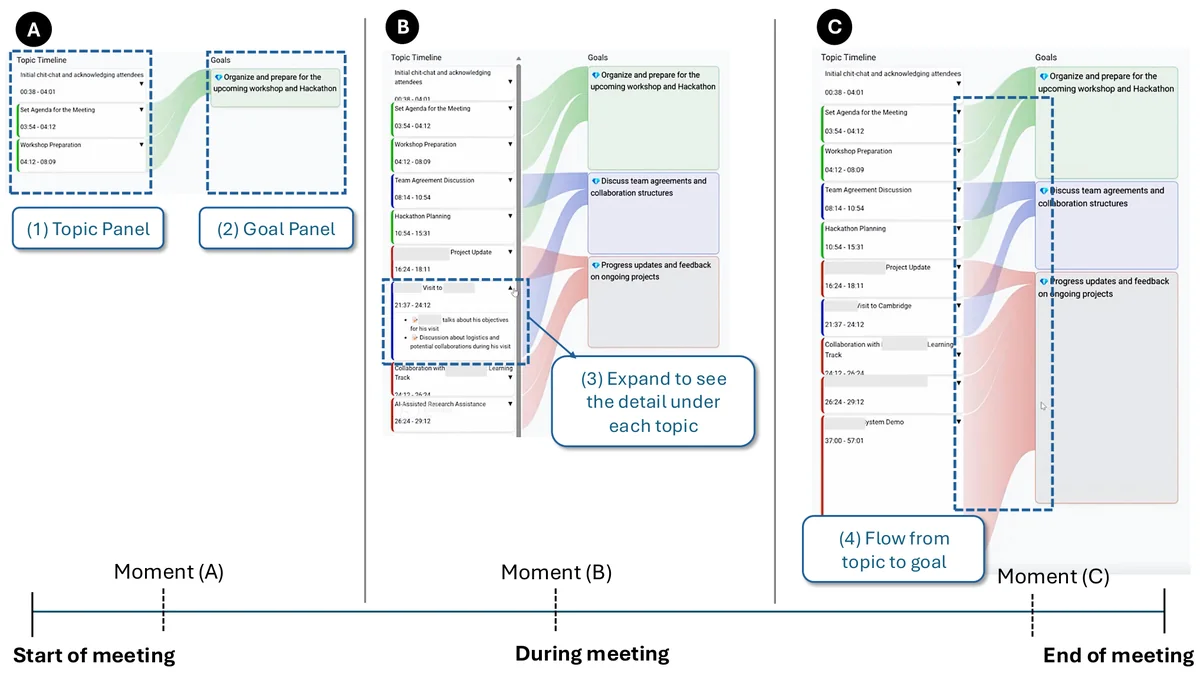
- Two working prototypes built into a simulated meeting window that played back the participant's own meeting recording, sending each turn of the transcript to GPT-4 (Node.js back end, D3.js graphics). Ambient Visualization is a passive sidebar. As the meeting plays, it lists the topics discussed on the left and the goals the AI infers on the right, joined by coloured flows showing which topic serves which goal. Users can click a topic for detail but never have to respond. Interactive Questioning is an active pop-up. When no goal has been set early in the meeting, or the AI judges the discussion has drifted from its goal, it asks a question tailored to the meeting (for example, what success would look like). It offers three options: vote for group reflection, agree but skip it, or disagree. If most vote to reflect, the AI listens and summarises the discussion (vote and summary were simulated). Each participant tried both.
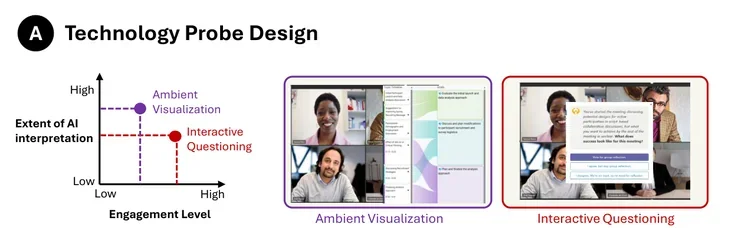
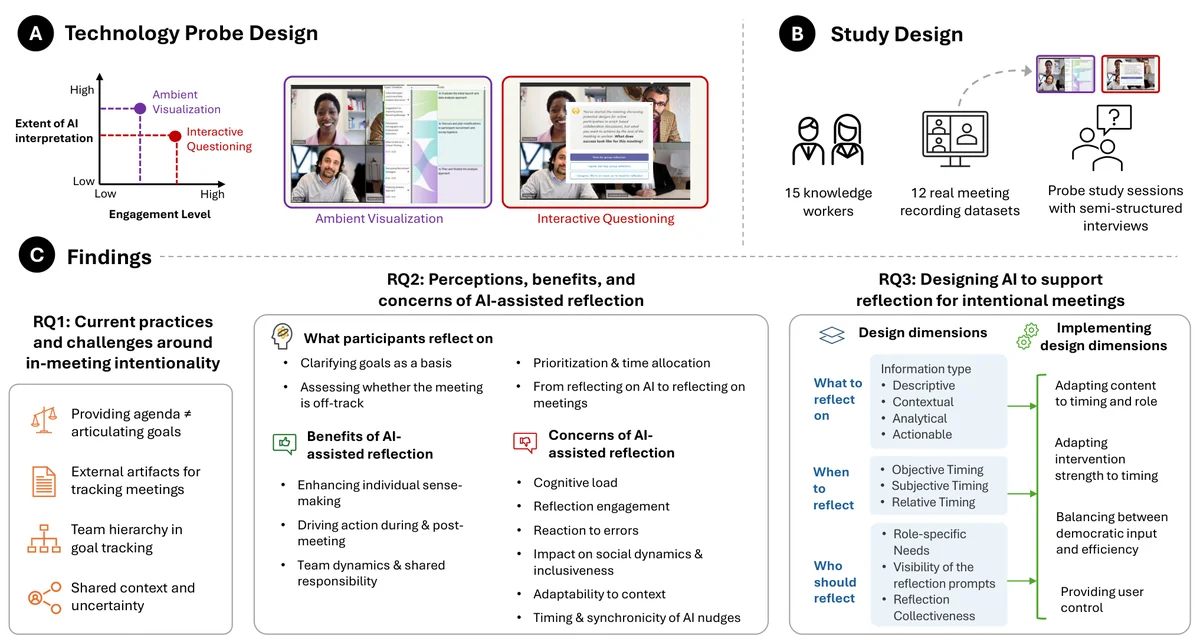
Panel A of Figure 1, Technology Probe Design: the two probes, Ambient Visualization and Interactive Questioning, placed by how much the AI interprets and how much engagement it asks for. From the paper, Figure 1, p. 1. The whole figure is under Figures. - Setting
- Remote sessions over videoconferencing. Participants' own recorded workplace meetings, with the consent of all attendees, were pre-processed and played through the probes to simulate real-time AI support.
- Participants / data
- Purposive sample of 15 employees of a global technology company, contributing 12 meetings (several participants attended the same meetings).
- Duration
- Sessions of approximately 60 minutes. 2-3 meeting segments of approximately 5 minutes each per meeting.
- Analysis
- Thematic analysis of interviews (open coding by the primary author, refined with the team), plus coding of the meeting data for goal communication, monitoring and adjustment, mapped against the interviews.
Findings
Agendas, but rarely goals. In the 12 real workplace meetings that participants shared, most had an agenda but few stated what the meeting should achieve. Junior staff and people not running the meeting often noticed drift but felt it was not their place to say so. #
“I noticed that we were diverging from the topic, but since I wasn't leading the meeting, I didn't feel it was my place to bring it up.”
Clarifying goals came first. Watching their own meetings with either AI probe, most participants reflected first on what the meeting was for. They asked themselves what it should achieve, or checked the goals the AI picked out against their own. #
“Normally you have like some goals in your mind, and then the AI summarized the goals from your discussion, then you can sort of like calibrate your thoughts on what actually the goals are”
A quiet display revealed drift. The passive display of topics and goals helped participants notice off-track discussion and time spent on unimportant topics, without interrupting anyone. But some found its continuous stream overloading, and others ignored it as background. #
“I think one thing that I didn't notice was that we were spending a lot of time on determining the computation...which I don't think was actually super important here.”
Questions prompted action, at a cost. Compared with the passive display, pop-up questions made participants more likely to say they would act in the moment, for example by steering the conversation back or reprioritising. But some found them intrusive or felt pressure to answer. #
“It actually creates interruptions in the meeting. I felt like I had to answer when the AI questioned something.”
Shared steering, but fear of exposure. Participants saw AI-prompted reflection as spreading the job of keeping a meeting on track across everyone, instead of leaving it to whoever dares to interrupt. Yet individual contributors feared being publicly flagged as off-topic. #
“Instead of one person bearing the responsibility to interrupt, the system fosters a shared awareness among everyone knowing there are still three topics to cover.”
Not every meeting needs deep reflection. Much reflection research treats deeper reflection as better. In fast-paced meetings, participants did not always want it, which suggests support that escalates or de-escalates with how much help people need. #
“lower levels of reflection (e.g., in the passive Viz probe), though not always motivating immediate action, were also shown to help maintain focus and alignment without overwhelming participants”
Questions this paper answers
- Why do meetings drift off track?
- Partly because their goals are rarely stated. Agendas list topics rather than outcomes, and goals evolve as discussion unfolds. People who are not running the meeting often notice drift but do not feel it is their place to say so. (See §4.3, p. 8.)
- Can AI help a meeting stay on track?
- Mostly by making goals explicit, which supports meeting intentionality (knowing why a meeting is happening). Goals often stay in people's heads. When AI showed what a meeting seemed to be for, people checked it against their own view. They said clear goals would help them spot drift and reprioritise. (See §5.2.1, p. 10; §5.1.3, p. 10.)
- Should a meeting AI interrupt with questions or quietly show information?
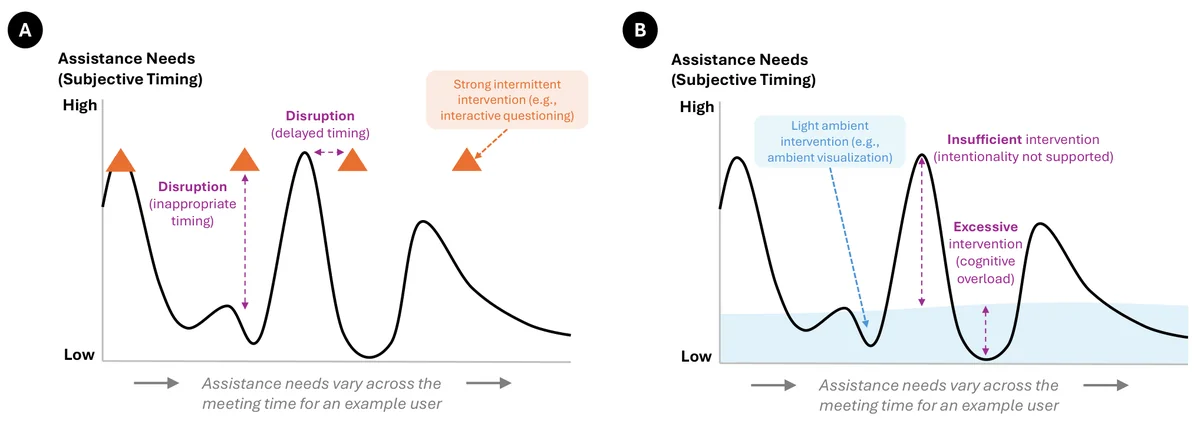
- Neither is right all the time. Ambient displays avoid interrupting but are easily ignored when help is most needed, and add load when it is not. Direct questions prompt action but disrupt the conversation if mistimed. The right strength depends on how much help people need at that moment. (See §5.1.3, p. 10; §5.3.2, p. 11; §7.1, p. 16.)
- Would people want an AI to flag them for going off-topic in a meeting?
- Many would not, at least not publicly. Individual contributors feared being judged and called out in front of colleagues, and some preferred private nudges. Managers worried that leaving the decision to reflect to them alone could silence junior staff. (See §5.2.3, p. 11.)
Quantitative results
| Measure | Result | Where |
|---|---|---|
| Participants and meetings | n = 12 meetings, n = 15 participants | §3.5, p. 7 |
| Meetings with explicitly articulated goals | 4 of 12 meetings | §4.1, p. 8 |
| Meetings found to be off-target in meeting data analysis | 3 out of 12 meetings | §4.2, p. 8 |
| Participants for whom clarifying goals was the primary value | 11/15 | §5.1, p. 9 |
| Participants who saw AI reflection as fostering shared responsibility | 9/15 | §5.2, p. 11 |
| With active reflection, began by asking what the meeting was trying to achieve | 13/15 | §5.1.1, p. 9 |
| With the passive display, first interpreted the AI-generated goals rather than forming their own | 10/15 | §5.1.1, p. 9 |
| Initially took the AI-generated goals as accurate, then found discrepancies on further questioning | 6 participants | §5.3.3, p. 11 |
| Meetings that referred back to their goals during the meeting (code count; meeting count) | 3 codes; 1 meeting | Appendix A, p. 22 |
Contributions and implications
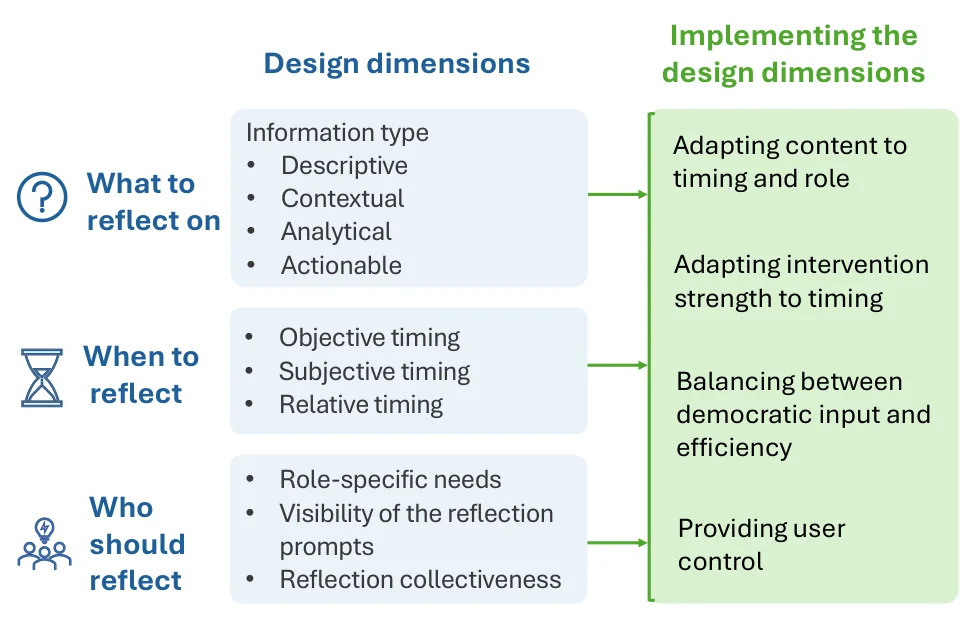
- Design for what to reflect on (descriptive, contextual, analytical, actionable), when to reflect (objective, subjective, relative timing), and who should reflect (roles, visibility, collectiveness).
- Adapt intervention intensity to need, from ambient through lightweight to strong.
AI systems should dynamically adjust intervention intensity between different intervention levels, from ambient through light-weight to strong intervention
(§7.2, p. 17) - Balance democratic input with efficiency, for example letting an organiser make the call on whether the team reflects.
the key is to find a balanced mechanism that encourages democratic input while allowing an accountable member, such as the facilitator or organizer, to make the call
(§7.2, p. 18) - Give users control over goals and AI corrections, and explain AI nudges.
- Treat generative AI as a tool for thought rather than automation.
Rather than using GenAI as a tool to automate away the mundane procedures of meetings, we believe in developing GenAI as a tool for thought to make meetings more effective.
(§8, p. 19)
Limitations
- Participants came from one global technology company, and the sample was not gender-balanced and had few managers.
Our participants were recruited from one global technology company.
(§7.4, pp. 18–19) - Probes ran on recordings, not live meetings, so feedback was retrospective.
meant that participants provided retrospective feedback
(§7.4, p. 19) - The quality of the AI-generated content was not formally evaluated.
we did not formally evaluate the quality of the AI-generated content
(§7.4, p. 19)
›Concepts
- Meeting intentionality
- The aim that agenda-focused meeting tools fail to foster:
they focus on procedure rather than fostering intentionality-knowing why a meeting is occurring and focusing activity on that purpose
(§1, p. 2) - Reflection-in-action
- Schön's distinction. Meetings demand the first kind:
Schön [82] distinguishes between reflection-in-action, involving real-time adjustments, and reflection-on-action, which occurs post-event.
(§2.3, p. 3) - Engagement level and extent of AI interpretation
- The two probe design dimensions: how actively the AI engages users (passive ambient vs active intermittent), and how much it interprets on their behalf (presenting conclusions vs asking questions). (§3.2, p. 4)
- Subjective timing
- Our proposed lens, distinct from objective (clock) and relative timing:
We propose subjective timing as a lens to determine when participants are in need of support and can accommodate interventions without disruption.
(§7.2, p. 17)
Figures
How to cite
Xinyue Chen, Lev Tankelevitch, Rishi Vanukuru, Ava Elizabeth Scott, Payod Panda, and Sean Rintel. 2025. Are We On Track? AI-Assisted Active and Passive Goal Reflection During Meetings. CHI 2025. https://doi.org/10.1145/3706598.3714052
This brief was prepared with AI assistance and published by Sean Rintel. It is not the authors' published text. Page numbers refer to this PDF.