Research brief
Takeaway: In mixed-reality work meetings, an avatar's communicative value matters more than likeness. With cartoon faces, colleagues read each other's moods more accurately and recognised each other better over time, while realistic faces may have raised expectations their limited body language couldn't meet.
Why this matters
- What was known
- Research on realistic versus cartoon avatars has produced mixed results, mostly from one-off lab studies in virtual reality with strangers, short animations or still images, which are prone to novelty effects.
We know little about how these findings apply to MR, less about effects in real-world contexts, and very little about the longitudinal effects on avatar acceptance.
(§1, p. 2) - What this paper adds
- A longitudinal field study in which real co-workers held their usual meetings in mixed reality using personalised full-body avatars, switching between realistic and cartoon faces halfway through.
To the best of our knowledge, there have been no studies comparing personalised realistic versus cartoon face styles on the same full-body avatars in IVEs, over time, in the field, and especially in business contexts.
(§2, p. 3) - Who it matters to
- Researchers of avatars and remote collaboration, and builders of commercial mixed and virtual reality meeting systems deciding how to design and deploy avatars.
A key message for future research and commercial usage, then, is to prioritise features and deployment plans around communicative value for the situations in which avatars will be used over accuracy
(§8, p. 15)
Research questions
- RQ1: How do the avatar representations interact with the functional communicative value based on (a) the identification of the other person (people); (b) the perceived authenticity of communications; (c) the perceived usefulness of expression and movement.
- RQ2: How do the avatar representations interact with the task satisfaction based on: (a) the level of task impact, (b) comfort and (c) engagement.
- RQ3: How do the avatar representations interact with the concept of presence based on: (a) co-presence and (b) social presence.
- RQ4: Does the avatar representation change the self-reported moods (a) overall and (b) over time?
- RQ5: Does the avatar representation affect how accurately people perceive others' moods (a) overall and (b) do they improve overtime?
- RQ6: Does positive or negative moods affect how accurately they are perceived by others?
- RQ7: What are the most valuable cues available for identifying moods and are these different depending on the avatar rendering styles?
Method and data
- Design
- Within-subjects longitudinal field study. Each group used one avatar rendering style for half its meetings and the other for the rest, with the starting style counterbalanced across groups.
- Prototype
- A networked mixed-reality meeting application for Microsoft HoloLens2, built in Unity. Each person had a personalised full-body avatar whose head was generated from a head-and-shoulders photo, in a realistic and a cartoon version on near-identical bodies. Wearing the headset in their own room, users gather around a shared hologram table where colleagues' avatars appear, and use a menu to create or join meetings, mute and switch avatar. The avatar's head, hands and walking follow the headset's head and hand tracking, its mouth moves with voice volume and its eyes blink. There was no tracked gaze or facial expression. The only comparison was the realistic face versus the cartoon face, with identical movement.
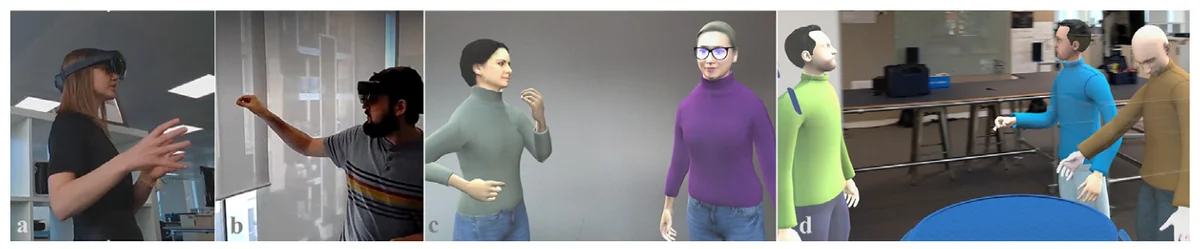
Fig. 1. Example of people interacting in remote meetings using the HoloLens Mixed Reality device (a,b). Example meetings where participants are embodying realistic (c) and cartoon (d) full-body rendering style avatars. From the paper, Figure 1, p. 5. - Setting
- Groups of co-workers from a global technology company held one of their regular daily meetings (such as stand-ups and status reports, at least 10-15 min) in mixed reality. Each person joined from their own space rather than a lab, standing for the meeting.
- Participants / data
- 14 participants (7 female, 6 male and 1 non-binary, aged 21-45) in 6 groups: 4 dyads and 2 triads.
- Duration
- Two to three weeks. 54 meetings in total.
- Analysis
- 124 daily questionnaire responses: 12 Likert items on communication, task satisfaction and presence, self-rated and perceived moods, and rankings of cues used to read moods. Analysed with repeated measures ANOVA, paired t-tests and linear regressions over time.
Findings
Realistic faces seemed more expressive. Co-workers who met daily as avatars rated realistic-faced avatars' body language as more appropriate and more useful for understanding colleagues than cartoon-faced avatars', although the movement was generated identically for both styles. #
“Overall I was really impressed with the likeness of the avatars to the real people”
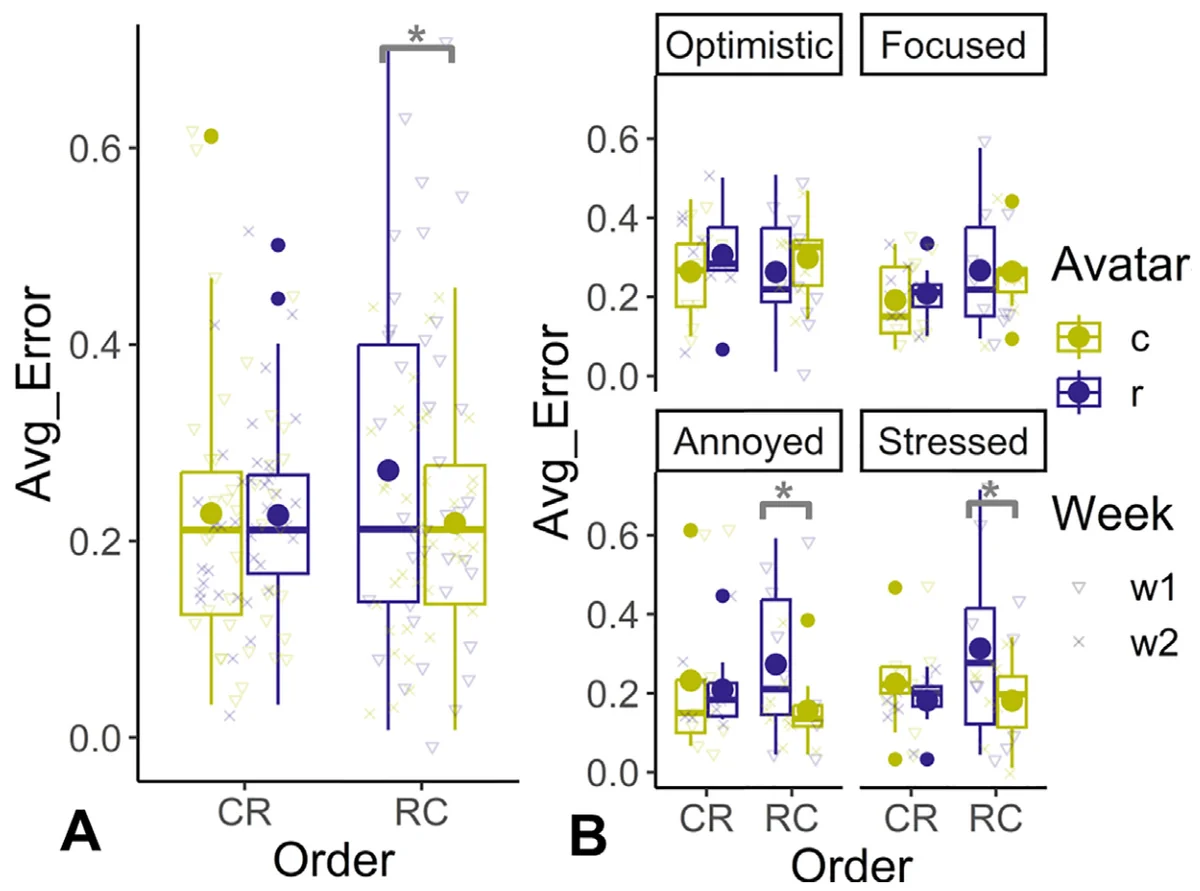
But moods were read better with cartoons. After each meeting, people rated their own mood and their colleagues' moods. Colleagues' ratings came closer to people's own with cartoon avatars than with realistic ones, and were furthest off in groups that started with realistic avatars. #
“Errors in reading other participants' emotions may have occurred because participants put too much trust in non-verbal cues relative to the more accurate verbal cues.”
Cartoon avatars grew on people. Groups that used cartoon avatars in their first week said, as the days went on, that the avatars' appearance mattered less and affected their comfort less. Across all groups, recognising colleagues improved over time with cartoon avatars but not with realistic ones. #
“It is possible that using Cartoon avatars first allowed participants to become more accustomed to the appearance of the avatars, leading to increased comfort and a reduced focus on appearance.”
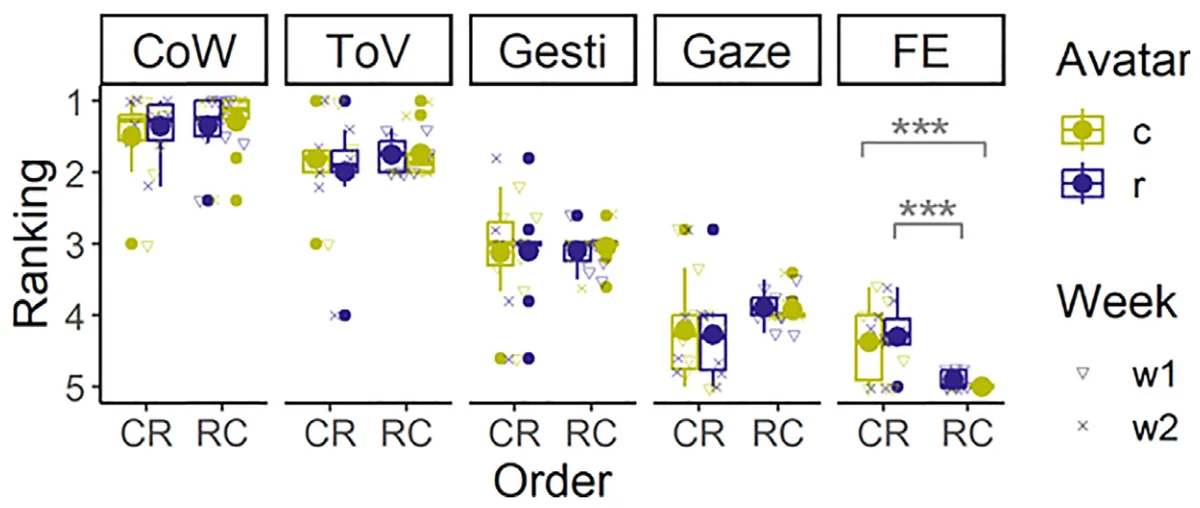
Voices mattered more than faces. Asked to rank the cues they used to read colleagues' moods, people put choice of words, tone of voice and movement first with either avatar style, and gaze and facial expressions lowest. The avatars had no tracked gaze or facial expressions. #
“The voice part is ok, however the avatar does not match the expression of my colleagues.”
Negative moods were harder to read. The more annoyed people said they were, the more their colleagues misjudged it, with both avatar styles. Stress showed the same pattern only in groups that started with realistic avatars, and positive moods did not. #
“This may be due to people tending to mask negative emotions more (and masking being easier with avatars that show limited non-verbal cues).”
No significant difference in satisfaction or presence. Avatar style made no significant difference to how engaged or comfortable people felt in the meeting, or to their overall sense of being present with their colleagues. #
(§5.1, p. 7)
Questions this paper answers
- Does a more lifelike avatar help people understand each other?
- Not necessarily. When co-workers met daily as mixed reality avatars for two to three weeks, they rated realistic faces' body language more useful than cartoon faces', despite identical movement. Yet they misread moods more with realistic faces. Realism may raise expectations, so people trust nonverbal over more accurate verbal cues. (See §6, p. 13; §6, p. 13.)
- What do people rely on to read colleagues' feelings through avatars?
- Mostly what they hear and see in motion, such as choice of words, tone of voice and body movement. Avatars without tracked gaze or facial expressions gave little to read in the face, whichever style they were drawn in. (See §6, p. 13.)
- Why are negative emotions harder to read through avatars?
- Possibly because people tend to mask negative emotions, and avatars that show few nonverbal cues make masking easier. Among co-workers meeting as avatars, the more annoyed someone said they were, the more colleagues misjudged it, with realistic or cartoon faces alike. Positive moods showed no such pattern. (See §6, p. 14.)
- Do people get used to avatars in meetings over time?
- Partly, so first impressions are a poor guide. Over time, co-workers who began with cartoon avatars said appearance mattered less. Recognising colleagues also improved over time with cartoon avatars, but not realistic ones. People may simply grow used to an avatar style, and recognition matters less once avatars are familiar. (See §6, p. 13.)
Quantitative results
| Measure | Result | Where |
|---|---|---|
| Realistic avatars' nonverbal behaviour rated more appropriate for the context (Q11) | F(1, 13) = 7.14, p = .019, η2 = .355 | §5.1, p. 7 |
| Realistic avatars' nonverbal behaviour rated more useful for understanding colleagues (Q12) | F(1, 13) = 5.5, p = .036, η2 = .296 | §5.1, p. 7 |
| Mood perception error, cartoon vs realistic avatars | M = .22 vs M = .25; F(1, 18) = 5.13, p = .036, η2 = .22 | §RQ5: Accuracy of perceived moods, p. 9 |
| Mood perception error, Realistic-Cartoon order: realistic week 1 vs cartoon week 2 | R W1: .27; C W2: .21; t (9) = 3.79, p = .004 | §RQ5: Accuracy of perceived moods, p. 10 |
| Recognising colleagues improved over time with cartoon avatars (Q8) | R 2 = .06, F(1, 59) = 4.25, p = .04 | §5.1, p. 7 |
| Appearance mattered less over time, cartoon avatars in week 1 (Q6) | R 2 = .27, F(1, 29) = 11.06, p = .002 | §5.1, p. 7 |
| Self-reported optimism, realistic vs cartoon avatars | t (13) = 2.53, p = .025 | §RQ4: Self-reported moods, p. 8 |
Contributions and implications
- First impressions of avatars set expectations. With current limited expressiveness, realistic avatars' communicative value is more fragile than cartoon avatars'.
the communicative value of realistically rendered avatars is more fragile than that of cartoon avatars
(§6, p. 14) - In the short term, better audio may matter more than more realistic visuals.
may provide more impact than improving visual realism
(§6, p. 14) - Avatars should be evaluated as whole communicative systems, with voice, not as still images or silent video.
Specifically, new avatars must not be evaluated as still images only or silent video.
(§6, p. 14) - Avatar research should include repeated encounters over time.
We would urge that future research on avatars features multiple encounters over time, lest we over-index on first impressions instead of allowing that time will tell.
(§6, p. 14)
Limitations
- A small sample, so effects of prior mixed-reality experience could not be tested.
Thus, another limitation is the relatively small number of participants.
(§7, p. 14) - Avatars had no tracked gaze or facial expressions, which may have shaped which cues people found useful.
Due to limited time, we did not implement into the avatars nonverbal behaviour gaze or facial expressions.
(§7, pp. 14–15) - No pre-meeting baseline mood rating, so self-reported moods may reflect the work rather than the avatars.
we did not compare these to a pre-meeting baseline rating
(§7, pp. 14–15) - All participants worked at a technology company and may be more open to novel systems. Each research question used only one or two questionnaire items.
All participants were part of a technology company.
(§7, p. 14)
›Concepts
- Avatar rendering style
- How an avatar is drawn, for example realistic or cartoon. Here only the personalised face differed, on otherwise similar full-body avatars.
Avatars can have different representations, ranging from floating spheres with hands to full or partial humanoid bodies with different appearance rendering styles (e.g., cartoon, realistic).
(§1, p. 1) - Mood
- Defined following Matthews and colleagues. Four moods were rated (optimistic, focused, annoyed and stressed):
mood being defined here as an emotion-like experience lasting for at least several minutes
(§4.5, p. 6) - Order conditions (CR and RC)
- Half the groups used cartoon-faced avatars in the first week and realistic ones in the second (Cartoon-Realistic). The other half the reverse (Realistic-Cartoon).
- Mood perception error
- How far a colleague's rating of someone's mood was from that person's own rating, scaled from 0 (no error) to 1 (maximum error).
Figures
How to cite
Georgiana Cristina Dobre, Marta Wilczkowiak, Marco Gillies, Xueni Pan, and Sean Rintel. 2025. Avatars in mixed-reality meetings: A longitudinal field study of realistic versus cartoon facial likeness effects on communication, task satisfaction, presence, and emotional perception. International Journal of Human-Computer Studies 205. https://doi.org/10.1016/j.ijhcs.2025.103632
This brief was prepared with AI assistance and published by Sean Rintel. It is not the authors' published text. Page numbers refer to this PDF.