Research brief
Takeaway: Combining mobile robotic telepresence with mixed reality should aim to help remote and local people feel the remote person belongs there, not just is there. Imitating presence raises expectations that go unmet (an 'Uncanny Valley of Telepresence'), so designs should offer the comforts of belonging, even in unnatural, asymmetric ways.
Why this matters
- What was known
- In hybrid collaboration, remote people are more likely to be marginalised. Technologies such as mobile robotic telepresence, VR, AR and 360° video each address part of what remote workers lack, but none addresses all of it.
Remote workers fundamentally lack five of the building block affordances for physical autonomy and affiliation available to local workers: mobility, embodiment, expressiveness, awareness, and presence.
(§1, p. 2) - What this paper adds
- Instead of giving both ends the same video link, our probe, VROOM, gives each side an experience suited to it. We compare it with a standard telepresence robot, not to pick a winner but to see how people account for each approach to belonging. From this we propose an 'Uncanny Valley of Telepresence', after Mori's Uncanny Valley.
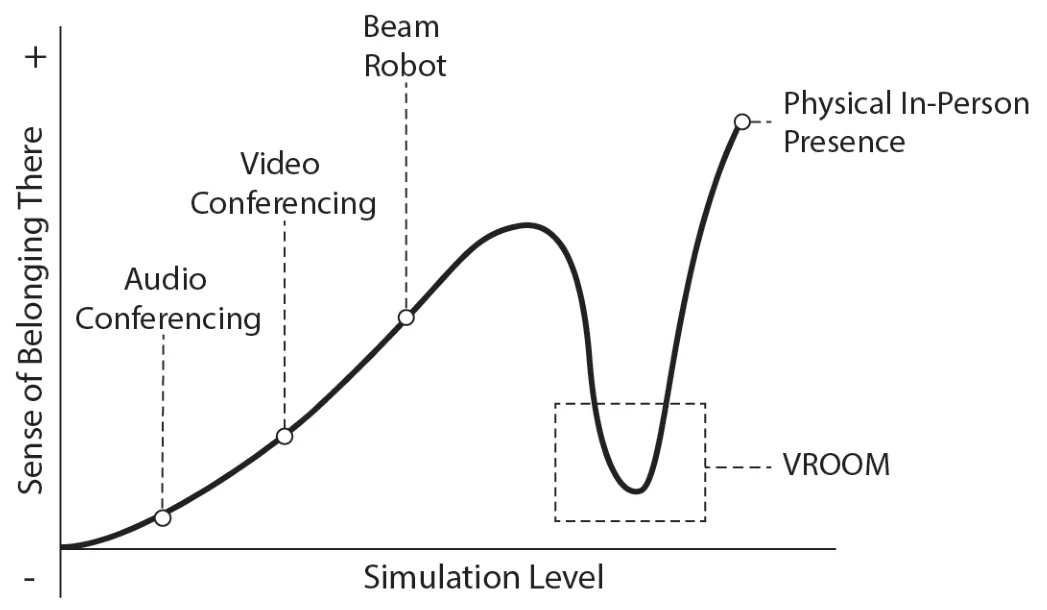
we argue that there is an 'Uncanny Valley of Telepresence' in which there a sharp dip in the continuous increase of both local and remote users' senses of belonging as a telepresence experience becomes more like physical presence
(§1, p. 2) - Who it matters to
- Designers and researchers of telepresence and XR systems for hybrid organisations, where some members are co-located and others remote.
We conclude that XR Telepresence should focus on providing the comforts of belonging, even if done in unnatural ways, rather than focusing on pure imitation.
(§1, p. 3)
Research questions
- How might remote workers present themselves and be perceived as an equal and unique embodied being in a workplace? (Stated aim of the probe study.)
- How do local and remote users account for the different technological approaches of a standard mobile robotic telepresence system and the VROOM XR telepresence probe to 'belonging' to a space, and where are the 'treacherous slopes and potential handholds' in the Uncanny Valley of Telepresence?
Method and data
- Design
- Exploratory study. Pairs (one local, one remote) played a search game (Gather) and a word-guessing game (Heads Up) in two conditions, a standard Beam mobile robotic presence system and VROOM, in counterbalanced order with fixed roles. Followed by a semi-structured paired interview.
- Prototype
- VROOM (Virtual Robot Overlay for Online Meetings), a technology probe assembled from existing parts. The local person wears an AR headset (Microsoft HoloLens) and sees a life-size 3D avatar of the remote person standing over a Beam telepresence robot, whose screen is turned off. The avatar's face is made from a photo of the remote person. The remote person wears a VR headset showing a live 360° view from a camera on top of the robot, and sees their own avatar body from the shoulders down when they look down. They drive the robot with a thumbstick, and move the avatar's head and arms with their own head and two hand-held controllers. The avatar mirrors the remote person's head turns and arm movements, its mouth moves with their speech, and it plays walking, idle and blinking animations. Built in Unity, with printed markers on the robot so the headset can place the avatar. Compared with the standard Beam robot, which shows the remote person's face on a screen and is driven from a desktop app.
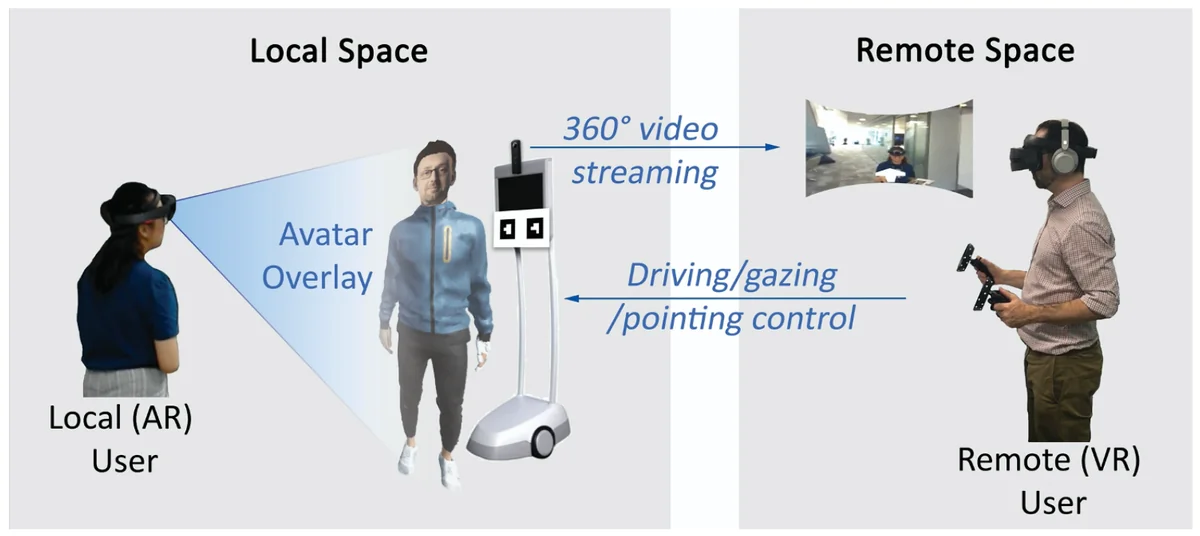
Fig. 1. An overview of the VROOM system. From the paper, Fig. 1, p. 2. - Setting
- Open-office space in the regional office of a global technology organisation.
- Participants / data
- Ten pairs, 20 participants in total, aged 25-54 (M = 35, SD = 7.3). Eight women and 12 men. Mostly researchers and software engineers, with varied and mostly limited experience of VR and head-mounted displays.
- Duration
- One session per pair: both game rounds plus an approximately 30-minute interview.
- Analysis
- Open, axial and selective coding of interview transcripts, video-based interaction analysis of the sessions, and cross-referencing of interview codes with key video events.
Findings
Pointing across the room got easier. In pairs playing search and word-guessing games, remote users moving VROOM's life-size avatar arms could point at things across the room much more easily than with the standard robot. The gestures were crude, though, and at close quarters the robot's ordinary 2D video conveyed finer gestures. #
“the arm was extending out of my field of view, and it was just flailing around rather than going like that, because the fidelity of the control”
Head turns showed where they looked. Local users could tell where the remote person was looking from the avatar's head movements, which sometimes made up for gestures the avatar could not show. #
“When I was saying, 'can you see that?' I could see that you [P5-RU] were looking up, and I thought, 'she has seen that.' So that was quite helpful.”
Many local users fell back on voice. Identification with the avatar was mixed. Some remote users recognised themselves in it. But its unnatural look, its lack of facial expression and the AR headset's narrow field of view led half the local users to rely mostly on the remote person's voice. #
“I might as well have done [...] that task with my eyes closed because I was just listening to what he was saying.”
A natural view, less confident driving. Remote users found VROOM's 360° headset view more immersive than the standard robot's screen, but drove less confidently. The standard robot's unnatural camera views, which show its edges and where it is heading, gave them a more predictable sense of the robot's body. #
“Counter to our expectations, the unnaturalness in the Beam interface was actually more of an asset than the apparently natural view from the VROOM condition.”
Nobody knew what the other could see. Neither local nor remote users knew what their partner could see or express, so some gestures were missed or never attempted. Remote users also felt dependent on their local partners rather than equal, more so with VROOM than with the standard robot. #
“My visual signal was much reduced, and I had less sense of how I could move and where it was safe to move the robot. So I just felt more like a dependent participant than an equal partner.”
More presence, less belonging. Compared with the standard robot, VROOM imitated physical presence more closely. Yet it seemed to leave users with less sense that the remote person belonged in the room. We hypothesise this places it inside an Uncanny Valley of Telepresence. Our explanation: #
“The illusion of 'being there' gives them higher expectations of their own abilities in the space, but once those expectations are not fulfilled, they become frustrated and feel more as if they are not meant to be there.”
Questions this paper answers
- Can a remote person point and gesture through a telepresence robot?
- Better with a body than a screen. When ten pairs played games in an office, remote partners moving a life-size AR avatar overlaid on the robot could point across the room. Its head turns showed where they looked. But gestures were crude. Up close, the robot's video showed finer ones. (See §5.3, p. 17; §5.3, p. 18.)
- Is a more realistic telepresence system always better?
- Not necessarily. We hypothesise an 'Uncanny Valley of Telepresence'. Belonging rises as a system imitates physical presence more closely, until both sides expect more of the remote person than the system can deliver. Then belonging dips. Overcoming it means finding what makes belonging with others comfortable, not just imitating presence. (See §6, p. 22.)
- Why is it hard to collaborate through a telepresence avatar?
- Because neither side knew what the other could see or express. Local partners' headsets had a narrow view that cut off the avatar's gestures, and remote users did not know how their gestures appeared, so some stopped gesturing. Remote users also felt dependent on their local partners rather than equal. (See §5.1, p. 14; §5.4, p. 21.)
- Why might an immersive view make a robot harder to drive?
- Seeing is not moving. A 360° headset view made remote users feel immersed, but they still steered a robot whose edges they could no longer see. The standard robot's odd but predictable camera views, which showed its edges and where it was heading, gave a better sense of its body. (See §5.2, p. 16.)
Contributions and implications
- Let users create their own avatars, possibly less photorealistic ones. The aim is an agreed, appropriate representation of the self rather than a copy.
if the point is to increase belonging, then pure imitation is not the threshold
(§6.1, p. 23) - Consider enlarging or distorting the first-person view of one's own avatar body, as in first-person video games, so remote users keep a peripheral sense of their body.
- Add richer expression through existing hand, finger, full-body and face tracking.
- Let each side see how they appear to the other and peek into the other's view.
To see the world from the other's point of view would provide a sense of reciprocity of perspectives that has eluded video-mediated communication for decades.
(§6.2, p. 24) - Expect both specialised systems for specific contexts and modular, adaptable ones.
We should not expect XR Telepresence to be one-size-fits-all.
(§6.1, p. 24)
Limitations
- Short-term use in an artificial game activity. Future work should use more realistic tasks and longer-term, everyday use. (§6.3, p. 25)
- VROOM was assembled from existing technologies not designed to work together, and was compared with a mature commercial robot, so the study was not a simple evaluation of which is better.
- Some findings may reflect novelty effects. People might adapt over time.
›Concepts
- Asymmetric XR telepresence
- Rather than giving both sides the same view, VROOM fits each side's experience to its own endpoint:
Instead of twinned endpoints, VROOM provides an experience contextualised to each endpoint
(§1, p. 2) - Belonging
- A remote person's ability to be part of a space: acting in it with autonomy (moving, pointing, being aware of others) and being affiliated with the people in it. (§1, p. 2)
- Uncanny Valley of Telepresence
- Our hypothesis, after Mori's Uncanny Valley. Past the turning point, unmet expectations make belonging drop:
the higher the simulation level of a telepresence experience, or the more it tries to simulate or replicate actual presence, the greater the user's feeling of 'belonging to the space' , up to a turning point
(§6, p. 22) - XR Telepresence (VROOM)
- Remote presence that mixes augmented and virtual reality, with the local and remote person each given a different experience of the same encounter. VROOM is
a bi-directional asymmetrical XR Telepresence system
(§3, p. 6) - Proprioception
- The sense of where one's body is. For remote users to feel they belong, a crucial step is that
they transfer their sense of proprioception (the awareness of the position of movement) of their real body to the avatar/robot body
(§5.2, p. 15) - Deictic gestures
- The first of the gesture types we analyse:
Deictic gestures are indicative or pointing movements
(§5.3, p. 17)
Figures
How to cite
Brennan Jones, Yaying Zhang, Priscilla N. Y. Wong, and Sean Rintel. 2021. Belonging There: VROOM-ing into the Uncanny Valley of XR Telepresence. 2021 Conference on Computer Supported Cooperative Work. https://doi.org/10.1145/3449133
This brief was prepared with AI assistance and published by Sean Rintel. It is not the authors' published text. Page numbers refer to this PDF.