Research brief
Takeaway: Social talk builds collegial bonds. Working from home, video calls helped colleagues widen and deepen them by reducing physical barriers, but chat had to be scheduled. In group calls, lag and a single audio channel caused talk-overs that over-polite floor-ceding made worse.
Why this matters
- What was known
- Social talk builds bonds between colleagues, but research has mostly studied it in person, and studies of video conferencing focused on task-based meetings or domestic calls.
To the best of our knowledge, how VC technologies are used to maintain collegial relations between team members and employees has yet to be examined in detail.
(§2.1, p. 4) - What this paper adds
- Groups of three co-workers, each at home, held an unstructured video chat. Individual interviews then explored that chat and months of remote social talk.
our study is the first to explore the ways in which colleagues facilitate multiparty group social talk through VC when working from home
(§6, p. 21) - Who it matters to
- Designers of video conferencing and team tools, and managers and organisers of remote and hybrid teams who want to support collegiality.
Our implications consider how connectedness between co-workers can be facilitated within the boundaries of work, without intruding on home life.
(§6.6, p. 26)
Research questions
- What are people's perceptions of the nature and role of casual multiparty social talk between colleagues over video conferencing as they work from home?
- What technologies and activities are used to facilitate video conferencing multiparty social talk, and what factors influence how colleagues choose to engage on these platforms?
Method and data
- Design
- Qualitative study. Each triad of colleagues held an unstructured 20 minute social conversation over Zoom. Then each participant took part in a separate 30-minute semi-structured interview about remote social talk with colleagues and the session.
- Setting
- Colleagues working from home during the COVID-19 pandemic, recruited from five research institutes in three countries (The Netherlands, Austria, Ireland), August and September 2020.
- Participants / data
- Ten groups of three (N=30, W=16, M=14), at a similar career stage within each group, who had worked together in person before COVID-19.
- Duration
- One session per group: a 20 minute conversation followed by 30-minute interviews.
- Analysis
- Inductive thematic analysis of transcribed interviews, coded independently by two researchers in NVivo, with themes clustered and agreed together.
Findings
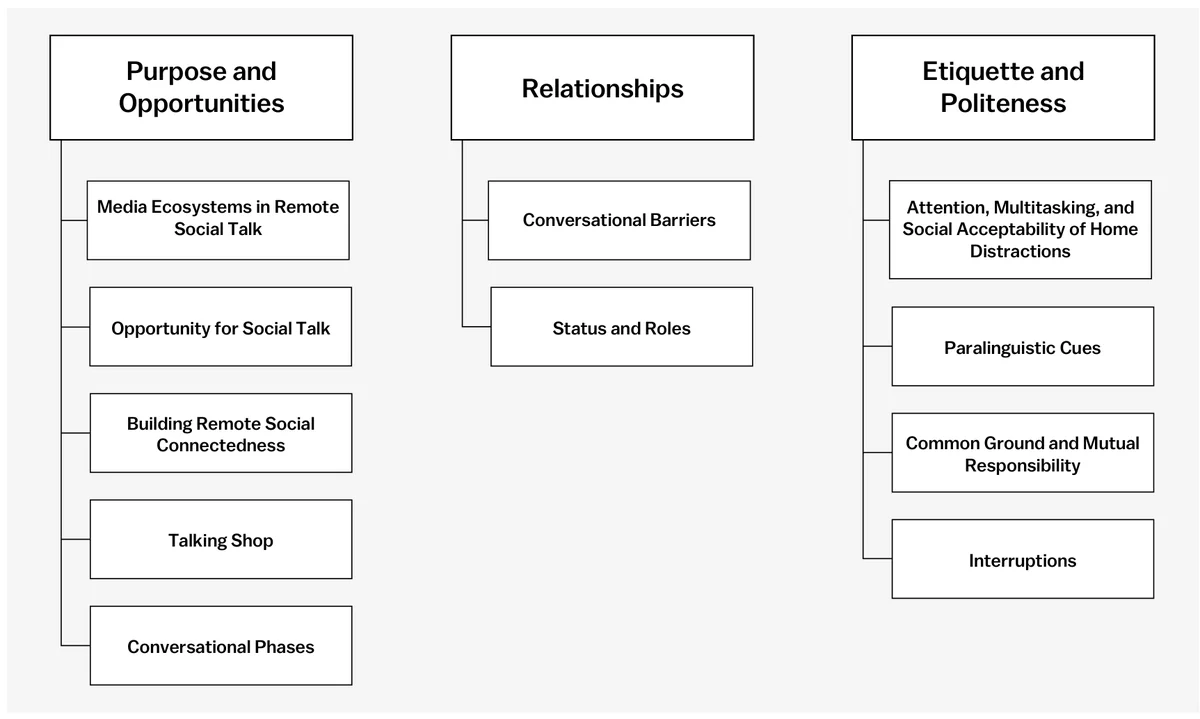
Wider and deeper ties. The research-institute colleagues we interviewed, working from home in 2020, said video calls lowered the barriers to social talk. They met colleagues outside their own group and in other countries, and got to know existing colleagues better. #
“Thanks to these platforms, I found myself interacting with people. I never interacted before in person, because they weren't in my work sphere...”
Fun had to be scheduled. Without chance encounters in corridors or at the coffee machine, social talk over video had to be planned, which removed its spontaneity and sometimes made it feel like one more work task. #
“There is thus some irony in having to treat the one element of workplace spontaneity as yet another calendar item”
Old friendships made it easier. Colleagues who had built relationships in person before the pandemic found chatting with each other over video easy, close to talking face to face. With less familiar colleagues it felt awkward. #
“I know them very well, I don't feel like there's anything. It doesn't feel difficult. It's easy to talk to them. As easy as in person.”
Seniority got magnified. Even in social calls, people were more careful about interrupting when senior colleagues were present, and senior members, or whoever had been made host of the call, tended to act as moderator. #
“I think all the kind of structures around seniority and stuff, maybe gets magnified in the Zoom space because you're being extra careful about not interrupting someone who's trying to say something important”
No side conversations, so topics stayed general. In group video calls people accepted each other's multitasking. And because a single shared audio channel left no way to split off into side conversations, as people would in person, they kept topics light and general so that nobody felt left out. #
“everything just is very general because people naturally don't want people to be left out or bored. So then the content must be something that has, that speaks to everybody in the room”
Politeness made the pauses worse. Lag and a single shared audio channel caused overlapping speech. The silences that followed grew longer when everyone politely ceded the floor at once. #
“if I talk over someone I might say, go ahead and they might say go ahead”
Questions this paper answers
- Can video calls help colleagues stay connected when working from home?
- Yes, sometimes more widely than an office allows, because video removes the need to share a corridor. But existing relationships matter, because colleagues who already knew each other in person found it easy. Social chat also had to be scheduled rather than happening by chance. (See §5.2, pp. 11–12; §5.2, p. 10; §5.3, p. 15.)
- How is socialising over video different from chatting at the coffee machine?
- In person, workplace social talk tends to be brief, unplanned and between two people. Over video it became scheduled and happened in larger groups, where nobody could drift into a side conversation, so topics stayed general and inclusive. (See §5.2, p. 10; §5.4, p. 19.)
- Why do group video chats with colleagues feel awkward?
- Mostly because of how turns are taken. Lag and one shared audio channel make people talk over each other, and missing body language makes it hard to see who wants to speak. The polite habit of ceding the floor then leaves everyone waiting. (See §5.4, pp. 20–21.)
- Does seniority still matter when colleagues socialise online?
- Yes, perhaps more than in person. When colleagues socialised over video, people were more careful about interrupting senior colleagues and deferred to them. Senior staff or the call's host tended to steer the conversation, which made social calls feel closer to meetings. (See §5.3, pp. 15–16.)
Contributions and implications
- Support planning by coupling asynchronous and synchronous tools so informal calls are easier to organise.
a tighter coupling of asynchronous and synchronous communication tools would allow remote informal conversations to be organized with less effort
(§6.6, p. 26) - Support playful interaction and shared activities such as games and quizzes.
Our work highlights that social talk with colleagues tends to be most effective when focused on a shared activity.
(§6.6, p. 27) - De-emphasise status, for example with bots that initiate social calls instead of senior staff.
Design practitioners should look to de-emphasize these status effects to improve social VC experiences.
(§6.6, p. 27) - As best practice, accept multitasking during social calls.
managers and team members should be accepting of this behavior when planning and conducting VC-based social talk
(§6.7, p. 29) - As best practice, consider how group size affects the conversation.
organizers should be aware of these limitations and how the size of the group may affect conversational experience
(§6.7, p. 29)
Limitations
- Participants came from research institutes, which may limit generalisability.
limiting our results to work practices in research institutes
(§6.8, p. 30) - Participants recruited colleagues they already knew, so findings apply more to people with prior relationships.
our interview findings are therefore likely to be more applicable to those that have a previous relationship
(§6.8, p. 30) - The study took place during the pandemic, so results must be read in that time period.
it is important to contextualize our results in the time period in which the data was collected (August and September 2020)
(§6.8, p. 30) - The timed, recorded conversation session lowers ecological validity.
We acknowledge the lower ecological validity of our study due to the allocated time frame and recording of the conversation.
(§4.2, p. 7)
›Concepts
- Social talk
- Often called watercooler conversation. Why it matters at work:
Social talk, or informal talk, is an important workplace practice that is used to build and maintain bonds in everyday interactions among colleagues.
(Abstract, p. 1) - Phatic communion
- Coupland and colleagues' term for the same thing:
phatic communion (Coupland et al., 1992) (i.e., non-task oriented talk)
(§1, p. 3) - Outeraction
- Nardi and colleagues' term for using tools such as instant messaging to negotiate whether people are available for social talk and to initiate it. (§2.3, p. 5)
- Remote collegiality
- Keeping up collegial relationships with co-workers at a distance, here through video calls.
Figures
How to cite
Anna Bleakley, Daniel Rough, Justin Edwards, Philip Doyle, Odile Dumbleton, Leigh Clark, Sean Rintel, Vincent Wade, and Benjamin R. Cowan. 2022. Bridging social distance during social distancing: Exploring social talk and remote collegiality in video conferencing. Human–Computer Interaction 37 (5), 404-432. https://doi.org/10.1080/07370024.2021.1994859
This brief was prepared with AI assistance and published by Sean Rintel. It is not the authors' published text. Page numbers refer to this PDF.