Research brief
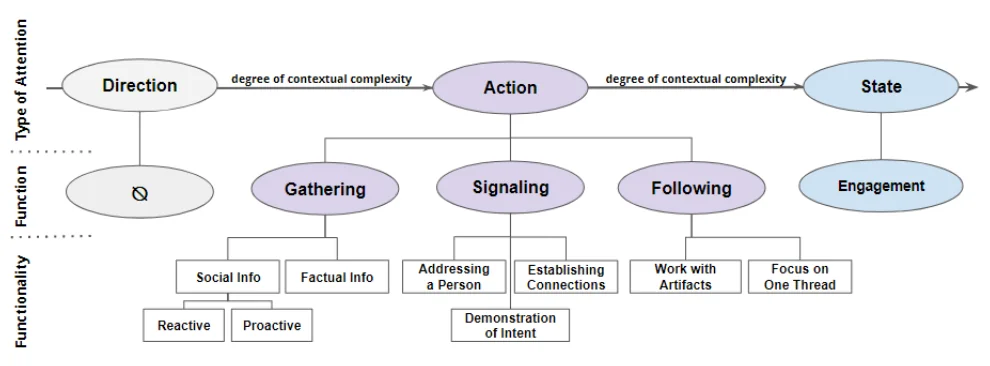
Takeaway: Supporting attention in video meetings means supporting what attention is for. A functional classification separates attention as direction (where people look), as action (looking to see, to be seen or to follow the work) and as state (engagement). Features should start with attention as action, because it feeds engagement.
Why this matters
- What was known
- Research and systems have tackled attention in video meetings from many angles, from gaze and eye contact to engagement and immersive environments, but without a shared account of what supporting attention means.
In sum, research on attention is very fractured [36]. Thus, there is a need for systematic understanding of what it actually means to support remote user's attention.
(Introduction, p. 1) - What this paper adds
- An empirically grounded, three-level classification of observable attention in meetings. It covers types of attention, their functions, and the meeting activities that correspond to each function.
The intent of our model is provide a language that allows designers to be more deliberate when deciding and articulating what type of attention they wish to foster through their tools.
(§INTRODUCTION, p. 2) - Who it matters to
- Designers and developers of video meeting features. (§Leveraging the Attention Classification in Design, p. 10)
Research questions
- Which aspects of visual attention contribute to participants' engagement in meetings, and how are these aspects affected by remote participation?
- How do people prioritise and make sense of purely visually observable cues of attention in work meetings?
- What are the fundamental types of attention in meetings that are accessible for technological support, and how might they be recognised during meetings?
Method and data
- Design
- Two complementary qualitative studies: semi-structured interviews, then a quasi-experimental narration study to triangulate and extend the interview themes.
- Setting
- Work meetings in co-located, remote and hybrid configurations. In the second study, participants narrated muted video clips of real work meetings (4 to 6 people, co-located or hybrid) to an experimenter.
- Participants / data
- Study I: twelve participants (age 21-50, 5f, 7m), all full-time employees with extensive experience of co-located, remote and hybrid meetings. Study II: a new set of fifteen participants (21-36 years, 8f, 7m) who each narrated six short videos.
- Duration
- Interviews lasted approximately 40 minutes each.
- Analysis
- Study I: open and axial coding of interview transcripts. Study II: semantic analysis of 'attention identifiers' in 225 responses of observable visual attention from 90 descriptions of 6 videos, plus debrief interviews.
Findings
Video does not restore attention. Twelve employees experienced in co-located, remote and hybrid meetings felt that joining remotely, even with video, limits three things attention does in a meeting. These are gathering social information, following the work, and signalling to others (for example, addressing a specific person). #
“If somebody addresses me, in person they turn, face me. In a remote meeting they would have to turn to the camera, or say my name.”
Hard to follow the work. Remote interviewees also struggled to follow work on whiteboards and slides, and could not take part when a meeting in the room split into side conversations. #
“If a big meeting splits into several conversations, I just switch it off all together, because I can't join one of those conversations.”
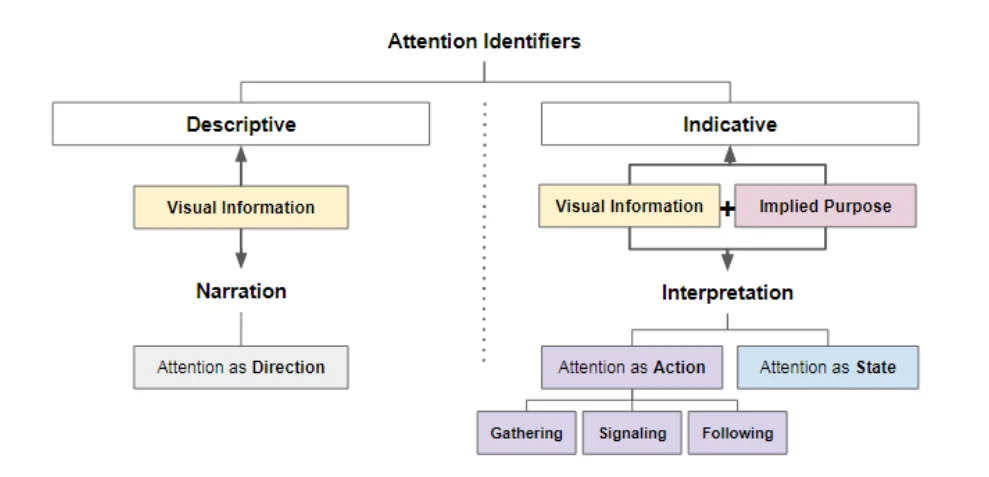
Seeing where versus seeing why. When fifteen people narrated silent videos of real meetings, they sometimes just reported where someone was looking and sometimes interpreted what the look was for, such as listening or addressing someone. This separates the direction of attention from purposeful attention and from general engagement. #
“It was both the captured motion and then the meaning of the motion that I was interpreting.”
Visible action reads as engagement. In debrief interviews, narrators suggested that being able to act visibly, by speaking, looking at others or contributing, feeds a person's sense of engagement, and that people who visibly do nothing get overlooked. #
“If someone doesn't say anything, doesn't do anything, you can just forget them.”
Gaze alone is not enough. Gaze direction is the easiest kind of attention to detect automatically. But interviewees said that on video it does not tell them what someone is attending to, so we do not treat it as a functional type of attention on its own. #
“because camera is over here and they are looking at the screen, so I can't tell whether they are actually looking at me or at something completely different.”
Questions this paper answers
- What does it mean to pay attention in a meeting?
- It involves three things that are easily confused. Attention as direction is where you are looking. Attention as action is looking with a purpose (checking reactions, addressing someone or following the whiteboard). Attention as state is a general sense of being mentally present. Each calls for different support. (See §Indicative Attention Identifiers, p. 6; §Inter-dependency of Functional Types of Attention, p. 7.)
- Is tracking where people look enough to support attention in video calls?
- Not on its own. Gaze direction is the simplest kind of attention to support technically. But without context it does not show what someone is attending to or why, because a person facing the screen may be reading an email. (See §Indicative Attention Identifiers, p. 6; §Level 1: Contextual Complexity Spectrum, p. 8.)
- Why do quiet remote participants get overlooked?
- Possibly because engagement is judged by what people visibly do. People who visibly do nothing tend to be ignored. Remote participants also feel they have fewer ways to signal attention, such as addressing someone or reacting. (See §Communicative Signaling, p. 5; §Inter-dependency of Functional Types of Attention, p. 7.)
Contributions and implications
- Attention as Action is the most promising starting point for feature development. (§INTRODUCTION, p. 2)
- Each function implies different features. Gathering calls for augmented information streams, signalling for notifying others of one's actions, and following processes for split views and selective contribution.
Supporting the Communicative Signaling function of Attention as Action necessarily requires some form of notification about one's actions delivered to other meeting participants
(§Leveraging the Attention Classification in Design, p. 10) - No single fix suits everyone. Designs should balance personalised attention processes with group attention needs.
Designing a one-size-fits-all solution to 'fixing' attention asymmetries in video meetings is challenging because of the astonishing range of idiosyncratic conditions and personal needs.
(§CONCLUSION, p. 10)
Limitations
- Because the narration videos were silent, the theme of following one of several conversations could not be observed in the second study. (§Following Dynamic Processes, p. 7)
›Concepts
- Attention as Direction
- Where someone is looking or facing, observed without any recognised purpose (e.g. Alice is looking at Bob).
purely observable attention that constitutes a process, but not a recognized purpose
(§INTRODUCTION, p. 2) - Attention as Action
- Attention with a direction, a target and a recognisable purpose (e.g. Alice is addressing Bob).
which reflects attention processes with a recognized specific purpose
(§INTRODUCTION, p. 2) - Attention as State
- The third and most contextually complex type (e.g. Alice is attentive):
the overall sense of engagement, which reflects only purpose, but no particular process
(§INTRODUCTION, p. 2) - Functions of Attention as Action
- The three purposes attention actions serve in meetings.
Gathering Information ('look to see'), Communicative Signaling ('look to be seen'), and Following Dynamic Processes ('look to be a part of a process')
(§INTRODUCTION, p. 2)
Figures
How to cite
Anastasia Kuzminykh and Sean Rintel. 2020. Classification of Functional Attention in Video Meetings. CHI 2020. https://doi.org/10.1145/3313831.3376546
This brief was prepared with AI assistance and published by Sean Rintel. It is not the authors' published text. Page numbers refer to this PDF.