Research brief
Takeaway: Asymmetric hybrid meeting design can give remote attendees heightened agency. A screen-and-camera seat at the table plus a 3D replica of the room to look around, not fixed 2D views, raised their reported awareness, agency and presence. That is because they could follow the room as one continuous perspective.
Why this matters
- What was known
- The usual hybrid meeting puts all remote participants in one grid on a single room display. This ignores the spatial relationships people in the room rely on and leaves remote participants unable to move around the space.
This setup places remote participants at a disadvantage by not accommodating the spatial relationships that in-room attendees can leverage.
(§1, p. 2) - What this paper adds
- Two remote interfaces for the Hybridge system, a 2D map-and-canvas view and a 3D digital twin of the meeting room with a pannable camera, compared within subjects to decide which to take forward.
Having the ability to manipulate one's view of the meeting room and a representation of the 3D space significantly enhanced perceived ease of awareness, sense of agency, and physical presence.
(§7, p. 6) - Who it matters to
- Designers of hybrid meeting systems, and organisations that want better hybrid meetings without purpose-built rooms or large infrastructure costs.
it may represent a more costeffective way forward for organizations that want to elevate their hybrid meetings without committing to significant infrastructural cost and effort
(§6, p. 6)
Research question
- Which of two remote interfaces for Hybridge, a 2D canvas (Hybridge2D) or a 3D digital twin of the room (Hybridge3D), affords remote users greater agency, ease of awareness and physical presence?
Method and data
- Design
- Within-subjects comparison of Hybridge2D and Hybridge3D, counterbalanced with a basic Latin square.
- Prototype
- Hybridge, an experimental hybrid meeting system built from commodity hardware in the room and software-only remote endpoints. In the room, each remote participant appears on their own 27" display, with a camera and speakers, placed among the chairs around the table (a digital seat). Remote users pick an empty seat on a minimap and see the room through that seat's camera. In Hybridge2D they can also open a second 'peek' view from another seat, and changing seat jumps straight to the new view. In Hybridge3D they first see a 3D replica of the room with a freely movable camera, choose a seat by clicking it, glide smoothly into the seated view, and can then pan left and right. A cone on the minimap shows where they are looking. The two interfaces were compared with each other.
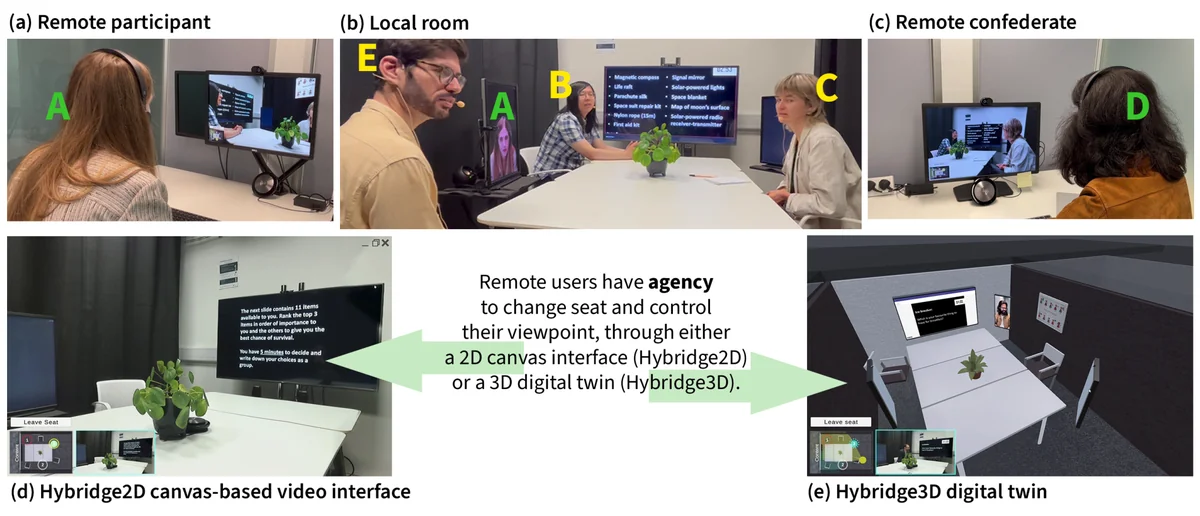
Figure 1: A hybrid meeting using Hybridge. (a, c) show remote users A (study participant) and D (confederate), who may view a Hybridge room from any digital seat. (b) shows the local Hybridge room, with remote users A and D distributed in-room (D is outside camera view). (d) shows the Hybridge2D interface, showing a webcam view from a digital seat. (e) shows the "room view" in Hybridge3D, a digital twin with 3D room representation. From the paper, Figure 1, p. 1. - Setting
- Each session was a meeting of four: one remote study participant and three confederates (two in the room, one remote). After an ice-breaker, groups did survival tasks, choosing 3 items from a list of 11 within five minutes.
- Participants / data
- 24 participants (16 male, 8 female): students and staff from university mailing lists (n = 10) and industry professionals in research and computing (n = 14). Results are based on 23 participants after one session was excluded for technical issues.
- Duration
- Each session lasted around 60 minutes.
- Analysis
- Survey summary scores for agency, ease of awareness and physical presence (adapted SUS questionnaire) analysed with aligned rank transform (ART) repeated-measures ANOVA. Semi-structured interviews on preferences.
Findings
Most preferred 3D. After trying both interfaces in a meeting, 20 of 23 remote participants (87%) said they would rather use the 3D room replica than the 2D seat view in future meetings. #
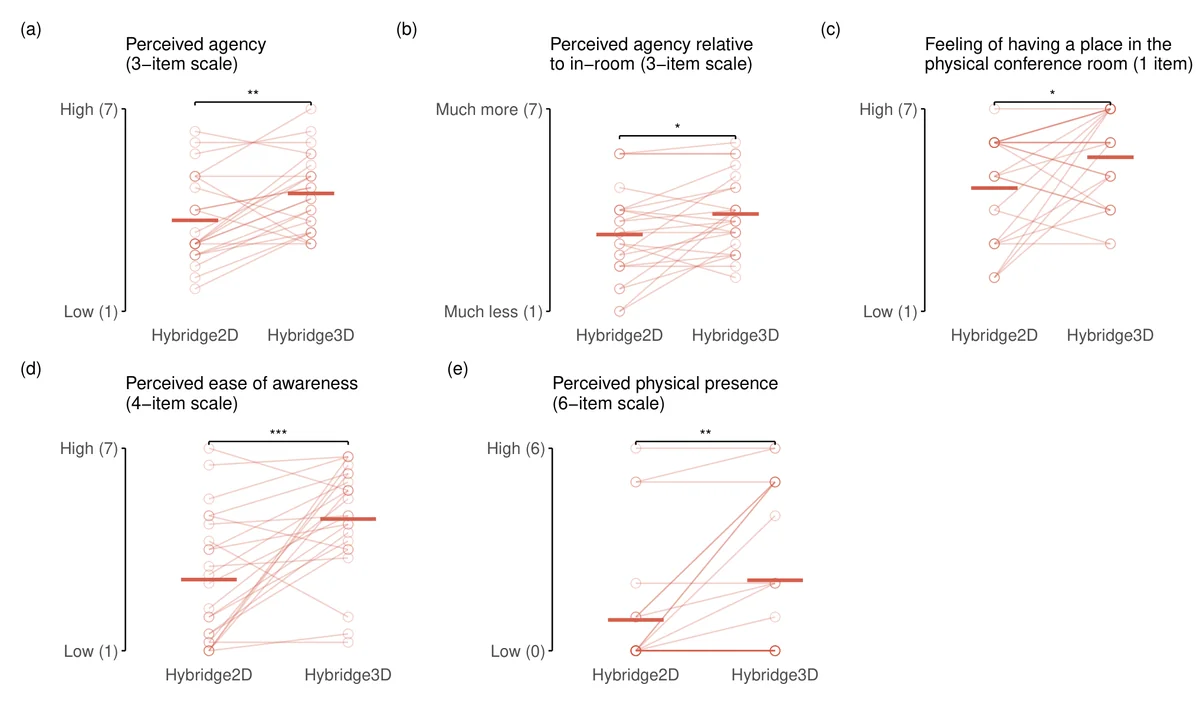
(§5, p. 3)More control, and a place in the room. Remote participants felt more in control of their view and position with the 3D interface, both overall and relative to the people in the room. They also felt more that they had a place in the room. Some still felt limited by the layout of the physical room: #
“This included having the "ability to avoid occlusions" (P15) and control "how close [others appeared]" (P8).”
Panning felt natural. Panning the camera from a seat in the 3D interface felt natural and less effortful to remote participants, whereas the 2D interface's second view from another seat had the opposite effect. #
“H2D's function of peeking from different viewpoints felt "abrupt" (P3) and therefore "distracted" (P19) people from the flow of the meeting”
Easier to follow, not yet easy. Remote participants found it easier to keep track of who and what was where with the 3D interface. However, some still could not follow everyone at once, and without spatial audio it was hard to tell who was speaking. #
“participants (n = 11) still noted frustration over not being able to always follow the meeting, being required to "swerve my view back and forth" (P24) and having difficulties "seeing everyone at the same time" (P12)”
More present in the room. Remote participants felt more physically present in the meeting room with the 3D interface. Six said even the 2D interface felt more present than their usual video meetings. #
“the ability to pan around the room was considered key to increasing the sense of presence and feeling "really there" (P4)”
Watching without being seen. People in the room could not tell when a remote participant was looking around from their seat, and one remote participant found this freedom to watch unseen intimidating. #
“One participant likened a remote attendee to being "a ghost in the room" (P8), having the freedom to observe from different angles without being seen”
Questions this paper answers
- Does letting remote participants control their own view help in hybrid meetings?
- Yes. Remote attendees usually depend on people in the room to adjust what they see, which can make them feel they participate less. In a preliminary comparison, a 3D replica of the room they could look around gave them more control, easier awareness and more presence than fixed seat views. (See §5, p. 3; §5.1, p. 5; §5.2, p. 5; §5.3, p. 5.)
- Is a view you can steer better than several fixed camera views?
- Yes, in a preliminary comparison. A single view that remote attendees could pan felt like looking around a real room and took less mental effort. Jumping to another seat's camera, even to see more, felt abrupt and pulled attention away from the conversation. (See §5.1, p. 4.)
- What still makes hybrid meetings hard for remote participants?
- Following everyone at once. Even with a 3D view, some remote attendees had to swing their view back and forth to keep up. Without spatial audio it was hard to tell who was speaking, so they spent effort watching mouths or recognising voices. (See §5.2, p. 5.)
- Does giving remote attendees more freedom create problems for people in the room?
- It can. Freedom to look around is invisible to the room, because people in the room could not tell where a remote attendee was looking as they panned. One remote attendee found watching unseen intimidating, 'a little bit like a ghost in the room'. (See §5.2, p. 5.)
Quantitative results
| Measure | Result | Where |
|---|---|---|
| Preferred Hybridge3D over Hybridge2D for future meetings | Twenty out of 23 (87%) | §5, p. 3 |
| Sense of agency, 3D vs 2D | F1,22 = 10.62, p = 0.004 | §5.1, p. 4 |
| Sense of agency relative to local participants, 3D vs 2D | F1,22 = 6.47, p = 0.02 | §5.1, p. 4 |
| Feeling of having a place in the room, 3D vs 2D | F1,22 = 5.6, p = 0.03 | §5.1, p. 4 |
| Ease of awareness, 3D vs 2D | F1,22 = 16.08, p = 0.001 | §5.2, p. 5 |
| Physical presence, 3D vs 2D | F1,22 = 9.84, p = 0.005 | §5.3, p. 5 |
Contributions and implications
- When a remote participant panned their view, their display in the room did not turn, so people in the room could not tell where they were looking. Displays that physically turn, or software cues such as arrows or a video that turns to match their gaze, could close this gap.
their in-room displays did not match this with physical left or right turning, creating an information asymmetry between in-room and remote participants
(§6, p. 5) - Spatial audio could improve speaker identification.
- The minimap should show who sits where, for example with profile pictures or initials, because numbered seats did not always keep remote users aware of who was where.
this feature did not always succeed at sustaining remote user awareness of where they and other users were, and who was sitting in any given seat
(§6, p. 5) - A second 'peek' view may add too much cognitive load and could be removed.
it might be adding too much cognitive load for participants to enable more than one view, even if one is intended to be only temporary
(§6, p. 5) - Asymmetry can lower cost. Unlike telepresence systems that need matching purpose-built rooms at every endpoint, Hybridge gives each endpoint different equipment, so it may be a more cost-effective route for organisations.
Hybridge can be created entirely from commodity hardware at the in-room end, and is an asymmetrical system in which remote endpoints see a software-only representation that can function entirely on a commodity desktop or laptop
(§6, p. 6)
Limitations
- This was a preliminary investigation to choose a remote interface. A more in-depth study comparing other meeting modalities and both remote and in-room endpoints is planned.
The purpose of this preliminary investigation was to determine the ideal remote interface features for our second design principle
(§6, p. 5) - The value of Hybridge depends on the type and scale of the meeting and the attendee's role, and it needs planning to set up.
Factors such as the type/scale of the meeting, and an attendee's role in a meeting will have an impact on the value of Hybridge.
(§6, p. 6)
›Concepts
- Inclusion
- How this paper uses the term:
Inclusion here refers to the equity of potential participation in a meeting.
(§1, p. 2) - Digital seats
- Display, camera and speaker units placed around the meeting-room table:
These "digital seats" can be occupied by a single remote participant, who can be seen and heard as if they were sitting at the table.
(p. 3) - Heightened agency
- Our second design principle, aimed at levelling the playing field with the people in the room:
remote users should have heightened agency to choose their viewpoint and where they appear in the room
(§2, p. 2) - Digital twin
- What remote users see in Hybridge3D:
Remote users participate through a digital twin of the meeting room, which blends remote and in-room participants through camera and virtual representations.
(p. 3)
Figures
How to cite
Becky Spittle, Payod Panda, Lev Tankelevitch, Kori Inkpen, John Tang, Sasa Junuzovic, Qianqian Qi, Pat Sweeney, Andrew D. Wilson, Bill Buxton, Abigail Sellen, and Sean Rintel. 2024. Comparing the Agency of Hybrid Meeting Remote Users in 2D and 3D Interfaces of the Hybridge System. CHI EA 2024. https://doi.org/10.1145/3613905.3651103
This brief was prepared with AI assistance and published by Sean Rintel. It is not the authors' published text. Page numbers refer to this PDF.