Research brief
Takeaway: Online memes rely on templatability. Crisis memes refill familiar templates to comment on power, disasters and online commentary itself alongside the news, giving people a public voice outside traditional media that restrictive copyright may threaten.
Why this matters
- What was known
- Earlier work by Knobel and Lankshear analysed classic online memes thematically and found social commentary to be one of their overarching purposes, in three subcategories:
people concerned with displays of good citizenship; tongue-in-cheek, socially oriented, political critique; and social activism or advocacy
(§Introduction, p. 2) - What this paper adds
- A structural rather than thematic analysis of image macro crisis memes, showing how templatability underpins their forms, deployment, purposes and value.
the value of crisis memes lies not in their content but rather their place as a public voice that sidesteps the constraints of traditional media
(Abstract, p. 1) - Who it matters to
- Internet users, legislators and other stakeholders in copyright, and researchers of Internet culture and civil society.
legislators need to better understand how the demands of restrictive copyright might be at odds with the Internet's technical infrastructure and Internet cultural practices
(§The value of crisis memes, p. 16)
Research question
- How is templatability relevant to the underpinnings, development, structure and value of crisis memes?
Method and data
- Design
- Interpretive, structural analysis of image macro crisis memes, set against ideas of meaning as movement, memes (Dawkins) and the networked public.
- Setting
- Memes found on social media and on meme collection and generation sites (for example Know Your Meme, Reddit, 4Chan, Meme Generator). They concern crises including the UK riots, the death of Osama Bin Laden, the US debt crisis, Queensland floods and the Norwegian terrorist killings.
- Participants / data
- Illustrative examples from several meme families: The Most Interesting Man in the World, Advice Animals, exploitables (Strutting Leo, Disaster Girl, Chubby Bubbles Girl), Rage Comics (Y U No) and meme combinations (Scumbag Steve, Scumbag Brain).
- Analysis
- Analysis of each meme family's templatable forms, situational deployment and purposes, followed by an argument about the value of crisis memes.
Findings
Built from ready-made templates. Tracing the history of online memes, the article shows that crisis memes are not made from scratch. They reuse templates developed in the early 2000s. These are image macros (pictures with superimposed text, named after forum software that expanded typed text into a pre-defined image) combined with snowclones (verbal templates such as 'X is the new Y'). #
“In other words, a commonly understood practice in computer science involves exploiting pre-fabricated structures. It is not surprising, then, that such understandings were imported into Internet culture.”
Formulas for ridiculing power. Image macro snowclones such as The Most Interesting Man in the World, and Advice Animals (a character's head on a colour-wheel background, with text), are used to comment on power. After the 2011 UK riots, a photo of a looter with a bag of rice was captioned in the first meme's formula. Advice Animals let a political position be deployed fast and reused in the next crisis. #
“I don't always loot/but when I do, its cuz I need some basmati rice”
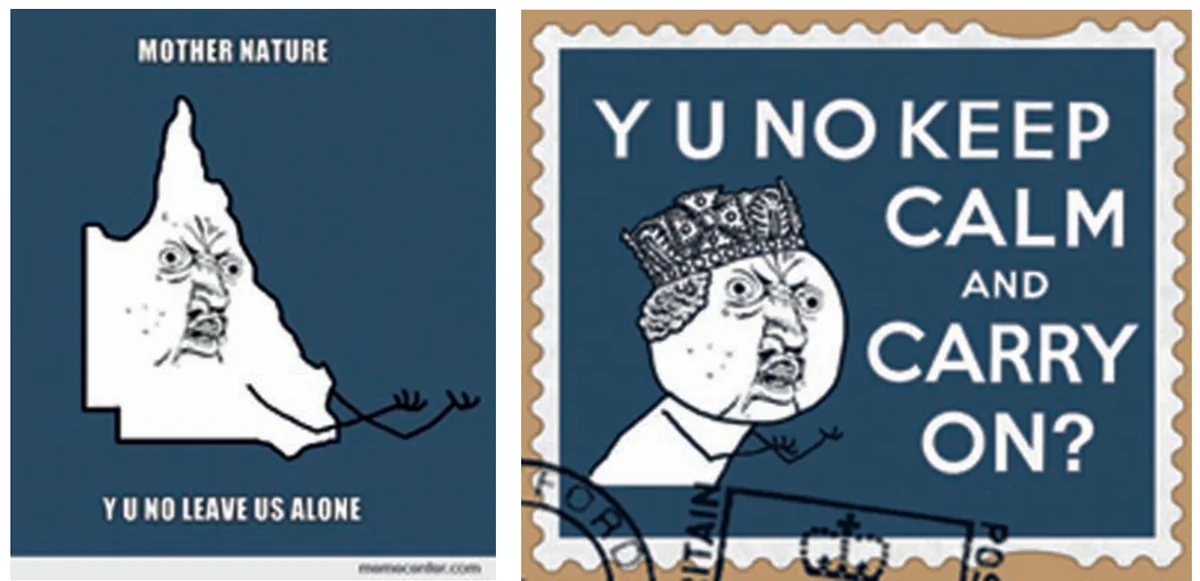
Ghoulish jokes arrive first. Exploitables (cut-out figures such as Disaster Girl pasted onto news photos) seem to circulate simply as ghoulish humour. Disaster Girl and Chubby Bubbles Girl are among the first memes to appear in a crisis because no text needs writing. Rage Comics such as Y U No instead express the anxiety of living through a disaster. Only the figure's face and arms must stay, so the rest adapts freely. #
“Thus for the Queensland example, the round head of the figure is replaced by a map of the state.”
Memes that mock meme culture. Memes are combined with one another, sometimes to comment on online comment culture itself. When the Norwegian terrorist killings coincided with Amy Winehouse's death, a Scumbag Brain meme (used for owning up to one's own bad behaviour) pointed out that far more online commentary went to the singer. #
“significantly more sorrow was being expressed for the natural or suicidal death of a single person versus the 76 shot by Anders Breivik”
Each meme is the next in a series. For people who know the originals, each crisis meme is read as another, and possibly the next, instance in a series. Crisis memes draw power from being timely, timeless and serial at once. #
“These features are especially relevant to crisis memes, which are produced and consumed in the heat of an emergent social crisis, which is new but also another instance of a crisis that has been experienced before.”
Ghoulish, but still civil society. However frivolous and ghoulish, crisis memes are argued to be a form of civil society and free expression, one that often relies on unlicensed use of copyrighted images. #
“crisis memes are nevertheless an important manifestation of civil society because they show people to be interested in taking an evaluative public position”
Questions this paper answers
- Why do jokey memes appear so quickly after disasters and crises?
- Because most are not made from scratch. Templatability (separating a meme's structure from its content) lets people fit new events into well-known image and text templates. Meme generator sites supply the artwork and tools, so new versions can be made almost immediately. (See §Online memes, templatability and the prehistory of crisis memes, p. 5; §Introduction, p. 2; §Commenting on disaster: Exploitables and Rage Comics, p. 11.)
- Are memes about tragedies just tasteless jokes?
- They can be frivolous and ghoulish, but the article argues they still matter. They show people taking an evaluative public position, in a voice that sidesteps traditional media. (See §Commenting on disaster: Exploitables and Rage Comics, p. 11; §The value of crisis memes, p. 14.)
- What do memes have to do with copyright and free speech?
- Crisis memes often reuse copyrighted images without a licence. Increasingly strict copyright regimes such as the DMCA, the proposed SOPA/PIPA bills and the Trans-Pacific Partnership could therefore restrict this form of freedom of expression. (See §The value of crisis memes, p. 14.)
- Do memes deepen cultural divides?
- The article argues this critique is poorly focused, because almost any communication technology tracks affluence, and in-groups have always bonded through restricted codes. Crisis memes do mean more to Internet insiders, but they may also show how Internet culture crosses national, class and other boundaries. (See §The value of crisis memes, p. 14.)
Contributions and implications
- Internet users should lobby for more positive individual fair use and sharing rights to protect this kind of expression.
Internet users should be lobbying for more positive individual fair use and sharing rights
(§The value of crisis memes, p. 16) - All stakeholders, including Internet users and legislators, need to be better educated about the relationship between copyright, technology and Internet culture.
- Future research should ask what place crisis memes have in twenty-first-century civil society, rather than judging them against reasoned discourse.
The question for future research, then, is not whether crisis memes should be judged as responses against idealized reasoned discourse, but what their place is in twenty-first-century civil society.
(§The value of crisis memes, p. 14) - Crisis memes could be used to study how templatable objects reify their origins, and how Internet culture crosses national, class and other boundaries.
Limitations
- The analysis focuses only on image macro crisis memes, not other forms such as videos, animated gifs or hashtags.
- No US left-wing Advice Animals relating to news crises were found, and non-English versions may make the picture more varied than English-language examples suggest.
- The flows of meme generation and distribution keep changing, so charting them remains an open empirical question.
charting these flows will remain an ongoing empirical issue
(§Commenting on commenting: Meme combinations, p. 13)
›Concepts
- Crisis memes
- Ghoulish and satirical image macro posts that spread through social media alongside serious reporting of crises.
Image macro crisis memes are folk productions produced as responses to challenging events based on thematic and structural templates of popular image macros.
(§The value of crisis memes, p. 14) - Templatability
- The paper's central idea, rooted in a basic human capability:
The memetic process is a product of the human capability to separate ideas into two levels - content and structure - and then contextually manipulate that relationship.
(§Online memes, templatability and the prehistory of crisis memes, p. 4) - Image macro
- One of the earliest forms of online meme, and the basis of every crisis meme analysed here:
An image macro is a picture with superimposed text (Wikipedia 2011a), conforming to a template for their combination and types of meaning.
(§Online memes, templatability and the prehistory of crisis memes, p. 4) - Snowclone
- A verbal template such as 'X is the new Y', whose slots can be filled to comment on any situation.
- Exploitable
- An image without text that others can add new elements to. The term also has a second sense:
a class of memes that involve superimposing images of a human or anthropomorphic figure onto another image
(§Commenting on disaster: Exploitables and Rage Comics, p. 9)
Figures
How to cite
Sean Rintel. 2013. Crisis Memes: The Importance of Templatability to Internet Culture and Freedom of Expression. Australasian Journal of Popular Culture 2 (2), 253-271. https://doi.org/10.1386/ajpc.2.2.253_1
This brief was prepared with AI assistance and published by Sean Rintel. It is not the authors' published text. Page numbers refer to this PDF.