Research brief
Takeaway: Meeting intentionality spans a series of meetings. People's temporal work (looking back and ahead) links them, yet today's tools cover only a narrow slice of time. So generative AI should carry goals and context between meetings, for example through instant recaps, handoffs to the next meeting and project browsers.
Why this matters
- What was known
- Meeting support tools, including recent Generative AI features, mostly focus on making individual meetings efficient, overlooking how work connects across meetings over time.
Much of current commercial and academic work, however, focuses on understanding how the emergent capabilities of Generative AI may be applied to the context of individual meetings
(§1, p. 2) - What this paper adds
- An analysis of real recurring meetings, a framework of objective and subjective time, a Generative AI Content Sandbox for prompting over many meetings at once, and three interface concepts with open-source prototypes. (§1, p. 2)
- Who it matters to
- Designers and researchers of Generative AI meeting and knowledge-work tools, and researchers in Meeting Science and CSCW.
Instead of features driven largely by what Generative AI" can" do, we offer a pathway for more considered design that is grounded in the reality of temporal work.
(§6.3, p. 17)
Research questions
- How can Generative AI tools support temporal work, and how can a focus on temporality inform the design of better supports for knowledge work?
- Understand how discussions about "subjective time" punctuate the "objective time" of recurring meetings.
- Uncover a map of workplace interactions that expands our understanding of the "objective time" experienced by teams over longer time horizons.
Method and data
- Design
- Exploratory analysis of recorded recurring meetings, followed by framework development and a design and prototyping exercise using a purpose-built research tool (see Prototype).
- Prototype
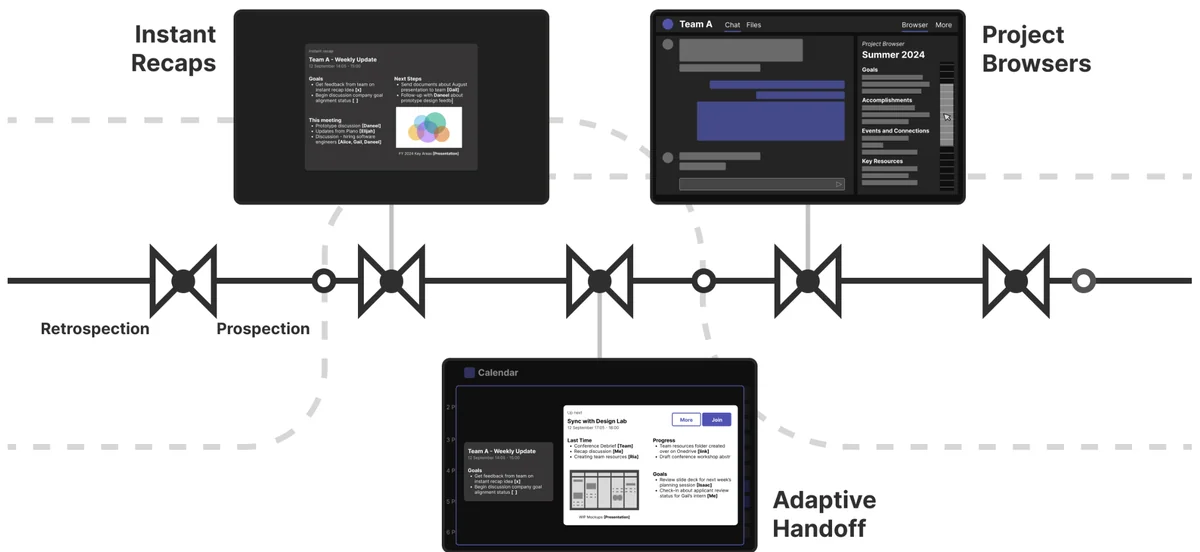
- Two kinds. The Generative AI Content Sandbox is a research tool built with React Flow. It is a web canvas where researchers drag in and connect nodes for meeting transcripts, recordings, slides and prompts. The system sends each combination to GPT-4o and shows the output, which can feed further nodes (for example, to combine summaries of several meetings). A template node produces a structured summary of goals, progress, plans and image highlights, which fills three interactive web prototypes. Instant Recaps: a summary card shown as a meeting ends, which people can tick off and add notes to. Adaptive Meeting Handoff: opened from the calendar's current-time marker, it shows the meeting just finished and the next one, shifting emphasis with the time available. Project Browsers: dragging a scroll handle in a team chat, or selecting a calendar range, sets the span of time to summarise. The prototypes show real model output on public AMI corpus meetings. They were not evaluated with users or compared with other tools.
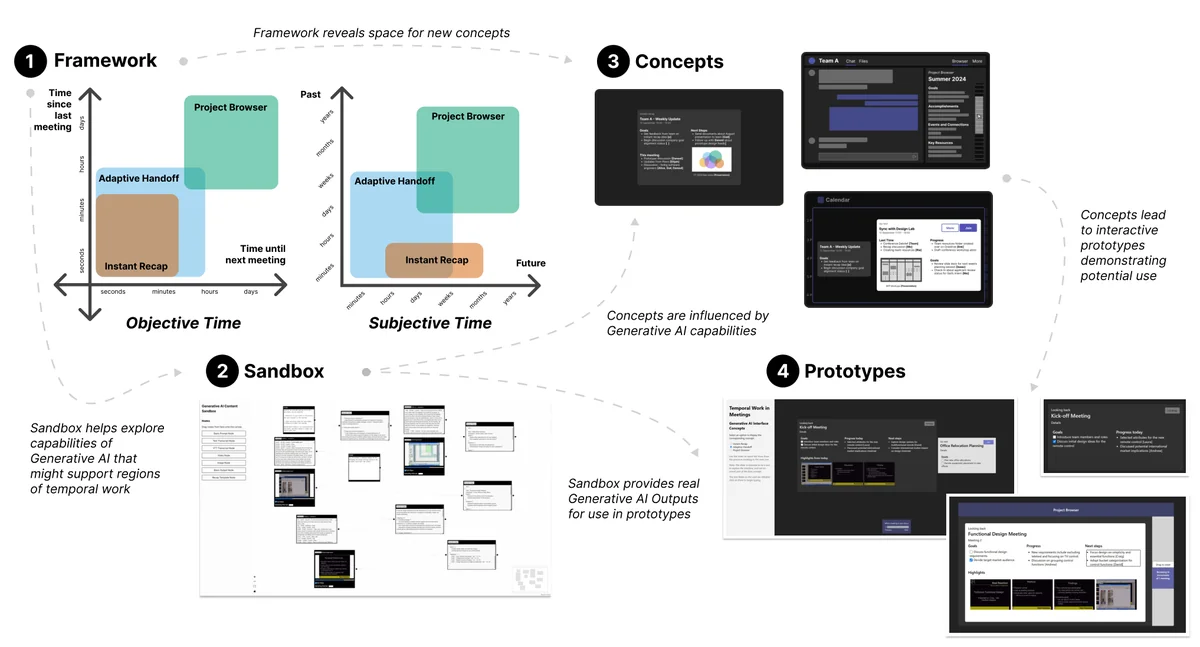
Figure 1: Designing Interfaces grounded in Temporal Work & Generative AI: (1) We can use the framework of temporal work to define regions in the spaces of objective and subjective time that require support for a given context. (2) The Generative AI Content Sandbox enables us to explore and understand how Generative AI might best support such forms of work. (3) Building on the framework and Sandbox, we can design interface concepts for different times and purposes. (4) These concepts can be operationalized as interactive prototypes, with real AI-generated content coming from the Sandbox. From the paper, Figure 1, p. 1. - Setting
- Two research teams (A and B) in a large technology company, in consecutive weekly hybrid meetings over the same four weeks following an internal conference.
- Participants / data
- Eight recorded meetings, each lasting 38 minutes to an hour, 6 hours and 45 minutes in total (Table 1 gives participants per meeting).
- Duration
- Four weeks of meetings.
- Analysis
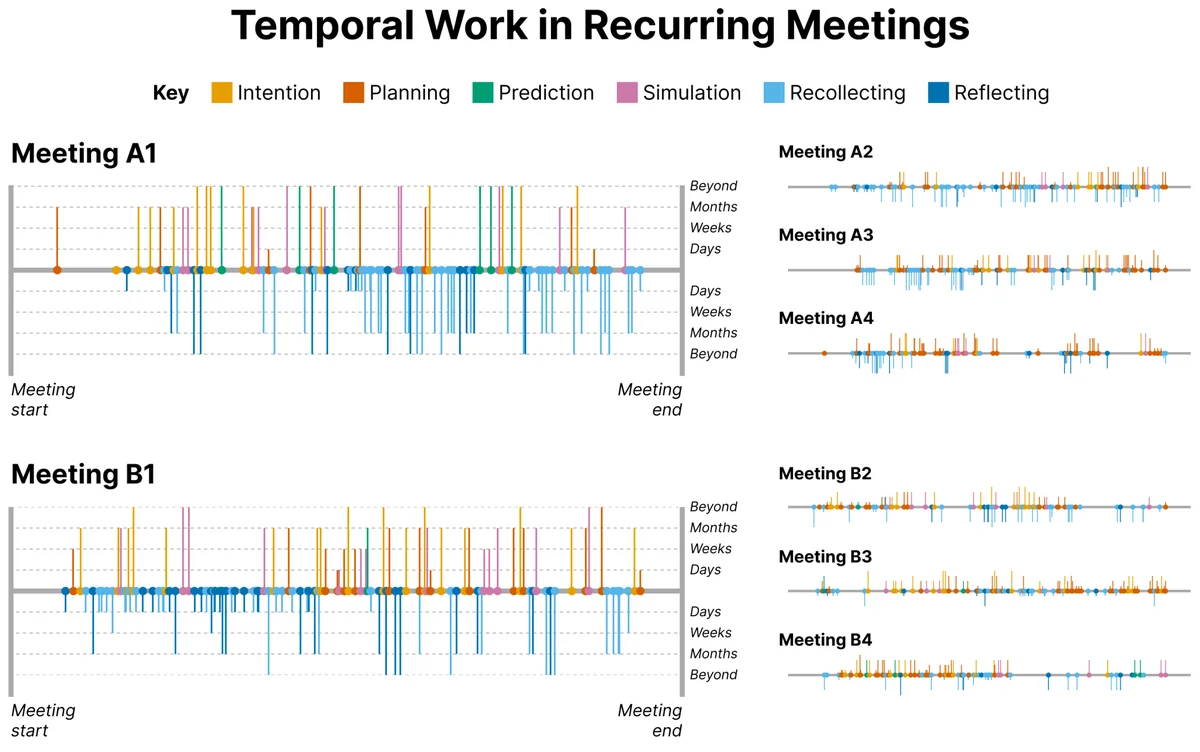
- Researchers watched each recording and tagged every instance of temporal work by form (recollecting, reflecting, intention, planning, prediction, simulation) and time horizon, then mapped links to other meetings, topics and milestones.
Findings
Time talk everywhere. In eight recorded weekly meetings of two research teams in a technology company, people looked back and ahead throughout every meeting, not only in the first one after an internal conference, which invited it. #
“When looking back and ahead, focus shifted across a wide range of timescales in the past and future, from specific points in time (meetings, events) to periods”
Looking back fuels looking ahead. Recalling the past and anticipating the future were intertwined. Team members recalled earlier experiences in order to reflect, set intentions or plan next steps, and used predictions to justify plans. #
(§3.3, p. 6)Meetings are hubs for other work. Each team's weekly meeting linked again and again to other meetings, recurring topics and distant milestones, so recurring meetings were where much of the looking back and ahead was concentrated. #
“These webs of retrospection and prospection are often unnoticed during meetings, and collapse soon after, only to be replaced by new traversals of subjective time.”
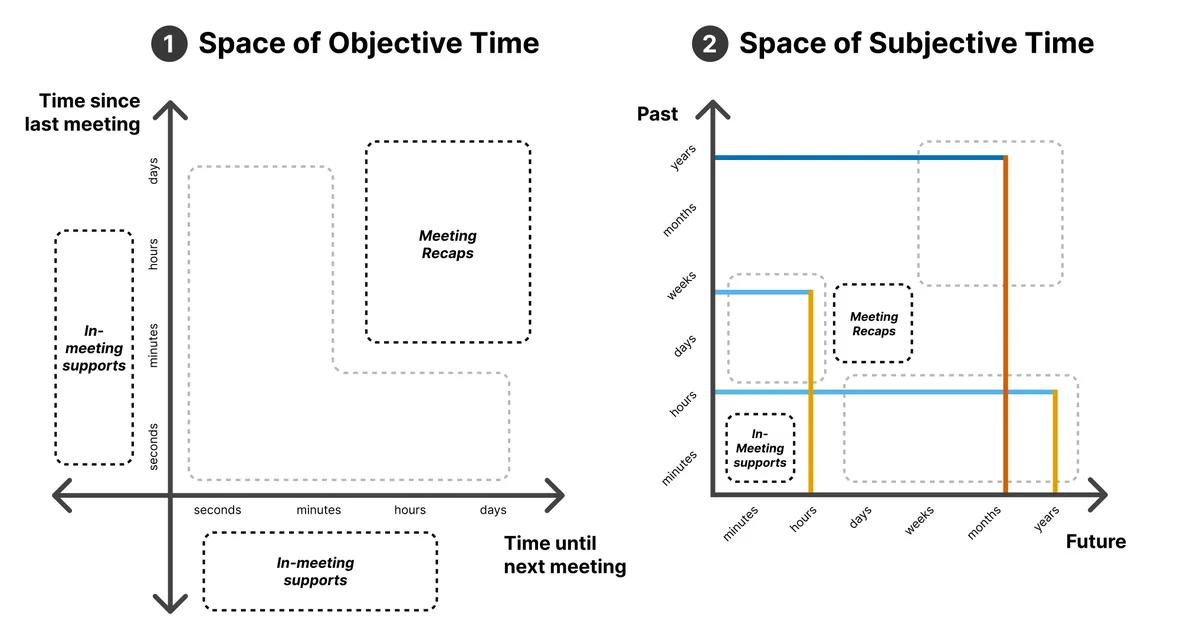
Today's tools cover a narrow slice of time. We placed existing meeting tools on our framework, which plots time since the last meeting against time until the next (objective time), and how far back or ahead people are thinking (subjective time). The tools clustered in small regions, leaving large ones untouched. #
“In the space of subjective time (Figure 6.2), most recap tools occupy the central region, supporting retrospection and prospection within a narrow time range of a few days to weeks.”
Three concepts for the gaps. We designed interfaces for those untouched regions. Instant Recaps are shown the moment a meeting ends, an Adaptive Meeting Handoff sits between one meeting and the next, and Project Browsers support reviewing months to years. #
“Instant Recaps combine the benefits of automation and manual record creation by making the most of the moments right after meetings, when memories are freshest and plans are forming.”
Early signs AI can spot links. In informal, unevaluated trials with simple prompts, GPT-4o run on the teams' meeting records connected many of the links between meetings that our qualitative analysis had found. #
“we have not yet conducted a structured evaluation of the overall quality or accuracy of these outputs”
Questions this paper answers
- How much do teams talk about the past and future in meetings?
- A lot, and not only when reviewing. This temporal work (looking back and looking ahead) ran through every recurring meeting examined, reaching from the same day to months and beyond. Recalling the past usually served reflecting, setting intentions or planning. (See §3.3, p. 6; §3.3, p. 6.)
- Why aren't meeting summaries enough?
- Because a summary sits at one point in time, while meeting intentionality (knowing why you meet) stretches across a series of meetings. Most recap tools look back and ahead only days to weeks. The threads woven in meetings tend to collapse soon after unless something carries them forward. (See §4, p. 7; §4, p. 9.)
- When is the best moment to reflect on a meeting?
- We argue it is right after it ends, when memories are freshest and plans are forming (a moment design usually writes off). It is also often the most time-pressured moment. So support there must be light, such as a short card people can tick and add notes to. (See §5.2, p. 12.)
- Can generative AI find the links between a team's meetings by itself?
- Early signs are promising. When run with simple prompts on two teams' recorded meetings, a large language model connected many of the links between meetings that human qualitative analysis had found. We have not yet evaluated the quality or accuracy of its output. (See §6.3, p. 17.)
Contributions and implications
- Meeting support tools should be chained so recaps, handoffs and project views carry reflection and intentions across meetings and projects.
This creates a chain of reflection and setting intentions that persists along a project.
(§6.1, p. 14) - The framework and Sandbox are tools for thought for researchers designing Generative AI support for temporal work, rather than a generative design space.
we see the framework as a useful encapsulation of the richness of temporal work in the modern workplace
(§6.3, p. 16) - The framework could also guide collaborative tools that support group reflection and collective intentionality.
Limitations
- Engineering and design research meetings in one company, in a similar timeframe and after a major internal event.
limits the generalizability of our findings to other types of knowledge work or organizational settings
(§6.3, p. 16) - Only four weeks of meetings.
Our analysis spans a relatively short period of four weeks.
(§6.3, p. 16) - Individual identities and contributions within meetings were not analysed, and the concepts focus on individual rather than collaborative use.
- Generative AI outputs were not formally evaluated, and verification, accuracy, bias and privacy remain challenges.
we have not yet conducted a structured evaluation of the overall quality or accuracy of these outputs
(§6.3, p. 17)
›Concepts
- Temporal work
- Looking back (retrospection) and ahead (prospection) to make sense of and act in the present, individually and as a team.
Temporal work involves the acts of prospection (future-oriented cognition) and retrospection (past-oriented cognition).
(§1, p. 2) - Objective and subjective time
- Shipp and Jansen's distinction, which gives our framework its two axes:
"objective" time (the actual passage of time based on the clock and calendar) and "subjective" time (experiencing the past, present, and future within the current moment)
(§2.2, p. 4) - Prospection and retrospection forms
- Four forms of looking ahead (intention, planning, prediction, simulation) and two of looking back (recollecting, reflecting), taken from prior taxonomies and used to tag the meetings.
We therefore use Recollecting to refer to thinking about the past as it happened, and Reflecting to refer to the past being reframed in the present.
(§3.2, p. 5) - Chain of intentionality
- Linked interfaces that carry reflection and intentions from one meeting to the next and across projects.
their true potential emerges when they are integrated to chain together, supporting temporal work across different timescales and contexts
(§6.1, p. 14)
Figures
How to cite
Rishi Vanukuru, Payod Panda, Xinyue Chen, Ava Elizabeth Scott, Lev Tankelevitch, and Sean Rintel. 2025. Designing Interfaces that Support Temporal Work Across Meetings with Generative AI. DIS2025. https://doi.org/10.1145/3715336.3735833
This brief was prepared with AI assistance and published by Sean Rintel. It is not the authors' published text. Page numbers refer to this PDF.