Research brief
Takeaway: Ecological validity changes avatar verdicts. Viewers watching a realistic conversation seemed to forgive more facial animation glitches than when judging isolated clips. But in conversation their judgements were swayed by context, culture and character, such as empathy and gender bias.
Why this matters
- What was known
- Research on how animation noise affects avatars is sparse, tends to focus on one's own avatar, is often low in ecological validity, and gives no direct evidence on acceptable noise thresholds.
Parameters assumed to be universal, such as animation noise thresholds, seem to change from study to study, reducing comparability, repeatability, and extrapolation of work
(§1, p. 1) - What this paper adds
- Instead of a single study, we pair a classic threshold-tuning experiment with a realistic conversation-watching one, and derive recommendations for when each kind of test can be trusted.
Running high and low ecologically valid conditions on the same cohort, on the same device, with the same assets, brings to light how experimental design impacts the results of a parameter evaluation.
(§5, p. 5) - Who it matters to
- Researchers and developers of avatars for communication systems who need to set technical requirements and evaluate avatar acceptance.
the level of ecological validity changes the usefulness of these results for researchers and developers of avatars
(§5, p. 6)
Research questions
- Which type of facial animation noise has the greatest impact on avatar acceptance?
- What is the threshold at which facial animation noise negatively impacts communication experience?
- How does ecological validity affect this threshold?
Method and data
- Design
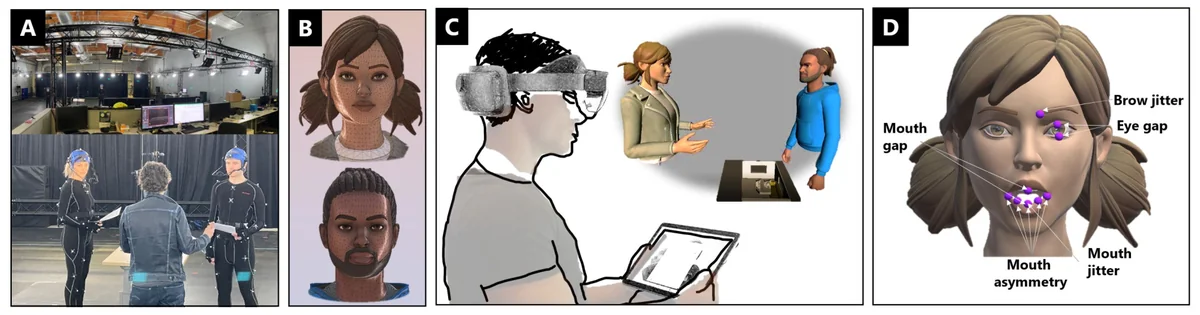
- Two within-subjects experiments in augmented reality on a HoloLens2. Experiment 1 (low ecological validity): participants used sliders to set acceptable noise levels on 20-second clips, for each noise type in isolation and then in combination, and chose noises to remove. Experiment 2 (high ecological validity): participants watched full conversations and pressed thumbs-up or thumbs-down for appropriate or inappropriate facial expressions while noise was introduced at 4 levels without their knowledge.
- Setting
- Motion-captured professional actors animated two stylized cartoon avatars in an architect and client house remodelling conversation. 4 versions varied the gender of the architect and whether the conversation ended in agreement or disagreement.
- Participants / data
- N=56 participants recruited in Washington, USA by a research recruitment firm.
- Analysis
- Cumulative acceptability thresholds (90% of participants), counts of noise priorities, response rates analysed with ANOVA, and comparison of top and bottom 25% scorers on the Toronto Empathy questionnaire.
Findings
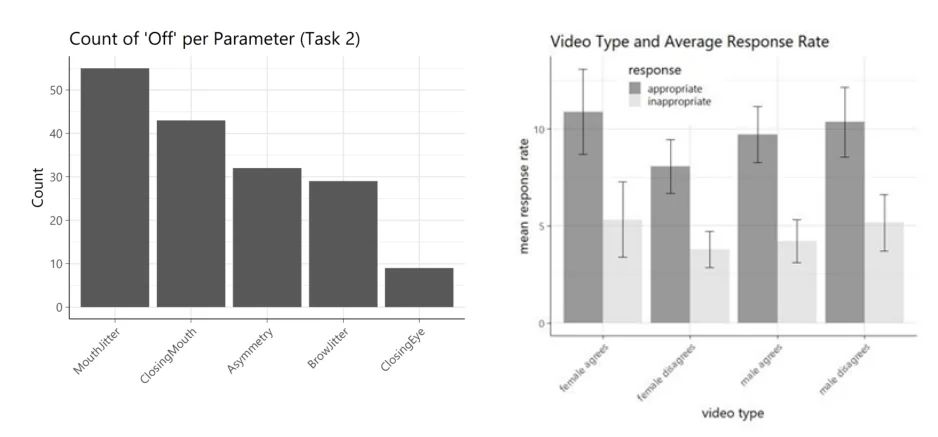
Jittering lips matter most. Cartoon avatars viewed in augmented reality were given several glitches (jittering lips or brows, eyes or a mouth that would not fully close, a lopsided mouth, and low frame rates). Shaky lip movement hurt acceptability most, whether participants tuned noise on short clips or watched a full conversation. #
“Almost all participants removed mouth jitter, with the mouth-closing parameter gathering the second-highest number of responses.”
Context raised tolerance. When participants watched a full architect and client conversation and flagged inappropriate expressions, they tolerated much more noise than when they set acceptable noise levels themselves on short clips. In the clip task, tolerance dropped further when all the noise types were combined. #
“we cannot rule out that the ordering effects could have predisposed study participants to lower their thresholds”
A modest frame rate was enough. Animating the faces at 15 frames per second was generally treated as good enough, both on isolated clips and in the full conversation. #
(§4.2, p. 4)Empathy mattered only in context. In the realistic conversation, participants who scored lower on an empathy questionnaire flagged more inappropriate expressions when the lips jittered, and higher-empathy participants flagged more appropriate ones. Empathy made no significant difference to the thresholds people set on isolated clips. #
“when perceiving social situations, individuals with lower empathy show greater focus on mouths, bodies, and objects”
Possible gender bias. Responses also varied with the gender of the two characters and whether the conversation ended in agreement, which suggests that social biases, possibly against women in professional roles, entered judgements of the avatars' faces. #
“When the architect presented as female, her agreement received the highest number of 'appropriate' responses; but when she disagreed, it received the lowest number of 'appropriate' responses.”
Questions this paper answers
- Which avatar facial glitch bothers people most?
- Jittering lips. When people tuned glitches on cartoon avatars in augmented reality, almost all included mouth jitter among the three glitches they chose to remove. It also hurt acceptability most, whether people tuned noise on clips or watched a full conversation. (See §4.1.1, p. 4.)
- Does the way you test avatars change the results?
- Yes. Short isolated clips make people stricter about glitches than a realistic conversation does, while a realistic conversation lets personality and social attitudes, such as empathy and gender, shape judgements. Thresholds from one kind of test should not be assumed to hold in the other. (See §4.1, p. 4; §5, p. 6; §5, p. 6.)
- What frame rate is good enough for avatar faces in augmented reality?
- Animating avatar faces at 15 frames per second was generally treated as good enough in augmented reality. That held in 87.5% of people's responses when judging isolated clips, and 90% when watching a full conversation. (See §4.2, p. 4.)
- Do avatar glitches bother people while they follow a conversation?
- Less than when they are tuning noise directly. When people were focused on a social task and not told about the noise, they judged most expressions appropriate. They seemed to tolerate much more noise than when tuning it, although more noise still meant a worse experience. (See §4.1, p. 4.)
Quantitative results
| Measure | Result | Where |
|---|---|---|
| Participants | N=56 | §3.3, p. 2 |
| Response rate, 'appropriate' vs 'inappropriate' facial expressions (high ecological validity) | F(1) = 86.7 , p < 0.0001 | §4.2, p. 4 |
| Response rate by video condition (gender of characters and outcome) | F(3)=3, p=0.03 | §4.2.1, p. 4 |
| Frame rate treated as good enough | 15 fps: 87.5% of responses (isolation), 90% (social context) | §4.2, p. 4 |
| Lower empathy and 'inappropriate' responses with mouth jitter | p < 0.05 | §4.3, p. 5 |
Contributions and implications
- Use cheaper, less ecologically valid experiments to find key trends, but not to set technical requirements or standards.
avoid using these experiments to establish technical requirements, set standards, or draw general conclusions on user sensibility
(§5, p. 6) - Use more ecologically valid experiments to validate strong hypotheses, understand experience factors and, if necessary, set technical requirements.
- High-validity experiments should consider the Triple-C factors of Context, Culture and Character to get balanced, generalizable and replicable results that reduce the effects of bias.
Limitations
- A fixed recruitment budget limited the number of participants, and limited attention constrained both experiments.
- Participants only observed the conversation rather than taking part in it.
- No gender measure was included in the low-validity experiment, and no zero-noise baseline was collected, because zero noise is not achievable in practice.
A limitation particular to the noise study was that we did not collect 0% animation noise baseline results.
(§6, p. 6)
›Concepts
- Ecological validity
- Our definition, which also says why it matters:
ecological validity, which is the extent to which an experiment reproduces the situation and environment in which the technology will be used, and hence the extent to which the research findings generalize
(§1, p. 1) - Facial animation noise
- The degradations we tested:
We explore different types and levels of degradation, including lip and brow jitter, full closure of the eyes and mouth, facial asymmetries, and drops in frame rate.
(§1, p. 1) - Triple-C factors
- Context, Culture and Character: three broad ecological factors to take into account when evaluating avatars.
high validity experimentation requires considering how the Triple-C factors matter to achieving balanced, generalizable, and replicable results that evaluate and reduce the effects of bias
(§5, p. 6)
Figures
How to cite
Marta Wilczkowiak, Ken Jakubzak, James Clemoes, Cornelia Treptow, Michaela Porubanova, Kerry Read, Daniel McDuff, Marina Kuznetsova, Sean Rintel, and Mar Gonzalez-Franco. 2024. Ecological Validity and the Evaluation of Avatar Facial Animation Noise. Workshop Series on Animation in Virtual and Augmented Environments (ANIVAE 2024). https://doi.org/10.1109/vrw62533.2024.00019
This brief was prepared with AI assistance and published by Sean Rintel. It is not the authors' published text. Page numbers refer to this PDF.