Research brief
Takeaway: Smartphones, our most precise clocks, also let people act on time within the rush of acceleration. Through 'temporal mobility' they jump from a rushed present to past photos or future plans. Through 'media multitemporality' they record ordinary moments now as future nostalgia, so the present feels worth more.
Why this matters
- What was known
- Research on time and technology has emphasised acceleration. Constant connectivity speeds up life and pushes work into home and leisure time, and intelligent scheduling is offered as the answer to time scarcity. (p. 2)
- What this paper adds
- Rather than asking how much faster life has become, we follow what people actually do with time in ordinary moments. We bring together two ethnographies, one in family homes and one among tech workers, and treat the smartphone as a tool for acting on time. (p. 2)
- Who it matters to
- Scholars of contemporary experiences of time, acceleration and everyday digital media. (p. 2)
Research question
- How do people use smartphones to act upon time, moving between points in time or juxtaposing past, present and future, within everyday conditions of acceleration and time scarcity?
Method and data
- Design
- Ethnography bringing together findings on temporal navigation via smartphones from two separate studies, one in homes and one in workplaces.
- Setting
- Study 1: digital media practices and household energy demand in homes in a small Midlands town in the UK, 2011 to 2014. Study 2: functional mobile image capture (photos and screenshots of information) in the workplace, Cambridge, UK, 2018.
- Participants / data
- Study 1: long-term fieldwork with twenty families. Study 2: semistructured interviews with nineteen participants, focusing on a subsample of twelve who worked for technology companies.
- Duration
- Study 1 ran from 2011 to 2014. Study 2 was conducted in 2018.
- Analysis
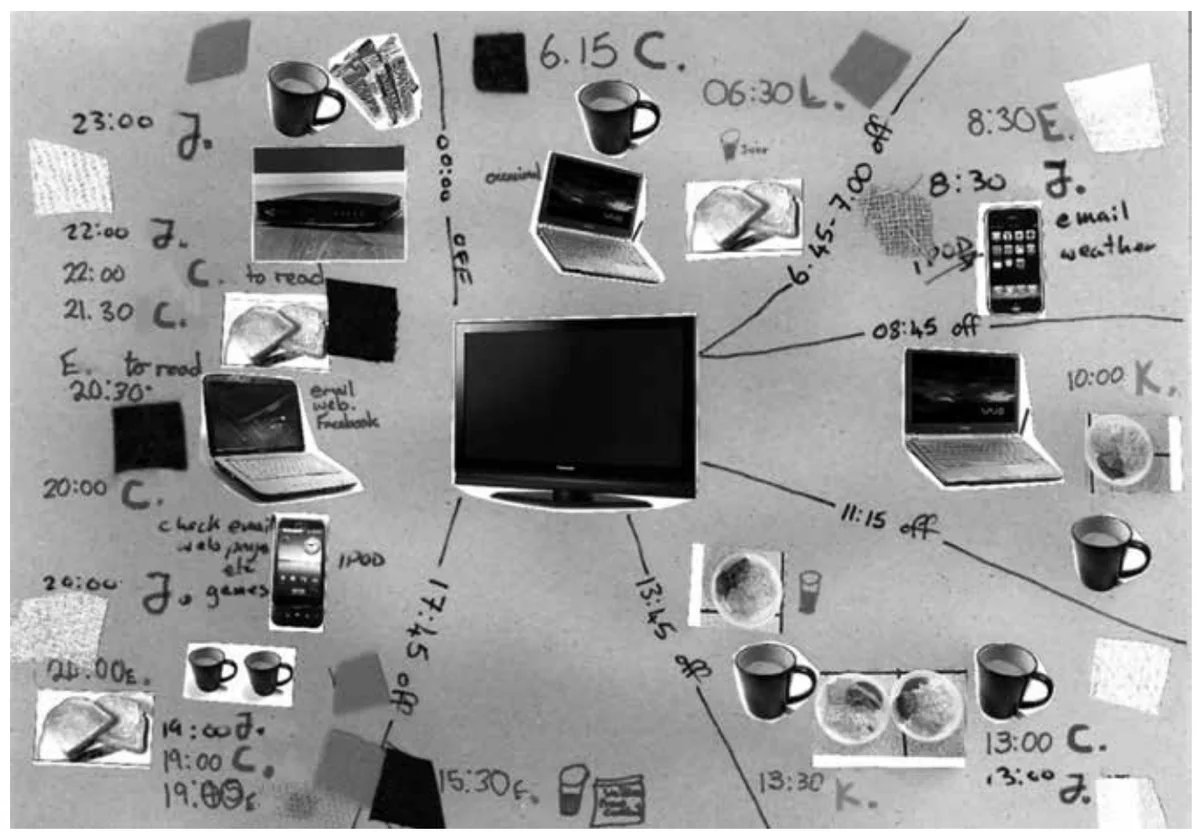
- Semistructured interviews, participant observation, visual and arts-based methods such as the Tactile Time Collage, and workplace tours. The chapter focuses on findings about temporal navigation common to both studies.
Findings
Spare seconds become time travel. Among the UK families we studied at home, the smartphone filled even tiny waits. One father, unwilling to wait thirty seconds for the microwave, checked his calendar for the coming weeks or read email instead. #
(p. 5)Escape, but also scarcity. Tech workers in Cambridge used commutes and waits to browse holiday photos or plan future purchases and trips, leaving a dull present behind. In both studies, the same habit signalled time scarcity (never enough time for everything people wanted to do). #
“Normally, time is something that we don't have enough of anyway”
Drawing a line under the day. Despite the pressure, most participants kept a firm point after which they stopped checking work email, usually around the late evening news at 10 o'clock. One senior tech worker screenshots his phone's clock at 22:22 and sends it to friends: #
“It's almost a marker that the day is done, 'Well done, you've nailed it'.”
Photos for an unknown future. The tech workers' functional photos, from train times to price labels and whiteboards after meetings, were often tied to particular timeframes, frequently the near or far future. Some photographed whiteboards with no particular use in mind: #
“I'd think they'd seen something of value that they wanted to keep for later, so I might as well. You don't know what you'll need in the future”
Honouring the work just done. A whiteboard photo does several jobs at once. It records ideas for possible future use, pays tribute to the work just done and gives the present moment added meaning. It does so even when the person expects never to look at it again. #
“when you've worked on something for a while it feels wrong to just throw it away immediately.”
Archiving everyday life for future nostalgia. Phone photo collections, sometimes of more than twenty thousand pictures, became an archive of the self that people browsed to revisit past periods of their lives. One participant deliberately recorded ordinary scenes, expecting them to mean more later: #
“things that you think are boring every day, aren't in the future.”
Questions this paper answers
- Why do people pull out their phones whenever they have to wait?
- To step out of a dull present into another time, which we call temporal mobility. People look ahead at plans, back at old photos, or trade a minute now for time saved later. These small escapes also reveal time scarcity (never enough time for everything people want to do). (See p. 5; p. 6.)
- Why keep thousands of photos you may never look at again?
- Because their value lies in the future. People keep everyday images because they cannot foresee what they will need, and because ordinary scenes become precious once life moves on. Taking the photo also gives a passing moment more meaning now. (See p. 9; p. 9; p. 11.)
- Can a phone help draw a line under the working day?
- For some people. Among twenty UK families studied at home, most had a firm cut-off, often the late evening news, after which they stopped checking work email. One tech worker marked it by screenshotting his phone's clock at the same time each night and sharing it with friends. (See p. 7.)
Contributions and implications
- People work with acceleration rather than escaping it, using their phones to step out of a single role and time. (§Conclusion, p. 12)
- Browsing the evidence of their lives on their phones reminds people they are more than workers. (§Conclusion, p. 12)
›Concepts
- Temporal mobility
- The first of the two orientations we describe:
Temporal mobility means moving between distinct points in time, such as jumping from the present to the past.
(p. 3) - Media multitemporality
- The second orientation, after Michel Serres's 'multitemporality'. For example, taking a photo now for its value later:
the past, present, and future are not navigated as distinct points in time, but they become juxtaposed
(p. 3) - Time scarcity
- The background that encouraged temporal mobility:
Time scarcity means that people are not able to do all the activities they are interested in.
(p. 6) - Smartphone as cognitive artefact
- A device in which knowledge, including how to tell the time, is placed, but which people still use in vernacular, creative ways.
We approach the smartphone analytically as a cognitive artefact and time-reckoning tool (Birth, 2012).
(p. 3)
Figures
How to cite
Roxana Morosanu Firth, Sean Rintel, and Abigail Sellen. 2020. Everyday time travel: Temporal mobility and multitemporality with smartphones. Making Time for Digital Lives: Beyond Chronotopia, 103-116. https://doi.org/10.5040/9798881811075.ch-006
This brief was prepared with AI assistance and published by Sean Rintel. It is not the authors' published text. Page numbers refer to this PDF.