Research brief
Takeaway: In a permissive university workplace, surveyed staff mostly described Facebook at work as a self-regulated, legitimate break rather than a work tool. Many saw a ban as distrust of their autonomy.
Why this matters
- What was known
- Research on social network sites at work was polarised between blocking access as a distraction and allowing it for professional and satisfaction benefits, with comparatively less research on university faculty and professional staff.
The relatively permissive university workplace context provides a unique case in terms of whether and how employees might self-regulate their SNS use.
(§SNS use at universities, p. 2) - What this paper adds
- Where studies of social network sites at universities mostly looked at students, and workplace studies at companies, we survey faculty and professional staff who already had unrestricted access, so self-regulation could be seen in practice.
if employers want the benefits that appear to come with open access to SNS, can employees be trusted to self-regulate their access?
(§Can university employees be trusted to self-regulate Facebook use at work?, p. 2) - Who it matters to
- University employers and managers deciding whether to allow or block social network sites, who must also weigh legal and security concerns beyond time-wasting.
From both a policy and a management perspective, these other issues cannot be treated as entirely separate from the time-management issue
(§Conclusion, p. 12)
Research questions
- If employers want the benefits that appear to come with open access to SNS, can employees be trusted to self-regulate their access?
- How did faculty employees at a particular university use Facebook at work, and how would they react to a hypothetical ban?
Method and data
- Design
- Exploratory online survey with quantitative items and open-ended 'why/why not?' follow-ups, adapted mainly from Skeels and Grudin's (2009) study.
- Setting
- One faculty, of approximately 900 employees, at a large Australian university, where all employees had unrestricted access to Facebook. Surveyed in October 2010.
- Participants / data
- 83 self-selected academic and professional staff (eighteen males, 65 females), just under 10 per cent of the faculty. Employment type not asked.
- Duration
- Single survey, October 2010.
- Analysis
- Simple frequencies. A Kruskal Wallis test of Facebook use frequency across age groups. Iterative open coding of the open-ended responses.
Findings
Most used it, mostly personally. In a survey of staff in one Australian university faculty, where everyone had unrestricted Facebook access, almost three-quarters used Facebook at work. They mostly used it to socialise with friends and see what people they know were doing, rather than for work. #
(§Discussion, pp. 9–10)A break that helps refocus. Respondents who used Facebook for personal reasons at work described it as a legitimate break, at lunch or between tasks, that helped them return to work focused, not as time-wasting. #
“It allows a brief exit from the stress of the place that allows employees to take a break, refocus on the task at hand and get on with it.”
Friending colleagues didn't sway support. Respondents with colleagues as Facebook friends talked with them more about personal matters than work. More disagreed than agreed that such friendship would make them more likely to support a colleague's project (about a third were ambivalent). Many said projects should be judged on merit, though some felt Facebook fostered collegiality. #
“Those colleagues who are also Facebook friends are more 'real' to me as fully rounded human beings with families, hobbies, political and religious views and so on than those I only encounter in a work context.”
Younger staff used it more. Respondents aged 21 to 30 checked Facebook at work significantly more often than older staff, and described being able to regulate it themselves. Older respondents tended to avoid it as a waste of time. Our tentative explanation: #
“Younger people might access Facebook more frequently while at work because they have a greater obligation to maintain online connections, which are also predominantly social connections.”
A ban would signal mistrust. Asked about a hypothetical ban, many respondents opposed it, most notably because it would show the employer did not trust them to manage their own time. Others valued Facebook as a break or a communication channel, and a sizeable share were ambivalent. #
“Signifies a mistrust of employees, and that my employer doesn't trust me to manage my time and prioritise my work.”
Little effect on satisfaction. Unlike earlier studies, which linked personal internet use at work to higher satisfaction, our respondents said Facebook made little difference to their satisfaction. However: #
“their opposition to prohibiting it at work suggests that SNS removal could at least damage levels of personal satisfaction while at work”
Questions this paper answers
- Do employees use social media at work for work?
- Mostly not, among 83 staff in one faculty of an Australian university. Use was mainly personal socialising during official or unofficial breaks, which staff described as a legitimate pause that helped them refocus. A minority used Facebook to research for work, probably mostly academics, who mentioned teaching and research. (See §Discussion, pp. 9–10; §Allowing or restricting Facebook access, pp. 7–8.)
- Why do employees object to social media bans at work?
- Surveyed university staff gave three reasons. A ban signals that the employer does not trust staff to manage their own time. Social media offers a legitimate break, like water-cooler talk. And it is a useful way to reach personal and professional contacts quickly. (See §Allowing or restricting Facebook access, pp. 7–8; §Allowing or restricting Facebook access, pp. 7–8.)
- Are you more likely to support a colleague's work if you are friends on social media?
- Not particularly, among 83 academic and professional staff in one Australian university faculty. Friending colleagues did not notably affect collegiality or whether staff would support their projects. Many said projects should be judged on merit, though some felt that seeing colleagues' lives on Facebook made them more 'real'. (See §Facebook and strength of collegial ties, pp. 6–7.)
- Do younger employees use Facebook at work more than older ones?
- Yes, among 83 staff in one Australian university faculty. Those aged 21-30 checked Facebook at work significantly more often and described regulating it themselves. Older staff avoided it as a waste of time. We tentatively suggest younger people may feel more obligated to maintain online connections, which are mostly social. (See §Uses, attitudes and age, p. 10.)
Quantitative results
| Measure | Result | Where |
|---|---|---|
| Respondents who used Facebook while at work | 74.7 per cent | §Form of Facebook use at work, pp. 3–4 |
| Uses chosen: socialising with friends; checking what people they know are doing; researching for work purposes | 48.2 per cent; 45.8 per cent; 27.7 per cent | §Form of Facebook use at work, pp. 3–4 |
| Access Facebook at work at least once a day; never | 28.9 per cent; 18.1 per cent | §Frequency of Facebook use at work, p. 5 |
| With colleagues as Facebook friends, discussed personal and social matters versus work-related topics | 65.1 per cent vs 37.3 per cent | §Facebook and strength of collegial ties, pp. 5–6 |
| Agreed or strongly agreed they would not enjoy working for an organisation that banned Facebook | 47 per cent | §Allowing or restricting Facebook access, p. 7 |
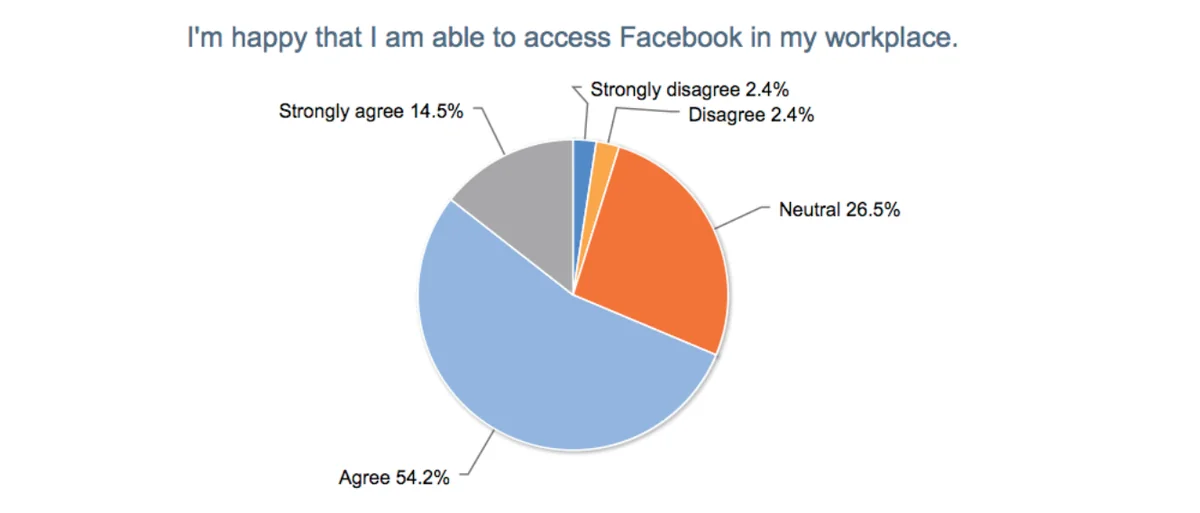
| Happy to be able to access Facebook at work: agreed; strongly agreed | 54.2 per cent; 14.5 per cent | §Allowing or restricting Facebook access, p. 8 |
Contributions and implications
- Relatively liberal access policies seem suitable for the university workplace.
it would seem that relatively liberal policies that allow employees to access SNS are suitable for the university workplace, as long as use does not interfere with work or productivity
(§Conclusion, p. 11) - University employees value being trusted to self-regulate their use.
the results of this study suggest that university employees value being trusted to self-regulate SNS use
(§Conclusion, p. 12) - Although respondents did not feel Facebook improved their satisfaction, removing access could damage it.
- Future research should study social capital between colleagues on social network sites, and the legal and security issues of access.
Limitations
- A small number of self-selected employees from one faculty. Academic and professional roles not separated. Mostly female respondents aged under 40.
Only a comparatively small number of self-selected employees from one faculty in one university were surveyed
(§Conclusion, pp. 11–12) - Exploratory results that are not claimed to be generalisable.
we are not claiming that these are highly generalisable trends
(§Discussion, p. 9) - Gender differences could not be reported given the gender imbalance and small sample.
›Concepts
- Social network sites (SNS)
- Sites such as Facebook. The debate over workplace access, as we frame it:
While some consider SNS a distraction, others consider them a tool for professional socialisation
(Abstract, p. 1) - Self-regulation
- Employees managing their own social network site use at work, rather than having access blocked by the employer.
they were more supportive of employees taking personal responsibility for regulating time on Facebook, as long as it did not affect their productivity
(§Self-regulation, p. 11) - Facebook at work versus for work
- The distinction respondents drew between using Facebook as a personal break while at work and using it as a work tool.
The open-ended responses showed thebiggest difference in accounts about using Facebook at work versus using Facebook for work.
(§Form of Facebook use at work, pp. 3–4)
Figures
How to cite
Aurora Francois, Aparna Hebbani, and Sean Rintel. 2013. Facebook in the university workplace. Media International Australia 149, 15-27. https://doi.org/10.1177/1329878x1314900104
This brief was prepared with AI assistance and published by Sean Rintel. It is not the authors' published text. Page numbers refer to this PDF.