Research brief
Takeaway: AI systems see people's requests but rarely the reasons behind them, so goals could become a persistent, structured layer shared by people, AI systems and organizations. Because goals are partly unspoken, changing and nested, the layer must blend human articulation with AI inference.
Why this matters
- What was known
- AI systems increasingly draw on a worker's context, but the reasons a person is pursuing a task usually stay implicit, scattered across surfaces, or spoken without any persistent record.
information about why a worker is pursuing a task-the goals that motivate, energize, and direct it-is typically missing
(§Introduction, p. 1) - What this paper adds
- We argue for goals as a shared representational layer for human-AI collaboration, derive what it must be like from the properties of human goals, and set out its opportunities, practical approaches and open challenges.
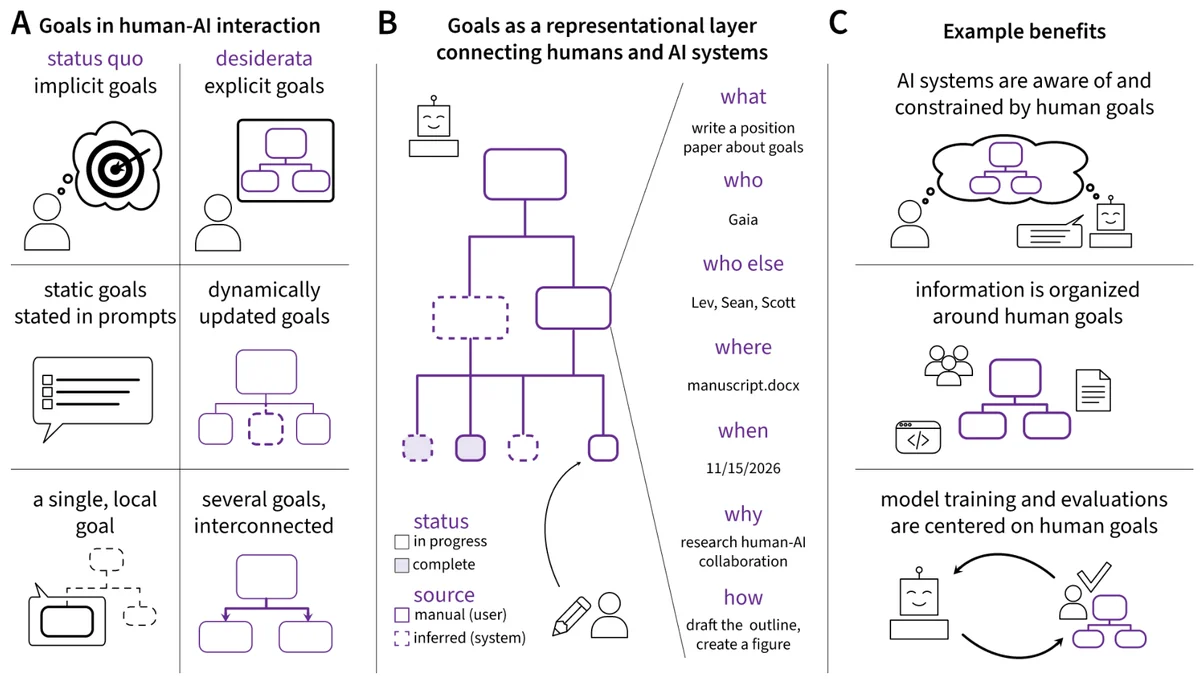
we propose goals as an explicit representational layer mediating interactions among people, AI systems, and organizations
(§Introduction, p. 2) - Who it matters to
- Designers and builders of AI assistants, agents and knowledge work tools, researchers who evaluate and train AI systems, and the organizations and workers who will rely on them.
Research question
- We argue that goals should become an explicit representational layer mediating interactions among people, AI systems, and organizations.
Method and data
- Design
- Position paper. It argues for a goal layer and does not report a new empirical study or build a system.
- Setting
- Human-AI collaboration in knowledge work, with attention to how the same goal representations could support coordination among people.
- Participants / data
- No new data. The argument draws on psychology and organizational research on goals and on recent work on AI assistants and agents.
- Analysis
- Argument and synthesis. We derive three requirements from the properties of human goals, discuss opportunities for context, reflection, coordination, evaluation and AI development, outline practical approaches, and set out open challenges.
Findings
Three properties of human goals set the requirements. Goals are partly unspoken, so the representation must be explicit. Goals change as people learn, so it must evolve. Goals nest from tasks to aspirations and form networks, so it must support abstraction and relationships. Of change we say: #
“a useful goal layer must be an evolving representation of users' goal ecosystems”
A goal layer could organize context and coordination. Persistent goal context could let AI judge which earlier information bears on a new request, so people restate less, and could help collaborators see where their objectives overlap, diverge or depend on one another. #
“beyond providing interaction histories, a goal layer could connect new requests to ongoing activity by identifying which parts remain relevant to the objectives currently being pursued”
It could support reflection and experimentation. Tracking current goals and the steps taken could support progress monitoring and re-evaluation. Separating desired outcomes from current tasks could let teams treat ways of reaching an outcome as testable hypotheses. #
“explicit goal representations could help people question the purposes and assumptions guiding their work, which is particularly relevant as people delegate more execution to AI”
Goals could anchor how AI is evaluated and developed. Goals could serve as a unit of analysis for studying how assistance changes the objectives people pursue. They could also link feedback during AI training to broader objectives and structure simulations of human users. #
“goals could provide a reference for evaluating AI assistance against outcomes that truly matter to workers, including learning and well-being alongside attributes of key work outcomes”
People and AI should build the layer together. Articulation support helps people state goals, while inference can propose candidates from distributed evidence. Neither is sufficient alone, because inference cannot see every priority or constraint. We also cite a study in which people were more likely to act on goals they set themselves than on equally relevant AI-generated ones. #
“These considerations thus favor hybrid approaches in which AI systems help surface and revise candidate goals, while people shape and endorse the actual representations that guide AI assistance.”
A goal layer supports alignment but does not deliver it. Open challenges include inferring goals from mostly retrospective evidence, keeping representations current without burdening users, and preventing a layer that makes work more legible from enabling excessive monitoring. A goal representation is necessary but not sufficient for AI to act in line with it. #
“A goal layer should therefore be understood as infrastructure for alignment rather than a solution to alignment itself.”
Questions this paper answers
- Why do AI assistants need to know a person's goals?
- Even a fully specified request rarely says why the task matters. Without that purpose, people must keep restating their intent, and AI can lose track of the wider objective. We argue a persistent goal layer could connect each request to the outcomes it serves. (See §Context organization and coordination, p. 4.)
- Can AI infer a person's goals instead of asking them to write goals down?
- Inference alone cannot give a complete picture, because available evidence is mostly about the past while goals concern the future. We argue for a hybrid in which AI proposes candidate goals and people revise and endorse them. (See §Surfacing and updating goals, p. 6; §Maintenance, adaptability, and alignment, p. 9.)
- Why should goals be an evolving structure rather than a fixed list?
- Goals are partly unspoken, change as people learn, and sit at several levels from daily tasks to long-term aspirations. A fixed list would go stale and miss how a task serves wider outcomes, so the representation must stay explicit, evolving and linked. (See §Desiderata for a Goal Layer Follow from the Properties of Human Goals, p. 3.)
- What are the risks of recording people's goals?
- A persistent goal record makes work more legible, so it could enable excessive monitoring or invasive evaluation. We argue each layer needs boundaries on who can see which goals, and that inferred goals should not carry the status of goals their owner has endorsed. (See §Maintenance, adaptability, and alignment, p. 9.)
Contributions and implications
- Connect each request only to the goals it may serve, retrieving enough surrounding context to grasp its purpose without loading the whole goal graph.
- Let the seven questions shape concrete assistance, such as tailoring an explanation to its audience, constraining a plan by a deadline, and directing retrieval to linked artifacts.
an intended audience may shape the explanation, a deadline may constrain a proposed plan, and linked artifacts may direct information retrieval
(§Putting goal representations to work, p. 7) - Keep consequential interpretations of goals visible and open to correction, and surface discrepancies for people to resolve as the work unfolds.
consequential interpretations should remain visible and open to correction
(§Putting goal representations to work, p. 8) - Set boundaries on who and what can see a goal, so that the layer supports people's agency instead of defining and monitoring what workers should pursue.
not every goal should be visible to every collaborator, manager, organization, or AI system
(§Privacy, authority, and governance, p. 9)
Limitations
- Goals are hard to infer because the evidence available is mostly about past activity, while goals concern what a person wants to do next.
A system that accurately explains what a person has done may therefore still fail to identify what they want to do next.
(§Inference and validation, p. 9) - A representation of a goal cannot guarantee that an AI system acts consistently with it.
Even an accurate and current representation cannot guarantee that an AI system's plans and actions will remain consistent with it.
(§Maintenance, adaptability, and alignment, p. 9) - We focus on knowledge work and do not examine goals outside work, such as education or health.
Although we do not examine goals outside work, the proposed approach may also be applicable to personal pursuits
(§Introduction, p. 2)
›Concepts
- Goals
- The psychological construct we build on:
mental representations of desired future states
(§Introduction, p. 2) - Goal layer
- Our proposal for how goals should be held so that people, AI systems and organizations can share them:
goals should be stored as persistent, structured entities that connect requests and activities to the broader outcomes they are intended to serve
(§Introduction, p. 2) - Seven interrogatives
- Seven questions (what, who, who else, when, where, why and how) that organize the information about each goal. Why and how link a goal upward to the objectives it serves and downward to its subgoals. (§Organizing information in a structured goal graph, p. 7)
- Goal graph
- The network that results when goals are linked to one another. Its shape is not a simple hierarchy:
The graph need not be a tree: multiple pathways may support one goal, and a subordinate goal or activity may contribute to several broader objectives
(§Organizing information in a structured goal graph, p. 7) - Articulation and inference
- Two complementary ways of surfacing goals: people stating them, and AI estimating them from evidence such as text and activity. We argue they should work together:
articulation support and inference as complementary mechanisms through which latent goals can be surfaced and dynamically maintained
(§Surfacing and updating goals, pp. 5–6)
Figures
How to cite
Gaia Molinaro, Lev Tankelevitch, Sean Rintel, and Scott Counts. 2026. Goals as a Representational Layer for Human-AI Collaboration. arXiv preprint arXiv:2611.08757. https://doi.org/10.48550/arXiv.2611.08757
This brief was prepared with AI assistance and published by Sean Rintel. It is not the authors' published text. Page numbers refer to this PDF.