Research brief
Takeaway: Embracing asymmetry can make hybrid meetings more equitable. In the room, each remote colleague gets a life-size screen at the table. Remotely, they join through a 3D replica of the room, choosing their seat and where to look. Remote people's felt agency then no longer lagged significantly behind the room's.
Why this matters
- What was known
- Standard hybrid meetings put all remote participants on one shared screen and give every endpoint the same interface, which leaves remote participants with less presence and agency than the people in the room. Earlier spatial systems were mostly symmetrical and inflexible, and the asymmetrical ones were complex to deploy.
symmetry of interfaces ignores the asymmetries inherent in remote versus in-room endpoints, and heightens the conditions that exclude remote participants
(§1, p. 2) - What this paper adds
- Rather than mirroring one interface at every endpoint, or moving everyone into a wholly virtual space, we blend the physical room with a navigable copy of it on everyday hardware. We test this against both gallery view and meeting fully in person.
an experimental hybrid video meeting system which manifests a combined physical-virtual space shared by all participants on commodity hardware
(§1, p. 3) - Who it matters to
- Designers of meeting rooms and videoconferencing products, and organisations that run hybrid meetings and want remote colleagues included.
the benefits of inclusive hybrid meetings that engage more participants might outweigh the initial engineering time cost
(§6.3, p. 24)
Research question
- How does an asymmetrical videoconferencing system that emphasises shared spatiality and heightened agency affect remote participants' inclusion in a hybrid meeting?
Method and data
- Design
- Within-subjects lab study with a mixed design: meeting type (fully in-person, Gallery, Hybridge) within subjects, and participant location (local, remote) between subjects. In-person always came first. Gallery and Hybridge were counterbalanced.
- Prototype
- Hybridge, a hybrid meeting system. In the meeting room, each remote participant appears on their own roughly life-size portrait display, with its own camera and speakers, placed among the chairs around the table. Shared slides go on a separate front-of-room screen. Remote participants see a 3D replica of the meeting room (a digital twin) with spatial audio. They click an empty display to take that seat. Their view then blends into the live camera feed from that seat, and they can pan left and right to look at people or the slides. A mini-map shows who sits where and which way each remote participant is looking, and in the room their video turns to show where they are looking. They can change seats at any time. It is built on Microsoft Teams for audio and video, with a Unity front end and a seating server. It was compared with a standard gallery view, in which remote participants appear in a strip beside the shared content on one screen, and with meeting fully in person.
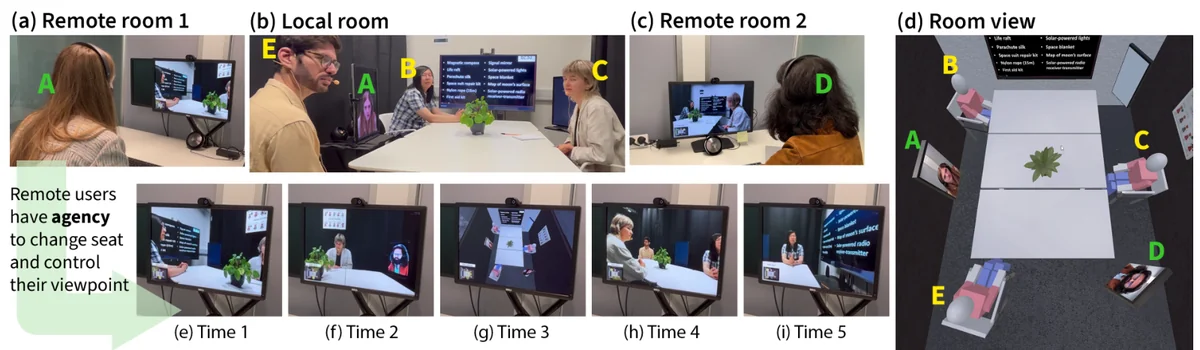
Fig. 1. A hybrid meeting using Hybridge. (a, c) show remote participants A and D, who may view a Hybridge room from any digital seat. (b) shows the local Hybridge room, with remote participants A and D distributed in-room. (d) show the meeting map of the Hybridge room digital twin with in-room (yellow) and remote (green) participants in their physical and digital seats. (e-i) Remote view choice: Remote participant A pans right to see Remote participant D (Time 1 - 2), switches to virtual view (Time 3), chooses a new digital seat (Time 4), pans right to see content (Time 5). From the paper, Figure 1, p. 1. - Setting
- Groups of four people who knew each other completed survival-style discussion tasks (choose 3 items from a list of 11 in 5 minutes). In the hybrid conditions two sat in the meeting room and two joined from separate satellite rooms.
- Participants / data
- 48 participants in 12 groups (university students and staff, and industry professionals). 10 groups were analysed after 2 sessions were excluded for technical issues.
- Duration
- Each session lasted 60-90 minutes.
- Analysis
- Questionnaires on sense of agency, co-presence, physical presence, conversation flow and ease of awareness, analysed with aligned rank transform (ART) mixed-effects models and ART-C contrasts. Preference rankings. Telemetry of seat changes and camera panning. Focus groups.
Findings
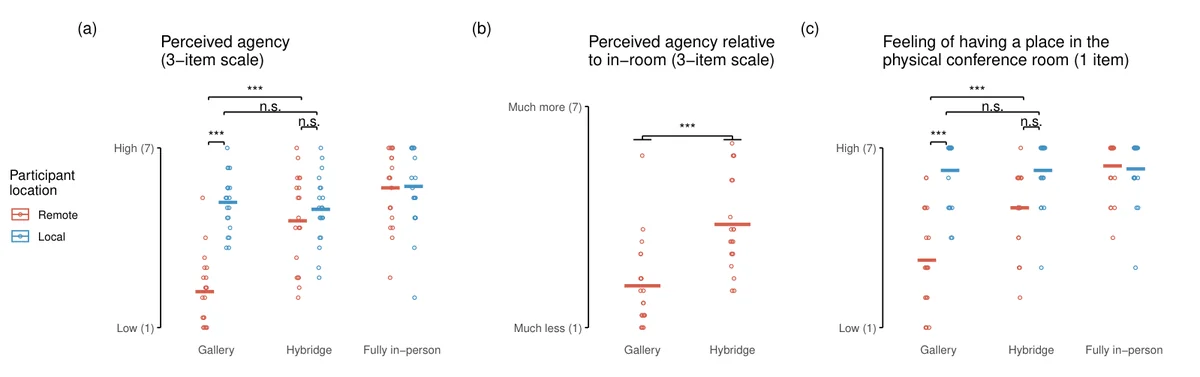
The control gap was no longer significant. In groups of four with two people in the room and two remote, remote participants felt much less in control than in-room participants when the remote pair appeared in a gallery view on one screen. With Hybridge, the difference was no longer significant, although the displays around the table may have left in-room participants feeling slightly less in control than when meeting fully in person. #
“I felt like I had more agency to move about. And I felt like I had more presence in the room.”
Closer, but not equal. With Hybridge, remote participants felt more together with the people in the room than with gallery view, and the gap between remote and in-room participants narrowed, though remote participants still felt less together. Eye contact was one reason. #
“when you shifted to look at me it really looked like we were looking in the eye”
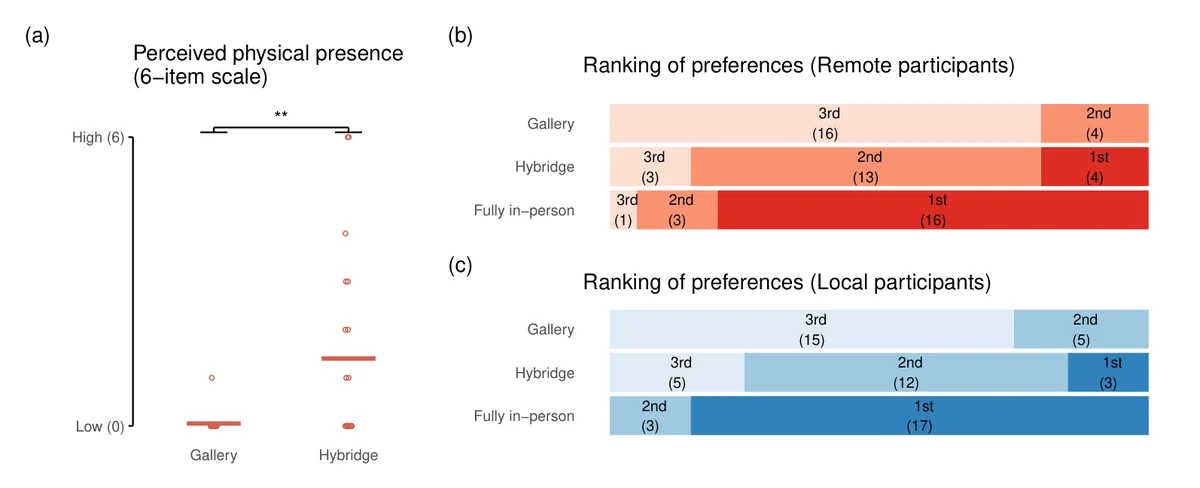
A place in the room. Remote participants felt more physically present in the meeting room with Hybridge than with gallery view, and in-room participants noticed and welcomed their dedicated places at the table. #
“It's nice having a chair or place in the room, It's nice having that dedicated space for you.”
Easier conversation. Both in-room and remote participants rated conversation as flowing better with Hybridge than with gallery view, helped by spatial audio and by seeing who was looking at whom. Keeping track of what was happening was not rated easier than with gallery view. Some participants said they had to look around the room. #
“having someone look at you, you kind of tacitly, like, get their approval to be like ohh you have the floor now you have the microphone now”
Preferred to gallery view. Asked how they would like to meet in future, most participants, remote and in-room alike, ranked Hybridge above gallery view and second only to meeting fully in person. One in-room participant said it removed remote participants' second-class status. #
“the remote people are definitely second class to the physical, whereas the Hybridge prototype equalised that imbalance because everyone had a seat”
They used the freedom. Remote participants actually used their new control. They changed seats during meetings, for example to sit closer to the shared slides, although some felt that moving seat mid-meeting was odd. #
“the first thing I said when I walked in here is I want to grab a seat that's close to the slides”
Questions this paper answers
- How can hybrid meetings be made fairer for people joining remotely?
- Give each remote attendee their own place in the room, and let them choose where to sit and look. In timed group tasks with two people in the room and two remote, this removed the significant gap in felt control that remote people had with a standard gallery view. (See §5.1, pp. 13–14; §5.1, p. 14.)
- Can technology make remote participants feel they are really in the meeting room?
- Partly. With their own display at the table, remote participants felt more physically present and more together with the people in the room than in a gallery view. Eye contact helped. They still felt less together than the people in the room did. (See §5.2, p. 18; §5.3, p. 18.)
- Do people want spatial hybrid meetings over standard video calls?
- Most people who tried both did. Remote and in-room participants alike typically ranked a spatial system second only to meeting in person and above a gallery view. They also rated conversation as flowing more easily, and one in-room participant said remote colleagues no longer seemed second-class. (See §5.4, p. 19; §5.6, p. 21.)
- Do remote participants actually use more control when they get it?
- Yes. Given the choice, remote participants changed seats during meetings, on average more than three times per session, for example to sit nearer the shared slides. They also panned their view towards the people or content they were attending to. (See §5.1, p. 14.)
Quantitative results
| Measure | Result | Where |
|---|---|---|
| Sense of agency: condition × location interaction | F2,76 = 22.89, p < 0.001 | §5.1, p. 14 |
| Sense of agency, remote vs local within Hybridge | p = 0.56 (no significant difference) | §5.1, p. 14 |
| Agency gap (remote vs local), Hybridge vs Gallery, difference in differences | t76 = 5.51, p < 0.001 | §5.1, p. 14 |
| Co-presence gap (remote vs local), Hybridge vs Gallery, difference in differences | t76 = 2.55, p = 0.013 | §5.2, p. 16 |
| Physical presence (remote participants), Hybridge vs Gallery | F1,19 = 13.99, p = 0.001 | §5.3, p. 18 |
| Conversation flow: Hybridge vs Gallery | p = 0.001 | §5.4, p. 19 |
| Ease of awareness: Hybridge vs Gallery | p = 0.89 (no significant difference) | §5.5, p. 19 |
| Preferred Hybridge over Gallery | 17 of 20 remote (85%); 15 of 20 local (75%) | §5.6, p. 21 |
| Seat changes by remote participants | 3.45 per session on average | §5.1, p. 15 |
Contributions and implications
- Design hybrid meeting systems to embrace asymmetry, tailoring each endpoint's interface to its needs rather than mirroring one interface everywhere.
We argue that asymmetry should be embraced when designing hybrid meeting systems
(Abstract, p. 2) - Equal capabilities do not make an equitable experience. Make the best use of the physical room for in-room participants and of the digital space for remote ones.
While we didn't create equal experiences for remote and in-room participants, we succeeded in creating a more equitable experience.
(§6.2, p. 24) - Tailored endpoints cost more engineering than uniform commercial interfaces, which may be outweighed by more inclusive meetings.
Limitations
- Shared content was passive, because only the moderator shared a screen and no one co-created artefacts.
- Sessions used one configuration (2 in-room, 2 remote), assigned discussion tasks, and a single use of Hybridge. Larger meetings and longitudinal use remain untested.
- The room setup was tied to one meeting room's size and furniture.
- Participants came from a university and a large tech organisation, with limited gender diversity.
›Concepts
- Inclusion (in hybrid meetings)
- We use inclusion in three senses:
equitable opportunity of participation for remote and in-room participants, increasing remote participants' agency within the meeting, and reducing remote participants' feelings of being isolated or ignored
(§1, p. 2) - Distributed spatial presence
- Each remote participant appears on their own display among the physical seats, rather than together on one wall screen.
The smaller displays act as "digital seats" that can be occupied by a single remote participant, who can be seen and heard as if they were sitting at the table.
(§3.2.1, p. 6) - Heightened agency
- Remote participants choose where they appear in the room and where they view it from.
designing for hybrid meetings should provide remote participants with as much or even more agency than the in-room participants
(§3.1, p. 5) - Digital twin
- What the remote interface shows:
The virtual room experienced by remote participants is a digital twin of the physical room, rather than a wholly virtual space.
(§3.1, p. 5) - Asymmetry
- Different endpoints get different interfaces suited to their resources.
the need for uniform systems across endpoints should be relaxed in favor of the needs for inclusion
(§6.1, p. 23)
Figures
How to cite
Payod Panda, Lev Tankelevitch, Becky Spittle, Kori Inkpen, John Tang, Sasa Junuzovic, Qianqian Qi, Pat Sweeney, Andrew D. Wilson, Bill Buxton, Abigail Sellen, and Sean Rintel. 2024. Hybridge: Bridging Spatiality for Inclusive and Equitable Hybrid Meetings. CSCW 2024. https://doi.org/10.1145/3687040
This brief was prepared with AI assistance and published by Sean Rintel. It is not the authors' published text. Page numbers refer to this PDF.