Research brief
Takeaway: Decades of automation research predict where generative AI costs productivity. People shift from producing work to checking output they didn't create, which demands understanding they no longer have.
Why this matters
- What was known
- Generative AI is expected to raise productivity, and some studies show gains, but users, especially programmers, also report extra cognitive load, frustration and lost time.
This suggests that the potential of GenAI systems to boost productivity may not be guaranteed, evenly distributed, or fully exploited.
(§1, p. 2) - What this paper adds
- Four named causes of productivity loss with GenAI, each matched with design remedies from Human Factors research.
Extrapolating from over 30 years of Human Factors research on the "ironies" of human-automation and productivity loss, we synthesize an overview of the usability and productivity challenges observed in recent GenAI user studies.
(§1, p. 3) - Who it matters to
- Designers and builders of GenAI tools and copilots, and HCI and Human Factors researchers.
ensuring that the design of human-AI interactions in this rapidly moving field learns from history instead of repeating it
(Abstract, p. 2)
Research questions
- Why do users of generative AI systems sometimes lose rather than gain productivity, and how do these challenges parallel those found in Human Factors research on automation?
- Which Human Factors design approaches could mitigate productivity loss in human-GenAI interaction?
Method and data
- Design
- Narrative review in two stages. It first distilled challenges from Bainbridge's 'Ironies of Automation' and related Human Factors research, then searched the generative AI literature for studies reporting productivity losses or ineffective use.
- Setting
- GenAI user studies, mainly programming (e.g., GitHub Copilot), plus writing, design, data science, law, consulting and healthcare.
- Participants / data
- Google Scholar and ACM Digital Library searches (generative AI, large language model, LLM, ChatGPT), cut-off 2024-01-20, including pre-prints. Included GenAI articles are listed in Table 1 with domain, task, method and challenge theme.
- Analysis
- Thematic synthesis aligning GenAI findings with four Human Factors challenge themes, then mapping Human Factors solutions to each challenge.
Findings
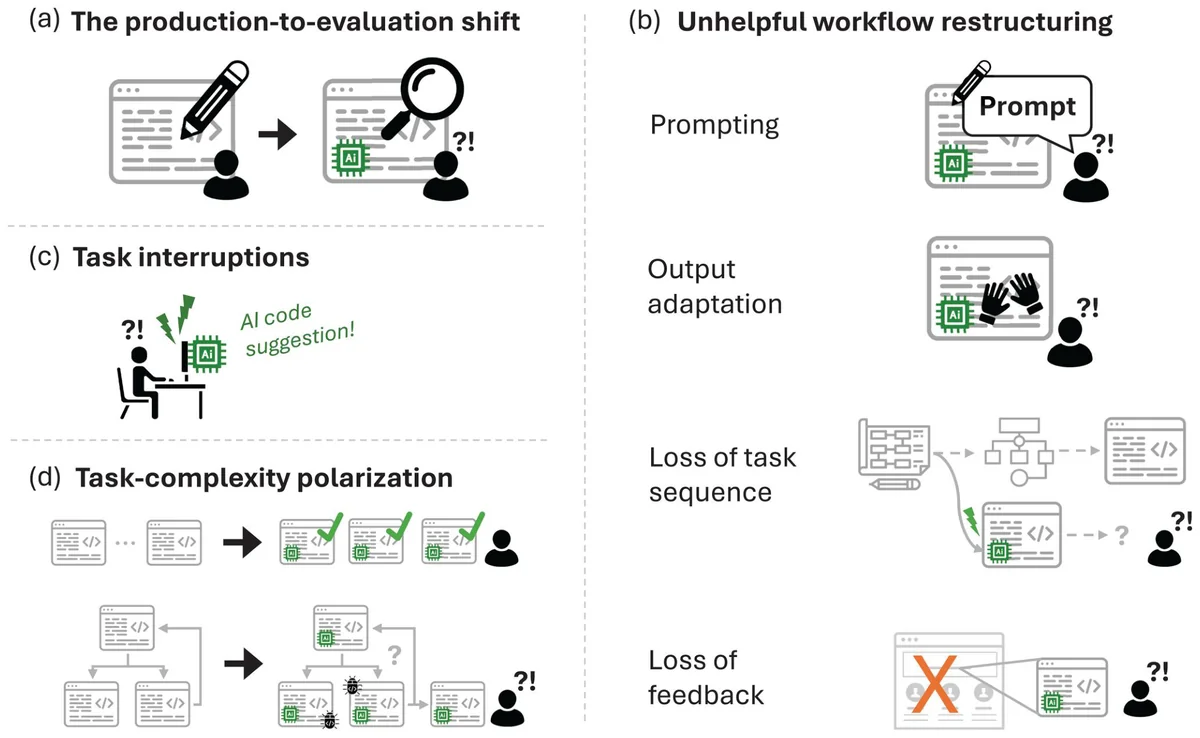
From producing to checking. Across the studies we reviewed, mostly of programmers using AI coding assistants, generative AI turns people from producers of work into evaluators of AI output. Checking is demanding because people lack the understanding of the situation they would have had if they had written the work themselves. #
“Some programmers have said that working with Copilot felt like a "proofreading task"”
Over-trust follows. As automation research predicts, the shift to checking, combined with reduced awareness and extra workload, can breed complacency and over-reliance. Early studies of AI-assisted writing already show people accepting AI drafts without revising them thoroughly. #
“both expert and non-expert writers showed overconfidence in the quality of AI-generated drafts, failing to thoroughly revise them”
New tasks get in the way. Prompting the AI and adapting its output are new tasks that compete with the main work and break up familiar ways of working, as a designer in a study by Kulkarni and colleagues described. #
“I had to massage every word and select every character very carefully not to upset it”
Suggestions break concentration. Unrequested AI suggestions interrupt people's flow. Even a suggestion they reject has already pulled their thinking away, as an experienced programmer in a study by Barke and colleagues put it. #
“I was about to write the code, and I knew what I wanted to write. But now I'm sitting here, seeing if somehow Copilot came up with something better”
Easy tasks get easier, hard ones harder. Generative AI helps most with simple tasks and can make demanding ones harder, through subtle errors, overwhelming suggestions and disrupted workflows. A study of legal work by Choi and Schwarcz supports the first half: #
“AI helps with simple legal analysis but stumbles over complex legal reasoning”
Questions this paper answers
- Why does AI help more with easy tasks than hard ones?
- Automation research calls this task-complexity polarization. Easy work is easiest to automate, so hard work stays with people, now with added monitoring in a fragmented workflow. Generative AI studies agree. The hardest part, such as breaking a coding problem down, gets little help, and subtle errors make debugging harder. (See §3.4, p. 11; §3.1, p. 4.)
- Do people really over-rely on AI?
- Automation research predicts it, and early generative AI studies already show it. When people shift to checking AI output, with less awareness of how it was made and more to do, they tend to accept it without enough scrutiny. (See §3.1.3, p. 8.)
- What are the 'ironies of automation', and do they apply to AI?
- They are a pattern from decades of automation research. The more advanced the automation, the more important the human's remaining role may be, and in some cases the harder it becomes. The same pattern is appearing in studies of generative AI tools. (See §3.1, p. 4; §3.4, p. 11.)
Contributions and implications
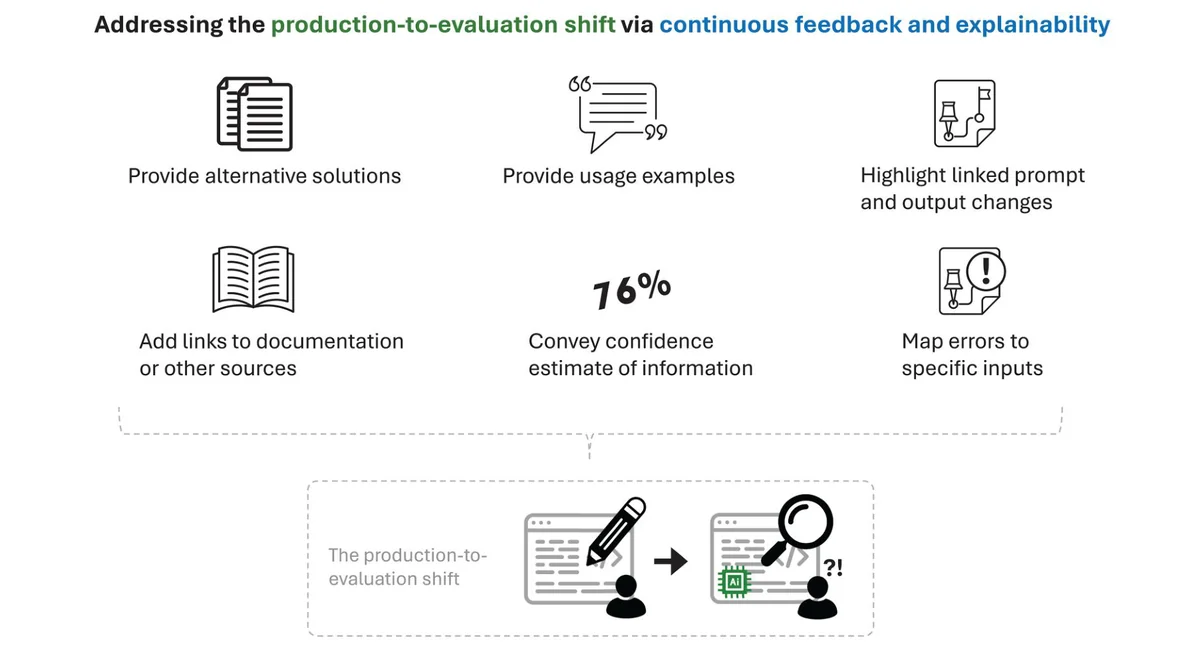
- Continuous feedback and explainability keep users in the loop by showing what the system relies on, its confidence, alternatives and how prompts map to outputs.
We propose that feedback about system behavior is a key strategy to keep users engaged and in the loop of GenAI system performance.
(§4.1, p. 12) - System personalization lets users choose inputs, the type of assistance and its timing to fit their way of working.
- Ecological interface design fits GenAI to domain-specific workflows, perceptual constraints and explainability needs.
- Main-task stabilization and interruption timing rely on attention guidance, pre-interruption alerts, and suggestions timed to users' flow states.
- Clear task allocation between user and system, which users can set themselves.
the allocation of tasks between the user and GenAI system should be clearly defined and supported by GenAI systems
(§4.5, p. 17)
Limitations
- A narrative, non-exhaustive review that may have missed articles.
As our approach was a narrative review, our search was not systematic or exhaustive, and there may be articles we have missed.
(§2, p. 4) - It deliberately focuses on productivity losses, while acknowledging that gains have also been observed.
- Skill development and expertise demands were left out because they were too early to observe in GenAI research.
- The proposed solutions come from Human Factors research and need testing in GenAI contexts.
›Concepts
- Ironies of automation
- Bainbridge's term from automation research, which we apply to GenAI:
the more advanced an automated system is, the more important the human operator may be
(§1, p. 2) - Production-to-evaluation shift
- Our name for the first of four GenAI productivity challenges:
users' roles have shifted from producing output to evaluating it, often with little contextual information and situational awareness
(§1, p. 2) - Situational awareness
- Endsley's definition, central to why evaluating AI output is hard:
their perception of data and elements of the situation, comprehension of the situation, and the projection of future status
(§3.1.1, p. 6) - Unhelpful workflow restructuring
- The second challenge, in the words of automation research:
Automation can restructure workflows in unhelpful ways by introducing new challenging tasks, disrupting familiar task sequences, and removing informative feedback
(§3.2, p. 8) - Task-complexity polarization
- Our more precise term for what Human Factors research calls 'clumsy automation':
Automation often makes easy tasks easier but fails to reduce the workload during cognitively demanding tasks, and in fact, often makes them harder
(§3.4, p. 11)
Figures
How to cite
Auste Simkute, Lev Tankelevitch, Viktor Kewenig, Ava Elizabeth Scott, Abigail Sellen, and Sean Rintel. 2024. Ironies of Generative AI: Understanding and Mitigating Productivity Loss in Human-AI Interaction. International Journal of Human–Computer Interaction. https://doi.org/10.1080/10447318.2024.2405782
This brief was prepared with AI assistance and published by Sean Rintel. It is not the authors' published text. Page numbers refer to this PDF.