Research brief
Takeaway: In data sensemaking, generative AI helps non-experts by suggesting hypotheses and ways to test them, but they need help stating what they want and checking answers.
Why this matters
- What was known
- Earlier work on AI assistance for data analysis focused on expert analysts or was only theoretical.
Notably, no prior studies have investigated how generative AI tools can impact the data-driven sensemaking workflows of end-user programmers.
(§2.3, p. 3) - What this paper adds
- A map of where generative AI helps and hinders data analysis workflows, and a reflection on the participatory prompting method itself.
Our study is the first to apply the participatory prompting protocol by Sarkar et al. [63] to explore the opportunities and challenges of generative AI for end-user sensemaking with data.
(§1, p. 2) - Who it matters to
- Designers of generative AI tools for data analysis, AI researchers, and researchers who want to study generative AI in other knowledge workflows.
the key question facing system designers is therefore one of scope: where are the greatest opportunities and challenges for improving the end-user experience of data-driven sensemaking with generative AI?
(§1, p. 2)
Research questions
- Where are the greatest opportunities and challenges for improving the end-user experience of data-driven sensemaking with generative AI?
- How can data analysis workflows be assisted or impaired by generative AI?
- What is the value of the participatory prompting method for eliciting such insights?
Method and data
- Design
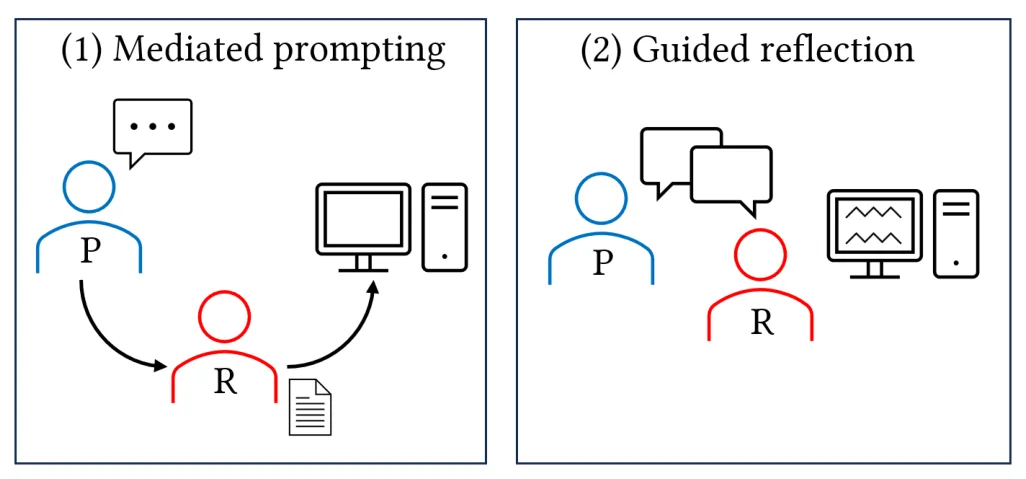
- Participatory prompting study in the researcher-as-relay format. Participants stated their intent, a researcher turned it into a prompt using pre-prepared prompting strategies, and participants thought aloud about each response. Semi-structured interviews followed.
- Setting
- Remote sessions over Microsoft Teams using Bing Chat (creative mode), on data sensemaking tasks participants brought themselves. 5-6 turns fit in the 45-60 minutes, after a pilot with 2 spreadsheet users.
- Participants / data
- N=15 spreadsheet users (5 women, 0 non-binary, 10 men), 7 in Africa, 3 in Europe and 5 in North America, with varied spreadsheet, programming and generative AI experience.
- Analysis
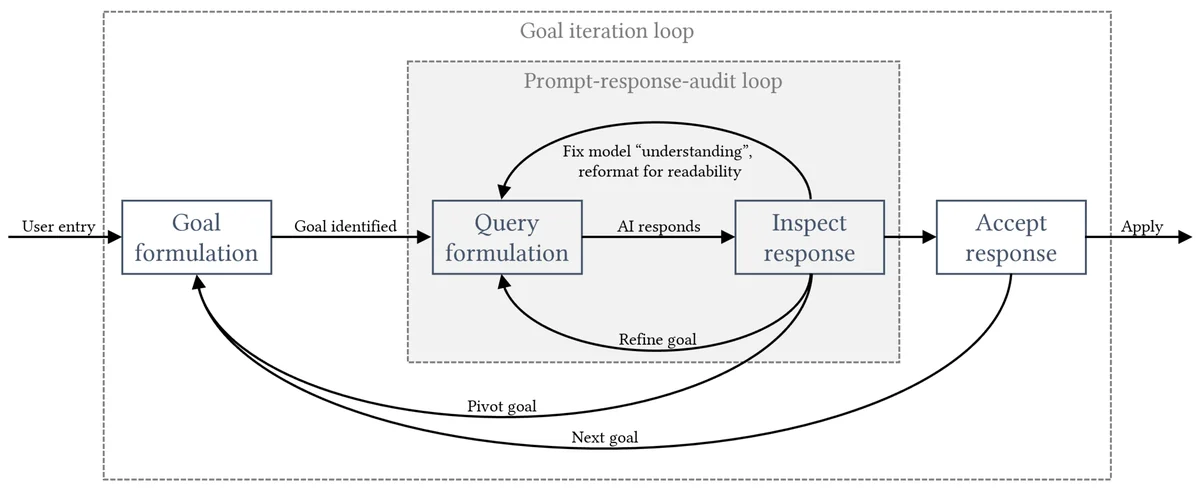
- Affinity mapping, then directed, negotiated coding by two researchers organised by sensemaking theory (for support) and the iterative goal satisfaction framework (for barriers).
Findings
Less searching, more ideas. Spreadsheet users each analysed their own data with a chatbot, through a researcher who wrote the prompts. For them, AI cut the effort of finding relevant information and helped them come up with hypotheses and ways to test them. #
“search engines will give you multiple results, and it's very messy, but this [Bing Chat] directly gives one thing to do.”
A partner for thinking. Participants valued fresh perspectives, step-by-step instructions and picking up new skills. For one, the chatbot helped them refine their own thinking: #
“it's like a rubber duck that actually talks back and is useful.”
Saying what you want is the hard part. Participants struggled to spell out their intent in detail and to work out what context the AI needed, and one found this harder than briefing a human colleague. #
“wording it in the right way that the AI understands [...] writing [what is in your head] down is the hard part.”
Answers were not always usable. Responses could be too long, wrongly formatted, incomplete or full of unfamiliar concepts, which made them hard to act on for people without the relevant expertise. #
“not easily understandable for someone who is being introduced or does not have much experience in statistics”
Checking takes effort. Verifying answers, by following citations or testing generated code and formulas, was laborious, and made-up content was hard to spot outside one's own expertise. #
“Participants found that manually verifying sources was burdensome, and in some cases the work of verifying a response might be greater than the work required to conduct a web search manually”
Small steps over big prompts. Rather than writing one detailed prompt, participants reached a good answer through a series of small follow-up requests that refined the previous response. #
(§5.1, p. 15)
Questions this paper answers
- Can AI chatbots help people who are not data experts analyse data?
- Yes, in specific ways. They reduce the effort of finding relevant information, suggest hypotheses and how to test them, and teach new skills. They help less with turning a vague intention into a precise request. (See §4.2.1, p. 9; §4.2.2, p. 9; §4.3.1, p. 10.)
- Why is it hard to get useful help from AI on your own data?
- Mostly because what you want lives in your head. People find it hard to state their intent in detail and to know what context the AI needs. One found it harder than briefing a colleague, and some blame themselves for poor prompts. (See §4.3.1, p. 10.)
- How far can you trust an AI's answers about your data?
- Not without checking. People followed citations, tested generated code and formulas, or cross-checked other sources. Checking takes real effort, sometimes more than searching manually, and made-up content is hardest to spot where you know least. (See §5.1, p. 15.)
- Is one carefully written prompt better than a back-and-forth?
- Many people seem to prefer the back-and-forth. Spreadsheet users built up a good answer through small refinements rather than one detailed prompt. This echoes a preference for rapid, incremental and reversible interaction long noted in direct manipulation interfaces. Why remains an open question. (See §5.1, p. 15.)
Contributions and implications
- Help users build more detailed prompts, for example with proactive questions, flagging ambiguous or missing context, and suggesting output formats.
This might be addressed by a design that helps a user build more detailed prompts, e.g., proactive questions that the system provides for the user to respond to
(§5.2, p. 16) - Provide verification assistance such as co-auditing features, guidance on reference quality, and generated tests for code and formulas.
Therefore, users need verification assistance, e.g., through co-auditing features [17].
(§5.2, p. 16) - Support critical thinking during goal formulation, for example by critiquing a recommended approach and spotting when data cannot answer the user's question.
- Integrate generative AI into the feature-rich applications people already use, while letting app-specific assistants delegate to others when better strategies exist elsewhere.
- Design systems that explicitly provide metacognitive support as users approach a task, formulate prompts and evaluate outputs.
Limitations
- Bing Chat's interface limited the behaviours we could study. For example, queries could not be edited and re-submitted.
- The prompting strategies were developed by trial and error by particular researchers, so this part of the method is not easily reproducible.
this aspect of the participatory prompting process is not easily reproducible
(§5.5, p. 18) - Each participant worked on a unique task, so themes from one participant's task may not generalise to others doing the same task.
- Expert mediation of prompts reduces external validity, since participants will not have it during real work.
›Concepts
- Participatory prompting
- Sarkar and colleagues' research method, which we apply here:
Participatory prompting is a user-centric research method for eliciting AI assistance opportunities. The method combines principles of contextual inquiry and participatory design [69], in which researchers mediate participant interactions with a real generative AI system.
(§3.1, p. 4) - Sensemaking
- Pirolli and Card's process, with an information foraging loop and a hypothesis generation and testing loop:
Sensemaking is the process by which individuals gather information, represent it schematically for interpretation, and develop insights into its meaning to create useful knowledge products.
(§2.1, p. 2) - Generative AI
- Our working definition for this study:
we define generative AI as "an end-user tool, applied to sensemaking with data, whose technical implementation includes a generative model based on deep learning"
(§2.2, p. 3) - Iterative goal satisfaction
- Our term for the workflow, moving through goal formulation, query formulation and response inspection in nested loops:
Broadly, this is the process by which a user satisfies a series of goals with AI assistance.
(§4.3, p. 10)
Figures
How to cite
Ian Drosos, Advait Sarkar, Xiaotong Xu, Carina Negreanu, Sean Rintel, and Lev Tankelevitch. 2024. "It's like a rubber duck that talks back": Understanding Generative AI-Assisted Data Analysis Workflows through a Participatory Prompting Study. CHIWORK 2024. https://doi.org/10.1145/3663384.3663389
This brief was prepared with AI assistance and published by Sean Rintel. It is not the authors' published text. Page numbers refer to this PDF.