Research brief
Takeaway: How remote meetings are scheduled and structured predicts when people multitask. Long, large, recurring and morning meetings draw more side work, often because topics don't concern attendees or they need to catch up. Treating attention as a spectrum can let multitasking aid productivity rather than only cost engagement.
Why this matters
- What was known
- Earlier work on multitasking in meetings and video chats focused mostly on in-person settings and on people's perceptions.
these works are mainly based on small-scale qualitative studies, and to the best of our knowledge, no research to date has reported systematic and comprehensive evidence from large populations
(§1, p. 2) - What this paper adds
- A large-scale, mixed-methods study combining anonymised telemetry with a diary study, linking meeting characteristics to multitasking and describing its motivations and consequences.
We present the first large-scale, empirical study of multitasking behavior during remote meetings, accompanied by rich qualitative evidence.
(§1, p. 2) - Who it matters to
- Meeting organisers, who can use best-practice guidelines, and designers of productivity and remote collaboration tools.
Research questions
- RQ0. How much multitasking is happening during remote meetings?
- RQ1. What factors are associated with multitasking during remote meetings?
- RQ2. What do people do when multitasking during remote meetings?
- RQ3. What are the consequences of multitasking during remote meetings?
Method and data
- Design
- Mixed methods: conditional logistic regression on anonymised telemetry (stratified by worker, standard errors grouped by meeting), plus a diary study.
- Setting
- A large technology company: Teams meetings, Outlook email and OneDrive/Sharepoint file edits of US employees, in four week-long snapshots from February (pre-COVID) to May 2020, and diary study of employees globally during COVID-19.
- Participants / data
- 34,524 (meeting, user) records in the May 18-22 regression snapshot. 849 diary participants onboarded, of whom 715 completed at least one entry. 819 multitasking responses from 413 participants, of which 100 were randomly selected for coding.
- Duration
- Telemetry February to May 2020. Diaries mid-April to mid-August 2020, 24 requested entries over two months.
- Analysis
- Regression of email and file multitasking on meeting duration, size, type, hour of day and day of week. Open coding of diary responses, with five researchers independently coding the first 20% and one researcher coding the rest.
Findings
Multitasking is routine. In telemetry from US employees' Teams meetings at a large technology company between February and May 2020, about 30% of meeting attendances involved sending email during the meeting. In our diary study, employees felt they multitasked more once all their meetings were remote, as one explained: #
“I think this is more of a habit that developed now that folks don't have face to face meetings at all and that the number of meetings has increased so much”
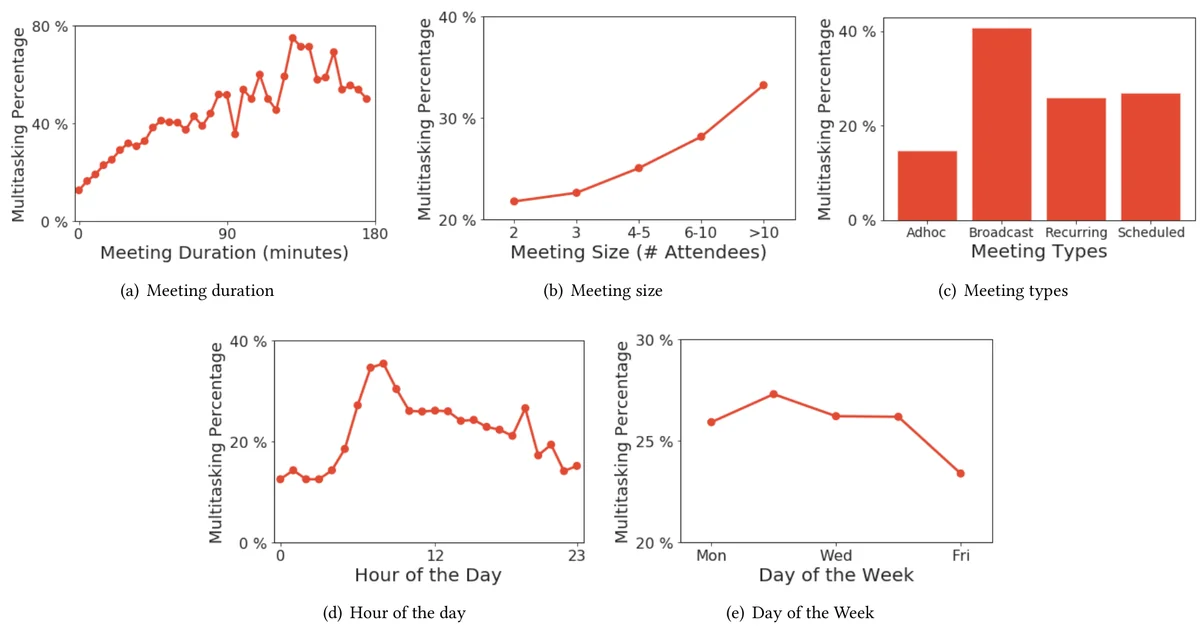
Bigger, longer meetings, more multitasking. Comparing meetings of different sizes and lengths in the telemetry, the odds of emailing during a meeting rose steadily with the number of attendees and, even more, with duration. Diary participants said they simply could not concentrate through long meetings: #
“meetings seem to be longer (e.g., I have a three hour brainstorming session with my team today) and I cannot focus on the meeting that long alone.”
Timing and type matter too. Recurring and scheduled meetings involved more emailing than ad hoc ones. So did morning meetings compared with afternoon or after-hours ones, and Monday to Thursday compared with Friday (possibly because the company encourages fewer Friday meetings). #
“I will try to glimpse at email more if a meeting is the first thing I do for work in the morning - so that's schedule-related.”
Catching up, tuning out, distractions. In the diaries, people said they multitasked to catch up on work squeezed out by more meetings, when a meeting seemed irrelevant to them, and because of pop-up notifications and distractions at home. Turning off video or muting made it easier to go unnoticed. #
“Another major reason (39 % responses) why people multitask is to catch up on their work.”
Sometimes it helps. Some diary participants said multitasking made them more productive, especially when it served the meeting itself, such as taking notes or looking up information under discussion. #
“multiple participants (15 %) mentioned that multitasking helps boost their productivity”
Attention is the main cost. The downside mentioned most often was losing track of the meeting, alongside mental fatigue and seeming rude to colleagues. #
“the most frequently (36 %) mentioned negative aspect is loss of attention/engagement”
Questions this paper answers
- How common is multitasking in video meetings?
- Very common. In telemetry from a large technology company in early 2020, about 30% of meeting attendances involved sending email during the meeting. Employees also felt they multitasked more once meetings moved online. (See §4, p. 5.)
- Why do people multitask more in big or long meetings?
- People say they cannot concentrate through long meetings, and large meetings often cover topics that do not concern them, whereas small meetings demand their full attention to follow the conversation. In company telemetry, the odds of multitasking rose steadily with meeting size and length. (See §5.1, pp. 6–7; §5.2, p. 8.)
- Is multitasking during meetings always bad?
- No. Multitasking can help when it serves the meeting itself, such as taking notes or looking things up, and some people said it made them more productive. The main cost is attention. Losing track of the meeting was the downside mentioned most, along with fatigue and seeming rude. (See §7.1, p. 9; §7.2, pp. 9–10.)
- Does turning your camera off make multitasking more likely?
- It seems so. People often linked multitasking to turning off video or muting, since remote meetings make it easy to stay in the background unnoticed. Some kept their camera on precisely to resist the temptation, because multitasking on camera feels rude. (See §5.2, p. 8; §7.2, pp. 9–10.)
Quantitative results
| Measure | Result | Where |
|---|---|---|
| Telemetry records in the regression | 34,524 (meeting, user) records | §3.1, p. 4 |
| Meetings with email multitasking, February to May 2020 | 31.1%, 30.9%, 29.2%, and 28.9% | §4, p. 5 |
| Odds of email multitasking by meeting size (3, 4-5, 6-10, >10 attendees vs one or two) | 1.12 (P = 0.021), 1.39 (P < 0.001), 1.70 (P < 0.001) and 2.16 (P < 0.001) | §5.1, p. 6 |
| Odds of email multitasking by duration (20-40, 40-80, >80 minutes vs 0-20 minutes) | 1.96, 3.22 and 6.21 (P < 0.001) | §5.1, p. 6 |
| Odds of email multitasking, morning and afternoon vs after hours | 1.86 (P < 0.001); 1.54 (P < 0.001) | §5.1, pp. 6–7 |
| Odds of email multitasking, recurring and scheduled vs ad hoc meetings | 1.59 (P < 0.001) and 1.31 (P = 0.012) | §5.1, pp. 6–7 |
| Diary responses linking multitasking to turning off video or muting | 32% of responses | §4, p. 5 |
Contributions and implications
- Avoid important meetings in the morning, when it is harder to concentrate.
meeting organizers might avoid scheduling important meetings in the morning, when it is harder for people to concentrate
(§8, p. 10) - Reduce unnecessary meetings, share information asynchronously, shorten meetings or insert breaks, and invite only as many people as needed for active engagement.
- Allow space for positive multitasking, for example with personalised agendas or a convention that video-on implies full attention.
Organizers can also implement a convention where video-on implies full attention, and video-off signals multitasking.
(§8, p. 10) - Tools could offer a meeting 'focus mode' that blocks pop-ups, support meeting-related work within the meeting space, and help people decide which meetings, or parts of meetings, to attend.
Limitations
- Data come from one global technology company (telemetry from US workers only), mostly information workers.
our findings may not generalize to other worker types under remote settings, or to other cultures
(§10, p. 11) - Remote work effects could not be separated from COVID-19 effects.
we were not able to distinguish remote work effects from COVID-19 effects
(§10, p. 11) - Telemetry cannot tell whether email and file actions were related to the meeting, and does not capture third-party apps or non-digital activity.
It is likely that some of the positive multitasking observations may be false positives.
(§10, p. 11) - File multitasking showed no significant relationship with meeting characteristics, possibly because edited files are often meeting-related.
›Concepts
- Multitasking
- In meetings it can be related to the meeting (such as note taking) or unrelated (such as email). The general definition:
Information work is often governed by multiple tasks and activities that an individual must remember to perform, often in parallel or in rapid succession, a practice that is called multitasking
(§1, p. 1) - Email and file multitasking
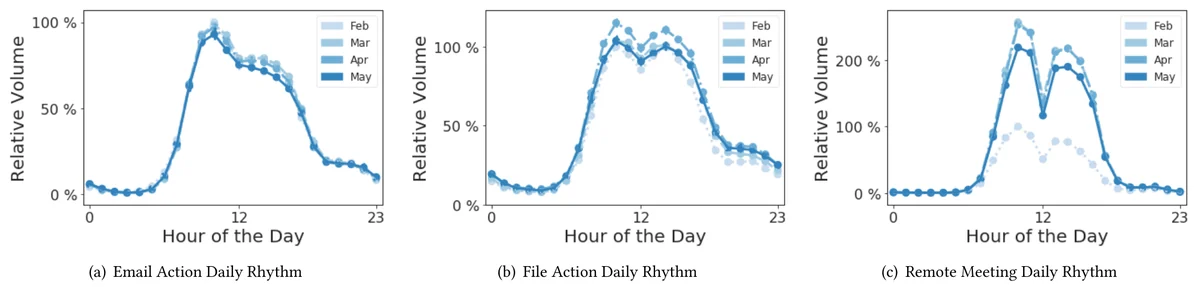
- Our telemetry proxies: sending, replying to or forwarding at least one email, or editing a productivity file, during a meeting. (§1, p. 2)
- Positive multitasking
- Multitasking that fits the meeting's purpose or helps people work, such as note taking or finding relevant information. The design catch:
Some positive multitasking fits the meeting purpose, but technically requires moving outside the meeting window which may increase the risk of being distracted from the meeting.
(§9, p. 11)
Figures
How to cite
Hancheng Cao, Chia-Jung Lee, Shamsi Iqbal, Mary Czerwinski, Priscilla Wong, Sean Rintel, Brent Hecht, Jaime Teevan, and Longqi Yang. 2021. Large Scale Analysis of Multitasking Behavior During Remote Meetings. CHI 2021. https://doi.org/10.1145/3411764.3445243
This brief was prepared with AI assistance and published by Sean Rintel. It is not the authors' published text. Page numbers refer to this PDF.