Research brief
Takeaway: University students who engage with AI proactively and critically (trying problems before asking and checking its answers) score higher on later AI-free exams. Because better-prepared students do this more, equal access may yield unequal learning.
Why this matters
- What was known
- Studies of AI in education report positive, null and negative average effects, and earlier educational technologies showed that averages hide large differences between students.
One reason for these divergent conclusions may be that average effects obscure variation across students and forms of AI use.
(§A Study design and procedure, p. 2) - What this paper adds
- Annotated logs of how each student actually used GPT, linked to their later exam scores and to their backgrounds (university ranking and prior knowledge).
we conducted a randomized controlled experiment involving 318 university students with diverse learner profiles to examine who benefits from AI assistance and how learning behavior is associated with these benefits
(§A Study design and procedure, p. 3) - Who it matters to
- Educators, students, policy makers, and designers of AI-supported learning systems. (§Discussion, p. 9)
Research question
- How does students' learning behavior with AI vary, which students benefit from AI assistance, and how do learner profiles and learning behavior shape these patterns?
Method and data
- Design
- Randomised controlled trial in two course contexts (Python and game theory). Within each course, students were allocated 2:1 to an experimental group with GPT access (during learning, assignment and review) or a control group with no LLM tools. All took the final exam without GPT access.
- Setting
- A fixed, stage-based online study platform: pre-task survey and prior-knowledge quiz, 40-minute course learning, 20-minute assignment, 20-minute review, 20-minute exam and post-task survey, screen recording for compliance, and performance-based pay.
- Participants / data
- 318 adult university students from a wide range of academic tiers, with no prior study of the target subject (game theory: 158 experimental, 79 control, and Python: 54 experimental, 27 control).
- Duration
- One structured session lasting up to 125 minutes.
- Analysis
- Manual annotation of assignment-phase chat logs into five behaviour patterns. One-sided Brunner-Munzel tests (Benjamini-Hochberg adjusted). OLS linear probability and nested OLS models of exam score with bootstrap indirect associations. OLS group-by-profile interaction models. Pre/post survey analysis. Behaviour comparisons are treated as observational.
Findings
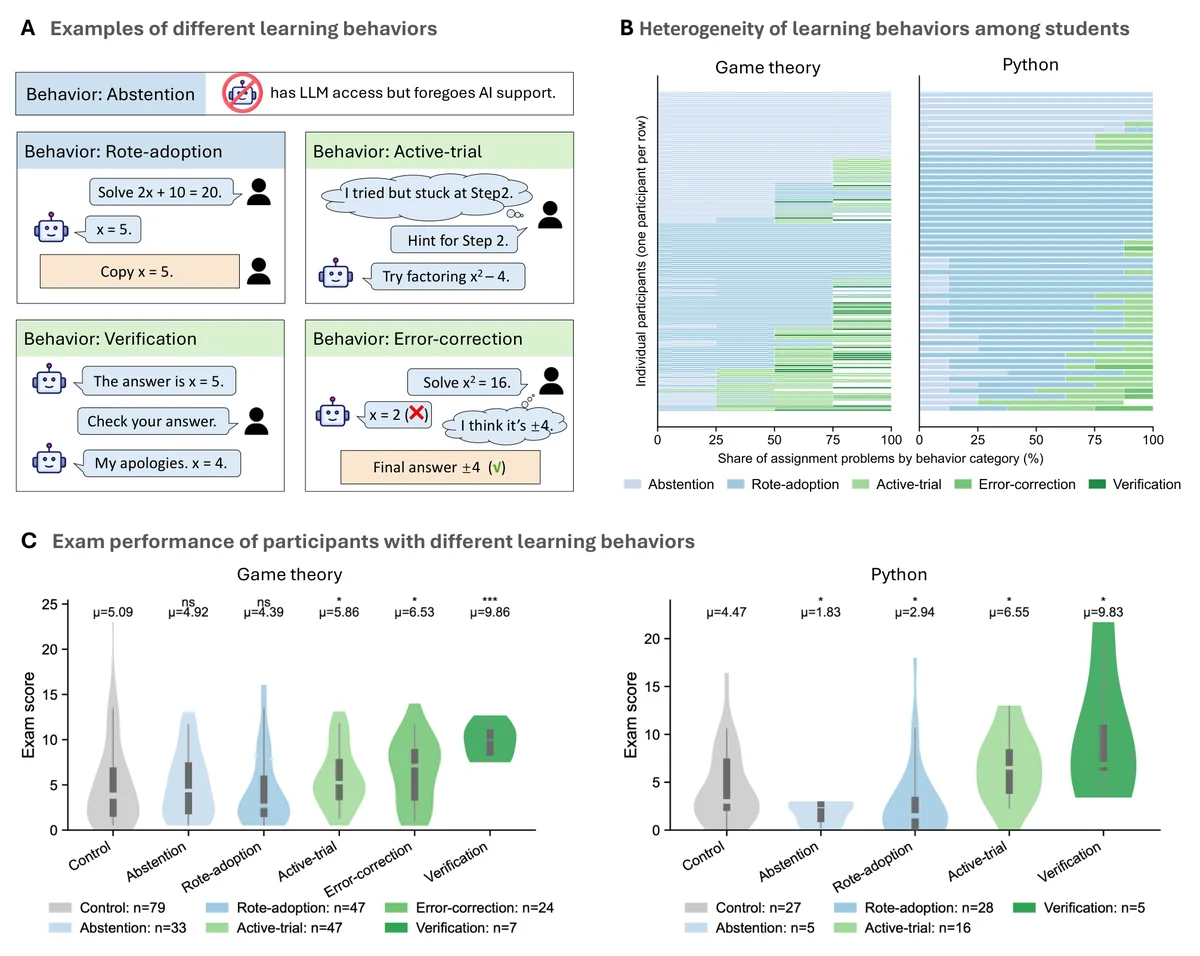
Skipping or copying the AI didn't help. Among university students learning game theory or Python with a GPT assistant, those who ignored it or copied its answers scored no better on a later exam without AI than students who never had it. In Python they scored worse. #
“Rote-adoption also shows limited benefit relative to the control group, even though it may help students complete assignment problems more directly.”
Trying first and checking paid off. Students who attempted problems before asking the assistant, checked its answers against their own reasoning, or caught and fixed its mistakes scored higher on the AI-free exam than students without AI. Students chose these behaviours themselves, so this is an association, not proof of cause. #
“which may help students use AI assistance as support for reasoning rather than as a substitute for engagement”
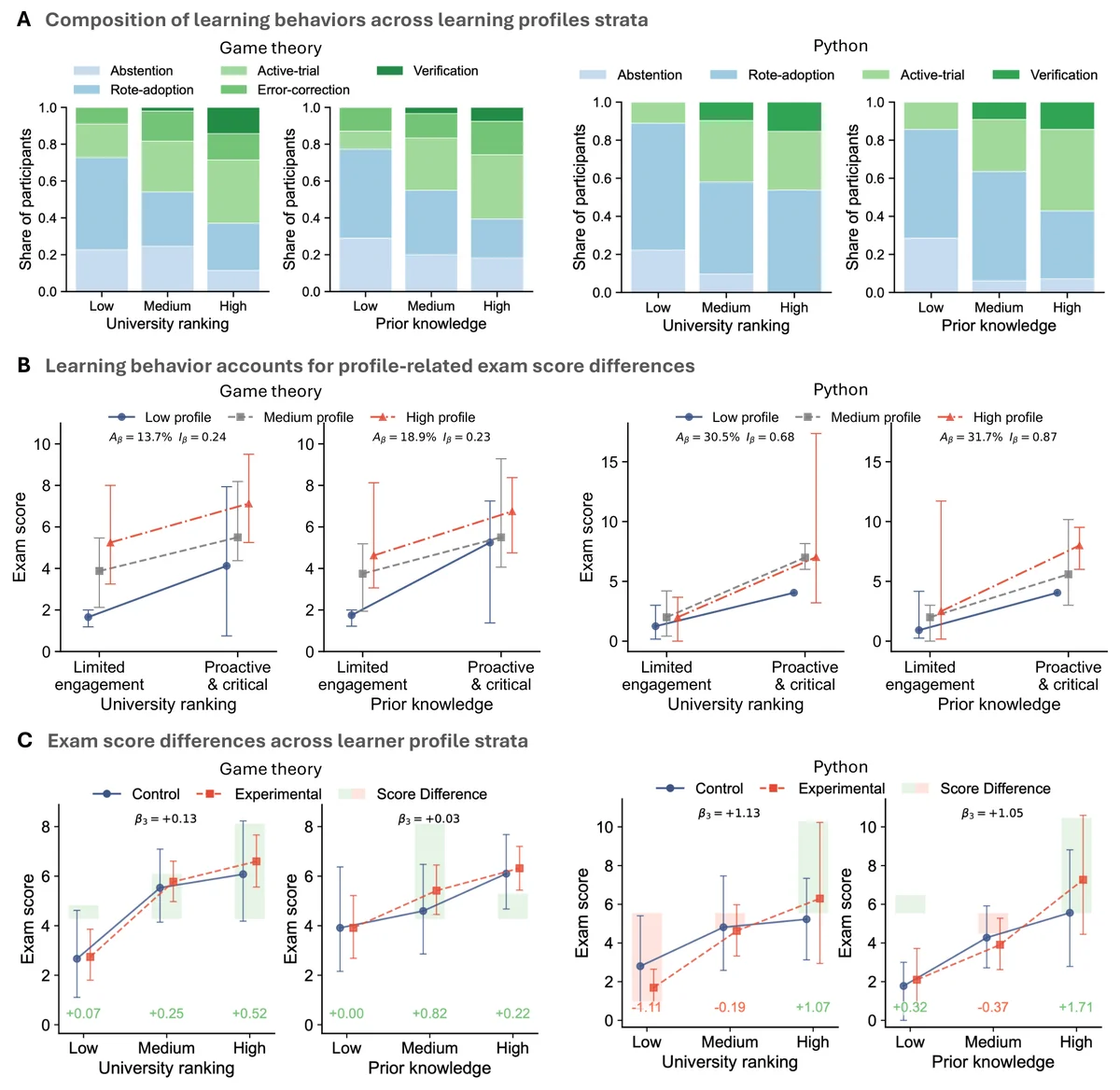
Stronger backgrounds, better habits. Students from higher-ranked universities, and those who scored higher on a prior-knowledge quiz, were more likely to try first, check and correct the AI rather than ignore it or copy it. #
“Equal access to the same tool can therefore produce unequal learning returns.”
Habits explain part of the advantage. Once we accounted for how students used the AI, the exam advantage of students with stronger backgrounds shrank, especially in Python, where it was no longer statistically significant. #
(Results, p. 7)Do stronger students gain more? Not yet clear. In exploratory analyses, students with stronger backgrounds tended to gain more from having AI, compared with similar students without it, but these differences were not statistically significant in our samples. #
“This uncertainty is expected in small samples, as detecting interaction effects typically requires larger samples than detecting main effects”
Students recognised their own habits. In surveys before and after the session, students who engaged proactively more often said they turned to AI when stuck, while concern about over-relying on AI grew more among those who ignored or copied it. #
“direct answer generation can make AI assistance feel useful while also increasing students' awareness of their dependence on the tool”
Questions this paper answers
- Does using an AI chatbot while studying help students learn?
- It depends on how they use it. Among students learning with a GPT assistant, those who tried problems first, checked its answers or corrected its errors did better on a later AI-free exam. Those who ignored it or copied its answers did no better, or worse. These are associations. (See §Heterogeneity in learning behavior shapes learning outcomes, p. 5; §Heterogeneity in learning behavior shapes learning outcomes, p. 5.)
- Does AI widen gaps between stronger and weaker students?
- It may. Students from higher-ranked universities or with more prior knowledge were more likely to use AI proactively and critically. They also tended to gain more, although those gain differences were exploratory and not statistically significant. (See §Discussion, p. 9; Results, p. 7.)
- Why do some students benefit more from AI than others?
- Part of the background advantage appears to run through behaviour. Taking into account whether students engaged proactively and critically weakened the link between background and exam score, in one course to the point of non-significance. These are associations, not causal estimates. (See §Discussion, p. 9; Results, p. 7.)
- Do students who lean on AI answers realise they depend on it?
- Partly. Concern about over-relying on AI grew more among students who ignored or copied the AI than among those who engaged critically. Ready-made answers can make AI feel useful while also making students more aware of their dependence on it. (See §Participant feedback analysis, p. 7.)
Quantitative results
| Measure | Result | Where |
|---|---|---|
| Sample | 318 students; game theory 158 experimental, 79 control; Python 54 experimental, 27 control | Table 1, p. 3 |
| Exam score vs control (control 5.09), game theory: abstention; rote-adoption | 4.92 (not significant); 4.39 (not significant) | Fig. 2, p. 4 Fig. 2 (read from the exam-score panel) |
| Exam score vs control (control 4.47), Python: abstention (n = 5); rote-adoption (n = 28) | 1.83 (significantly lower); 2.94 (significantly lower) | Fig. 2, p. 4 Fig. 2 (read from the exam-score panel) |
| Profile predicts proactive-critical engagement, game theory (linear probability) | auniv = +0.171, P = 0.010; aprior = +0.161, P = 0.002 | Results, p. 5 |
| Profile predicts proactive-critical engagement, Python | aprior = +0.217, P = 0.046; auniv = +0.161, P = 0.127; mid/high vs low ranking proportion difference = +0.32, P = 0.035 | Results, p. 5 |
| Share of profile-exam score association accounted for by learning behaviour (university ranking, prior knowledge) | game theory 13.7% and 18.9%; Python 30.5% and 31.7% | Results, p. 7 |
| Indirect association through learning behaviour, Python prior knowledge | 0.87 (95% CI, 0.032-2.105) | Results, p. 7 |
| Experimental-by-profile interaction on exam score (exploratory; not significant) | Python β3 = +1.13 (ranking), +1.05 (prior knowledge); game theory β3 = +0.13 and +0.03 | Results, p. 7 |
Contributions and implications
- Equal access to AI may not reduce inequality, because students with stronger profiles use it more productively.
Equal access to the same tool can therefore produce unequal learning returns.
(§Discussion, p. 9) - Treat AI literacy as educational support, teaching students to question AI, attempt problems first and not substitute AI output for engagement.
Policy makers and educators should treat AI literacy as educational support
(§Discussion, p. 9) - AI-supported learning systems and instructional practices should guide students towards more productive AI-use behaviour.
Limitations
- Adult university students in two controlled short-course settings only.
the study examines adult university students in two controlled short-course settings
(§Discussion, p. 9) - A single session with an immediate exam. Longer-term learning effects are not established.
it does not establish longer-term learning effects
(§Discussion, p. 9) - Behaviour-outcome links within the experimental group are observational, not causal.
the analysis of learning behavior and exam score within the experimental group is observational
(§Discussion, p. 9) - Interaction (gain) estimates were underpowered. Larger longitudinal and intervention studies are needed.
›Concepts
- Limited engagement
- Two of the five behaviour patterns we annotated, grouped together:
Abstention denotes completing the assignment without using the assistant despite having GPT access. Rote-adoption denotes direct use of AI-generated answers with minimal independent reasoning.
(§Heterogeneity in learning behavior shapes learning outcomes, p. 5) - Proactive and critical engagement
- The other three patterns, grouped together:
Active-trial denotes independent attempts before consulting the AI. Verification denotes explicit checking or follow-up questioning of AI responses against one's own reasoning. Error-correction denotes identifying and revising incorrect AI outputs.
(§Heterogeneity in learning behavior shapes learning outcomes, p. 5) - Learner profiles
- Students' background, measured here as university ranking tier and a timed prior-knowledge quiz. (§Measures, p. 10)
- Abstention
- Having GPT access but not using it during the assignment. (§Heterogeneity in learning behavior shapes learning outcomes, p. 5)
Figures
How to cite
Jingwei Yi, Yueqi Xie, Jiyan He, Rui Ye, Junming Huang, Bin Zhu, Sean Rintel, Yu Xie, Xing Xie, and Fangzhao Wu. 2026. Learning behavior accounts for background-related advantage in AI-assisted education. arXiv preprint arXiv:2607.10101. https://doi.org/10.48550/arXiv.2607.10101
This brief was prepared with AI assistance and published by Sean Rintel. It is not the authors' published text. Page numbers refer to this PDF.