Research brief
Takeaway: Video-only messaging invites 'Me For You' (crafting oneself as worth watching for someone close). That makes treasured gifts, like singing for an overseas best friend, but imposes a 'tyranny of the ordinary' on everyday chat. Every message and reply must be worth watching, so one pair switched to text.
Why this matters
- What was known
- Video messages date back to MMS and video calling services, and modern apps offer video as one mode among many.
Qik exemplifies a new video niche (e.g. Pop, Glide, and Tiiny), and provides an interesting field experiment into the challenges and opportunities of pure asynchronous video messaging as an everyday utility.
(§Introduction, p. 2) - What this paper adds
- We follow a video-only messaging app in everyday use from its launch. We treat gaze over video as a moral matter between people, not only a question of eye line and turn-taking, as earlier video research did.
To warrant another's gaze requires artfulness, and in some relationships one might not want to demand that artfulness in return.
(§Conclusions, p. 4) - Who it matters to
- Designers of everyday telepresence and video messaging, who the paper argues must move beyond assuming that richer modes give better experiences.
The design of everyday telepresence must account for this moral orientation.
(§Conclusions, p. 4)
Research question
- What are the opportunities and challenges of pure asynchronous video messaging as an everyday utility, as seen in how people used Skype Qik 'in the wild'?
Method and data
- Design
- Naturalistic two-week field trial of Skype Qik from its launch in October 2014, with a kick-off, 7 day check-in and 14 day debrief. Interviews, recorded messages, some real-time feedback and communication ecosystem drawings. No set times or tasks.
- Setting
- Everyday use of Skype Qik, which allowed video messages of up to 42 seconds and no other modes.
- Participants / data
- Convenience sample of 53 users from the UK (22), Australia (17) and Macau (14), aged 17 to 44 (70% between 19 and 25). 55% female, 45% male.
- Duration
- Two weeks (14 days).
- Analysis
- Qualitative analysis of users' vernacular descriptions and practices of using Qik.
Findings
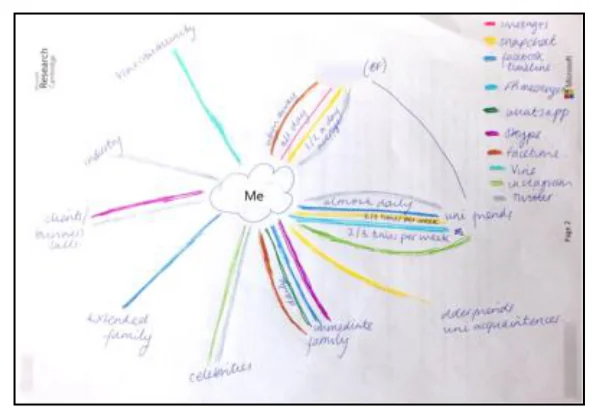
Each app has its own character. Asked to map their communication apps, the people trying Skype Qik described messaging, sharing and calling apps in distinct terms ('nowness', 'look-at-this-ness' and 'personal newsyness'). Video had a special place in each. #
“Calling video involved a special need for ongoing video, proposing that the relationship is special and video can be used to manage that specialness.”
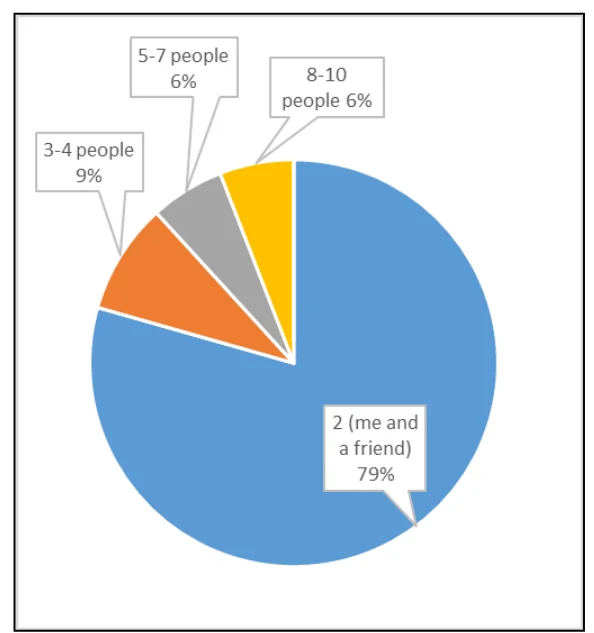
Recording yourself, for one person. Qik was used overwhelmingly one-on-one. Users said that recording with the front camera, with no immediate response from the other person, focused them on recording themselves to be watched. #
“We first noticed this in the overwhelming use of Qik one-on-one rather in groups (Figure 2), indicating an orientation to video as intimate.”
Crafted gifts were valued. The uses people valued most were one-take performances made for someone special, such as singing for a best friend overseas, giving a family member a tour of a university, or flirting. #
“All of these activities derive value from there making and receiving a one-take video that is known to be a crafted performance of the self for the other.”
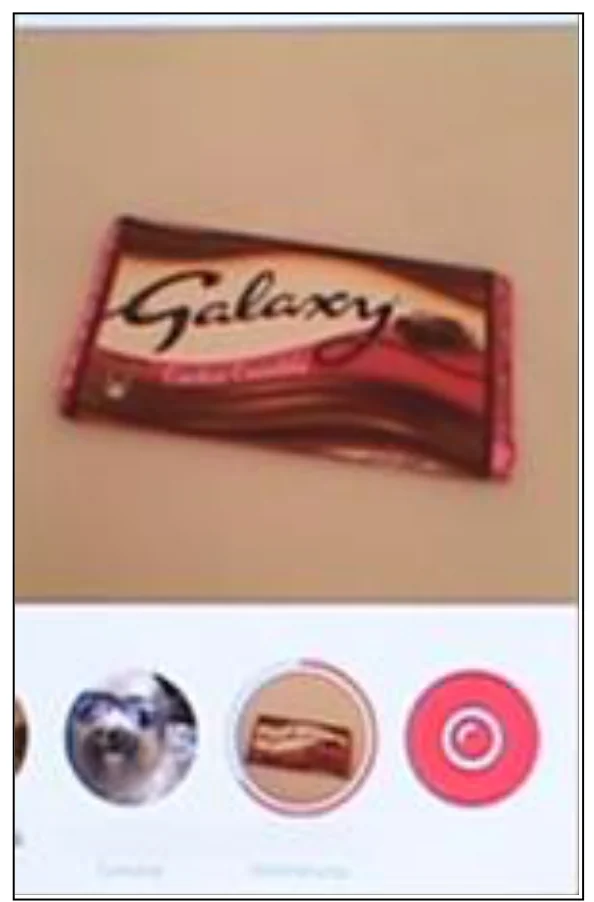
Ordinary chat stalled. For some users, in ordinary back-and-forth, having to reply in video made both starting and answering a message feel like it had to be worth watching. One pair stalled over a voiceless video of a chocolate bar and moved to a service where text was easier. #
“wanted to say 'I hope that isn't all you're having for breakfast' but I had nothing to show back.”
Rich media is not rich interaction. Video is a rich medium, but what people in the trial wanted was control over how much each message carried, so a rich medium did not make for rich interaction. #
“Richness is a matter of fine-grained control, allowing each turn to be constructed with 'just enough' resources rather than the risk of providing 'more than necessary'.”
Questions this paper answers
- What are video messages good for?
- Video messages work best as gifts, in what we call 'Me For You' (crafting oneself as worth watching for someone close). When 53 people tried the video-only app Skype Qik for two weeks, they valued messages visibly made for the recipient, such as singing for an overseas friend or flirting. (See §Me For You, p. 2; §Me For You, p. 3.)
- Why might video-only messaging fail for everyday chat?
- Because of what we call the 'tyranny of the ordinary'. When every reply must be video, mundane surroundings have to seem worth watching. Among 53 people trying Skype Qik for two weeks, one pair stalled over a voiceless video of a chocolate bar and continued by text elsewhere. (See §Me For You, p. 4.)
- Is richer media like video always better for communication?
- No. We argue richness is a matter of fine-grained control (being able to build each turn with 'just enough' rather than more than necessary). Video can be overdetermined for mundane talk. (See §Me For You, p. 4; §Conclusions, p. 4.)
Contributions and implications
- Design should move beyond assuming richer modes offer better experiences and give users control over producing message attention.
users are looking for ways to control everyday production of message attention, creativity, delight, fit, flexibility, reportability, and uniqueness
(§Conclusions, p. 4) - Everyday telepresence design needs a deeper understanding of gaze as a moral orientation, since some relationships need a lighter touch.
Sometimes the moral order of friendship needs a lighter touch.
(§Conclusions, p. 4)
Limitations
- A convenience sample that is not claimed to be representative.
While we do not claim to have recruited a truly representative sample
(§Method, p. 2) - 'Me For You' is not presented as the only or defining orientation to video in telepresence.
'Me For You' is clearly not the only or defining orientation to video in all forms of telepresence
(§Conclusions, p. 4)
›Concepts
- 'Me For You'
- Our name for Qik users' main orientation:
a self-conscious morality of creative and responsive obligation to being gazed at over video
(§Me For You, p. 2) - Technologized interaction
- The lens we use for everyday app use:
Technologized interaction refers to the vernacular categories and practices by which users treat technology as relevant to their interactions
(§The vernacular of everyday app use, p. 2) - Tyranny of the ordinary
- What 'Me For You' confronts some users with:
Recording a video asynchronously focuses attention on whether the mundane self and surroundings warrant viewing
(§Me For You, p. 3) - Soft ephemerality
- Unlike the few-second 'hard ephemerality' of Snapchat:
Since Qik videos are made in the production context of 'soft ephemerality' (persisting for up to two weeks)
(§Me For You, p. 3)
Figures
How to cite
Sean Rintel, Richard Harper, Rod Watson, and Kenton O'Hara. 2015. Me For You: Lessons About Everyday Video Messaging From Skype Qik. CHI 2015.
This brief was prepared with AI assistance and published by Sean Rintel. It is not the authors' published text. Page numbers refer to this PDF.