Research brief
Takeaway: Telepresence-robot visits can build intimacy through 'dwelling' (everyday togetherness rather than imitation of being there). In one household, family visitors could look around and keep the host company on their own initiative.
Why this matters
- What was known
- Mobile robotic telepresence is often marketed as being like in-person presence, and long-term studies of the lived experience of close relationships are lacking.
research into MRP use in the home has been quite limited
(§1, p. 1) - What this paper adds
- Unlike interview studies of couples using robots, we analyse video of six months of habitual visits moment by moment, from the host's side, after the novelty had worn off.
we explore MRP not in order to evaluate its ability to imitate in-person presence but to understand what communication needs it supports for intimate relations
(§1, p. 2) - Who it matters to
- HCI researchers studying mediated closeness, and designers of telepresence for families, couples and friends living apart.
Research questions
- What is it like to be visited via a mobile robotic telepresence (MRP) robot as a routine part of close relationships?
- What communication needs does MRP support for intimate relations, and what interactional possibilities does it offer in the home?
Method and data
- Design
- Longitudinal, autobiographically oriented ethnography with an ethnomethodological and conversation-analytic (EMCA) sensibility. The first author was the local user.
- Setting
- The first author's single-floor apartment in the United Kingdom, partly during COVID-19 lockdown, with a Double 3 telepresence robot, from 27 January to 28 July 2021.
- Participants / data
- Main remote visitors were the first author's mother and partner, each visiting almost once a week for 40 minutes to an hour. A friend, her brother and her PhD supervisors also visited. The corpus is 23 videoed MRP visits.
- Duration
- Six months.
- Analysis
- Video recorded from cameras in the living room and kitchen (a third-person view, so the remote user's view is not in the data), plus the first author's notes. Fragments of typical visits transcribed and analysed with EMCA.
Findings
The whole flat went on show. Because a robot visitor could look at almost anything in the flat, from any angle, the host (the first author) at first always tidied up before a visit. Closed doors became a way to keep a backstage. #
“Over time, I stopped controlling the state of my flat and let people close to me experience being in my unedited space, and in doing so experience being with me on a more sincere level.”
Arrivals you cannot put off. A robot visit starts when the visitor logs in and the robot's brakes release with a distinctive sound, which works like a doorbell. Visitors announced themselves and often made a show of driving out to meet the host. #
“However, unlike in those cases, I do not have the option not to answer, or to wait-to take a moment to prepare-before answering.”
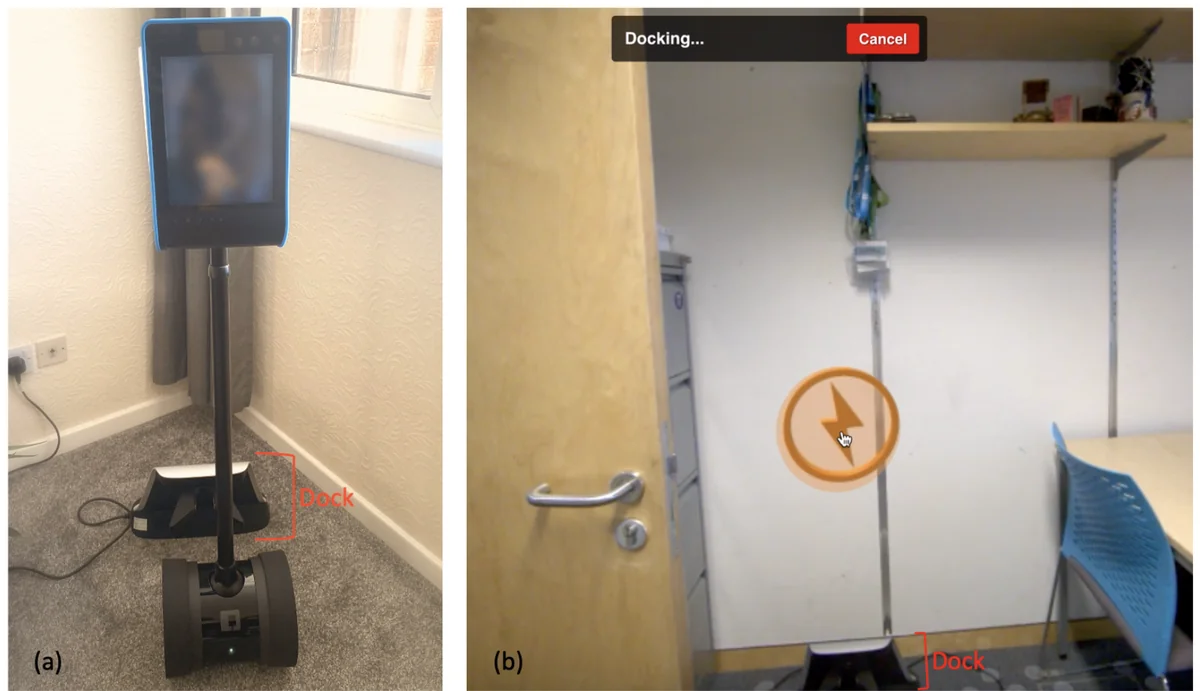
Goodbyes take longer. Leaving meant driving the robot back to its charging dock, so goodbyes stretched out, new topics came up on the way, and the host often walked alongside, like seeing a guest to the door. #
“So, departing is not just about' saying goodbye' but also about' parking' the MRP-departing' considerately' .”
Visitors looked around for themselves. Driving the robot, visitors such as the host's mother could explore the flat and remark on things that mattered to them, like a chair from the host's childhood. On a video call they would have had to wait to be shown things. #
“The MRP, then, allows the remote user to do that and demonstrate that they are doing it on their own accord, rather than relying on the local user to show them things.”
Just being there felt intimate. Quiet moments of simply sharing the space, such as the host's partner keeping her company while she made coffee, felt intimate, perhaps partly because the visitor had chosen where to be. #
“the possibilities of this physical autonomy of the remote user helped make such presence feel intimate”
Unequal abilities became care and play. The robot visitor was slower than the host and could not handle objects, an asymmetry that left mutual awareness occasionally problematic. In this intimate setting, though, the host's accommodating her visitor (stepping aside and keeping herself in view) became a way to care for them. The robot's slowness became a source of jokes rather than frustration. #
“In having him "race" against the speed of the closing door, the slow speed of the MRP is funny.”
Questions this paper answers
- Can a telepresence robot make remote family visits feel intimate?
- It can. Being able to move lets a visitor look around, follow the host from room to room and keep the host company, on their own initiative. Over six months in one household, that autonomy made quiet moments feel intimate and put both people on a more equal level. (See §4.4, p. 17; §4.5, p. 19.)
- What is it like to have someone visit your home through a robot?
- More like a visit than a call, with a beginning, middle and end. In one household, the host tidied beforehand, could not delay the visitor's arrival once they logged in, and walked them back to the charging dock. So each visit took up a stretch of the day. (See §4.1, p. 8; §4.2, p. 9; §4.3, p. 11.)
- Are the limitations of telepresence robots a problem for close relationships?
- Not necessarily. The robot was slow and had to be accommodated, but in this domestic, intimate setting its limits could become sources of play and conversation rather than frustration. (See §4.5, p. 19.)
- Do people keep using a home telepresence robot once the novelty wears off?
- Not automatically. Over six months in one household, visits became routine and less exploratory. One regular visitor often defaulted to video calls, partly to avoid sitting at a desk after work, while another stayed keen. The qualities we describe persisted throughout. (See §4.5, p. 19.)
Contributions and implications
- Telepresence robots are better understood for their own interactional possibilities than as a simulation of being there in person.
These features set MRP apart from traditional video calling, not because MRP use simulates 'being there' in-person as some marketing material suggests
(§6, p. 23) - The remote user's autonomous movement lets both people show initiative, express interest and influence the situation.
We find that the autonomous movement of MRP enables its users to interact on a more equal level
(§6, p. 23) - Playfulness, rarely examined in research on mediated intimacy, was a prominent element of these visits.
playfulness has not been specifically examined in the mediated intimacy literature
(§5.3, p. 22)
Limitations
- The study focuses on one household. Other families, households with children and other long-distance couples may use robots differently.
Our study trades off a broad understanding of domestic MRP use by focusing on just one household.
(§5.4, p. 23) - The data and the autobiographical perspective are the local user's. The remote user's experience still needs study.
For a complete understanding of the medium, future studies should capture the experience of the remote user as well.
(§5.4, p. 23)
›Concepts
- Mobile Robotic Telepresence (MRP)
- The technology studied here:
Mobile Robotic Telepresence (MRP) systems are remotely controlled, mobile videoconferencing devices that allow the remote user to move independently and have a physical presence in the environment.
(Abstract, p. 1) - Dwelling
- Ingold's term, which we use instead of presence measured by fidelity to in-person encounters:
Ingold uses "dwelling" to describe "being" as the intransitive act of producing our lives together as we live them
(§1, pp. 1–2) - Visit
- The participants' own term for this use of the robot (dropping into the home for a while, with an arrival, a middle and a departure).
we describe the experience as a' visit' , which is also the term participants employed to name this kind of MRP use
(§3.6, p. 7) - Fractured ecology
- Luff and colleagues' term, which applies to robot visits:
This is what Luff et al. describe as a "fractured ecology", as the remote visitor and I have different access to the environment and what is happening in it
(§4.4, p. 15)
Figures
How to cite
Andriana Boudouraki, Stuart Reeves, Joel E. Fischer, and Sean Rintel. 2022. Mediated Visits: Longitudinal Domestic Dwelling with Mobile Robotic Telepresence. CHI 2022. https://doi.org/10.1145/3491102.3517640
This brief was prepared with AI assistance and published by Sean Rintel. It is not the authors' published text. Page numbers refer to this PDF.