Research brief
Takeaway: Machines describing meetings to visually impaired colleagues must bridge an interpretation gap. A cue people call simple and objective, like someone 'listening to both of them', is many pose and gaze labels added up. That is because social attention is selective sense-making, not just what can be seen.
Why this matters
- What was known
- Machine vision can already label basic visual information such as pose and gaze.
Research has yet to systematically address the significant gap between levels of granularity and interpretation of machine labels and of human comprehension.
(Abstract, p. 1) - What this paper adds
- Preliminary results from interviews with visually impaired employees and a narration study, yielding a structural model of how people describe social attention in meetings.
the output viewed by human users as elemental and objective is, in fact, often highly interpretive and requires several levels of algorithmic accumulation of basic recognized events
(§INTRODUCTION, p. 2) - Who it matters to
- AI and HCI researchers building systems that translate machine recognition into output for people, such as voice assistants and assistive technology for visually impaired meeting participants.
we strongly encourage specialists from both fields to start considering the degrees of minimal required interpretability in AI systems
(§CONCLUSION, p. 4)
Research questions
- How do visually impaired people experience social dynamics in work meetings, and what additional information would they find useful?
- How do people narrate the visual social attention cues of a meeting for a visually impaired person, and what structure do those descriptions have?
Method and data
- Design
- Two preliminary studies: semi-structured interviews, then a quasi-experimental narration study.
- Setting
- Work meetings. In Study II, participants narrated muted video recordings of meetings to an imaginary visually impaired person, focusing on social dynamics.
- Participants / data
- Study I: ten visually impaired employees from diverse types of organizations. Study II: 15 participants, each shown six ~2 min videos of work meetings with 4 to 6 meeting participants.
- Analysis
- Qualitative analysis of interview accounts and of narrated descriptions, used to build a structural model of social attention description.
Findings
Questions this paper answers
- What do visually impaired people want to know about what's happening in a meeting?
- Body language and attention, such as whether others are engaged, attentive, confused or supportive. Visually impaired employees interviewed about meetings saw this as objective information. They preferred to receive it unprocessed, so that they could interpret it themselves. (See §Study I: How visually-impaired people experience social dynamics in meetings, pp. 2–3; §Study I: How visually-impaired people experience social dynamics in meetings, pp. 2–3.)
- Can machine vision describe social dynamics in meetings to blind users?
- Many relevant signals, such as gestures and body pose, are potentially recognisable by machine vision. But the descriptions people expect are interpretive and accumulative, so a system would need to combine basic labels into higher-level events before they are meaningful to a listener. (See §Study I: How visually-impaired people experience social dynamics in meetings, pp. 2–3; §Study II: How people narrate the social attention cues of a meeting, p. 3; §Study II: How people narrate the social attention cues of a meeting, p. 3.)
- Is a description like 'she is listening' objective?
- Not to a machine. People treat it as plain observation, but it interprets gaze and posture as an act of attention, and attention to a group must be pieced together from several individual acts. Such summaries spare a listener overload, so systems need rules for building them. (See §Study II: How people narrate the social attention cues of a meeting, p. 3; §Study II: How people narrate the social attention cues of a meeting, p. 3; §Study II: How people narrate the social attention cues of a meeting, p. 3.)
Contributions and implications
- Research should explore how people build accumulative descriptions and turn them into machine recognition rules, since these reduce the listener's cognitive overload.
it is important that research continues to explore further the mechanisms of accumulative descriptions and formulate them as machine recognition rules
(§Study II: How people narrate the social attention cues of a meeting, p. 3) - AI and HCI researchers should work together, with HCI articulating the requirements for applying machine recognition in human-oriented technology, including the minimal interpretability systems need.
we strongly encourage specialists from both fields to start considering the degrees of minimal required interpretability in AI systems to advance the possibilities of systems applications
(§CONCLUSION, p. 4)
Limitations
- The results are preliminary, and understanding of the right degree of interpretability is at a very early stage.
We are still at the very early stages of understanding how to identify the appropriate degree of interpretability
(§CONCLUSION, p. 4)
›Concepts
- Interpretation gap
- The problem the paper names:
the gap between the degree of atomization of labels produced by machine recognition and the complexity of system output required for human comprehension
(§INTRODUCTION, p. 2) - Social attention
- Why machine labels of pose and gaze are not enough:
social attention is above all a progressive process of selection of cues that lies as much in human sense-making abilities as it does in their physical abilities
(§INTRODUCTION, p. 2) - Actor, target and attention identifier
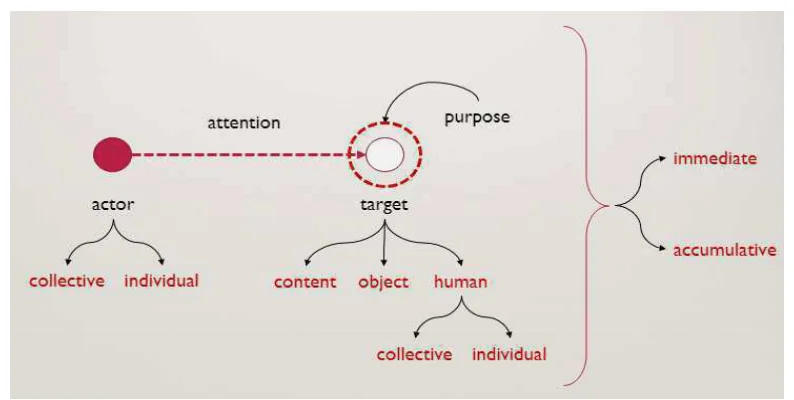
- The elements of our model of attention descriptions: who attends (individual or collective), what they attend to (content, object or human), and the verb naming the act of attention.
descriptions identified an actor element as a source of a 'attention action' (the 'who' of an attention description), differentiated as individual and collective
(§Study II: How people narrate the social attention cues of a meeting, p. 3)
Figures
How to cite
Anastasia Kuzminykh and Sean Rintel. 2019. Meeting in the Middle: The Interpretation Gap Between People and Machines. CHI 2019.
This brief was prepared with AI assistance and published by Sean Rintel. It is not the authors' published text. Page numbers refer to this PDF.