Research brief
Takeaway: People hold two mental models of meeting goals (meetings as means to an end, or as ends in themselves for connection and discovery). Misaligned goals can create tension between organizers and attendees, so meeting intentionality (knowing why you meet) needs tools that surface goals across the meeting lifecycle, from scheduling.
Why this matters
- What was known
- Meeting science has long flagged unclear goals as a cause of ineffective meetings, yet calendar and videoconferencing tools do not ask anyone why a meeting is needed. (§1, pp. 1–2)
- What this paper adds
- Rather than classifying meeting topics, as earlier taxonomies did, we examine people's intentions and assumptions before a meeting, how goals arise or are obstructed, and what follows. We draw design implications for calendar and meeting technologies, including generative AI. (§2.4, p. 3)
- Who it matters to
- Designers of calendar, planning and meeting systems, and the organizers and attendees of workplace meetings.
Our findings have implications for designing systems which increase effectiveness in meetings by catalyzing intentionality and reducing tension in the organisation of meetings.
(Abstract, p. 1)
Research questions
- What mental models of meeting goals do workers hold?
- How do meeting goals arise, and what obstacles stand in the way of setting, communicating and understanding them?
- What functional, affective and interpersonal implications do these mental models, practices and obstacles have?
- How might calendar and meeting technologies be designed to support intentionality in meetings?
Method and data
- Design
- Exploratory, formative qualitative interview study, with an exploratory probe asking participants to consider a 'meeting goals' field in calendar invitations.
- Setting
- A global technology company. Interviews held as recorded Microsoft Teams video meetings.
- Participants / data
- A purposive sample of 21 employees across six work areas, selected for diversity of gender, age, location, work area, seniority, hybrid work status and managerial status.
- Duration
- Semi-structured interviews lasting between 30 and 70 minutes, preceded by an onboarding survey.
- Analysis
- Two authors open-coded six interviews. An initial hierarchical codebook was developed through iterative discussion, and the first author coded the remaining 15 interviews in MAXQDA Plus 2022.
Findings
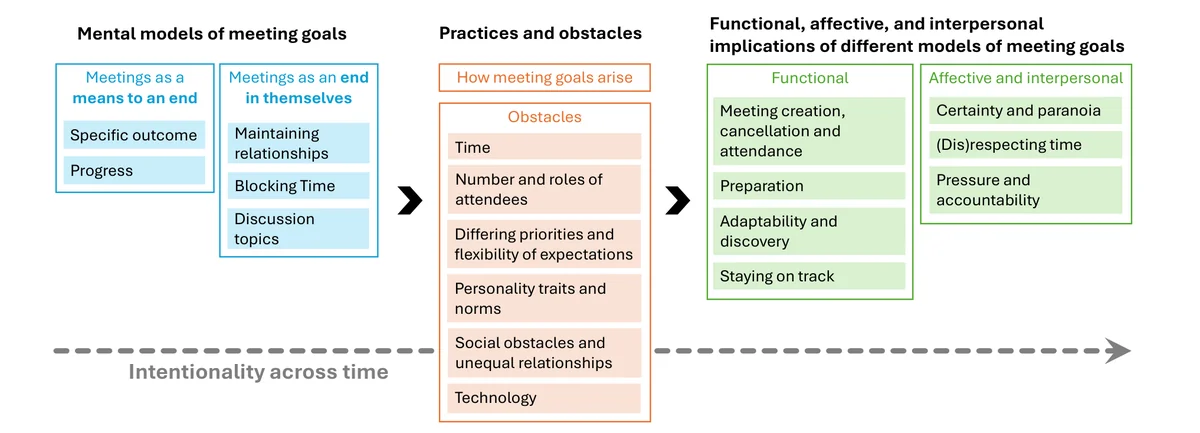
Two ways to see a meeting. Across interviews with employees of a global technology company, two contrasting mental models of meeting goals stood out. One sees meetings as a means to an end (reaching an outcome or making progress). The other sees meetings as an end in themselves (maintaining relationships, discussing topics or simply blocking time). One person can hold both. #
“sometimes the only goal for me wasn't really so much to get something out of that kind of a meeting, other than making sure my team felt connected with each other”
Topics are not goals. Many people treated a list of discussion topics, or a recurring meeting's standing agenda, as its goal. That says what will be discussed but not why, which hides the meeting's purpose. #
“If it's a recurring meeting... they always have an agenda and, you know, the goal is just to get through the agenda.”
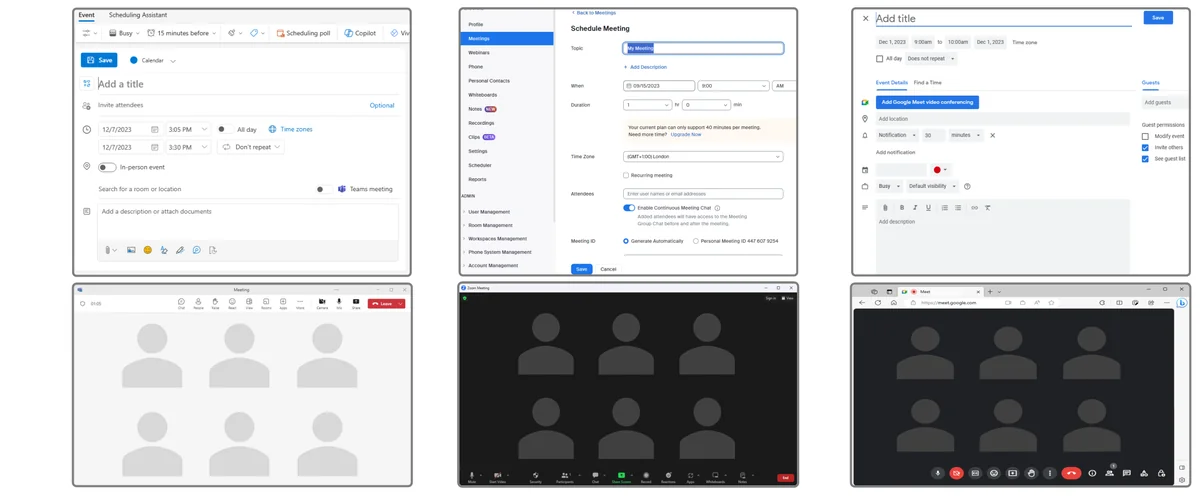
Time, people and tools get in the way. People named many obstacles to setting and sharing meeting goals. These included too little time, many attendees with different roles, personality and team norms, differing priorities, and hidden agendas. Tools also scatter a meeting's context across scheduling, chat and meeting apps. #
“Hence, technological systems supposedly designed to support meetings and wider collaboration can actually lead to the fragmentation and obscuring of intentionality.”
Asking 'why?' feels risky. Invitees sometimes avoided asking an organizer what a meeting was for, for fear of seeming impolite, critical or ignorant. They asked more readily when they already knew the organizer. #
“I don't want to offend them if I decline their meeting or if I'm a jerk about, hey, I'm not gonna come unless you tell me what the agenda is, alright?”
Goals cut both ways. Clear goals helped people decide whether to attend and how to prepare, while open, goal-light meetings allowed adaptability and discovery but risked going off track. Missing goals caused uncertainty, even paranoia, and a sense of wasted time. Stated goals could feel like pressure. #
“Six participants (P3, P8, P10, P13, P18, P19) mentioned that they were less likely to attend a meeting without a clear goal.”
A goals field appealed, with caveats. Asked to imagine a 'meeting goals' field in calendar invitations, participants thought it would help both organizers and attendees. Some worried it would feel pressurizing, be neglected or be hard to keep up to date. #
“I feel like people would just write, you know, garbage in there because for that meeting where it's not important and then at some point it's just gonna be like a field people just ignore.”
Questions this paper answers
- Why do so many work meetings lack a clear goal?
- Partly because meeting intentionality (knowing why you are meeting) is hard to establish beforehand. Planning takes time people lack, and specific goals are hard for large mixed groups. Tools split a meeting's context across apps, and asking organizers why can feel impolite, so unclear goals sometimes go unchallenged. (See §4.2, p. 9; §4.2, p. 9.)
- Does every meeting need an explicit goal?
- Not necessarily. Some meetings exist to maintain relationships or give space for open discussion, and loose structure can allow adaptability and discovery. But goal-light meetings risk going off track, and treating discussion topics as the goal can hide why the meeting exists. (See §4.1.2, pp. 6–7; §4.1.2, p. 7; §4.3, p. 10.)
- What happens when people are invited to a meeting without a clear purpose?
- Uncertainty and a sense of wasted time. People described being less likely to attend or unable to prepare properly, uncertainty and even paranoia about why they were invited, and feeling their time was wasted. Clear goals before a meeting helped people decide whether to attend and how to prepare. (See §4.3, p. 10.)
- Why do recurring meetings so often feel like a waste of time?
- Their original purpose can fade. A series may run for a long time while any single instance is unlikely to change anything. Time is often blocked in advance before anyone knows what it is for. Getting through a standing agenda can replace asking why the meeting exists. (See §4.1.2, pp. 6–7; §4.1.2, p. 7.)
Contributions and implications
- A 'meeting goals' field at scheduling time could serve organizers, invitees and attendees at different points.
a meeting goals field can help (a) organizers to decide on whether they need a meeting in the first place, (b) invitees to decide on whether they should attend, and (c) attendees to adequately prepare for the meeting as needed
(§5.1, p. 13) - Supporting intentionality is about reflection, not forcing explicit goals onto every meeting.
Supporting intentionality does not mean that every meeting should have an explicitly communicated set of goals.
(§5, p. 12) - Generative AI could prompt people to reflect on meeting intentions in context, draft goals and agendas, suggest alternatives to meeting, let attendees ask about goals without offending organizers, and eventually generate goal-driven meeting interfaces.
- Intentionality interventions carry risks, such as added demands on time and attention, over-analysis during meetings, and pressure or a sense of surveillance.
By repeatedly surfacing intentionality, systems could be perceived as applying pressure on users, contributing to greater feelings of stress at work
(§5.1, p. 15)
Limitations
- All participants came from one global technology firm.
Our participant cohort consisted of employees from just one global technology firm, which has shaped their norms, practices, and available technologies.
(§3.3, p. 4) - Seventy percent of participants were from the US, and meeting practices differ across cultures, so findings may not fully generalize.
- Participants self-selected from people who had taken part in earlier meeting research and may be more thoughtful about meetings than most.
participants self-selected into our study based on participation in prior meeting research
(§3.3, p. 4) - Meeting organizers may be biased in evaluating their own meetings, and the study had no way to account for this.
›Concepts
- Meetings as a means to an end
- A mental model in which a meeting's goals are specific and knowable:
participants view meetings as achieving outcomes that are expressly in aid of broader work
(§4.1, p. 5) - Meetings as an end in themselves
- A mental model in which the act of meeting is itself the purpose, which can also mean simply blocking time:
participants view meetings as time for connection or discussion
(§4.1, p. 5) - Meeting goals versus agendas
- Goals and agendas are related but distinct: an agenda is a plan for reaching a goal.
If goals set the destination for a meeting, then agendas outline the route.
(§2.1, p. 2) - Intentionality across the meeting lifecycle
- The purpose behind a meeting, which can be catalyzed or obstructed at different moments from setting it up to holding it.
Intentionality can travel through the meeting lifecycle, from its conceptualization to its execution.
(§4, pp. 4–5)
Figures
How to cite
Ava Elizabeth Scott, Lev Tankelevitch, and Sean Rintel. 2024. Mental Models of Meeting Goals: Supporting Intentionality in Meeting Technologies. CHI 2024. https://doi.org/10.1145/3613904.3642670
This brief was prepared with AI assistance and published by Sean Rintel. It is not the authors' published text. Page numbers refer to this PDF.