Research brief
Takeaway: Realistic avatar faces are not automatically better for communication. In mixed reality work meetings, identical body language seemed more useful on realistic faces. Yet colleagues who started with cartoon faces came to care less about appearance. So designing avatars people accept over time differs from designing ones that look nice.
Why this matters
- What was known
- Most of what is known about avatar appearance in meetings comes from one-off virtual reality lab studies with strangers, prone to novelty effects. (§1, p. 2)
- What this paper adds
- A longitudinal, within-subjects field study comparing realistic and cartoon full-body avatars in co-workers' real recurring mixed reality meetings.
To our knowledge, there are no studies comparing different avatar styles over time in immersive environments.
(§2.2, p. 3) - Who it matters to
- Designers of avatars and of mixed and virtual reality meeting systems, and researchers studying avatar acceptance over time.
The implication is that designing for longitudinal avatar acceptance is different to designing acceptable avatars.
(§6, p. 6)
Research questions
- RQ1: the functional communicative value based on (a) the identification of the other person (people); (b) the perceived authenticity of communications; (c) the perceived usefulness of expression and movement.
- RQ2: the task satisfaction based on: (a) level of tasks impact, (b) comfort and (c) engagement.
- RQ3: the concept of presence based on: (a) co-presence and (b) social presence.
Method and data
- Design
- Within-subjects longitudinal field study: each person used a personalised full-body avatar with a realistic face and one with a cartoon face, and half the groups started with each, switching half-way.
- Prototype
- A networked mixed reality meeting application built in Unity for Microsoft HoloLens 2. Each person sees a holographic blue table, adjustable to fit their room, with colleagues' avatars placed around it, and a menu to create, join or leave a meeting, mute, and switch avatar. Each participant had two personalised full-body avatars made with Avatar SDK from a head-and-shoulders photo, one with a realistic face and one with a cartoon face. Avatars were animated live from the headset's head and hand tracking, with mouth movement driven by voice loudness and blinking but no gaze. The animation was the same for both styles. The two styles were compared with each other.
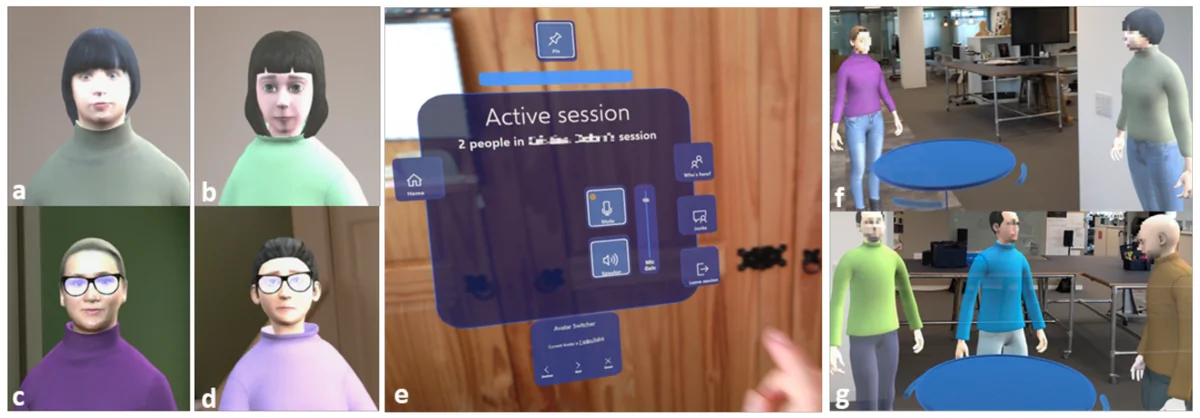
Figure 1: Example of realistic (a,c) and cartoon (b,d) avatar upper bodies. The main menu controlling the session (e). A meeting between two participants in realistic avatars (f) and three in cartoon avatars (g) with the adjustable blue table marking the centre. From the paper, Figure 1, p. 1. - Setting
- Groups' own recurring work meetings (often stand-ups, status reports or catch-ups), held in mixed reality on Microsoft HoloLens 2.
- Participants / data
- 14 participants (7 female, 6 male, 1 non-binary) from a global technology company, in 6 groups of co-workers who knew each other: 4 dyads and 2 triads.
- Duration
- Two to three weeks (up to ten meetings per group). 54 meetings in total.
- Analysis
- 124 daily questionnaires with 12 items on 1-7 Likert scales. Repeated measures ANOVA on per-participant averages, and regression over time by avatar type and week.
Findings
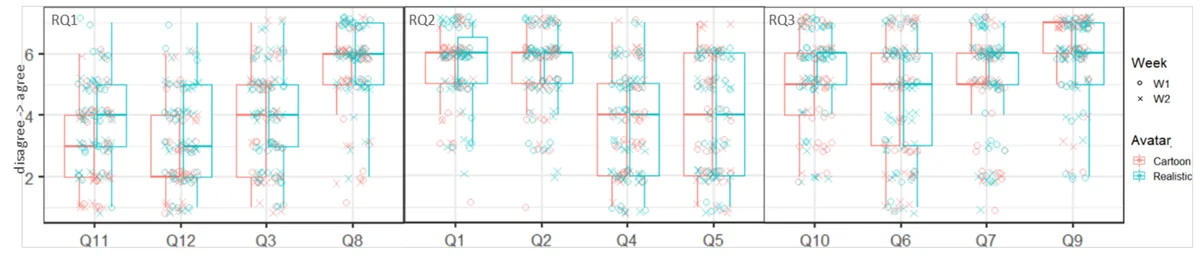
Same movement, more meaning. Co-workers holding their regular meetings in mixed reality rated their colleagues' body language as more appropriate and more useful for understanding them with realistic avatars than with cartoon ones. Both styles were animated in exactly the same way. #
“This indicates that the realistic avatars showed a higher functional communicative value based on the perceived authenticity of communication”
Otherwise, no significant difference. Avatar style made no significant difference to how engaged or comfortable people felt, how much appearance affected their tasks, whether they felt in their colleagues' presence, or whether the avatars seemed only computerised images. #
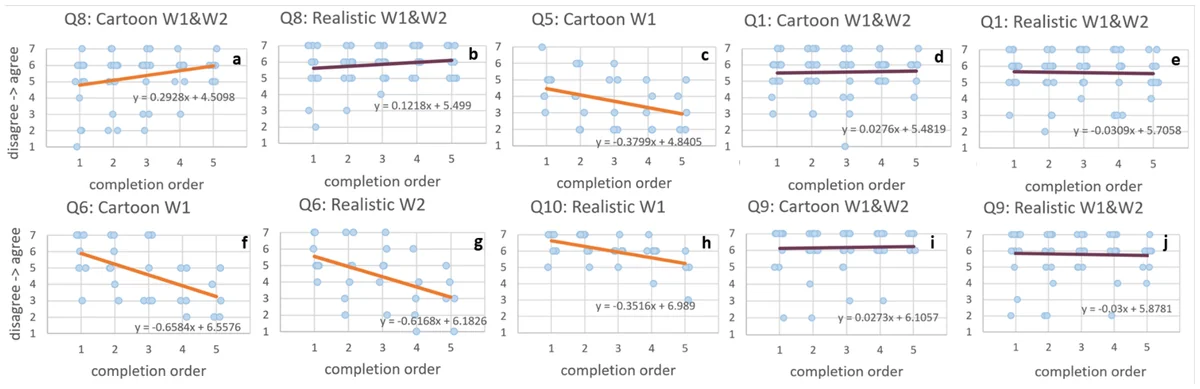
(§4.1, p. 5)Cartoon colleagues became recognisable. With cartoon avatars, people got better at identifying their colleagues across meetings. With realistic avatars, identification was high from the start. #
(§5.2, p. 6)Starting with cartoons made appearance matter less. Groups that began with cartoon avatars said appearance mattered less and less, and the trend continued after they switched to realistic avatars. Groups that began with realistic avatars showed no such trend. #
“I feel like I am starting to care less about the avatar's appearance”
Realism's strangeness faded. Groups that began with realistic avatars noticed less obviously unnatural body language from their colleagues' avatars as the first week went on. This may be a recovery from the uncanny valley (the unease people feel when a lifelike figure does not move quite right). #
“This was possibly due to a strong initial mismatch between realistic appearance and less realistic behaviour, that participants adjusted to over time.”
Questions this paper answers
- Are realistic avatars better than cartoon avatars for work meetings in mixed reality?
- Partly. Co-workers rated realistic avatars' body language as more appropriate and more useful for understanding each other, although the animation was identical. Engagement, comfort, task impact and co-presence did not differ significantly between styles. (See §5.1, pp. 5–6; §4.1, p. 5.)
- Do people get used to avatars over repeated meetings?
- Initial results suggest so, which is why first impressions can mislead. Over repeated meetings, cartoon avatars became easier to recognise and appearance mattered less for people who started with cartoons. The unnaturalness of realistic avatars faded for those who started with them. (See §5.2, p. 6; §5.2, p. 6; §5.2, p. 6.)
- Does the order in which you use avatar styles matter?
- It may. Over repeated meetings, trends depended on which style people used first, not on style alone. Starting with realistic avatars may create a strong mismatch between lifelike looks and less lifelike movement that people adjust to. Those starting with cartoons were already used to the movement when they switched. (See §5.2, p. 6; §5.2, p. 6.)
Quantitative results
| Measure | Result | Where |
|---|---|---|
| Sample | 14 participants in 6 groups; 54 meetings; 124 daily questionnaire responses | §3, p. 3 |
| Nonverbal behaviour appropriate for the context (Q11), realistic vs cartoon | F (1, 13) = 7.14, p=.019, η 2 = .355 | §4.1, p. 4 |
| Nonverbal behaviour useful for understanding colleagues (Q12), realistic vs cartoon | F (1, 13) = 5.5, p=.036, η 2 = .296 | §4.1, p. 5 |
| Identifying colleagues (Q8), realistic vs cartoon (not significant) | F (1, 13) = 3.53, p = .08, η 2 = .217 | §4.1, p. 5 |
| Appearance mattered less over time (Q6): cartoon in week 1; realistic in week 2 | p = 0.002; p = 0.005 | §4.2, p. 5 |
Contributions and implications
- The study raises the possibility that lifelike avatars should not be assumed to be the only valuable endpoint for real work meetings. What people find nice is not the same as what helps communication.
what people consider to be nice for an avatar does not equate to the communicative good that it provides
(§6, p. 6) - Longitudinal studies help overcome novelty effects in avatar research.
This demonstrates the value of longitudinal studies in overcoming novelty effects.
(§5.2, p. 6)
Limitations
- Participants had varied prior mixed reality experience, and the sample was too small to test whether that influenced responses.
Due to the small number of participants we could not be test whether the prior MR experience of some participants influenced their responses.
(§5, p. 5) - All participants worked at a large tech company and may be more accepting of innovations in virtual environments.
- These are initial results from the daily questionnaires only. Telemetry and focus group data were left for future work.
›Concepts
- Uncanny Valley
- The theory behind concerns about realistic avatars (affinity later recovers as realism increases further):
when the avatar gets more realistic, the users' affinity increases until a certain point, after which affinity drops quickly and the avatar makes users feel uneasy
(§2.1, p. 2) - Novelty effect
- Responses driven by a system being new, which one-off studies cannot separate from lasting effects. Longitudinal studies can.
we were interested in whether various acceptance ratings for both realistic and cartoon conditions would change over time as the novelty effect wore off
(§1, p. 2) - Functional communicative value
- What we measured, in three parts:
the functional communicative value based on (a) the identification of the other person (people); (b) the perceived authenticity of communications; (c) the perceived usefulness of expression and movement
(§1, p. 2)
Figures
How to cite
Georgiana Cristina Dobre, Marta Wilczkowiak, Marco Gillies, Xueni Pan, and Sean Rintel. 2022. Nice is Different than Good: Longitudinal Communicative Effects of Realistic and Cartoon Avatars in Real Mixed Reality Work Meetings. CHI EA 2022. https://doi.org/10.1145/3491101.3519628
This brief was prepared with AI assistance and published by Sean Rintel. It is not the authors' published text. Page numbers refer to this PDF.