Research brief
Takeaway: In all-avatar work meetings, meaningful movement beats realism. Webcam-driven nods and smiles made colleagues more comfortable and included than lip-synced or static avatars, because they gave visible feedback, though alignment with group decisions did not differ.
Why this matters
- What was known
- Microsoft Teams and Zoom introduced stylised avatars in 2023, with limited animation. Prior research showed motion fidelity matters more than visual fidelity for trust and self-identification, but its link to work meeting outcomes was unclear. (§1, p. 2)
- What this paper adds
- A controlled comparison with real colleagues of three avatar animation modalities (static picture, audio-animated, webcam-animated) on meeting outcomes and avatar satisfaction, plus a thematic framework of ten factors. (§1, p. 3)
- Who it matters to
- Researchers of avatar-mediated communication and the industrial designers building avatars for videoconferencing, and people who prefer not to, or cannot, use video at work. (§6, p. 23)
Research questions
- RQ1. How does avatar animation modality impact meeting outcomes?
- RQ2. Which avatar animation modality do people prefer?
Method and data
- Design
- Within-subjects, mixed-methods experiment. Each group used all three animation modalities, in an order counterbalanced across groups with a Latin square.
- Prototype
- Personalised stylised avatars for video meetings. Each participant's avatar was generated from a short self video and two photographs, using 3D face reconstruction, and participants chose from three versions in advance. A Unity3D application on their own computer animated the avatar and fed it into Microsoft Teams as a virtual camera, so others saw the avatar in place of video. It had three modes: a static picture of the avatar, audio animation, in which the avatar's lips moved with the person's voice, and webcam animation, in which the person's webcam drove the avatar's facial expressions and head movements. Each group met in all three modes.
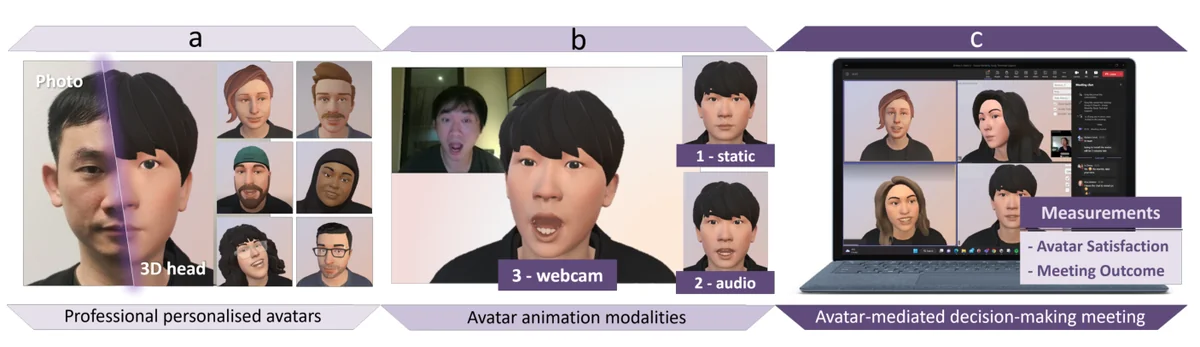
Fig. 1. An overview of the experimental study. a) A personalized 3D stylized avatar was generated for each participant, using their photos with facial landmarks, and preserving diverse personal features like beards, glasses, and hairstyles. b) Participants used their avatars in 3 modalities: static picture, audio-animated and webcam-animated, affecting their head movements and expressions (see supplementary video). c) Participants used the avatars in a videoconferencing meeting, during which they engaged in three group decision-making tasks, one for each avatar modality. Meeting outcomes and avatar satisfaction were measured after each task and compared. From the paper, Figure 1, p. 1. - Setting
- Microsoft Teams meetings in gallery view in which everyone, including the moderator, appeared as an avatar. Three five-minute group decision-making tasks, each followed by a questionnaire, then a 15-minute focus group in which participants chose their own mode.
- Participants / data
- 68 employees of a global technology company, in 16 groups of colleagues who already worked together (44 male, 24 female).
- Duration
- About one hour per session.
- Analysis
- Test of Proportions for effectiveness and Wilcoxon Signed-Rank tests for 5-point measures. Inductive then deductive thematic analysis of free-text responses (50 of 68 participants responded).
Findings
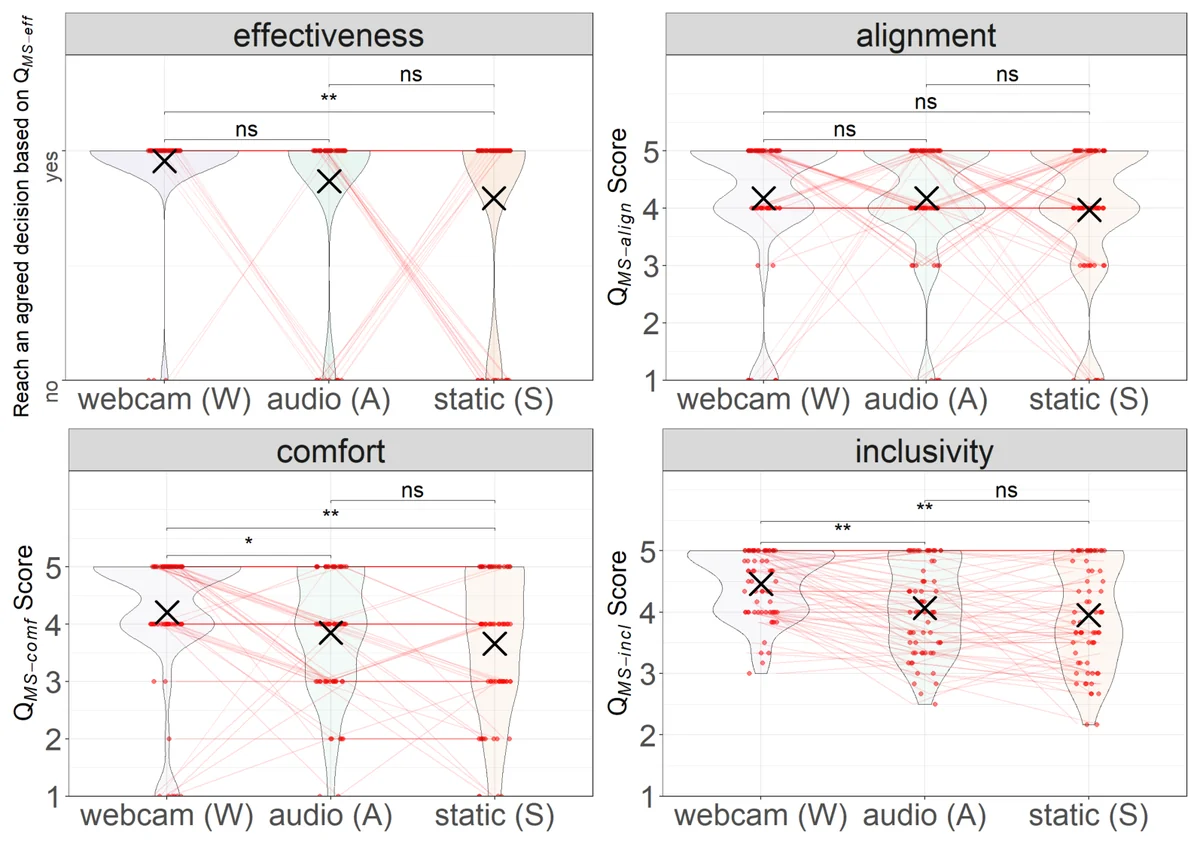
More participants reported a decision than with pictures. Groups of colleagues held short decision-making meetings in which everyone appeared as an avatar. More participants said their group reached a decision when avatars were animated by webcam than when they were static pictures. The difference from avatars animated by voice alone was not significant. #
“It [webcam-animated modality] was helpful to see smiles and head nods as feedback to my statements”
More comfortable, more included. Participants felt more comfortable and more included in meetings with webcam-animated avatars than with either voice-animated or static ones. How far they agreed with the group's decision did not differ significantly between modes. #
“The [picture modality] was somewhat exhausting, as it presented difficulties in discerning the appropriate moments to contribute to the discussion”
Lip-sync alone was not enough. Avatars whose lips moved with the speaker's voice were rated more expressive than static pictures, but did not improve any meeting outcome over them. #
“The upshot is that partial or subtle expressive cues can enhance interaction and expressiveness when contrasted with entirely static representations.”
Nearly everyone chose the webcam avatar. When free to choose their mode for the closing focus group, almost every participant picked the webcam-animated avatar. #
“I appeared as the [webcam-animated modality] because it felt expressive but didn't invade my privacy like a full-on camera would.”
Movement over realism. In participants' written comments, every theme linked to both preference and meeting outcomes concerned movement, such as expressiveness and non-verbal cues, not how realistic the avatar looked. #
“the motion of smiles, head nods, and head shakes are considered more critical for achieving effective communication than realism”
Many said the avatar made no difference. Many participants felt the avatar mode did not affect their group's decision making, pointing instead to how complex the task was and how well they knew their team. #
“Not for this group because we all know each other very well so the non-animated avatars were just like being in a phone call.”
Questions this paper answers
- Are animated avatars good enough to replace video in work meetings?
- We argue webcam-animated avatars are a plausible alternative where video is impractical, though we did not test them against video. Compared with static or lip-synced avatars, they made colleagues feel more comfortable and included, and 95.6% chose them. (See §4.2.1, p. 15; §4.2.1, p. 16.)
- Does avatar animation help teams reach decisions in video meetings?
- Somewhat. More people said their group reached a decision with webcam-animated avatars than with static pictures. It was not significantly more than with audio-animated ones, and agreement with the decision did not differ. Many credited task complexity and team familiarity more than the avatars. (See §4.2.2, p. 18; §4.2.1, p. 15; §4.2.2, p. 18.)
- Is lip-sync animation enough for meeting avatars?
- Not for meeting outcomes. Audio-driven mouth movement made avatars seem more expressive than static pictures, but it did not improve effectiveness, alignment, comfort or inclusivity. Head and face motion from the webcam did more. (See §5.2, p. 19; §5.3, p. 20.)
- Do people want others to read their expressions in meetings?
- Not always. Some people seemed to want to be harder to read themselves, while wanting others animated so they could read their feelings. One found the webcam-animated avatar tiring because it meant being more 'on'. Earlier avatar and video-call research reports the same tension. (See §4.2.1, p. 15; §5.3, p. 20.)
Quantitative results
| Measure | Result | Where |
|---|---|---|
| Participants who said the group reached agreement: webcam, audio, static | 96%, 87%, 79% | Table 2, p. 13 |
| Effectiveness, webcam vs static (Test of Proportions) | z = 2.85, p = 0.004 | §4.1, p. 11 |
| Effectiveness, webcam vs audio | z = 1.81, p = 0.070 | §4.1, p. 11 |
| Comfort, webcam vs audio; webcam vs static (Wilcoxon) | T = 146, z = 2.46, p = .014; T = 474, z = 3.05, p = .002 | Table 2, p. 13 |
| Inclusivity, webcam vs audio; webcam vs static (Wilcoxon) | T = 581, z = 2.68, p = .007; T = 541, z = 2.92, p = .003 | Table 2, p. 13 |
| Chose webcam-animated avatar for the focus group | 65 participants (95.6%) | §4.1, p. 12 |
| Felt avatar modality had no influence on group decision making | 66% of participants (33 out of 50) | §4.2, p. 18 |
Contributions and implications
- Meaningful movement outperforms realism for meeting outcomes. Developers focusing on visual fidelity may raise immediate satisfaction without making meetings more effective.
focusing on visual fidelity might increase the users' immediate satisfaction, but not necessarily lead to a more effective meeting
(§5.3, p. 21) - Where video is impractical, webcam-animated avatars could be better than turning the camera off.
webcam-animated avatars could be more advantageous compared to merely deactivating the camera
(§5.3, p. 21) - Adding hand gestures and blending animation technologies, such as more natural audio-driven head motion, are promising next steps.
Limitations
- Participants used their own computers, webcams and connections, so quality varied. Some data were discarded and some sessions were split.
A key limitation of the study resulted from the trade-off of ecological validity [34] against experimental consistency.
(§5.4, p. 22) - Each discussion was capped at five minutes to fit a one-hour session.
- Teams already knew each other well, and all came from one company. Results may differ for unfamiliar teams and other organisations.
- The sample was unbalanced by gender (24 female, 44 male), and there was too little data on mixed-modality meetings to draw conclusions.
›Concepts
- Avatar animation modality
- How an avatar is animated. The three conditions compared:
no animation (picture), audio-animation (visemes), and webcam-animation (visemes, facial expressions, and head movements)
(§1, p. 2) - Meeting outcome factors
- Effectiveness (did the group reach a decision), alignment (agreement with it), comfort and inclusivity. (§2.2, p. 5)
- Avatar satisfaction factors
- How well one's own avatar and others' avatars express themselves, and which modality people choose. (§2.2, p. 5)
- Motion fidelity vs visual fidelity
- How faithfully an avatar moves, as opposed to how realistic it looks.
outcome-oriented research on avatars has consistently shown that motion fidelity is more important than visual fidelity
(§2.1, p. 4)
Figures
How to cite
Fang Ma, Ju Zhang, Lev Tankelevitch, Payod Panda, Torang Asadi, Charlie Hewitt, Lohit Petikam, James Clemoes, Marco Gillies, Xueni Pan, Sean Rintel, and Marta Wilczkowiak. 2025. Nods of Agreement: Webcam-Driven Avatars Improve Meeting Outcomes and Avatar Satisfaction Over Audio-Driven or Static Avatars in All-Avatar Work Videoconferencing. CSCW 2025. https://doi.org/10.1145/3711040
This brief was prepared with AI assistance and published by Sean Rintel. It is not the authors' published text. Page numbers refer to this PDF.