Research brief
Takeaway: Mental health voice agents can word mood questions to appeal to people's wish to feel wanted, as a caring companion ('I would love to know…'). Or they can appeal to the wish not to be imposed on, as a neutral assistant. Caring wording risks implying empathy the agent lacks.
Why this matters
- What was known
- Conversational agents for mental health self-management are growing, and recent research suggests we need to better understand how dialogue design shapes people's perceptions of them.
perceptions of conversational agents as caring or polite both can contribute to a sense of empathy and aid disclosure of sensitive information; but also risk inviting misperceptions of their emotional capabilities
(§Introduction, p. 1) - What this paper adds
- Rather than writing agent dialogue by intuition, we derive it from a theory of human conversation, applying Brown and Levinson's politeness strategies to the same mood-log questions to produce two contrasting dialogue templates. (§Designing Polite Conversational Voice Agents for Mood Logging, p. 2)
- Who it matters to
- Designers of dialogue for voice agents and chatbots that support mental health self-management, who must balance inviting disclosure against unrealistic expectations.
Research questions
- How can Brown and Levinson's politeness strategies be used to create dialogue templates for a mental health 'mood log', as a theoretical underpinning to the design of conversational dialogue structure?
- How might politeness be used to create different agent personalities, and how might this affect people's interactions with the agent and readiness to self-disclose about mental health?
Method and data
- Design
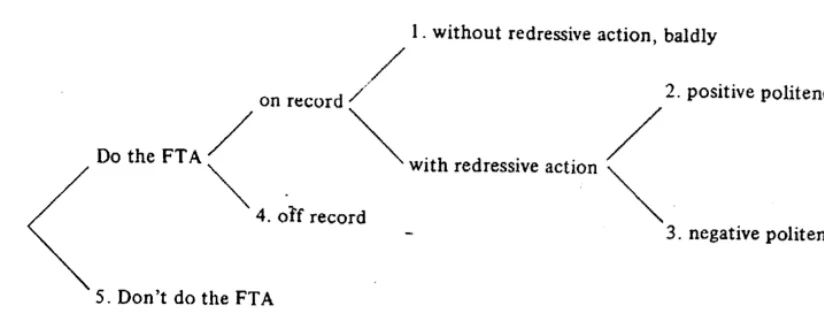
- Design concept (CHI 2019 workshop paper): applying Brown and Levinson's politeness strategies for face-threatening acts to the questions of a mental health mood log.
- Setting
- Dialogue for a conversational voice agent that helps a person log their mood, a mood situation, sleep and a diary entry.
- Participants / data
- A set of mood log queries, from log initiation to log completion, each written in a 'personal' and a 'passive' version (Table 1). No user study.
- Analysis
- Comparison of the wording each politeness strategy produces, and of the features (such as person pronouns and expressions of sentiment) that distinguish the two templates.
Findings
Blunt or vague questions offer little encouragement. Applying the politeness strategies to the opening of a mood log, we argue that asking directly, or hinting indirectly, gives a person little encouragement to respond. Phrasings that appeal to the wish to be wanted, or respect the wish not to be imposed on, can motivate engagement. #
“a direct question: "What is your mood today?"; or an off-record approach to ask indirectly: "Mood logging is a good way to track how you are feeling"”
Some politeness implies a relationship. Some polite phrasings imply a personal connection and make the agent seem caring and emotionally intelligent. Others stay polite without implying empathy, as in this in-between example: #
“"If you let me know how you are feeling, I will log it for you"”
The personal agent speaks as 'I' and 'we'. Our 'personal' template refers to itself in the first person, calls the user 'partner' and frames the mood log as something done together. #
“It conveys a vested emotional interest in the person, stating to be "glad to hear", "love to know" and to "hope to speak" to the person again soon”
Caring words, no feelings. The personal style can make the agent seem emotionally invested in the user even though the system has no such capability. #
(§Designing Polite Conversational Voice Agents for Mood Logging, p. 2)The passive agent stays in the background. Our 'passive' template uses no first-person pronouns, keeps the focus on the user, presents itself as an assistant and makes no emotional evaluations. #
“"Now that you have completed your mood entry this will be added to your log for you to review later"”
Questions this paper answers
- Why does wording matter when a chatbot asks how you feel?
- Asking about mood can threaten 'face' (a person's wish to be wanted and their wish not to be imposed on). Blunt questions or vague hints give little reason to answer, while wording that honours either wish can encourage people to engage. (See §Designing Polite Conversational Voice Agents for Mood Logging, p. 2.)
- Should a mood-tracking voice assistant sound caring?
- There is a trade-off. Earlier work shows caring or polite agents can foster empathy and the disclosure of sensitive information. But caring wording also makes a system with no feelings sound emotionally invested, which invites misperceptions of what it can do. (See §Designing Polite Conversational Voice Agents for Mood Logging, p. 2; §Designing Polite Conversational Voice Agents for Mood Logging, p. 2.)
- Can theories of human conversation guide chatbot design?
- They can supply structure. Brown and Levinson's politeness strategies turned one set of mood-log questions into two systematically different dialogue styles, from a caring companion to an impersonal assistant. Whether users respond as the theory predicts has not yet been tested. (See §Designing Polite Conversational Voice Agents for Mood Logging, p. 2; §Designing Polite Conversational Voice Agents for Mood Logging, p. 2.)
Contributions and implications
- When moving dialogue structure from human conversation to voice agents, designers need to be mindful of, and study, how users come to perceive the agent and its purpose.
we have to be mindful of, and need to better study, how users come to perceive the agents and their purpose in supporting a specific activity
(§Designing Polite Conversational Voice Agents for Mood Logging, p. 2) - Dialogue design likely needs to balance inviting self-disclosure against unrealistic expectations of the agent.
a careful balancing in the dialogue design in ways that invites self-disclosure without risking unrealistic expectations of the agents emotional or relational capabilities
(§Designing Polite Conversational Voice Agents for Mood Logging, p. 2)
Limitations
- This is a design proposal. The two dialogue templates have not yet been tested with users, and their effect on engagement and self-disclosure remains to be studied.
›Concepts
- Face-Threatening Act (FTA)
- The core of Brown and Levinson's politeness model:
the concept of the Face-Threatening Act (FTA), any act which challenges the face wants of an interlocutor
(§Designing Polite Conversational Voice Agents for Mood Logging, p. 2) - Positive and negative face
- Brown and Levinson divide face wants in two:
A person's positive face is their desire to be wanted. A person's negative face is desire not to be impeded.
(§Designing Polite Conversational Voice Agents for Mood Logging, p. 2) - Mood log
- The activity our agents support:
a mental health 'mood log', which has been shown to be beneficial way for technology to support mental health self-management
(§Introduction, p. 1) - Personal versus passive agent
- The two styles we distinguished (the passive style asks indirectly, like an impersonal assistant):
those that were more personal - reflecting a sense of care for, or personal investment in, the person, like a human companion; and those that were more passive
(§Designing Polite Conversational Voice Agents for Mood Logging, p. 2)
Figures
How to cite
Joseph Newbold, Gavin Doherty, Sean Rintel, and Anja Thieme. 2019. Politeness Strategies in the Design of Voice Agents for Mental Health. CHI 2019 Workshop.
This brief was prepared with AI assistance and published by Sean Rintel. It is not the authors' published text. Page numbers refer to this PDF.