Research brief
Takeaway: Meeting-centered design can make hybrid meetings more inclusive by configuring the meeting itself, not just the user. It makes the meeting's turn order, expected behaviour and technical state visible to everyone. Otherwise people keep meetings on track by sidelining remote colleagues whom the technology fails.
Why this matters
- What was known
- Research spread across studies of online, remote, virtual and distributed meetings and work has had one main focus, yet meetings still stall when remote participants have technology trouble.
has focused on remote participant fidelity and equality of local and remote participation
(§2, pp. 2–3) - What this paper adds
- Rather than improving how well remote people are seen and heard, we analyse moment by moment how one real meeting handled three breakdowns. We borrow the idea of 'configuring' from science and technology studies to move the design target from the individual user to the meeting.
our suggested design implication is to think about these aspects and others as 'configuring the meeting' and not just the users
(§6.2.4, p. 19) - Who it matters to
- Designers of hybrid meeting software and hardware, and the organisations and teams that rely on hybrid meetings.
Designing flexible hybrid meeting services and hardware for 'configuring the meeting' is essential to meeting institutional goals and needs
(§6.3, pp. 21–22)
Research question
- How do practices of inclusion and exclusion of remote participants arise in hybrid meetings, especially in the context of technology troubles?
Method and data
- Design
- Ethnomethodology and conversation analysis (EM/CA): micro-analysis of three episodes of technological trouble leading to inclusion or exclusion of remote participants, all drawn from the meeting's status round.
- Setting
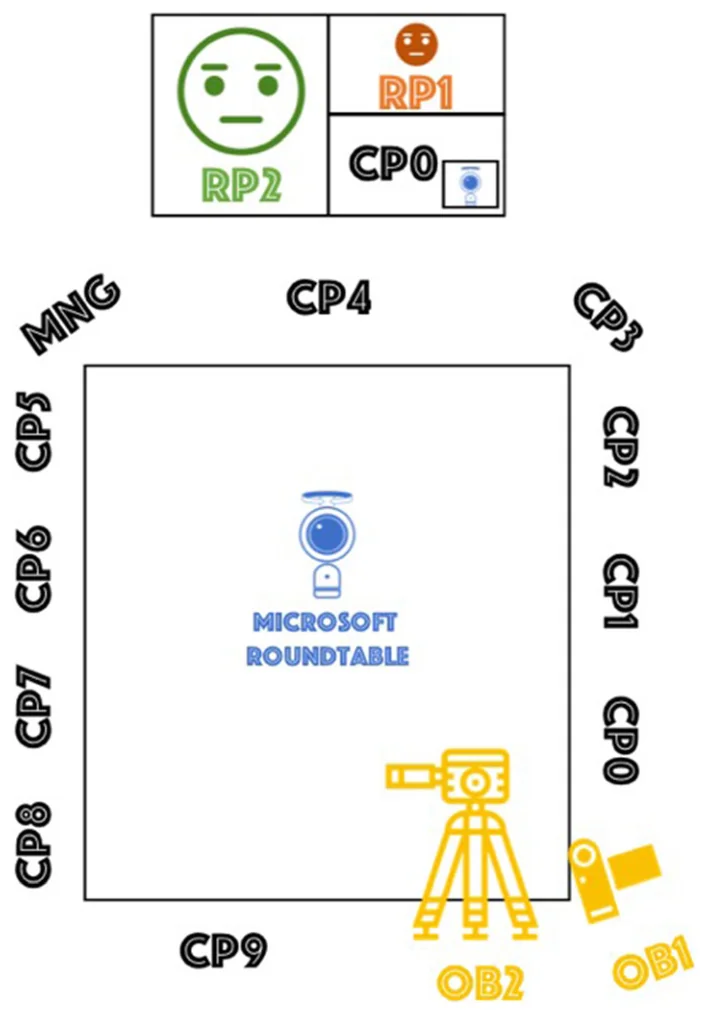
- A single hybrid status-update and brainstorming meeting in 2018 at a global software company in the United Kingdom, using Microsoft Teams, a wall screen for remote participants, and a Microsoft RoundTable 360° panoramic camera on the table.
- Participants / data
- 11 co-located participants and two remote participants, plus two observers (one a co-author).
- Duration
- One 90-min-long video recording.
- Analysis
- Episodes transcribed with Jefferson's transcription system, noting relevant physical details, and analysed for sequential sociotechnical dynamics.
Findings
Silence was read as inattention. In a recorded hybrid status meeting at a software company, with eleven people in the room and two remote, a remote colleague with his camera off did not respond when mentioned. The room began to question whether he was paying attention, and the manager teased him to turn his video on. #
“This summon embeds an institutional 'rule' that video should be available as a means of demonstrating participation.”
Camera on, still sidelined. When his video finally came on, the meeting moved straight on without giving him a turn, so turning the camera on did not make him a fuller participant. #
“He is included only insofar as he can be accounted for as a passive participant.”
Included in an order they could not see. The manager brought the remote participants in by treating the wall screen as a seat in the table's speaking order. This was an inclusive move, but its cost fell on the remote side. #
“remote participants do not know when they will be asked to talk”
'Got the gist' closed the floor. After repeated sound and video failures, the manager ended the remote colleague's status report by saying the room had 'got the gist'. No other channel, such as chat or a phone line, was offered. #
“While having "got the gist" treats the remote participant's report as adequate, this is a form of exclusion because it clearly marks further effort as futile.”
Equal time is not equitable. Moving on, possibly so that everyone got the same time, did not give the remote colleague an equal chance to report, and even people in the room did not get equal time afterwards. #
“In the end, neither the equality nor equity of talk is ensured, and, as is often the case in hybrid meetings, a remote participant is partially excluded.”
Keeping the meeting going came first. As couples on long-distance video calls do, the meeting's participants put continuity first. Each breakdown was handled in whatever way kept the meeting moving, even at a remote colleague's expense. #
“we observe that participants in hybrid meetings try to overcome technical breakdowns and keep the meeting going either by fixing them, or letting them pass, or incorporating them into the interaction”
Questions this paper answers
- Why do remote participants get left out of hybrid meetings?
- Often not through neglect but through efforts to keep the meeting moving. When technology fails, a remote person's silence can be read as inattention. A room under time pressure may decide it has heard enough rather than wait or switch to another channel. (See §5.1, p. 7; §5.3, p. 16; §6, p. 16.)
- Does turning your camera on in a hybrid meeting make you more included?
- Not necessarily. In a recorded status meeting at a software company, with eleven people in the room and two remote, the room insisted on one remote participant's video. But once it came on, the meeting moved on without him, leaving him included only as a passive participant. (See §5.1, p. 7; §5.1, p. 10.)
- Is giving everyone equal speaking time enough to make a hybrid meeting fair?
- No. In a recorded status meeting at a software company, the manager moved on, possibly so everyone got their slot, cutting short a remote colleague whose sound and video kept failing. Equal time is not an equitable chance to contribute, especially when technical trouble falls on one side. (See §5.3, p. 16; §5.3, p. 16.)
Contributions and implications
- Improve technical state awareness, so breakdowns are read as technical problems rather than moral failures.
help resolve breakdowns as technological problems and not moral failures
(§6.2.1, pp. 18–19) - Communicate expected behaviour for when problems arise, such as switching to chat or a landline, or muting when not speaking.
- Communicate meeting formats, including an order of talk that is more inclusive for remote participants.
It is feasible to inform users of an order of talk that would be more inclusive for the remote participants
(§6.2.3, p. 19) - Hybrid meeting design needs to be flexibly configurable to each meeting's needs, goals and dynamics.
there is a strong need for design solutions that are flexibly configurable according to the specific needs, goals, and dynamics of each meeting
(§7, p. 22)
Limitations
- The hypothetical self-moderating meeting flow, with virtual turn-taking for everyone, is untested.
This will, of course, require further research to be verified.
(§6.2.4, p. 21) - Configuring meetings in detail beforehand adds planning overhead.
causing an increased initial overhead of planning meetings
(§6.2.4, p. 21)
›Concepts
- Inclusion
- Our definition:
By inclusion, we mean episodes in which the meeting continuity is disrupted either to organize the participation of a remote user, or to organize meeting tasks around a spatial orientation that accounts for both remote and local participants.
(§1, pp. 1–2) - Exclusion
- Our definition, the counterpart of inclusion:
we refer to episodes in which meeting continuity is itself organized to accountably exclude remote participants during or following a technological breakdown
(§1, pp. 1–2) - Configuring
- Borrowed from Woolgar and extended here from users to the meeting. Woolgar's account:
considers the design of a technology to be a process of 'configuring' that 'includes defining the identity of putative users, and setting constraints upon their likely future actions'
(§2, pp. 4–5) - Meeting-centered design
- Designing for the meeting as a social phenomenon with its own needs, rather than for individual users' perception of fidelity.
We suggest that the individual user alone should not be 'configured' since the meeting itself configures the participants in different ways.
(§6.3, pp. 21–22) - Asymmetries of hybrid meetings
- Following Heath and Luff, video adds its own asymmetries to the physical, social and cultural ones already dividing the room from remote participants. We treat them as a problem that keeps remote people at a disadvantage, and breakdowns make it worse:
Technological breakdowns exacerbate, and are exacerbated by, such asymmetries.
(§2, p. 4)
Figures
How to cite
Banu Saatçi, Kaya Akyüz, Sean Rintel, and Clemens Nylandsted Klokmose. 2020. (Re)Configuring Hybrid Meetings: Moving from User-Centered Design to Meeting-Centered Design. Computer Supported Cooperative Work (CSCW) 29, 769-794. https://doi.org/10.1007/s10606-020-09385-x
This brief was prepared with AI assistance and published by Sean Rintel. It is not the authors' published text. Page numbers refer to this PDF.