Research brief
Takeaway: Social media can expose how politicians and journalists co-produce news. When video of an interview recorded for several broadcasters showed a politician giving the same answer to six questions, built to survive editing, it went viral. Yet commentators mostly mocked him or defended their profession instead of questioning that routine.
Why this matters
- What was known
- The co-dependence of politicians and journalists (the mediatization of politics) has mostly been studied through media output or interviews with journalists and politicians.
Until recently research on this symbiotic relationship has been largely confined to examining media output or interviewing journalists and politicians
(§1, p. 1) - What this paper adds
- A close look at mediatization in practice, via the lamination and delamination of the interview, and a mixed analytic and visualization approach to how exposure of it ripples across news, Twitter and YouTube.
The question, then, is whether and how the exposure of mediatization is treated as an accountable matter across a range of Internet media and networked publics
(§3.2, p. 3) - Who it matters to
- Researchers of political communication and media discourse, journalists and PR professionals, as the mediatization of politics increasingly moves online.
This form of analysis will, we believe, become more important as the mediatization of politics itself increasingly diffuses online
(§6, p. 13)
Research questions
- What does exposure look like?
- Do different groups deal with the exposure of mediatization in different manners?
- And, ultimately, does it matter?
Method and data
- Design
- Case study of the 'Miliband Loop' combining turn-by-turn analysis of the interview, discursive comparison with the interviewer's TwitLonger complaint, and visual text analytics of the online responses.
- Setting
- The June 30th 2011 pool interview with Ed Miliband during the UK public sector strikes (J30), and its circulation online.
- Participants / data
- The unedited BBC pool interview video. Damon Green's TwitLonger complaint. 18 online newspaper and blog posts. 504 tweets of Green's complaint. 548 tweets of the BBC video. 484 tweets of the YouTube video. 785 YouTube comments.
- Duration
- Data gathered from June 29 2011 to August 31 2011.
- Analysis
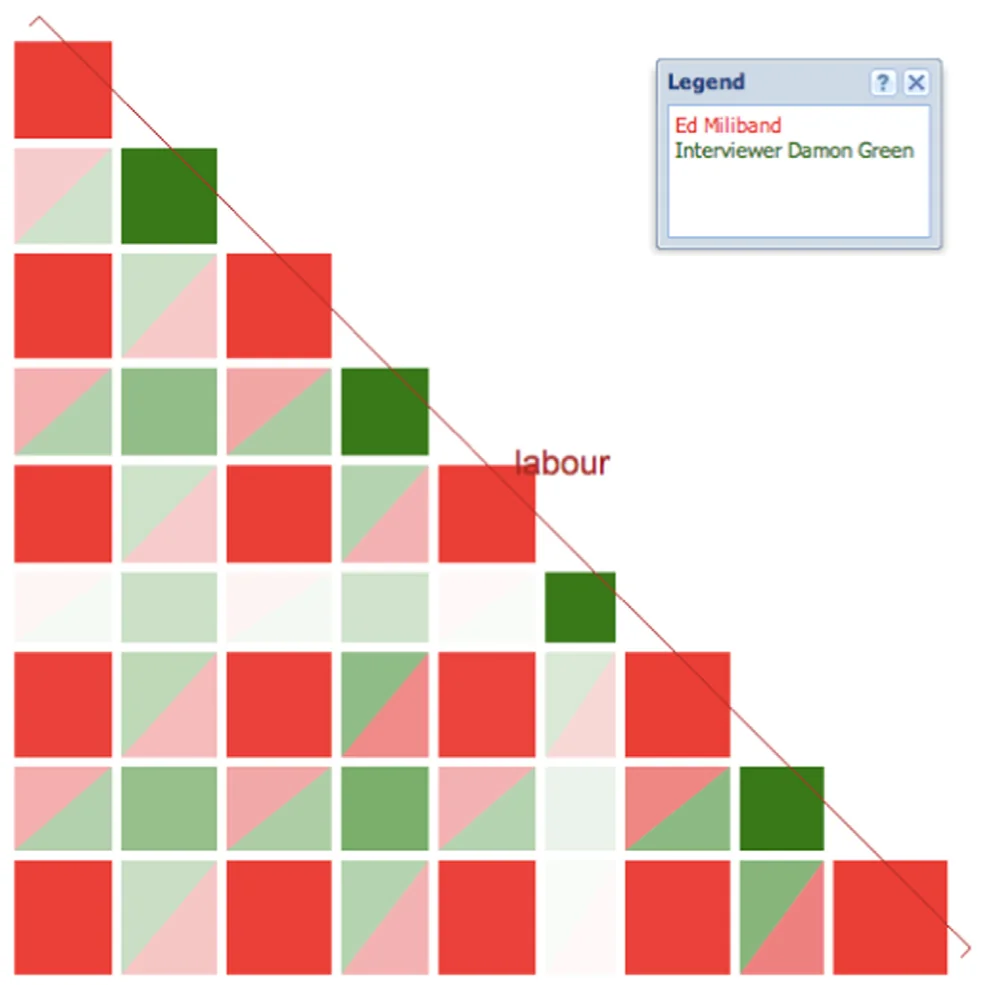
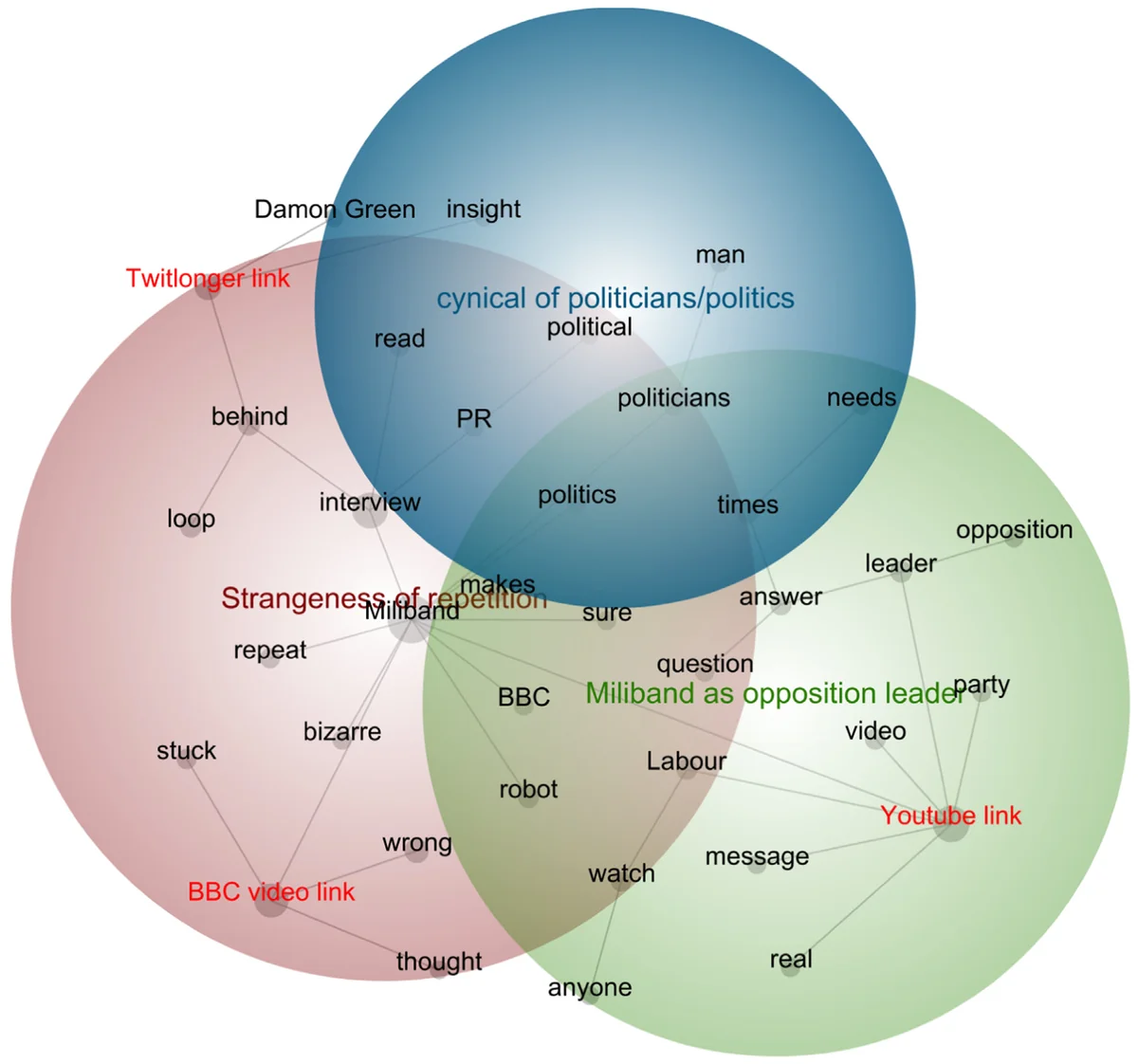
- Discursis conceptual recurrence plots of the interview. Leximancer concept maps and a Gephi network plot of news articles, tweets and YouTube comments. Topsy statistics for reach.
Findings
The repetition was the job. Ed Miliband gave much the same answer to six questions in a 2011 pool interview (a format in which one reporter records answers for several broadcasters to edit). Our recurrence analysis confirmed the repetition, but it reflects the format, because each answer was built to stand alone. #
“what Green framed as cynical is Miliband highlighting the professional goal of all parties to record pre-prepared interviewee talking points artfully fitted to the content and phrasing of an interviewer's questions”
The interviewer never challenged it. The interviewer, Damon Green, never challenged the repetition during the interview, and complained about it online only afterwards. #
“whatever Green may have intended, he provided the essential structural resources for the sound-bite politics that he later claimed to abhor”
Each profession blamed the politician. In online news and blog commentary, journalists and public relations professionals each blamed Miliband, ignoring their own roles and each other's commentary. One blogger took almost everyone to task. #
“Sound-bites are a product purely of public relations and mediatization is "exposed" only to the extent that it feeds the news value of dramatic celebrity downfall.”
Twitter mocked rather than questioned. Tweets sharing the video and the interviewer's complaint were almost all against sound-bites, Miliband and public relations, with little critique of the media's part. #
“much of this virality lies simply in humor or hand-wringing rather than serious political discussion for most users”
YouTube went wider, and darker. YouTube comments on the video discussed the general state of politics more than tweets did, and included much racist abuse. Only a few acknowledged the journalist's role or explained how pool interviews work. #
“the large amount of such material outweighs a small proportion of YouTube comments that acknowledged the journalistic role in mediatization”
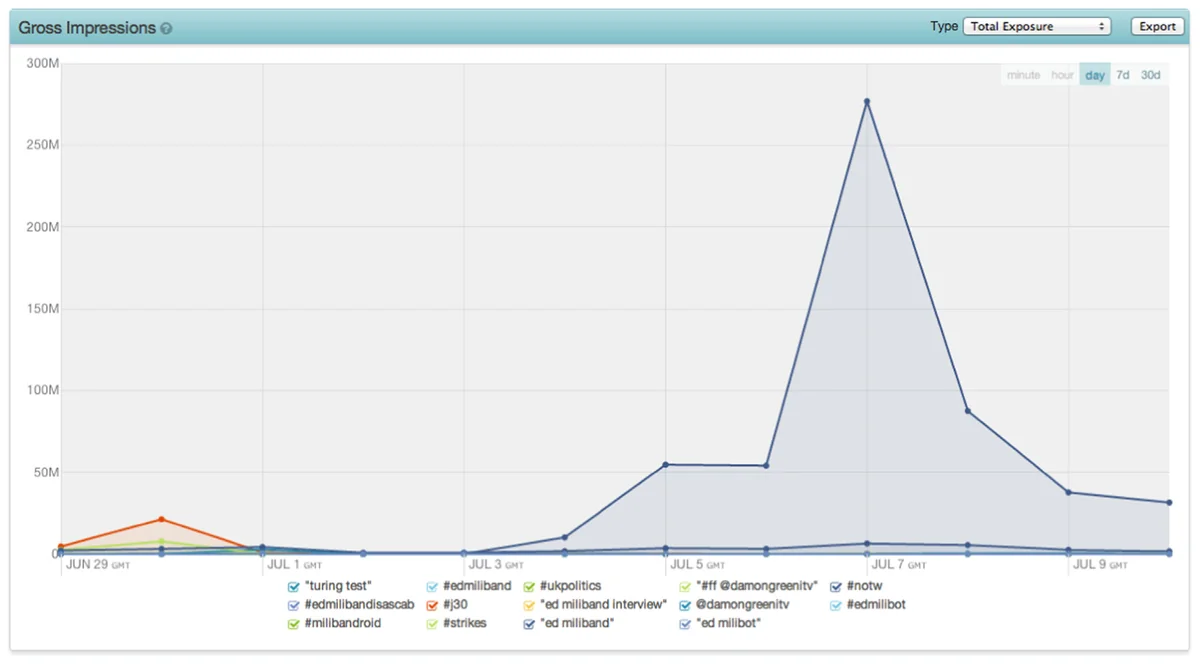
Wide reach, little effect. The incident reached millions of potential Twitter impressions, far fewer than the strikes or the phone-hacking scandal of the same days. But it changed little in professional or public recognition of mediatization, and Miliband was not seriously damaged at the time. #
“The potential exists for a loss of control by the professional organizations involved, but it is not yet clear just what the threshold will be for this to matter in a larger political sense.”
Questions this paper answers
- Why do politicians give the same answer to different interview questions?
- In a pool interview, one reporter records answers for several broadcasters to edit. So each answer must stand alone, built for editing, not conversation. We call this delamination. Fitting the same talking points to every question is what all parties expect. It only shows if the unedited recording is released. (See §5.1, p. 6.)
- Are journalists victims of political spin?
- Not simply, because journalists and politicians co-produce sound-bites. In Ed Miliband's pool interview, the reporter never challenged the repeated answers, which suited collecting variations on a theme for editing. Only later did he recast it as a conversation the politician had refused. (See §5.1, p. 6; §6, p. 13.)
- Why didn't exposing the interview spark debate about the media?
- Because each group read it through its existing story. Journalists cast themselves as defenders of truth against cynical politicians, and public relations professionals as practical message-crafters. Most people sharing the video saw a joke or a cause for hand-wringing. Few asked how news production made the repetition. (See §5.2, p. 7; §5.5, p. 12; §5.4, p. 10.)
- Does social media exposing political spin change anything?
- Not necessarily. In the Miliband case, the exposure reached millions of potential impressions but did little for professional or public recognition of mediatization, and Miliband was not seriously damaged at the time. It also came outside an election. (See §6, p. 13.)
Quantitative results
| Measure | Result | Where |
|---|---|---|
| Total Twitter activity associated with the incident (Topsy) | approached 7000 posts, retweets, favorites etc. | §5.5, p. 12 |
| Gross Twitter impressions of the Miliband Loop (Topsy) | almost 2.8 million | §5.5, p. 12 |
| Gross impressions of the J30 protests, for comparison | approaching 20 million | §5.5, p. 12 |
| Gross impressions of the News of the World phone hacking scandal, for comparison | almost 300 million | §5.5, p. 12 |
Contributions and implications
- The Internet is a dangerous place for the old rules of mediatization. (Abstract, p. 1)
- Viral exposure can matter when it reaches the right group at the right time, such as swinging voters during an election. PR professionals will seek strategies that minimise risk and exploit unexpected virality.
- Combining analytic and visualization methods can show how mediatization issues diffuse across platforms and how themes evolve, which will matter more as political mediatization moves online.
Limitations
- Impressions are not a measure of people seeing tweets, only of instances in which tweets were potentially visible. (§5.5, p. 12)
- The 'ripples' are metaphorical, because the responses overlap in time rather than occurring in distinct phases.
- This single incident occurred outside an election period and may have mattered little in the 'real world'.
›Concepts
- Mediatization of politics
- Following Strömbäck, the mutual dependency in which journalists need content and politicians need publicity.
This mutual dependency has been described by Strömbäck (2008) as the mediatization of politics.
(§1, p. 1) - Pool interview
- An interview in which one reporter gathers material for a collective of news organisations, each of which edits it as it sees fit.
The pool interview is one of the purest forms of deliberate collaborative mediatization
(§3, p. 2) - Lamination
- Our term for when the lived conversation of an interview runs in parallel with media production, so everything said may be heard by the audience as the interviewee's views.
the joint awareness held by all parties the production of turns-at-talk is going to be treated as an observable-reportable part of the media experience
(§3.1, p. 3) - Delamination
- Our term for when the lived interview is separated from media production, so the audience sees only an edited representative answer.
Delamination in this context refers to the joint awareness held by all parties that the production of turns-at-talk is not going to be treated as an observable-reportable part of the experience
(§3.1, p. 3) - Ripples of mediatization
- Our metaphor for
the way in which moments of mediatization start at one point and then move out through various audiences via different Internet services
(§3.2, p. 3)
Figures
How to cite
Sean Rintel, Daniel Angus, and Richard Fitzgerald. 2016. Ripples of mediatization: Social media and the exposure of the pool interview. Discourse, Context, and Media 11, 50-64. https://doi.org/10.1016/j.dcm.2015.10.003
This brief was prepared with AI assistance and published by Sean Rintel. It is not the authors' published text. Page numbers refer to this PDF.