Descriptive overview chapter on social media in Australia. It draws on industry and government statistics, mostly from 2011 to 2013, five case vignettes and analysis of public policy.
Usage statisticsPublished figures from sources such as the Australian Bureau of Statistics, Sensis and Roy Morgan.
Five vignettesCases including Qantas, Charlotte Dawson, Destroy the Joint, Jill Meagher and Greg Jericho.
Policy reviewAnalysis of infrastructure, media regulation, copyright and surveillance policy, including government reviews and inquiries.
BWhat the chapter reports and argues
Usage trendsstatistics the chapter reports
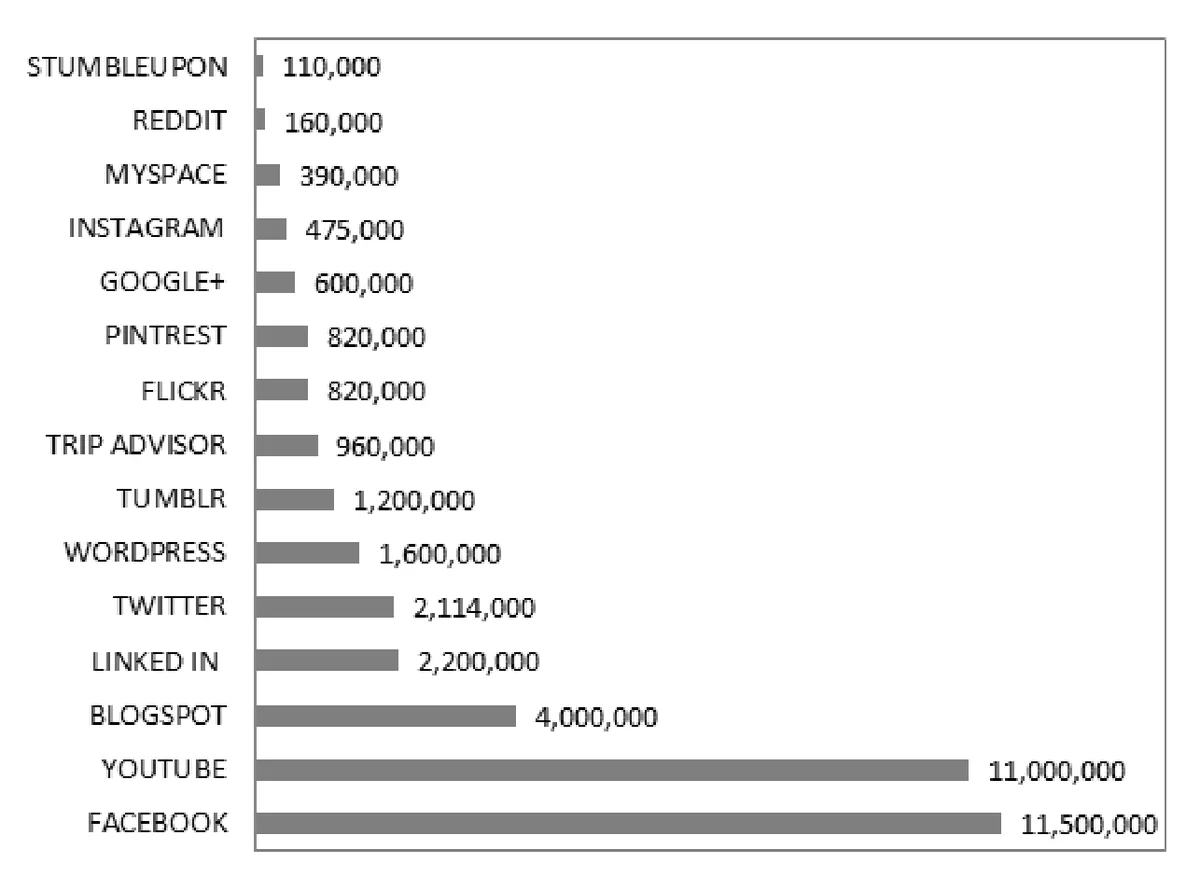
•The chapter reports about 11.5 million Facebook and 11 million YouTube accounts in Australia in 2012.The population was approaching 23 million. The chapter notes Australians seem keen on sharing image macro memes in local Facebook groups.
•The chapter reports that 93% of Australians aged 65 and over had internet access.Access was close to universal across age groups, although older Australians used social media less.
•The chapter reports smartphone take-up among Australian adults rising from 25% to 49%.This rise ran from June 2011 to May 2012. Internet subscribers in Australia reached 12.2 million by the end of 2012.
•Of large Australian businesses, 79% claimed a social media presence in 2012, against 27% of small ones.The chapter concludes many businesses focused on presence and either did not grasp that social media is interactive or saw little advantage under legal limits.
Law and policyconflicts the chapter argues
•The chapter argues online outrage in the Jill Meagher murder case at times threatened the prosecution.Social media helped the search. Posts about the accused then collided with laws against prejudicial publication written for traditional media.
•The chapter calls the government's 2012 Convergence Review of media policy a missed opportunity.The review took an inconsistent stance on regulating user-generated content and no position on fair use.
•The chapter argues a leaked draft trade agreement chapter favoured corporations over social media users.The leaked US draft of the Trans-Pacific Partnership chapter on intellectual property gave few positive rights to individuals sharing online.
CKey takeaway
Distance can drive early uptake of new communication technology, as with social media in Australia. Media law built for organisation-bound media can clash with the fifth estate of online sharing.
Made for this site with AI assistance from the verified research brief. It is not the paper's own figure.
Abstract
The vast distances Australians must negotiate to connect their small, highly urbanized population both nationally and internationally have long created the incentive for invention, innovation and the early adoption of communication technologies. Important also in any reflection in relation to Australia's socio-technological evolution is this country's location as a modern, developed, predominately western nation perched in the southeast of the Asian landmass. The Australian continent's seven million square kilometers are geographically, and increasingly economically, politically and culturally, part of Asia. Forty percent of Australians were born overseas and almost one third of overseas-born Australians were born in Asia (Australian Bureau of Statistics, 2013). At the end of 2012, Australia's population was approaching 23 million with about half that number-12.2 million-Internet subscribers. Broadband subscribers accounted for 98% of subscriptions; the split between private and public (business or government) use was 76% and 24% respectively. After exploring some of the central characteristics and tensions of the social media landscape in Australia, the authors illustrate issues and trends in social media usage in Australia and conclude with a discussion of salient policy issues, including challenges around the evolution of digital infrastructure, media law and copyright.
Research brief
By John Harrison, Sean Rintel, and Elizabeth Mitchell.
Takeaway: Social media spread rapidly in Australia, whose vast distances have long encouraged early adoption of communication technologies. But media law, built for the bounded, organisation-tied world of traditional media, sits in unresolved conflict with it. Online outrage over a murder case, for example, at times threatened the prosecution.
Why this matters
What was known
Social media in Australia have grown rapidly and dramatically, and are still maturing. Social media in Australia are in their adolescence, and we are watching their maturation with interest and not a little trepidation.(§1. Introduction, p. 5)
What this paper adds
An overview of Australian social media usage trends by individuals, businesses and institutions, five illustrative vignettes, and the salient policy issues from infrastructure to media law and copyright. (§1. Introduction, p. 6)
Who it matters to
Scholars, regulators, media, politicians, businesses and an engaged public, all of whom pay attention to social media. (§4. Australian Social Media Stories, p. 18)
Research question
What are the central characteristics and tensions of the social media landscape in Australia? These include key trends in usage by individuals, businesses and institutions, emergent issues, and the most salient policy issues from infrastructure to media law and copyright.
Method and data
Design
Descriptive overview chapter drawing on published industry and government statistics, five illustrative vignettes, and analysis of public policy.
Setting
Australia, with data mostly from 2011 to 2013.
Participants / data
Secondary statistics from sources including the Australian Bureau of Statistics, Sensis, Roy Morgan, AdCorp, Social Media News and Social Blade. Five vignettes (Qantas, Charlotte Dawson, Destroy the Joint, Jill Meagher, Greg Jericho). Policy reviews and inquiries.
Analysis
Narrative synthesis of usage trends, case vignettes, and critique of infrastructure, regulatory, copyright and surveillance policy.
Findings
Nearly everyone is online. By the time of writing, internet access in Australia was close to universal across age groups, even among people aged 65 and over, although older Australians used social media less. #
“while 99% of those aged 40 to 49 and 50 to 54 had access, and that of those aged 65 and over 93% had access”
Facebook and YouTube dominate. Facebook and YouTube dominated Australian social media in 2012, with about 11.5 million and 11 million accounts in a population approaching 23 million. Australians seem especially keen on sharing image macro memes in local Facebook groups. #
“All Australian cities have many pages and groups devoted to sharing image macros commenting on varied aspects of social life.”
Business was slow to engage. Australian businesses, especially those selling to other businesses, were slow to commit to social media, and many focused on maintaining a presence rather than driving people to it. We conclude that many either do not grasp that it is interactive or see little advantage given legal constraints, which could change: #
“Such Web 1.0 models of behaviour may change for listed companies when regulatory authorities in Australia follow the example of the Securities and Exchange Commission and deem social media posts as an acceptable form of continuous disclosure”
Online outrage can collide with fair trials. Our vignettes show tensions between social media and public life. In the Jill Meagher murder case, social media helped the search. But online outrage at the accused then at times threatened the case against him, colliding with laws against prejudicial publication that were written for traditional media. #
“an important and unresolved conflict between the Australian legal system and the conventions and culture of social media”
A media review that missed its chance. The government's 2012 Convergence Review of media policy took an inconsistent stance on regulating user-generated content and no position on fair use, which we call a missed opportunity. The consequence: #
“means the Copyright Review will not be able to treat the Convergence Review as a source of alignment between notions of convergence with those of personal fair use”
Trade rules favour corporations over users. The leaked US draft of the intellectual property chapter of the Trans-Pacific Partnership trade agreement favours corporations and governments, with few positive rights for individuals sharing on social media. #
“does not contain the words "fair", "share", or other synonyms that might indicate an interest in the free flow of ideas”
Questions this paper answers
Why might a country take up social media especially fast?
We suggest geography helps. Separated by vast distances from each other and from the rest of the world, Australians have long been early adopters of communication technologies. By 2012 internet access was almost universal, and Facebook and YouTube each had accounts numbering about half the population. (See §2. Internet Connectivity in Australia, p. 7; §3. The Social Media Landscape in Australia, p. 9.)
Why are some businesses slow to use social media?
We argue many firms treat it as a page to keep up rather than a conversation, missing that interactivity is the point. Listed companies also see legal risk and little commercial gain. Small businesses were far less likely than large ones to have any social media presence. (See §3. The Social Media Landscape in Australia, p. 17.)
Can social media posts interfere with a criminal trial?
They can. Laws against publishing material that could prejudice a fair trial were written for traditional media. In the Jill Meagher murder case, online outrage at the accused at times threatened the prosecution, exposing an unresolved conflict between the legal system and social media culture. (See §4. Australian Social Media Stories, pp. 21–22.)
Do copyright and trade rules keep up with how people share online?
Not in the policies we reviewed. A major media review took no position on fair use for the remixes and memes common on social media. A leaked draft of a Pacific trade agreement's intellectual property chapter offered individuals few positive rights. (See §6. Regulation of Social Media, p. 28; §6. Regulation of Social Media, p. 29.)
Quantitative results
Measure
Result
Where
Internet subscribers in Australia, end of 2012 (ABS)
12.2 million
§2. Internet Connectivity in Australia, pp. 6–7
Smartphone take-up among adults, June 2011 to May 2012 (ACMA)
25% to 49%
§2. Internet Connectivity in Australia, pp. 6–7
Facebook and YouTube user accounts in Australia, August 2012 (AdCorp)
Facebook 11.5 million; YouTube 11 million
§3. The Social Media Landscape in Australia, p. 8
Businesses claiming a social media presence, June 2012 (Sensis and AIMA)
27% of small, 34% of medium and 79% of large businesses
§3. The Social Media Landscape in Australia, pp. 16–17
Contributions and implications
Businesses should apply some traditional rigour, such as considering timing and context, when using social media for relationships, as the Qantas case shows. the Qantas misstep provides a rationale for applying some traditional rigour to using a social medium to advance business relationships(§4. Australian Social Media Stories, p. 19)
Changes to online media regulation, and their flow-on to social media, are expected to come through regulation rather than legislation. will progress by way of regulation rather than legislation(§6. Regulation of Social Media, p. 31)
Proposed data retention for national security raises privacy concerns, including collateral surveillance of non-targets on sharing-based services.
The challenge for social media in the Asian Century is to use technological imagination to foster harmonious social ties in a diverse region.
Limitations
Usage statistics are only a snapshot, and platforms can change quickly. these data are simply a snapshot in time, and the advent of new devices, new platforms, and new applications can change the landscape quickly(§3. The Social Media Landscape in Australia, p. 15)
Statistical sources disagree substantially for some platforms, such as LinkedIn, Pinterest and Instagram. The two sources we have consulted for statistics on the size of social media sites in Australia Social Media News and AdCorp have substantially different data on LinkedIn.(§3. The Social Media Landscape in Australia, p. 12)
›
Concepts
Social media
Online platforms that make social networks technologically visible, involve user-generated content, and let that content be shared, searched and responded to. (§1. Introduction, p. 6)
Fifth estate
Greg Jericho's term for political blogging and social media acting as a corrective to mainstream journalism, rather than competing with it. he makes the case for political blogging, and the 'fifth estate', as he styles it, to be a corrective to the corporatist, and even corrupt, transactional nature of contemporary mainstream journalistic practice(§4. Australian Social Media Stories, p. 23)
Transformative use
Use of copyright material in new creative ways such as sampling, remixes, mashups and memes, which the Copyright Review Issues Paper addresses. copyright materials being used in transformative and collaborative ways-for example, in 'sampling', 'remixes' and 'mashups'(§6. Regulation of Social Media, p. 28)
Figures
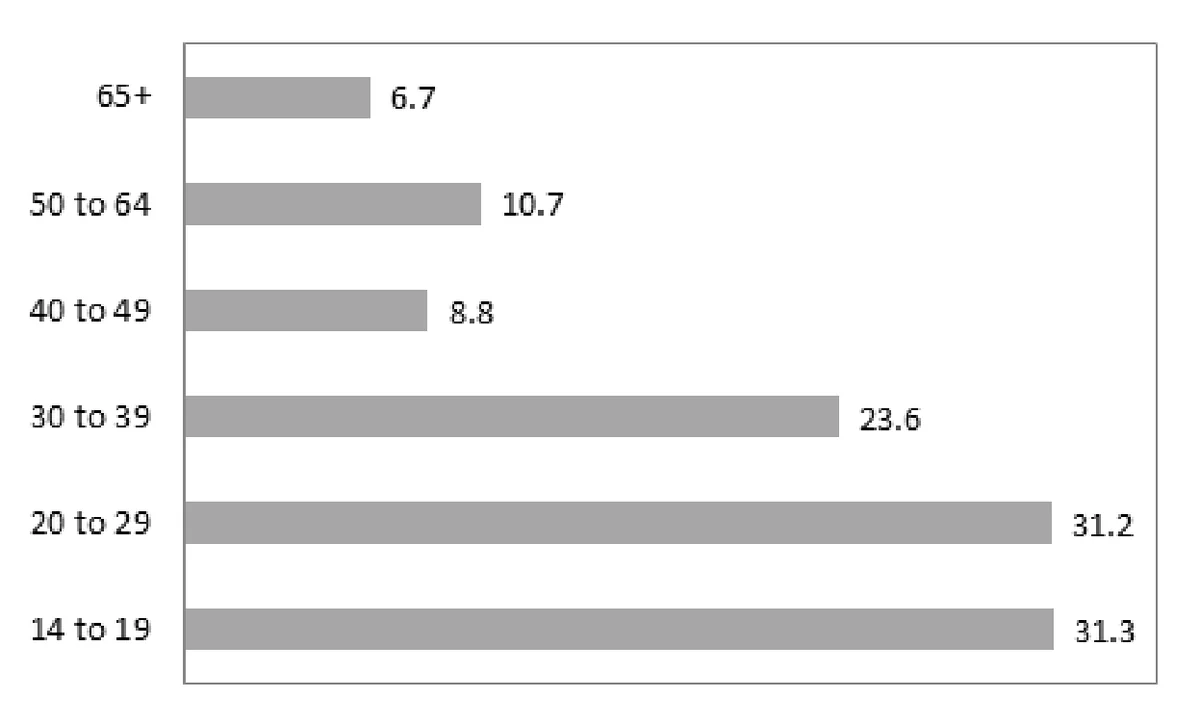
Figure 2: Active users of top 15 social media sites in Australia (as of August 2012) From the paper, Fig. 2, pp. 7–8.Figure 3: Average weekly use of Australian's use of Facebook in age ranges (as of 2012) From the paper, Fig. 3, p. 9.
How to cite
John Harrison, Sean Rintel, and Elizabeth Mitchell. 2014. Australian Social Media Trends. Social Media in Asia., 589-627.
This brief was prepared with AI assistance and published by Sean Rintel. It is not the authors' published text. Page numbers refer to this PDF.
BibTeX
@inbook{harrison2014social,
author = {Harrison, John and Rintel, Sean and Mitchell, Elizabeth},
title = {Australian Social Media Trends},
booktitle = {Social Media in Asia.},
year = {2014},
month = {February},
publisher = {Dignity Press, L. Cui & M.H. Prosser (Eds.).},
url = {https://seanrintel.com/publications/social-media-in-australia.html},
pages = {589-627},
note = {Harrison, J., Rintel, S., & Mitchell, E.K. (2014). Australian Social Media Trends. Pp. 589-627 in L. Cui & M.H. Prosser (Eds.). Social Media in Asia. Lake Oswego, OR: Dignity Press.},
}