Research brief
Takeaway: Sharing everyday rhythms could ease the isolation of older people living alone. When kitchen activity in one home played as sounds in a friend's or relative's home, people heard routines rather than single sounds. They built comforting stories about each other and sometimes adjusted their own behaviour out of care.
Why this matters
- What was known
- Strong social ties benefit seniors' health, but independent living can slide into isolation.
Ironically, this isolation may be exacerbated by telecare technologies that support independent living and decrease healthcare costs associated with ageing populations
(§1, p. 2) - What this paper adds
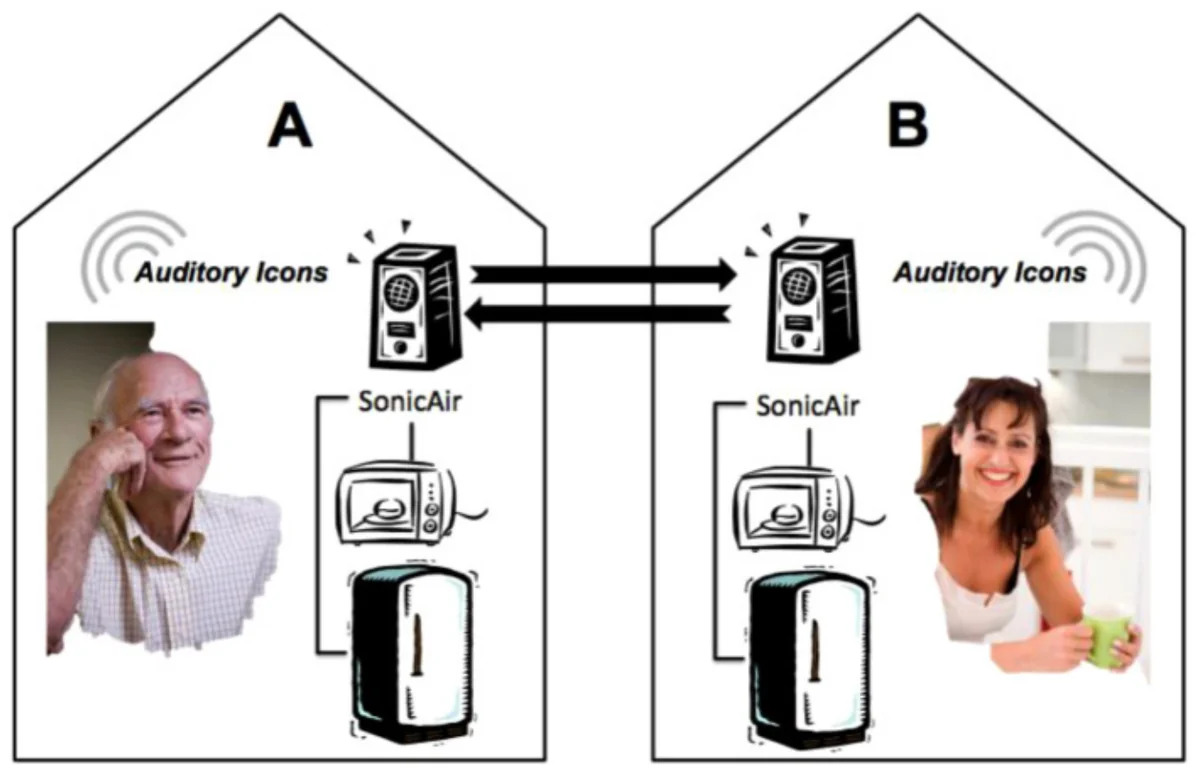
- A reciprocal, always-on audio awareness probe deployed in seniors' homes, linking each person's kitchen to a friend's or daughter's.
Rather than evaluating the viability of SonicAIR, we were interested in participants' accounts of how individual signals generated by actions from the remote other were learned as resources for social understandings.
(§1, pp. 1–2) - Who it matters to
- Designers of ambient awareness and sonification systems, and those providing telecare and support for older people living independently.
we argue that, in the future, ambient awareness technology could be installed alongside telecare and make use of existing infrastructure that enables remote monitoring
(§7, p. 19)
Research question
- How might connecting the soundscapes of friends or family members reduce the isolation of seniors living independently, and how do participants learn to treat individual sound signals generated by a remote other's actions as resources for social understandings?
Method and data
- Design
- Technology probe field study with two pilot deployments of SonicAIR (see Prototype).
- Prototype
- SonicAIR (Sonic Atomic Interaction Radio): a pair of linked boxes, one in each home's kitchen. Magnetic reed switches on appliance doors, drawers and cabinets detect when they are opened. Each box (a Mac Mini with an Arduino board and a 3G modem) posts a code for the activity to a private Twitter feed. The box in the partner's home watches that feed and plays a matching recorded sound, so opening your fridge plays a sound in your partner's kitchen, and vice versa. There is no live audio, to save bandwidth and ease fears of surveillance, and nothing for users to operate. Sounds began as recordings of the actual action. For participants who confused these with sounds in their own home, they were prefaced with short musical tones (earcons) or replaced by suggestive sounds such as soft bells. It was not compared with another system.
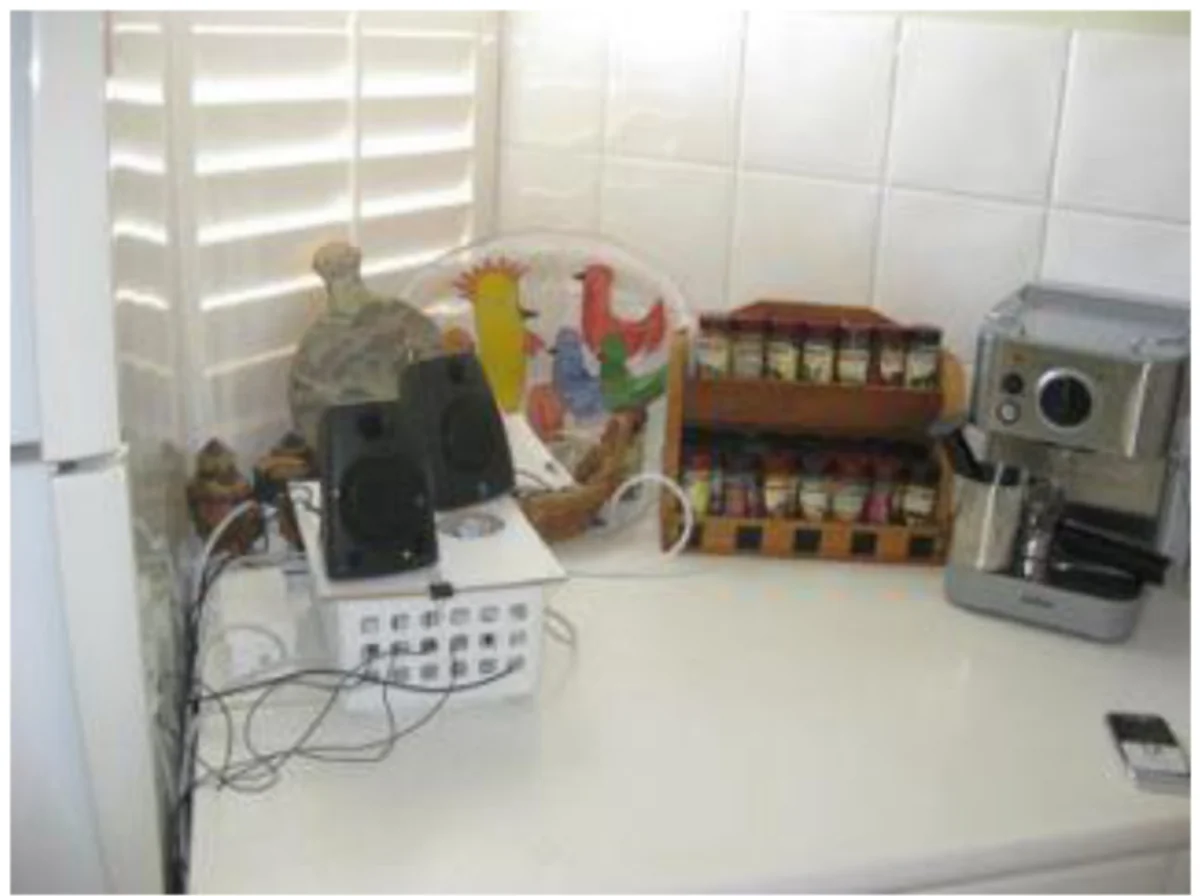
Fig. 2. SonicAIR deployed. From the paper, Fig. 2, p. 7. - Setting
- Pairs of homes: a pair of friends (Lucy with Janet, then with Mary after Janet had a fall) and a mother-daughter pair (Roseanne and Josephine).
- Participants / data
- Five people, three dyads in two pairs of homes. Participants aged 60 to 79, plus a daughter in her 30s.
- Duration
- Each deployment lasted a total of five to six weeks.
- Analysis
- Qualitative analysis of participant interviews (a dozen sessions), participant diaries, some in-home observation, researcher logbook and Twitter logs of sensor events, looking for perspicuous examples rather than generalisable uses or measurable evaluations.
Findings
Learning where the sounds came from. Older people whose kitchens were linked by sound to a friend's or daughter's first had to learn that the sounds came from the device rather than from their own home. One put them down to possums. #
“All participants reached a threshold moment of mutuality after just a few days, as indicated by a change in descriptions of sounds in both diaries and interviews.”
Rhythm, not individual sounds. Rather than working out which sound meant which action, participants attended to when sounds came and in what patterns. They combined this with what they knew of each other to tell stories of everyday life, such as a meal being made. #
“I usually hear sounds sort of in groups, and then you'd think somebody's having a meal or something like that.”
Stories that were never checked. Nobody reported checking whether these stories were true. Being able to create them mattered more than whether they were accurate. #
“the potential for misrecognized narratives certainly does need to be taken into account, especially if there is the possibility of ambiguity that could affect wellbeing”
Adjusting habits for the other. Three of the five participants changed their own kitchen habits so as not to disturb their partner, for example not heating milk late at night. #
“The participants changed their behavior because they wanted to accommodate or respect their coparticipant's routine.”
Mother and daughter played back. The mother and daughter deliberately triggered sounds in reply to each other's, a playful way of saying 'I'm here' that the friend pairs did not use. #
“She hasn't heard me all day. And I'm finished with it but I'll just do it this once. Yeah, yeah so you know I'm here too.”
Taking cues from a partner's routine. In the second pair of friends, each sometimes took the other's sounds as a cue to act themselves, getting up or making a drink, without signalling back. We consider this the most interesting finding for social presence in independent living. #
“Behavioral interdependency thus involved treating the cues of the remote other as a resource for reflecting on ones' own behavior and then enacting a locally relevant activity”
Questions this paper answers
- Can hearing a relative's kitchen sounds make older people living alone feel connected?
- Yes, in a lean way. When older people's kitchens were linked by sound with a friend's or daughter's for five to six weeks, they soon heard the sounds as the other person, not just noises. They built comforting stories of each other's routines. (See §5.1, p. 15; §4.2, p. 11; §5.2, p. 16.)
- Do people need to know exactly what each awareness sound means?
- Mostly not. When five people's kitchens were linked by sound with a friend's or relative's for five to six weeks, all but one paid little attention to which sound meant which action. The timing and rhythm of sounds, combined with what they knew about each other, carried the meaning. (See §4.2, p. 11; §5.2, p. 16.)
- Does being connected by ambient sound change people's behaviour at home?
- It can. Hearing a partner's routine made people consider their own. Among five people whose kitchens were linked by sound, three changed habits to avoid disturbing their partner. Two friends sometimes took a partner's activity as a prompt to make a drink or get up. (See §4.3, pp. 12–13; §4.5, p. 14.)
- Does ambient sound make people feel they are living together?
- No. People talked about the sounds they triggered as if present in the other's home, but said they did not feel they were living with their partner. The link felt like two lives running in parallel, not an illusion of being together. (See §5.1, p. 15; §4.2, p. 11.)
Contributions and implications
- Sonification for ambient awareness should emphasise systematicity over objectivity, while managing the annoyance of repetition.
It would seem that sonification designed to support ambient awareness should emphasize systematicity over objectivity.
(§6.1, p. 18) - Offer users a range of sounds to choose from, and design sounds that avoid startling them.
- Provide feedback on whether signals were transmitted and received, since participants were anxious about whether their actions triggered sounds remotely.
What is important, and would need to be more objectively provided, is feedback on the transmission-reception success or failure.
(§6.2, p. 18) - Socially oriented ambient awareness could be installed alongside telecare, using its monitoring infrastructure, as a resource for older people to keep social contact.
Limitations
- Two small pilot deployments. More generalisable patterns and links to health outcomes are left to future research.
Future research will seek more generalizable patterns across larger deployment groups and explore the link between connected remote soundscapes and health outcomes.
(§3.2, p. 8) - SonicAIR connected only two locations at a time. Many-to-many connections were beyond scope.
SonicAIR only allowed for one-to-one location connections
(§7, p. 19) - Misrecognised narratives are a risk, especially if such technology runs alongside telecare where ambiguity could affect wellbeing.
the potential for misrecognized narratives certainly does need to be taken into account
(§5.2, p. 16)
›Concepts
- Phatic technology
- The design tradition SonicAIR belongs to:
Phatic technologies are those designed to sustain remote relationships between noncolocated parties by affording lightweight reciprocal communication in which the fact of exchange itself is more important than the quality or quantity of information exchanged
(§2.1, p. 2) - Reciprocity of perspectives
- A central idea of ethnomethodology, from Schutz via Garfinkel:
actors engaged in coordinated actions with others will assume the socially standardized and shared nature of their knowledge and will seek actively, if unconsciously, to sustain it
(§2.1, p. 3) - Technologized interaction
- The lens we use:
Technologized interaction refers to communication in which users treat technology as materially framing but not causally determining social action.
(§2.1, p. 3) - Earcons
- One of the sound types SonicAIR used, alongside denotative samples (recordings of the actual sound) and connotative samples (realistic sounds that suggest the action):
Earcons are the representation of information using abstract musical sounds
(§3.1, p. 6)
Figures
How to cite
Hanif Baharin, Stephen Viller, and Sean Rintel. 2015. SonicAIR: Supporting independent living with reciprocal ambient audio awareness. ACM Transactions on Computer-Human Interaction 22 (4). https://doi.org/10.1145/2754165
This brief was prepared with AI assistance and published by Sean Rintel. It is not the authors' published text. Page numbers refer to this PDF.