Research brief
Takeaway: A tabletop telepresence robot with a handle lets remote and in-room people share control, and groups who actively shared it included the remote person best. Sharing worked when the remote person stated their needs and boundaries, because in-room people otherwise felt moving the robot meant moving the person.
Why this matters
- What was known
- Mobile robotic telepresence gives remote people presence and agency, but the robots are expensive, one-size-fits-all, built for roaming rather than meetings, and awkward for people in the room to move or assist.
the high price and one-size-fits-all design means that existing physical settings must be adapted to the MRPs, rather than them being adopted in the varied settings of hybrid collaboration
(§1, p. 2) - What this paper adds
- Instead of giving the remote person full control of a floor-standing robot, we design for control that is shared and contested with the people in the room. We developed this over three design iterations, and offer three design trade-offs and a framework for analysing who controls a telepresence system. (§1, p. 2)
- Who it matters to
- Designers and researchers of telepresence robots and hybrid communication systems. (§7, p. 13)
Research question
- To explore the opportunities for designing lightweight telepresence robots that support negotiation of control in hybrid meetings, and how non-verbal communication such as deictic gesturing and direction of focus is expressed and understood through a robot representation.
Method and data
- Design
- Serial Research-through-Design: three iterations of TableBot (iA, iB, iC), each with an exploratory qualitative study, reframed from lightweight design to negotiation of control to deictic capabilities.
- Prototype
- TableBot, a small robot, 35 to 45 cm tall, that stands on the meeting table and represents a remote 'pilot' through a video call. The pilot drives its wheeled base around the tabletop from a computer and can tilt the screen and camera. These sit on an arm shaped as a handle, so people in the room can pick the robot up and move it, and with it the pilot's view. It is built from low-cost, off-the-shelf parts in a 3D-printed body. The first two versions held a smartphone for the call. The third had an integrated 7-inch screen, a fish-eye camera for a wide view, a conference speaker, and a row of LEDs. The LEDs light up to show where the pilot is looking as they move a sharp focus area within a blurred wide view. Across the studies we compared who could move the robot (the pilot, the people in the room, or both) and narrow versus wide views, with and without the blur.
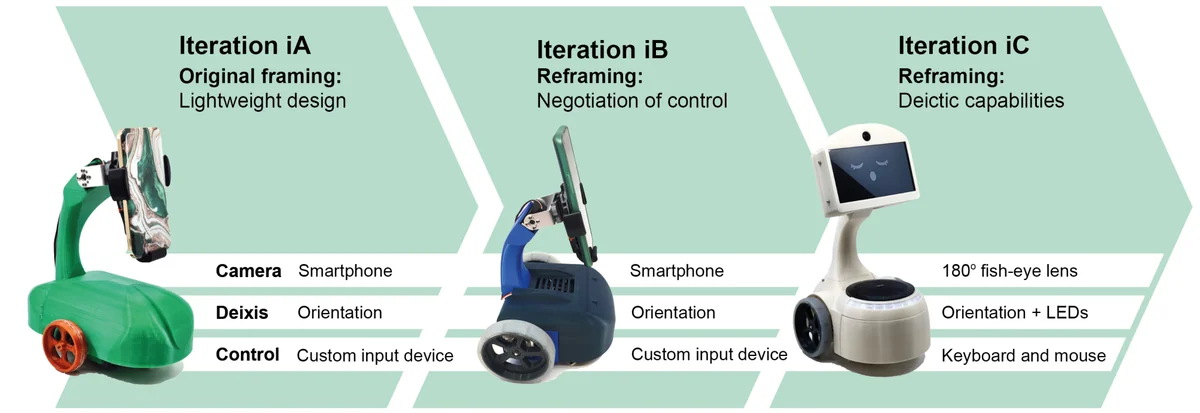
Figure 1: An overview of the iterations of TableBot and the framing used in the design process: Iteration 1 (iA) framed the design in terms of a lightweight design. Iteration 2 (iB) reframed the design to focus on negotiation of control. Iteration 3 (iC) reframed the design again, to focus on deictic capabilities in hybrid settings. Limitations and opportunities in the design space were identified through explorative studies, which motivated the reframings. From the paper, Fig. 1, p. 1. - Setting
- Hub-satellite hybrid sessions with one remote pilot and co-located participants around a table: designing a poster (study 1) and a Codenames-inspired board game (studies 2 and 3).
- Participants / data
- 46 study places across three studies: 2 groups of 3 in study 1 and 4 groups of 5 in each of studies 2 and 3, and aged 20-58, primarily university students from a convenience population. The paper's total of '43 participants (17 female, 26 male)' appears to be a typo (see dataNotes).
- Duration
- Studies of 20 minutes (study 1) and three 20-minute rounds (studies 2 and 3), each followed by a focus group of around 20 minutes. The design process spanned 1.5 years.
- Analysis
- Observation and video analysis of episodes (robot movement, conversation, inclusion of the pilot), robot movement logs, and thematic analysis of focus group interviews.
Findings
Sharing control included the pilot best. In the second and third studies, where four people at a table played a board game with a fifth joining through the robot, groups that actively shared control integrated the remote pilot best. The most successful group in the second study had a pilot who was clear about needs and limits: #
“one of the pilots was very explicit about needs from the co-located participants and boundaries, which encouraged the co-located participants to support the pilot even when not explicitly asked”
Wide views for presence, narrow views for readable focus. When we compared camera views, everyone, remote and in the room, preferred a wide view, which gave the best sense of presence. But a narrow view made it easier to tell where the pilot was looking. LEDs showing the pilot's direction of gaze were mostly overlooked. #
(§5.1, p. 7)Outnumbered pilots lose attention. With four people in the room, the remote pilot struggled to get attention, especially without speaking. When the pilot was not allowed to move the robot, they were more likely to be left out. #
“It was very challenging to be unable to control [the view]. I did not feel as much a part of [the task].”
Moving the pilot felt invasive, but helped. People in the room felt that moving the robot violated the pilot's personal space, while pilots mostly found being moved helpful. When the robot visibly glitched, people quickly helped. With the polished final version, they assumed no help was needed. #
(§6.2.3, p. 10)Shared control can turn into seizure. In one group, a participant anxious that the robot would drive off the edge of the table lifted it out of the pilot's control, just after the pilot had been given the freedom to roam. The pilot's view of it: #
“It was a bit annoying when [the co-located participant] just picked me up and just held me, kind of hostage.”
Person or robot? It shifts. Whether people treated the robot as their colleague or as a piece of equipment shifted from moment to moment, and this shaped their willingness to move it. When glitches made it seem more like a robot, moving it felt acceptable: #
“I did not see [the pilot] or something [human], so it was not that bad [to move the robot].”
Questions this paper answers
- Should people in the room be able to move a remote colleague's telepresence robot?
- It can help, if control is negotiated. In studies of a tabletop robot, groups that shared control with its remote driver included that person best, and drivers mostly found being moved helpful. But drivers need a way to refuse. One anxious participant lifted the robot out of its driver's control. (See §5.3, p. 8; §6.2.3, p. 10; §5.3, p. 8.)
- Is a wide camera view better for someone joining through a telepresence robot?
- Mostly, yes. With a tabletop telepresence robot, everyone, remote and in the room, preferred a wide view, which gave the best sense of presence. But a narrow view made it easier to tell where the remote person was looking. LEDs meant to show this went mostly unnoticed. (See §5.1, p. 7.)
- Why do people hesitate to help a remote person on a telepresence robot?
- Because moving the robot can feel like invading the remote person's personal space. In studies of a tabletop robot, people moved it readily when glitches made it seem more like a machine (a mixed human-and-robot perception called robomorphism). A polished design led them to assume no help was needed. (See §6.2.3, p. 10; §5.3, p. 8.)
Contributions and implications
- Tabletop telepresence robots involve three design trade-offs. These are wide field of view versus clear locus of attention, polished design versus expressing limitations, and autonomy versus assistance.
The trade-offs emphasise that there is no one-design-fits-all approach.
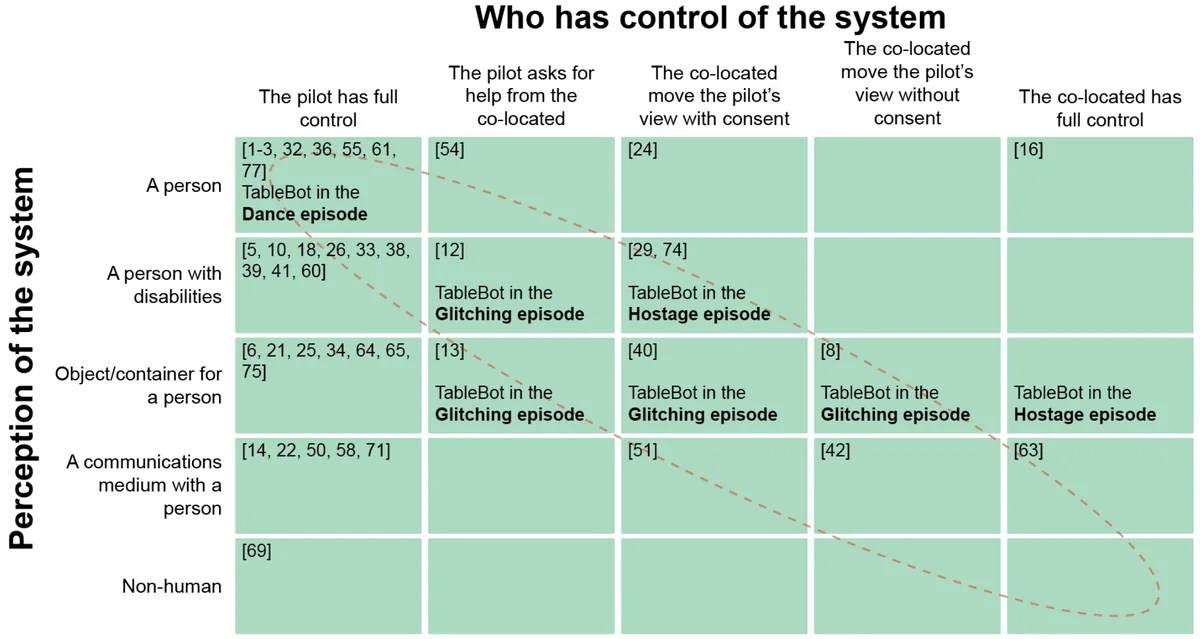
(§7, p. 13) - A framework mapping who controls the robot against how the pilot is perceived. Designing along its diagonal, where a robomorphic perception supports shared control, can help.
Along this downward diagonal, the Robomorphic perception supports the negotiation of control of the system, encouraging the co-located participants to assist the remote participant, without dehumanising the remote participant.
(§6.3, p. 11) - Hybrid meetings' asymmetries are usually tackled by imitating physical presence and giving the pilot full control. Designs can instead embrace those asymmetries, as TableBot does with its non-human 'cute' form. They can use negotiated control and non-human abilities, such as spikes on the handle to signal non-consent to being moved.
Opportunities remain to lean further into different asymmetries, and explore how they affect hybrid collaboration
(§6.4, p. 12)
Limitations
- Studies used equal power distributions among participants and a playful setting and task, so not all findings transfer to traditional work meetings. (§Limitations, p. 13)
- TableBot is small, which may affect the impression of the pilot's authority.
- Participants were recruited through the authors' networks and some knew each other. The effect of these relationships and of personality was not examined.
›Concepts
- Negotiation of control
- Sharing and contesting who steers the robot, and so whose choice sets the pilot's view, ranging from the pilot driving alone to people in the room picking it up.
Being moved is inherently an act of negotiation between the co-located participants needing to physically move the robot, and the remote participant having their view changed by being moved around.
(§6.2.3, p. 10) - Robomorphism
- A concept from prior work that frames how the pilot is perceived:
Schouten et al. [59] coined the term Robomorphism to describe when people apply robotic traits to a telepresence robot mediated interlocutor, perceiving them as both a human and robot simultaneously.
(§2.2, p. 3) - Pilot
- The remote participant driving TableBot. (§1, p. 2)
- Serial Research-through-Design
- Our design process, in which findings from each study reframed the next prototype:
we adopted a serial RtD approach [4, 8, 33, 70] where each iteration acted as a design experiment
(§4, p. 4)
Figures
How to cite
Maja Dybboe, Johannes Ellemose, Alexander Langagergaard Vastrup, Andriana Boudouraki, Sean Rintel, Marianne Graves Petersen, Jens Emil Sloth Grønbæk, and Clemens Nylandsted Klokmose. 2024. TableBot: Getting a Handle on Hybrid Collaboration by Negotiating Control of a Tabletop Telepresence Robot. NordiCHI 2024. https://doi.org/10.1145/3679318.3685350
This brief was prepared with AI assistance and published by Sean Rintel. It is not the authors' published text. Page numbers refer to this PDF.