Research brief
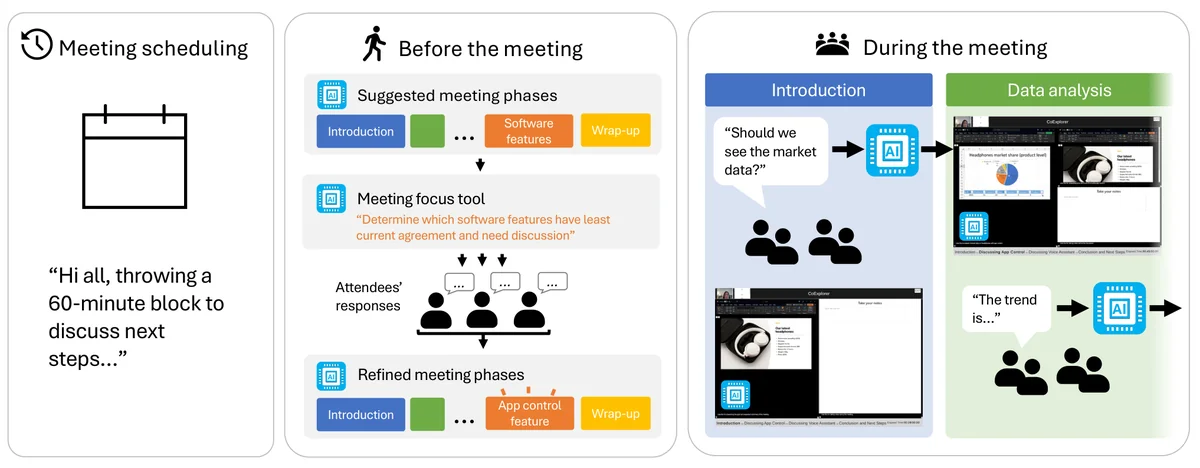
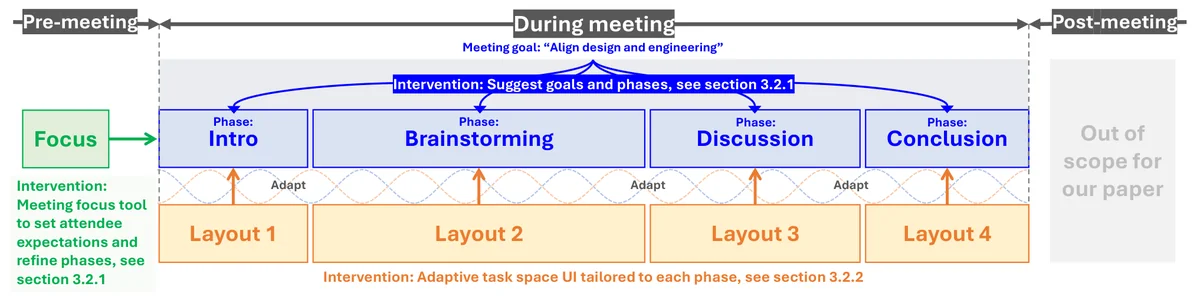
Takeaway: Generative AI can ease meeting intentionality (knowing why you meet). From the invitation, AI can generate a goal, meeting phases and a poll of where attendees agree, focusing discussion on differences. Then an adaptive interface can open apps and files as talk changes phase.
Why this matters
- What was known
- Videoconferencing systems mostly connect endpoints. Research and commercial AI tools target specific pain points, missing the bigger picture of meeting intentionality across the meeting lifecycle. (§2.2, p. 3)
- What this paper adds
- A working probe that applies generative AI across the whole meeting lifecycle (from the invitation to in-meeting screen layouts) rather than to a single pain point. It comes with a user study, design implications and the prompts used, so others can rebuild it. (§1, p. 2)
- Who it matters to
- Designers and researchers building generative AI meeting technology and adaptive windowing systems.
Our results and design implications suggest next steps for creating GenAI-mediated meeting systems, and the Appendix helps other researchers recreate and build upon our system.
(§7, p. 13)
Research questions
- RQ1. What are users' perceptions of GenAI driving a meeting's purpose for a collaborative meeting of teammates?
- RQ2. What are users' perceptions of GenAI surfacing implicit needs and resources in meetings, and the potential effects on participation and effectiveness?
- RQ3. What are users' perceptions of human-on-the-loop interactivity in GenAI video meeting systems?
Method and data
- Design
- Technology probe study: a guided walkthrough of the CoExplorer prototype in a simulated meeting, with a semi-structured interview and think-aloud.
- Prototype
- CoExplorer, a video meeting app driven by generative AI (GPT-3.5 and GPT-4, with Microsoft Azure speech-to-text). From a pasted calendar invitation, it shows each attendee a suggested meeting goal, the reasoning behind it and a list of phases (such as introduction, brainstorming and discussion). It also generates a Meeting Focus Tool (here a feature-ranking calculator) in which attendees state their preferences before the meeting. It then narrows the goal and phases to where views diverge. During the meeting it transcribes speech, detects when the talk moves to a new phase, and asks whether anyone wants to stop the change. If no one objects, it rearranges the screen into a tiled layout of video, files and apps for that phase. For the study, the phases and focus tool were pre-generated and the researcher triggered phase changes. There was no comparison condition.
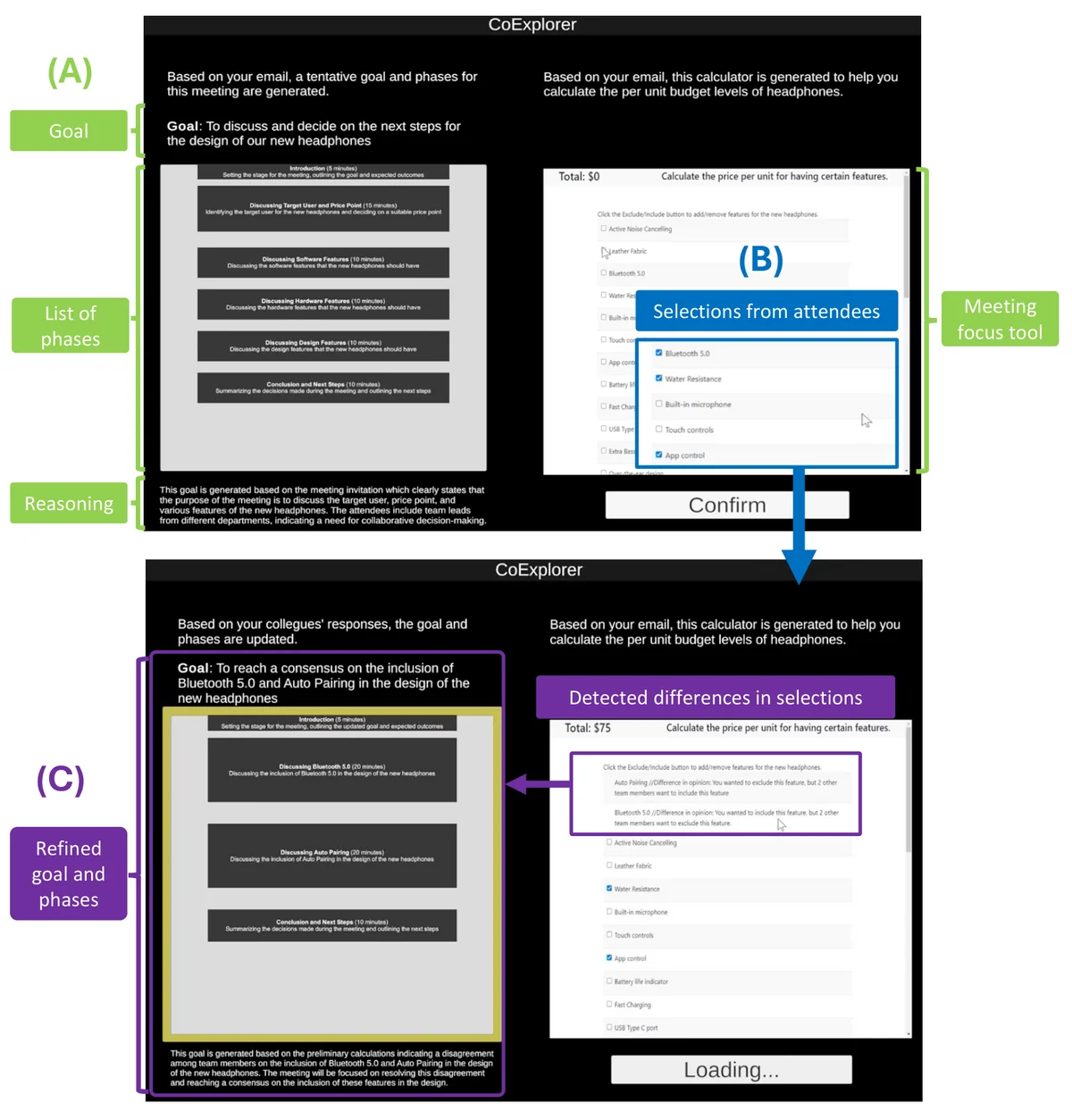
Figure 4: (A) Sequence of phases and tool for determining meeting focus. (B) Participants in the meeting employ the focus tool to select preferred features. (C) CoExplorer uses the aggregated preferences to adjust the meeting's objective and flow. From the paper, Fig. 4, p. 6. - Setting
- One-hour one-to-one sessions over Microsoft Teams, on participants' own laptops. A fictional scenario in which a cross-functional product team decides features for a new version of headphones, using fictitious documents. The other attendees were simulated, with contrasting opinions assigned to them.
- Participants / data
- 26 employees of a large global technology company (18 males and 8 females) in roles including project manager, software engineer, hardware engineer, designer and researcher.
- Duration
- About one hour per session.
- Analysis
- Transcripts analysed with closed coding of attitudes to specific concepts, followed by iterative open coding of the reasons behind them.
Findings
Gathering views beforehand helped. Employees who tried the prototype in a simulated product-planning meeting almost all found it helpful to collect attendees' preferences before the meeting, so discussion could focus on where they disagreed. #
“a lot of the discussion often talks about the differences I guess. So it would be good to see where everybody's aligned and where everyone's not aligned.”
Organisers should keep the final say. Our design let the AI refine the meeting plan automatically, but many participants wanted its refinements to go through the meeting organiser. Some worried refined phases could overwrite the organiser's agenda, or let dominant speakers steer the meeting. #
“The person who's chairing the meeting should be able to accept, reject, or modify any suggestions because they might know better or they might like the suggestion or not.”
Quick structure, ready resources. Of 26 participants, 7 valued how quickly the system turned a line of text into a meeting structure, and 10 were excited by it gathering relevant files and apps for each phase. Six worried too much structure would make meetings rigid and linear. #
“One of the most difficult things in meetings is, do we have a document around this... So having that as resources that people can get to easily is really vital in a meeting.”
Ask first, but don't interrupt. The system acted unless someone objected. Most participants instead wanted it to ask before showing any file or app on the shared screen, yet also wanted fewer prompts during the meeting. #
“You don't want to present and then you have something popping up quite regularly for some reason. That could be distracting.”
Distrust came before any error. Nearly every participant was sceptical of the AI-generated content, even though the system made no visible mistakes for nearly all of them. Trust often depended on more experience with the system or seeing previews of its choices. #
“there is a general reluctance among meeting attendees to trust AI systems which do more than merely give suggestions”
Questions this paper answers
- Would people want AI to plan their meetings?
- Partly. AI can support meeting intentionality before a meeting. When employees tried a prototype, gathering attendees' views beforehand to focus discussion on goals was widely welcomed. Some valued quick structure from a short invitation. But many wanted the organiser to approve the AI's changes, and some feared rigid structure. (See §5.2, p. 9; §5.2.1, p. 9; §5.4, p. 10.)
- Should AI act on its own during a meeting?
- Mostly no. People liked the idea of a system finding relevant files and apps. But most wanted to be asked before anything appeared on the shared screen, while also not wanting frequent interruptions. Such systems have to resolve this tension. (See §5.4, p. 10; §5.4.1, p. 11.)
- Do people trust AI meeting assistants?
- Not readily. People who tried an AI meeting prototype mistrusted its generated content even when it had made no mistakes. This suggests an aversion that predates any error. Where they did trust it, it was often on condition of longer experience or previews of its choices. (See §5.4.1, p. 11; §6.1, p. 11.)
Quantitative results
| Measure | Result | Where |
|---|---|---|
| Participants | 26 employees; 18 males and 8 females | §4.1, p. 8 |
| Found capturing attendees' preferences in advance helpful | 24 of 26 | §5.2, p. 9 |
| Trusted the curated contents (often conditionally) | 17 of 26 | §5.4, p. 10 |
| Expected a way to recall windows the system closed | 20 of 26 | §5.4, p. 10 |
| Said the system should consult humans before showing files or apps; before phase changes | 21 of 26; 16 of 26 | §5.4.1, p. 10 |
| Wanted the organiser to have the final say on attendees' input | 14 of 26 | §5.2.1, p. 9 |
| Wanted the tool well in advance of the meeting | 17 of 26 | §5.2, p. 9 |
| Appreciated the easy structuring capability | 7 of 26 | §5.2, p. 9 |
| Excited about the system curating shared applications and files | 10 of 26 | §5.4, p. 10 |
| Voiced concerns about excessive structuring of the meeting | 6 of 26 | §5.4.2, p. 10 |
Contributions and implications
- Offload human-in-the-loop checks to low-engagement times, such as before the meeting or during breaks, to balance low effort with agency and trust.
- Address the tension between structured, linear meetings and flexible, non-linear ones, including capturing attendees' preferences about structure.
- Design across the whole meeting lifecycle and the wider project, for example showing the focus tool well in advance.
- Systems should assist rather than decide.
Systems should act as an assistant-reducing task-load and enhancing agency-not a decision-maker.
(§6.3, p. 12) - Balance effectiveness with sociality, preserving the social and ritual value of meetings and balancing agreement with disagreement.
Limitations
- Participants came from a single company and the pool was not gender-balanced.
- Confidentiality meant fictitious documents rather than participants' real work files.
- The study did not validate generated phases and tools or compare GenAI with people creating interfaces or running meetings.
our study method did not validate the generated phases and support tools, nor was it a comparative evaluation of GenAI creating an interface versus an interface created by a person
(§6.5, p. 13)
›Concepts
- Meeting intentionality
- What the paper means by intentionality:
everyone in a meeting knowing why they are there, what it is for, and what they need to discuss
(§2.2, p. 3) - Meeting phases
- Locally organised, activity-oriented stretches of a meeting that may match, split or span agenda items and need different resources.
Phases are activity-oriented, often involving the use of multiple resources, and different phases may require different resources.
(§2.1, p. 2) - Human-on-the-loop (HOTL)
- The system acts on its own and humans can only abort its decisions, unlike human-in-the-loop, where actions need prior approval.
HOTL characterizes humanmachine interactions in which the automated system mainly allows humans to abort the machine's decisions, once initiated by the system
(§3.1, p. 5) - Meeting Focus Tool
- A generated pre-meeting tool in which attendees state preferences, used to refine goals and phases towards points of disagreement.
a Meeting Focus Tool that lets meeting participants assess the implications of including specific features in a product from their role perspective and voice their preferences on key features
(§3.2.1, p. 7) - Technology probe
- A working prototype used to elicit users' reactions to design concepts rather than to evaluate performance.
our technology probe walk-through allowed users to engage with a working example of a system that was not yet possible to build to a fidelity necessary for plausible evaluation
(§6.5, p. 13)
Figures
How to cite
Gun Woo (Warren) Park, Payod Panda, Lev Tankelevitch, and Sean Rintel. 2024. The CoExplorer Technology Probe: A Generative AI-Powered Adaptive Interface to Support Intentionality in Planning and Running Video Meetings. DIS 2024. https://doi.org/10.1145/3643834.3661507
This brief was prepared with AI assistance and published by Sean Rintel. It is not the authors' published text. Page numbers refer to this PDF.