Research brief
Takeaway: Error messages are brand moments, because failure stirs emotion. Cute mascots like Twitter's Fail Whale showed care and earned publicity, but the more memorable, the more they tied the brand to failure. So designs seem to have moved to generic faces and robots that point less to the brand.
Why this matters
- What was known
- Usability guidelines treat error messages as rational information, overlooking that they also carry the brand. (pp. 1–2)
- What this paper adds
- Where usability guidelines judge error messages by how informative they are, we read them as branding, tracing error screens from the Blue Screen of Death through fail pets to more cautious recent designs. (pp. 1–2)
- Who it matters to
- UX designers and brand strategists deciding how error messages should look and sound. (§Cons, p. 17)
Research question
- How have error screens evolved, from cryptic system messages to whimsical 'fail pets' to more restrained imagery, and what are the branding pros and cons of fail pets?
Method and data
- Design
- Essay (UX Magazine article) tracing the history of error screens through examples and design commentary.
- Setting
- Error pages and crash messages from Microsoft, Hewlett-Packard, Yahoo!, Blippy, Twitter, Tumblr, GitHub, Zappos, Ars Technica, Mozilla Firefox, Adobe Flash, Apple iCloud and Google, among others.
- Analysis
- Interpretive analysis of branding and user experience, drawing on usability guidelines, designers' public comments, and work on enchantment and anthropomorphism in interfaces.
Findings
Ugly errors stuck to brands. Early error messages such as Windows' Blue Screen of Death became infamous. Kept unchanged while Windows itself grew ever more polished, it came to stand for the brand. #
“The BSOD highlighted the fact that the interface was a veneer, undermining the company's claims of innovation.”
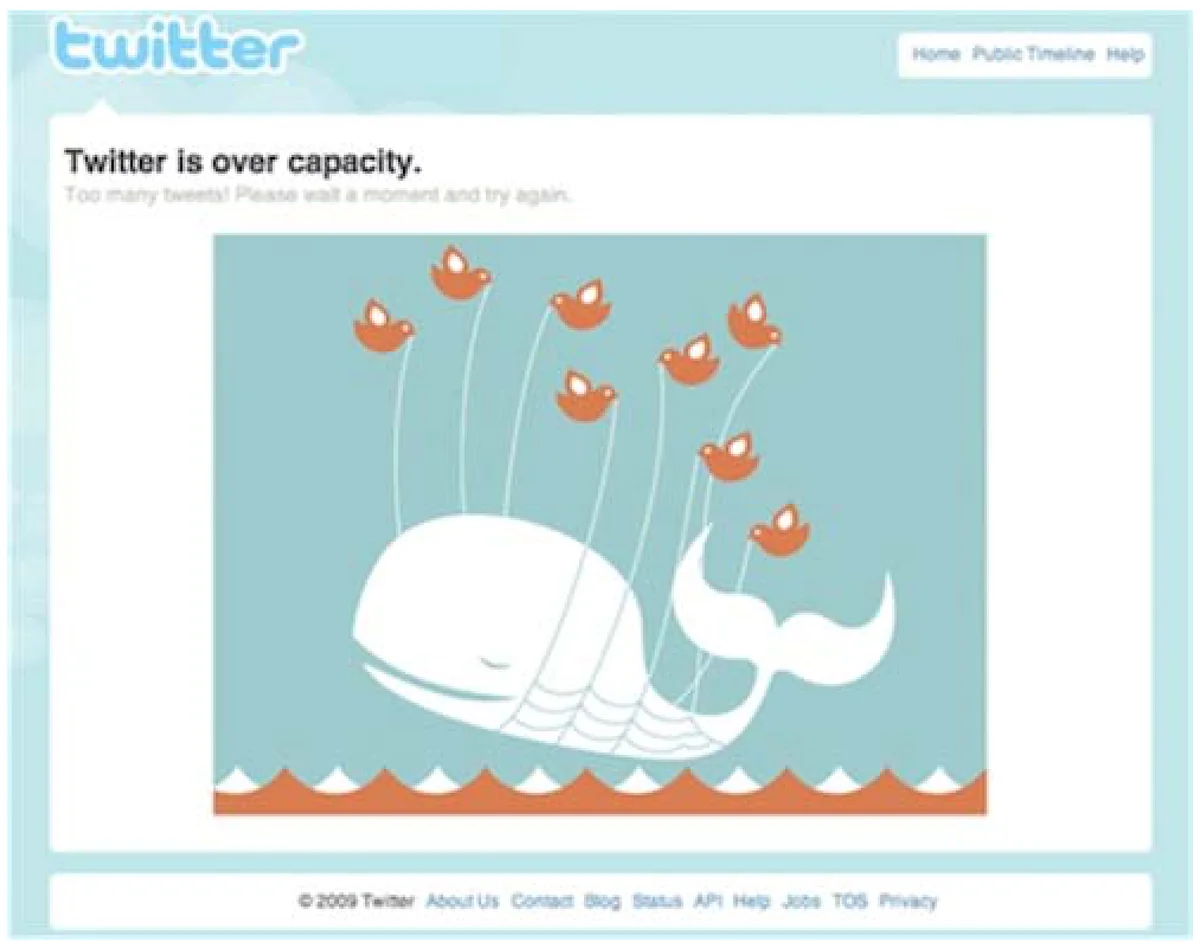
Users loved the Fail Whale. Twitter's Fail Whale turned an error page into a beloved symbol. Users named it and spread it in cartoons, tattoos, art and games, treating it as a badge of membership. #
“Getting members to love your error message rather than revile it is quite an achievement.”
Memorable mascots retreated. Highly recognisable fail pets may then have begun to retreat. Zappos replaced its named dog with an unnamed penguin, Tumblr seems to have dropped its Tumbeasts, and Firefox's lead designer argued against a memorable crash mascot: #
“I'm not sure if we want to create something that is too memorable since it will inevitably become the symbol of our failure”
Generic imagery, weaker brand link. Newer error imagery from Adobe, Apple, Google and Microsoft uses simple emoticon-like bricks, clouds and folders, or broken robots, which resist a strong link to any one brand's logo or mascot. #
“the more that websites use similar imagery (whether robots, emoticonized bricks, clouds, etc.), the less each new fail pet becomes associated with the particular brand and the more fail pets come to indicate service failure generally”
Pros, cons and little evidence. Weighing them up, fail pets show that a brand cares, are recognised faster than words and can earn free publicity, but they can tie a service to failure, annoy users and raise cultural issues. #
“Even given the amazing earned media of the Fail Whale, there is not strong empirical evidence that the practice of using fail pets is, in fact, working for users.”
Questions this paper answers
- Are cute error page mascots good for a brand?
- They can be. They show the brand cares, are recognised quickly, and can earn free publicity, as Twitter's Fail Whale did. But they can also tie the brand to failure, annoy users, or seem flippant, and there is little evidence they work for users. (See §Web 2.0 and the Rise of Fail Pets 1.0, p. 7; §Cons, p. 17.)
- Why did companies move away from memorable error mascots?
- Probably because a highly recognisable mascot risks becoming the symbol of a service's failure, and there is little evidence that mascots help users. Generic imagery shared across many sites signals that something went wrong without pinning the failure on one brand. (See §The Case Against Fail Pets 1.0, p. 10; §Fail Pets 2.0, p. 14; §Cons, p. 17.)
- Why should an error message care about branding at all?
- Because failure is an emotional moment, and how a product handles it shows how much the brand cares about users. Error messages people see again and again can come to stand for the brand, as Windows' Blue Screen of Death did for Microsoft. (See §A Brief History of Error Message Infamy, p. 2.)
Contributions and implications
- Before using a fail pet, research users' likely social reaction to the specific failure.
Research carefully what kind of social reaction users will have to the particular failure, and decide whether the evocation of a highly social response is a desirable branding opportunity, or a problematic barrier between failure and resolution.
(§Cons, p. 17) - The failures of Microsoft Bob and Clippy warn against mascots chosen only for cuteness.
should serve as a warning to those who would deploy fail pets simply because they are cute or funny
(§Cons, p. 17)
Limitations
- An essay based on examples and commentary. It reports no user data, and notes the lack of strong empirical evidence on whether fail pets work for users.
›Concepts
- Fail pets
- Where the term comes from:
Fred Wenzel refers to error mascots, such as Twitter's (/topics/twitter) Fail Whale (Figure 1) as fail pets
(pp. 1–2) - Error messages as brand messages
- Because failure evokes emotion, the form of an error message signals how much a brand cares about the user experience.
Error messages are therefore a critical strategic moment in brand awareness and loyalty.
(pp. 1–2) - Earned media
- Recognition that users spread themselves:
The Fail Whale became earned media of a particularly important stripe, because Twitter users treated it as a badge of membership.
(§Web 2.0 and the Rise of Fail Pets 1.0, p. 7) - Fail pets 2.0
- Recent, simplified error imagery (emoticon-like bricks, clouds, folders, broken robots) that avoids a strong link to the brand's logo or mascot.
seem to have become more restrained while still retaining some element of the value of fail pets
(§Fail Pets 2.0, p. 12)
Figures
How to cite
Sean Rintel. 2011. The Evolution of Fail Pets: Strategic Whimsy and Brand Awareness in Error Messages. UX Magazine 759.
This brief was prepared with AI assistance and published by Sean Rintel. It is not the authors' published text. Page numbers refer to this PDF.