Research brief
Takeaway: Students' generative AI use is shaped by the university around them, not just the tool. Faced with unclear, plagiarism-focused guidelines and educators reluctant to discuss AI, students used it as tutor or assistant yet governed themselves by unspoken rules, some anxiously. Clearer, co-designed guidance and AI literacy training could help.
Why this matters
- What was known
- Earlier work gave high-level overviews of students' perceptions and attitudes towards generative AI, mostly in computer science, without examining real-world practices or the university context that shapes them. (§1, p. 2)
- What this paper adds
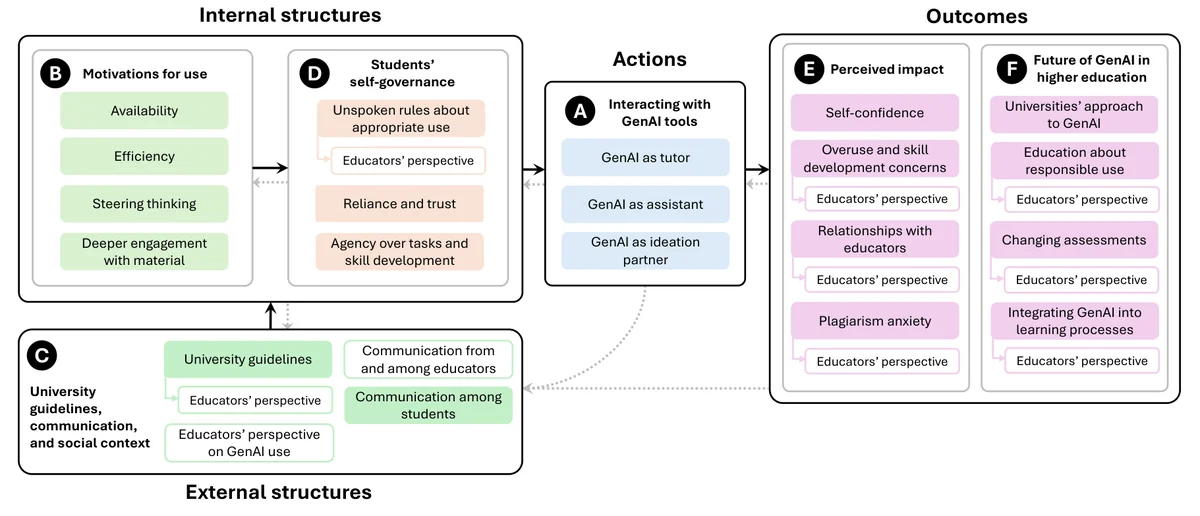
- Unlike earlier surveys of attitudes, mostly in computer science, we look at what students across disciplines actually do. We set it against their university's guidelines and educators' views, and organise the findings in a model of how structures and practices shape each other.
In-depth findings on higher education students' broader practices around GenAI, including uses, reliance-mediating strategies, and communication norms, covering multiple disciplines and year groups.
(§1, p. 2) - Who it matters to
- University policymakers, educators, researchers, and HCI designers of educational AI tools.
Both policymakers and researchers need to understand its practical realities as part of an ecosystem
(§1, p. 2)
Research questions
- (1) How and why do students use GenAI in higher education?
- (2) What are students' norms and etiquette around the use of GenAI in higher education, and how is this shaped by their university context?
- (3) What are students' GenAI reliance strategies and what mediates this?
- (4) What are the perceived impacts of GenAI on students?
- (5) What is the future role of GenAI in higher education according to students and educators?
Method and data
- Design
- Pre-interview surveys and semi-structured interviews. Inductive thematic analysis with comparative analysis of students against educators, then mapped onto Strong Structuration Theory.
- Setting
- Two UK universities, across humanities, social science and STEM disciplines. Interviews by video meeting.
- Participants / data
- Undergraduate students (n = 26. 18 from University A) and educators (n = 11. 8 from University A).
- Duration
- Interviews from December 2023 to February 2024, averaging 40 minutes.
- Analysis
- Two researchers coded transcripts in MAXQDA. Counts reported as proportions of students or educators (e.g. 13/26).
Findings
Tutor, assistant, ideation partner. The 26 undergraduates we interviewed at two UK universities were mostly in the humanities. They used generative AI in three roles, as a tutor (explaining material, giving feedback), an assistant (summarising, searching, polishing writing, outlining essays) and an ideation partner. #
“replacement for a partner that you get in, like a seminar or a smaller discussion group”
Always there, and quick. They valued its constant availability and the time it saved, and also its help in getting unstuck and in engaging more deeply with their reading, for example by questioning its answers against the original source. #
“It's in your pockets, in your phone, your home. You don't have your professor always there”
Guidance unclear, silence common. Most students and most of the 11 educators found university guidance on generative AI unclear, and students who knew it saw mainly warnings about plagiarism. Students talked openly about AI with each other. Many educators avoided the topic, even with colleagues. #
“Everyone was interested, but nobody actually touched on the topic. I think everyone was a bit scared.”
Students set their own rules. In that vacuum, students regulated themselves. They followed unspoken rules, double-checked outputs against other sources, trusted AI less where they lacked expertise or the stakes were high, and sometimes avoided it to keep their own skills. #
“It is okay to use GenAI within certain boundaries, with the boundaries being: (1) "reference, do not plagiarise", (2) "edit, do not copy and paste", and (3) "use it to assist you, not to do work for you"”
Mixed effects, and plagiarism anxiety. Some students felt more confident, others less. Some students, and most educators, worried about losing or never building skills such as critical thinking. Some feared weaker ties with educators. And some feared being falsely accused of plagiarism, even one who did not use AI. #
“I don't want to have worked on a project for a really long time... and then be told, no, this was AI. There's no way of proving, you know, I've written this myself”
Teach it, don't ban it. Many students want universities to embrace generative AI and teach responsible use. Some students and educators envisaged new kinds of assessment and AI complementing teachers, and some students compared it to calculators or the internet. #
“It seems mad to me that we're at an institution like this and we're not encouraging intellectual people to be using this”
Questions this paper answers
- How do university students actually use ChatGPT for their studies?
- Much like familiar kinds of help. They use it as a tutor that explains readings and gives feedback, an assistant that summarises, searches and outlines, and a partner for bouncing ideas around. Saving time was the most commonly cited draw, alongside help getting unstuck, deeper engagement and round-the-clock availability. (See §5.1.3, p. 8; §5.2.1, pp. 8–9.)
- Are university rules on generative AI clear to students?
- Mostly not. Most students and educators interviewed at two UK universities found guidelines unclear. Students who knew of them saw a focus on plagiarism, and many educators avoided discussing GenAI. Some students felt anxious about plagiarism accusations. (See §5.3.3, p. 11; §5.5.4, p. 14.)
- How do students decide what counts as acceptable AI use?
- Through unspoken rules, such as referencing it, editing rather than copying and pasting, and using it to assist rather than do the work. They also double-check outputs and weigh their own expertise, the task's stakes and their skill development. (See §5.4, pp. 11–12.)
- Does using AI harm students' skills?
- Many worried it could. Some students feared losing or not developing skills such as critical thinking and writing, and most educators saw the same risk, many viewing practising skills as the key protection. (See §5.5.4, p. 14.)
Quantitative results
| Measure | Result | Where |
|---|---|---|
| Students who felt university communication on GenAI use lacked clarity | 17/26 | §5.3, p. 10 |
| Educators unaware of official GenAI guidelines | 9/11 | §5.3, p. 10 |
| Educators who do not talk openly about GenAI | 7/11 | §5.3, p. 11 |
| Students who double-checked GenAI outputs against other sources | 13/26 | §5.4, p. 12 |
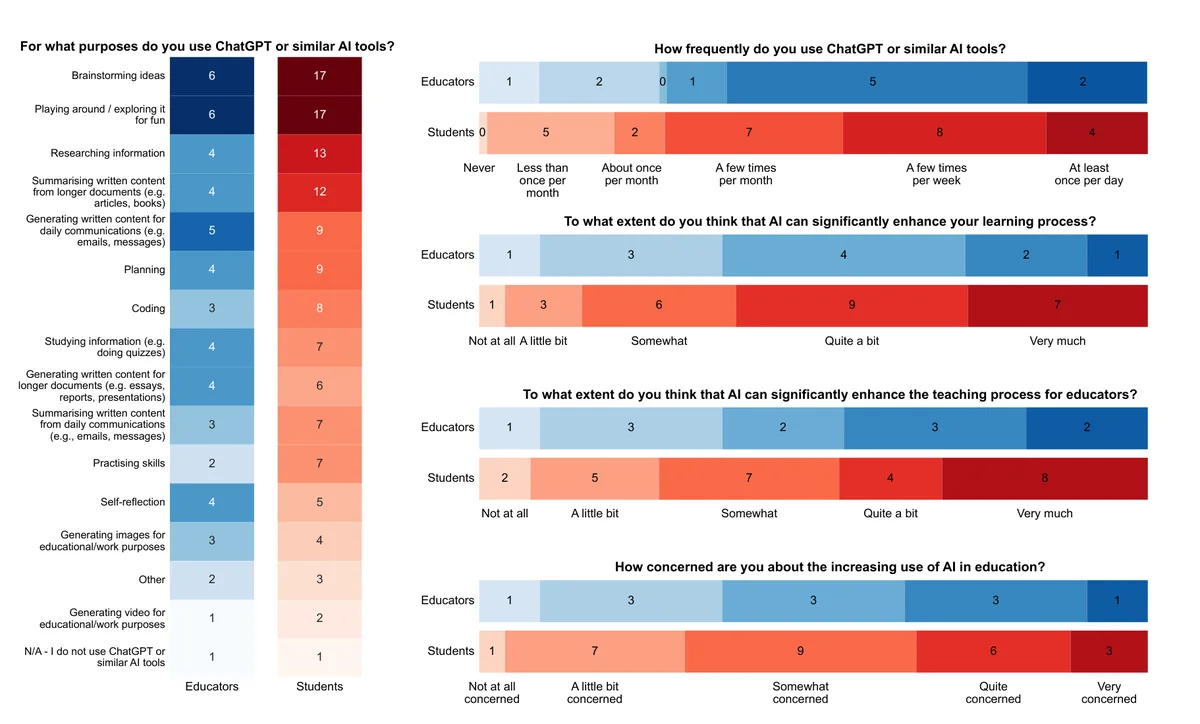
| Pre-interview survey (indicative only): believe AI can enhance learning 'quite a bit' or 'very much' | 16 out of 26 students vs 3 out of 11 educators | Appendix C, p. 27 |
Contributions and implications
- Communicate guidelines systematically, cover issues beyond plagiarism, and involve students and educators in developing them.
One approach is to involve both groups in the development of guidelines using participatory design methods
(§6.1, p. 16) - Empower educators to talk about GenAI and share practice through their professional communities.
- Provide multi-faceted GenAI literacy training, including collaborative learning and recognising errors in GenAI output.
Our findings therefore indicate a need for multi-faceted GenAI literacy training in universities
(§6.2, p. 17) - Redesign assessments, for example by incorporating GenAI into assignments, and design personalised learning that keeps roles for educators and peers.
- Consider safeguards for skills at risk from over-reliance, such as critical thinking, for example through cognitive forcing functions.
Safeguards may be necessary to protect skills that are key for students' education goals.
(§6.3, p. 18)
Limitations
- A snapshot of evolving practice, from a self-selected sample at only two UK universities.
This study captures a snapshot of experiences that are continuously evolving.
(§4.4, p. 7) - Samples were not representative. Students skewed to the humanities, and educators were mostly junior teaching staff.
Student participants were more from humanities (n = 21) than STEM subjects (n = 5).
(§4.4, p. 7) - Findings rest on self-reports, so the real extent of over- or under-reliance remains to be studied.
- SST was applied post hoc rather than guiding the study design.
the study would have benefited from using SST to guide the study design
(§4.4, p. 7)
›Concepts
- Strong Structuration Theory (SST)
- A framework that distinguishes external structures, internal structures, actions and outcomes, and how they shape one another. We used it to cohere our themes.
SST recognises the mutual interactions between individuals' agency, technology, and their encompassing socio-techno-political structures
(§4.3, p. 6) - Conjuncture
- A Strong Structuration Theory term. Our findings are a snapshot of this moment in GenAI adoption:
SST emphasizes the conjuncture, a' critical combination of events or circumstances'
(§4.3, p. 7) - Overreliance
- The particular risk that students' reliance strategies mediated:
overreliance-the erroneous acceptance of incorrect GenAI output
(§5.4, p. 12) - Plagiarism anxiety
- Potentially due to universities' unclear communication about GenAI,
students (7/26) were feeling anxious about being accused of plagiarism
(§5.5, p. 14)
Figures
How to cite
Auste Simkute, Viktor Kewenig, Abigail Sellen, Sean Rintel, and Lev Tankelevitch. 2025. The New Calculator? Practices, Norms, and Implications of Generative AI in Higher Education. arxiv. https://doi.org/10.48550/arXiv.2501.08864
This brief was prepared with AI assistance and published by Sean Rintel. It is not the authors' published text. Page numbers refer to this PDF.