Research brief
Takeaway: Video-only messaging suits crafted, gift-like exchanges but imposes a 'tyranny of the everyday'. With every turn on camera, being ordinary takes effort, so many return to lighter apps.
Why this matters
- What was known
- Video clips are widely shared on mobile, but exchanging video clips as conversational turns has never become mainstream. Research on video-mediated communication has repeatedly found a tension between its emotional value and the self-consciousness of being seen and heard. (§FITTING VIDEO INTO ORDINARY LIFE, p. 2)
- What this paper adds
- A field trial of Skype Qik (an app restricted to video only) at its launch. We use it as a rare natural case of extreme constraint, to examine how people reason about the economy of turn exchange in asynchronous mobile video messaging. (Introduction, p. 1)
- Who it matters to
- Designers of mobile messaging and communication apps.
designing for fluid control of the obligations of turn exchange is key to mobile applications intended to support everyday messaging
(Abstract, p. 1)
Research questions
- Would new users intuitively take to pure asynchronous video for everyday messaging or revert to one of their existing apps?
- How do people reason about the economies of turn exchange in asynchronous mobile video messaging?
Method and data
- Design
- Two-week field trial of Skype Qik, a video-only asynchronous messaging app, on participants' own phones from the day of its launch, with kick-off, check-in and debrief interviews and, where participants allowed, recorded message threads and stimulated recall.
- Setting
- The UK, Australia and Macau. Participants used the app freely alongside their other apps, with no set tasks.
- Participants / data
- 53 participants recruited by convenience and snowball sampling: 23 in the UK, 17 in Australia and 13 in Macau, aged 17 to 44, 70% between 19 and 25, and all but 10 were university students.
- Duration
- Two weeks, matching the app's auto-deletion of messages after 14 days.
- Analysis
- Ethnomethodological and Conversation Analysis (EMCA) of transcribed interviews and videos, focused on when asynchronous video messaging was treated as enjoyable and when it was a struggle, illustrated with perspicuous cases.
Findings
Video was for posting, not chatting. Before the trial, the young adults we recruited in the UK, Australia and Macau treated video as a special mode. It was something to post, or to drop into a conversation for others to comment on, rather than a medium for back-and-forth exchange. #
“Videos are for Facebook, where people have time to look at them and comment. They don't really fit into messaging”
Being on camera puts you on the spot. On first using the video-only app, participants' first concerns were looking presentable and the sound of video, both recording and playing it, in places where noise is unwelcome. #
“First thing that springs to mind is obviously you've got to look half decent all the time when you're using it, because obviously everyone can see what you look like.”
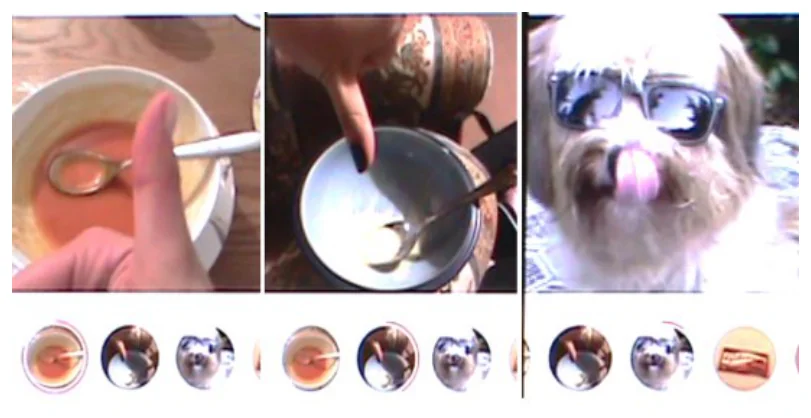
Video as a gift. The most enthusiastic users treated video as a gift economy of specially crafted, emotional clips whose exchange showed the relationship. Examples were two best friends coping with separation and a man flirting with four women at once. Even so, most exchanges ran to two or three clips rather than sustained conversation. #
(§Embracing Skype Qik as a gift economy, p. 5)The everyday is unshowable. Outside gift exchange, many struggled to be ordinary on video. When they simply wanted to say something, there was nothing suitable to show, and filming themselves talking drew attention to the act of commenting rather than the comment. #
“Being ordinary in Skype Qik was a challenge because the ordinary was 'inherently unshowable'”
Nobody likes their own voice. Many participants disliked hearing their own recorded voice, and the fact that any clip could be replayed made it worse. #
“It's really awkward because you don't want to talk on them. Nobody likes hearing their own voice.”
A matching reply is a burden. Having to reply in video raised the effort of every response. One pair of friends stalled three times, and twice moved to WhatsApp for much longer conversations, where, as one put it, replies take no thought: #
“You just don't even think about it. You know, 'How's your night going?' Or, 'Oh, my God. Are you watching this on TV?' That kind of thing. You don't really think, yes, you just do.”
Questions this paper answers
- Why do video messages feel harder to send than texts?
- Video messages show where you are, how you look and how you sound, so every turn can feel like a performance open to scrutiny. Many people disliked their recorded voice most. Text is lean, so friends can chat from bed in pyjamas without that becoming the topic. (See §First impressions of asynchronous video messaging, p. 4; §The tyranny of the everyday, p. 6; §Video struggles: Moving on from matching play, p. 8.)
- When does sending video messages back and forth work well?
- When the effort is the point. Close friends coping with separation, and a flirtatious group, valued crafted clips and rapid replies because each one showed how much the relationship mattered. But such gift exchanges are only a small part of everyday conversation. (See §Embracing Skype Qik as a gift economy, p. 5.)
- Do people dislike seeing and hearing themselves in messages?
- Many do. New users of a video-only messaging app worried first about looking presentable, and many disliked hearing their own recorded voice, made worse because any clip could be replayed. Self-presentation was foremost in their minds, though the greater struggle was appearing ordinary rather than appearing good. (See §First impressions of asynchronous video messaging, p. 4; §The tyranny of the everyday, p. 6; §Voice struggles, p. 6.)
Contributions and implications
- When sustained everyday exchange is the goal, video alone is probably of limited value except in niche contexts.
when sustained everyday exchange is the goal, using purely video is probably of limited value to users except for certain niche contexts
(§DISCUSSION, p. 10) - Video clips work best as one-offs with lighter response features attached, or as one mode among several.
Video clips work best either as one-offs with such features attached to each, or when video is one of a number of features
(§DISCUSSION, p. 10) - Rather than richness of mode, designers should aim for flexible control of communication.
designers should strive for perceived flexibility of communicative control
(§DISCUSSION, p. 10)
Limitations
- The two-week trial at launch captures developing rather than mature use.
our findings cover developing behavior and reasoning rather than mature understandings
(§METHOD, p. 3) - Participants were mainly university students.
our recruitment of primarily university students limits our findings to that population
(§METHOD, p. 3) - As a small-scale study, the findings are preliminary.
our findings and conclusions are preliminary
(§DISCUSSION, p. 9)
›Concepts
- Doing 'being ordinary'
- Following Harvey Sacks, the everyday work of displaying and attending to the world as usual, banal and nothing much.
no matter what happens, pretty much everybody is engaged in finding only how it is that what is going on is usual, with every effort possible
(§FITTING VIDEO INTO ORDINARY LIFE, p. 2) - Moral order of looking
- A term from prior research on video-mediated communication:
sets of rights and obligations surrounding the enactment of intimacy over distance through an explicit technical frame
(§FITTING VIDEO INTO ORDINARY LIFE, p. 2) - Recipient design
- A conversation-analytic term:
Recipient design refers to way that turns are constructed with an orientation to who is being addressed
(§FITTING VIDEO INTO ORDINARY LIFE, p. 2) - Gift economy
- How the enthusiastic users treated video:
the use of specifically crafted emotionally-oriented clips in which the obligations of turn and response were demonstrative of the relationship
(§Embracing Skype Qik as a gift economy, p. 5) - Leanness
- The low richness of text messaging, which frees what is talked about from where and how it is produced.
leanness decouples the topic of talk from its literal production context
(pp. 9–10)
Figures
How to cite
Sean Rintel, Richard Harper, and Kenton O'Hara. 2016. The Tyranny of the Everyday in Mobile Video Messaging. CHI 2016. https://doi.org/10.1145/2858036.2858042
This brief was prepared with AI assistance and published by Sean Rintel. It is not the authors' published text. Page numbers refer to this PDF.