Research brief
Takeaway: 'VR as a bridge' connects people to real places, not only virtual ones. An AR avatar on a telepresence robot seemed to help partners read gestures and gaze. But some remote users didn't identify with it, perhaps because researcher-made photorealistic avatars felt uncanny, so self-made or cartoon ones might help.
Why this matters
- What was known
- Social VR usually brings distant people together in a shared virtual place, which can be empowering, but it gives no access to the real world.
VR technologies provide connection opportunities to many people who would otherwise not have them.
(§Introduction, p. 2) - What this paper adds
- A 'VR as bridge' view of social VR, illustrated by two design explorations that use VR and AR to connect a remote person with a real, distant place and the people in it.
We are interested in using VR and the related technology of Augmented Reality (AR), as tools to (1) bring a distant part of the physical world to someone, and (2) bring someone to a distant part of the physical world.
(Abstract, p. 1) - Who it matters to
- Social VR designers and researchers, and people who cannot easily travel to work or social events. (§Conclusion, p. 4)
Research questions
- How can VR and AR (1) bring a distant part of the physical world to someone, and (2) bring someone to a distant part of the physical world?
- How can VR-enabled telepresence support the ability to freely roam the environment, a feeling that the environment belongs to telepresent users as much as to those physically present, and the ability to freely express oneself there?
Method and data
- Design
- Workshop paper summarising two design explorations (see Prototype). (1) Remote participants used the VR robot interface to accompany a local participant searching for geocaches. (2) A mixed-methods study in which pairs played a clue-finding and word-guessing game, once with VROOM and once with standard robotic telepresence.
- Prototype
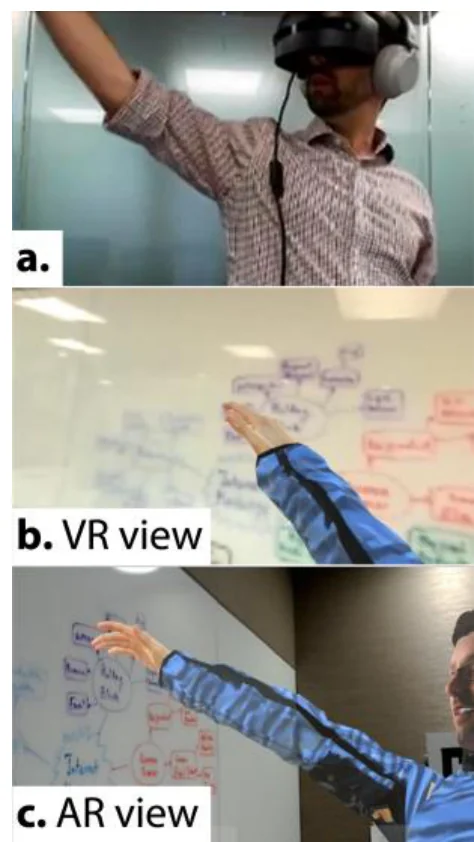
- Two systems built on a Beam telepresence robot (a video-chat screen on wheels that a remote person drives). First, a 360° camera on top of the robot streams live video to a mobile VR headset. The remote user drives the robot while looking around its surroundings naturally, instead of turning the robot to look. Second, VROOM (Virtual Robot Overlay for Online Meetings) adds a photorealistic avatar of the remote user, which the local person sees superimposed on the robot through a HoloLens AR headset. The avatar's head follows the remote user's head, its arms follow their VR motion controllers so they can wave and point, its mouth moves when they speak, and it walks when the robot drives. The remote user sees the avatar's body in first person in VR. VROOM was compared with standard robotic telepresence.
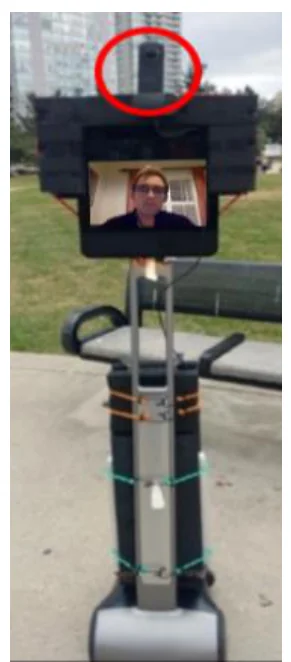
Figure 1: Beam telepresence robot with 360° camera (circled) attached. This camera streams to a remote user who can view the robot's surroundings in VR. From the paper, Figure 1, p. 2. - Setting
- Study 1 outdoors in a park, with the remote participant in an office. Study 2 with one participant local in the activity space and the other remote in a separate room.
- Participants / data
- Pairs of participants (numbers not reported in this paper).
- Analysis
- Preliminary findings reported qualitatively.
Findings
Looking around freely. Remote users driving a telepresence robot through a park with a 360° VR view enjoyed being immersed and being able to look around naturally, without turning the robot. #
“Some participants were so invested in the immersive view of the outdoor environment that they temporarily forgot that they were in an office using a VR system.”
Harder to drive and to point. Steering got harder, because drivers lost track of which way the robot faced. Partners on site, who saw the driver only on the robot's screen, often could not tell what they were pointing at. #
“it was easy for the remote user to lose their orientation in the VR view, and thus their orientation with respect to the robot”
An avatar made gestures readable. VROOM is asymmetric by design. Local users see the remote user's avatar in third person through an AR headset, while remote users see its body in first person in VR. Preliminary findings suggest local users read their partner's gestures and gaze well through it, and some remote users felt it embodied them because their partners saw the same avatar in the same spot. #
“made them feel more like the avatar was an embodiment of themself in the local space”
Not everyone saw themselves. Some remote users did not identify with their avatar once they saw how it looked to their partner. This was perhaps because the research team built the photorealistic avatars from photos, which may have triggered an uncanny valley reaction. #
(Concept 2: VROOM, p. 4)
Questions this paper answers
- Can VR make a telepresence robot feel more like being there?
- Partly. A 360° VR view lets remote users look around without turning the robot. Joining a partner geocaching in a park, some were so immersed they briefly forgot they were in an office. But driving became harder, and local partners struggled to follow their pointing. (See §Concept 1: VR Telepresence Robot Interface, p. 2; §Concept 1: VR Telepresence Robot Interface, p. 3.)
- Does putting an avatar on a telepresence robot help people communicate?
- Preliminary findings suggest so. Local partners wore augmented reality headsets that overlaid the remote person's avatar on the robot, with head and arms moving as the remote person did. They understood that person's gestures and gaze well, and many identified the avatar as their partner. (See Concept 2: VROOM, p. 4.)
- Do people identify with photorealistic avatars of themselves?
- Not always. Some remote users did not identify with an avatar the researchers had built from their photo, once they saw how it looked to their partner. Not having made it themselves, and an uncanny valley reaction to near-realism, may explain why. (See Concept 2: VROOM, p. 4.)
Contributions and implications
- Letting users create their own avatars, or using cartoon-style avatars, may help them identify with their avatars. (Concept 2: VROOM, p. 4)
- Pure virtual spaces risk excluding remote people from really being part of teams and events, and privileging the local.
If a colleague or friend is never really 'here' in local physical space, but only 'there' in virtual space, we may still be privileging the local.
(§Conclusion, p. 4)
Limitations
- The underlying technologies are immature, and the VROOM findings are preliminary. (Abstract, p. 1)
- For technical reasons the research team made each remote user's avatar rather than letting participants create and customise their own.
›Concepts
- Telepresence
- As distinct from presence in a virtual space:
Telepresence is the feeling of being in a physical space other than one's own [15].
(§VR-Enabled Telepresence, p. 2) - Telepresence robot
- The standard hardware this work builds on:
Telepresence robots are mobile robots that have a screen at the top for a talking-heads videochat interface and wheels at the bottom.
(§VR-Enabled Telepresence, p. 2) - VR as bridge
- Using VR and AR to connect people with distant physical places and people, rather than only meeting in a virtual place.
we have a more expansive view of VR as a bridge between people, environments, and experiences
(Abstract, p. 1) - VROOM (Virtual Robot Overlay for Online Meetings)
- A bi-directional, asymmetric VR-AR system. The remote user's avatar is overlaid on the robot for a local user wearing a HoloLens, and seen in first person by the remote user in VR.
we designed VROOM (Virtual Robot Overlay for Online Meetings) [10] to provide the remote user with an avatar in the remote space
(§Concept 2: VROOM, p. 3)
Figures
How to cite
Brennan Jones, Yaying Zhang, Priscilla N. Y. Wong, Sean Rintel, and Yasamin Heshmat. 2020. VR-Enabled Telepresence as a Bridge for People, Environments, and Experiences. CHI 2020.
This brief was prepared with AI assistance and published by Sean Rintel. It is not the authors' published text. Page numbers refer to this PDF.