Research brief
Takeaway: Before meetings, AI can build meeting intentionality by coaching prospective reflection (asking why a meeting is needed, what success looks like and what could derail it). People clarified goals, prepared, shared agendas and rethought recurring meetings. It suits important, uncertain meetings, building a skill instant AI answers would bypass.
Why this matters
- What was known
- Meeting tools support the 'how' of meetings, not the 'why'. Earlier workplace reflection tools used fixed questions, and we found no study of reflection on meeting goals, success conditions and challenges. (§1, p. 2)
- What this paper adds
- Earlier workplace reflection tools used fixed questions or looked back at meetings afterwards. We use generative AI to adapt the questions to each person's real upcoming meetings, and to turn the reflection into something they can share. (§1, p. 2)
- Who it matters to
- Designers of meeting, calendar and AI assistant tools, and researchers of reflection and intentionality at work.
Our findings may inform the design of features for reflection across the meeting lifecycle, and potentially other areas of workplace intentionality
(§1, p. 3)
Research questions
- (1) What could a process of GenAI-assisted prospective reflection on meeting goals and challenges look like: how do people respond and how could AI adapt to their responses?
- (2) What are the potential impacts of GenAI-assisted prospective reflection on people, meetings, and collaborative workflows?
- (3) What are the design implications for GenAI systems that aim to enable and encourage prospective reflection for meetings?
Method and data
- Design
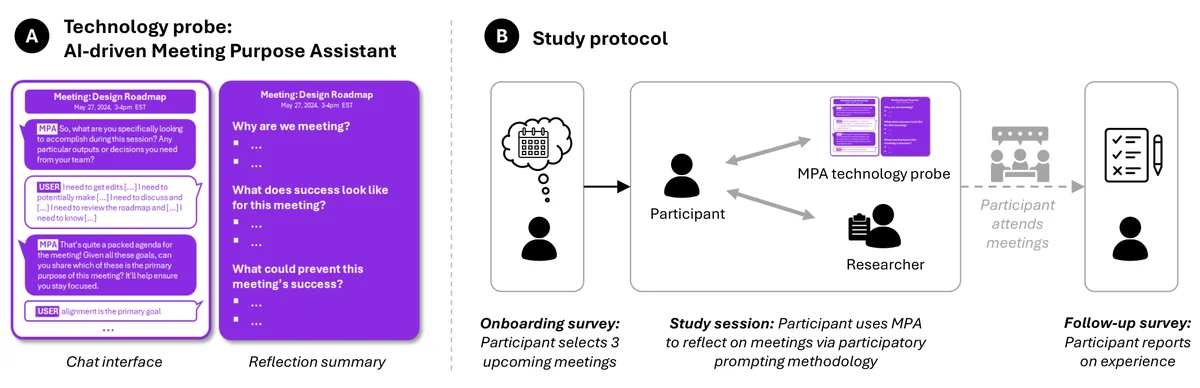
- Exploratory, qualitative participatory prompting study using the Meeting Purpose Assistant as a technology probe. It had three parts: an onboarding survey, a moderated session with the MPA, and a follow-up survey after the meetings. The onboarding survey asked about three upcoming meetings (a familiar one they organised, an unfamiliar one they organised, and one they attended and expected to be ineffective).
- Prototype
- The Meeting Purpose Assistant, a chat interface much like ChatGPT, built as a Node.js web application on GPT-4 Turbo through OpenAI's Assistants API. Before each session the researcher uploaded basic details of three of the participant's real upcoming meetings (title, time, description, attendees). For each meeting the user opened the conversation, and the assistant asked what they hoped to achieve, what success would look like and what could get in the way. It then followed up on their answers by probing vague replies, asking them to prioritise among several goals, or asking how they would tackle a challenge. It did not volunteer its own solutions (though it gave suggestions when asked). Its questions focused on the meeting's overall purpose for organisers and on their own purpose for attendees. A 'summarize' button produced a Reflection Summary of bullet points under three headings: why we are meeting, what success looks like, and what could prevent it. It was explored on its own, not compared with another tool.
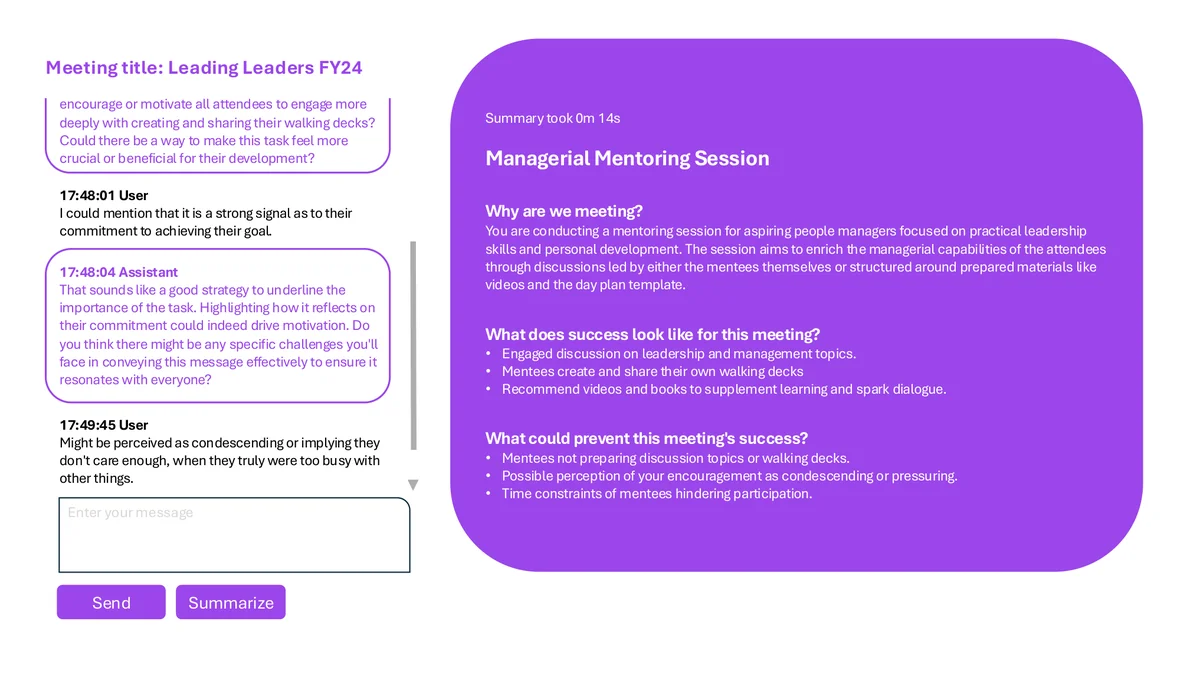
Figure 2: The Meeting Purpose Assistant technology probe consisted of a chat interface (left), powered by GPT-4 Turbo, that participants interacted with, and a Reflection Summary (right) of their conversation that participants could obtain by clicking the 'summarize' button. The MPA had basic context about the meeting from information uploaded in advance by the researcher. From the paper, Fig. 2, p. 6. - Setting
- A global technology company. Sessions held as video meetings with the participant sharing their screen.
- Participants / data
- A purposive sample of 19 participants from six work areas, including prior research participants who had indicated interest in future studies and four volunteers from adjacent research groups. One excluded, leaving 18 (10 women, 8 men).
- Duration
- One session per participant averaging 60 minutes (three sets of 10 minutes of conversation with the MPA, each followed by 5 minutes of discussion), then a follow-up survey.
- Analysis
- Reflexive thematic analysis of session transcripts in MAXQDA (initial themes from six transcripts by two authors. All 18 coded by the first author), with follow-up survey responses used to check whether impacts held after the meetings.
Findings
Saying it made it real. Employees of a global technology company who talked through three of their real upcoming meetings with the assistant said that putting implicit goals into words helped them focus, warm up and arrive with a plan. #
“Actually forcing myself to articulate it in and of itself is helpful.”
Like a coach, for some. Several compared the assistant to a therapist or coach, because it made them think for themselves, and some reported less stress about the meeting. Others found it too polite and passive and wanted to be challenged. #
“Any anxiety I had about the meeting evaporated.”
Reflection spilled into action. Participants shared summaries or agendas and asked attendees to contribute. In follow-up surveys after their meetings, three said this had improved attendance and engagement. #
“I sent [the summary] to the attendees, and they all brought topics of discussion, which made it very effective.”
Sometimes too general to help. Some found the reflection too general. A recurring meeting rarely had specific goals for one instance, and the assistant lacked technical context they did not want to type out. Some topics, such as those in one-to-ones, felt too confidential to share. #
“One on ones also have sensitive topics coming up. Many a times folks may feel that it's better to discuss these things offline, without anyone listening. When I say anyone, that includes tools and systems also.”
People wanted answers, not questions. Solution-minded participants wanted recommendations rather than questions, and attendees often felt they could not act on any solution in a meeting someone else organised. #
“If the MPA did not provide useful materials or solutions, some participants questioned whether reflection was worth their time.”
Save it for meetings that matter. Participants saw important and uncertain meetings, such as those with unfamiliar people or new projects, as the best candidates. Reflecting on every instance of a familiar recurring meeting felt excessive. #
“Any meetings that are critical or very important... Any meetings that we're nervous or apprehensive about, this would be really good.”
Questions this paper answers
- Can an AI chatbot help me get clearer about why I'm having a meeting?
- It can help. Prospective reflection (asking ahead why a meeting exists and what success looks like) appeared to support meeting intentionality. When 18 employees of a global technology company talked through real upcoming meetings with an AI assistant, they made implicit goals explicit and felt prepared. Some felt less stressed. (See §5.2.1, p. 9; §5.2.4, pp. 9–10.)
- Does reflecting on a meeting beforehand actually change the meeting?
- Sometimes. After reflecting with an AI assistant, some people shared summaries or agendas and asked attendees to contribute. In follow-up surveys, three said this had improved attendance and engagement. Attendees often felt they could not change meetings organised by others. (See §5.3.1, pp. 10–11; §5.4.3, p. 12.)
- Why might people not want to use an AI meeting reflection tool?
- Mainly effort and expectations. Explaining enough background to get useful questions takes typing, and some topics feel too confidential to share with a tool. Many people also expect AI to hand over answers, so questions alone can seem a poor use of time. (See §5.4.1, p. 12; §5.4.3, p. 12.)
- Which meetings are most worth reflecting on beforehand?
- People who tried AI-assisted reflection pointed to important and uncertain meetings, such as those with unfamiliar people or new projects. Reflecting on every instance of a familiar recurring meeting could feel excessive. (See §5.5.2, pp. 13–14.)
Contributions and implications
- Ask incisive questions rather than offering immediate solutions, so people think actively.
Prioritizing incisive questions over immediate solutions can encourage active thinking and deeper reflection in users, rather than passive receipt of information.
(Table 3, p. 17) - Use context from enterprise knowledge bases so people do not have to explain everything.
Contextual information from enterprise knowledge bases can be used to reduce extraneous cognitive load, personalize the interaction, and prime reflection.
(Table 3, p. 17) - Embed reflection and its outputs, such as goals and agendas in invitations, in existing workflows.
reflection should be embedded in collaborative workflows to increase its value and offset its time cost
(§6.3.2, p. 18) - Treat the social side of meetings with sensitivity, and keep provocative reflection in private interfaces.
The social context of meetings should be treated with sensitivity and could be used to inform the type of reflection guidance provided.
(Table 3, p. 17) - Mimicking active listening helps reflection but increases anthropomorphism and its risks, such as over-reliance and disclosure. Reflections exposed to employers could deepen power asymmetries.
Limitations
- Self-selected sample from one company. Participants may have been more thoughtful about meetings than others.
the participants may have been more thoughtful or opinionated about meetings than a broader cohort might be
(§6.4.2, p. 19) - Participatory prompting mixes human and AI-driven reflection, and the researcher's presence may have created demand characteristics.
risk the conflation of human and AI-driven reflection
(§6.4.2, p. 19) - Some interactions were cut short, and each participant was seen for only about an hour rather than longitudinally.
This means the 'full' course of interaction was not observed in some cases.
(§6.4.2, p. 19)
›Concepts
- Prospective reflection
- The kind of reflection studied, covering a meeting's purpose, success and challenges:
prospective reflection, that is, thinking about why a meeting is needed and what might happen
(Abstract, p. 1) - Reflection
- Intentionality requires reflection, broadly defined in prior work as:
consciously re-evaluating thoughts, ideas and experience(s) for the purpose of guiding future behavior
(§1, p. 2) - Meeting Purpose Assistant (MPA)
- Our technology probe: a chat interface powered by GPT-4 Turbo that asks about a meeting's purpose, success and challenges, plus a Reflection Summary.
we built a technology probe [33, 68]-the Meeting Purpose Assistant (MPA)-that engaged participants in brief conversations to stimulate reflection on their meetings
(§1, p. 2) - Reflection Summary
- The MPA's structured record of the conversation, which participants could reuse in meeting invitations or chats.
distilled the conversation into bullet points about the meeting's purpose, success criteria, and potential challenges
(§5.1, pp. 8–9) - Participatory prompting
- The study method:
where the researcher guides the user's interaction with the GenAI system to clarify technical issues and elicit further reasoning
(§1, p. 2)
Figures
How to cite
Ava Elizabeth Scott, Lev Tankelevitch, Payod Panda, Rishi Vanukuru, Xinyue Chen, and Sean Rintel. 2025. What Does Success Look Like? Catalyzing Meeting Intentionality with AI-Assisted Prospective Reflection. CHIWORK 2025. https://doi.org/10.1145/3729176.3729204
This brief was prepared with AI assistance and published by Sean Rintel. It is not the authors' published text. Page numbers refer to this PDF.