Research brief
Takeaway: A systematic review of CSCW research finds hybrid collaboration (co-located and remote people working together) scattered under dozens of names, its asymmetries often assumed rather than studied. Most research is experimental. Problems it had already identified, like remote people becoming an out-group, resurfaced when hybrid work surged during the pandemic.
Why this matters
- What was known
- Researchers have studied people in a room working with remote colleagues for decades, but under many different terms ('distributed', 'virtual', 'remote', 'mediated'), so there was no shared understanding of hybrid work.
the emergent concepts on what we might want to call hybrid collaboration and meetings do not reflect a common understanding, conceptualization, and definition of phenomena that the world is now desperately racing to understand
(§1, p. 2) - What this paper adds
- A systematic literature review of hybrid collaboration and meetings in the ACM Digital Library up to November 2019, with a taxonomy of the hybrid settings studied. It adds a synthesis with excluded high-profile work (such as Media Spaces) and 2020 and 2021 publications.
The end result is a baseline that researchers and designers can use in shaping the post-COVID-19 future of HCM systems.
(Abstract, p. 1) - Who it matters to
- Researchers, designers and developers of hybrid collaboration and meeting systems, and anyone searching the earlier literature on hybrid work. (§1.4, p. 5)
Research questions
- RQ1: Is there research which deals with HCM according to our definitions (see Sections 1.1 and 1.2) and if yes, where is the work on HCM thematically rooted?
- RQ2: How were HCM called/coined/termed?
- RQ3: Which research topics have been covered and which research methods have been used when studying HCM?
- RQ4: Was HCM discussed using the term 'hybrid' or at least with the aim of researching settings that can be regarded as HCM (implicit/explicit)?
- RQ5: What domains are relevant for HCM and what domains make use of HCM?
- RQ6: Since when is research on HCM reported and how did it chronologically evolve; are there historical shifts or trends in terms of 'hybridity' in HCM?
- RQ7: How can work on HCM beyond the mere results be thematically clustered and categorized?
Method and data
- Design
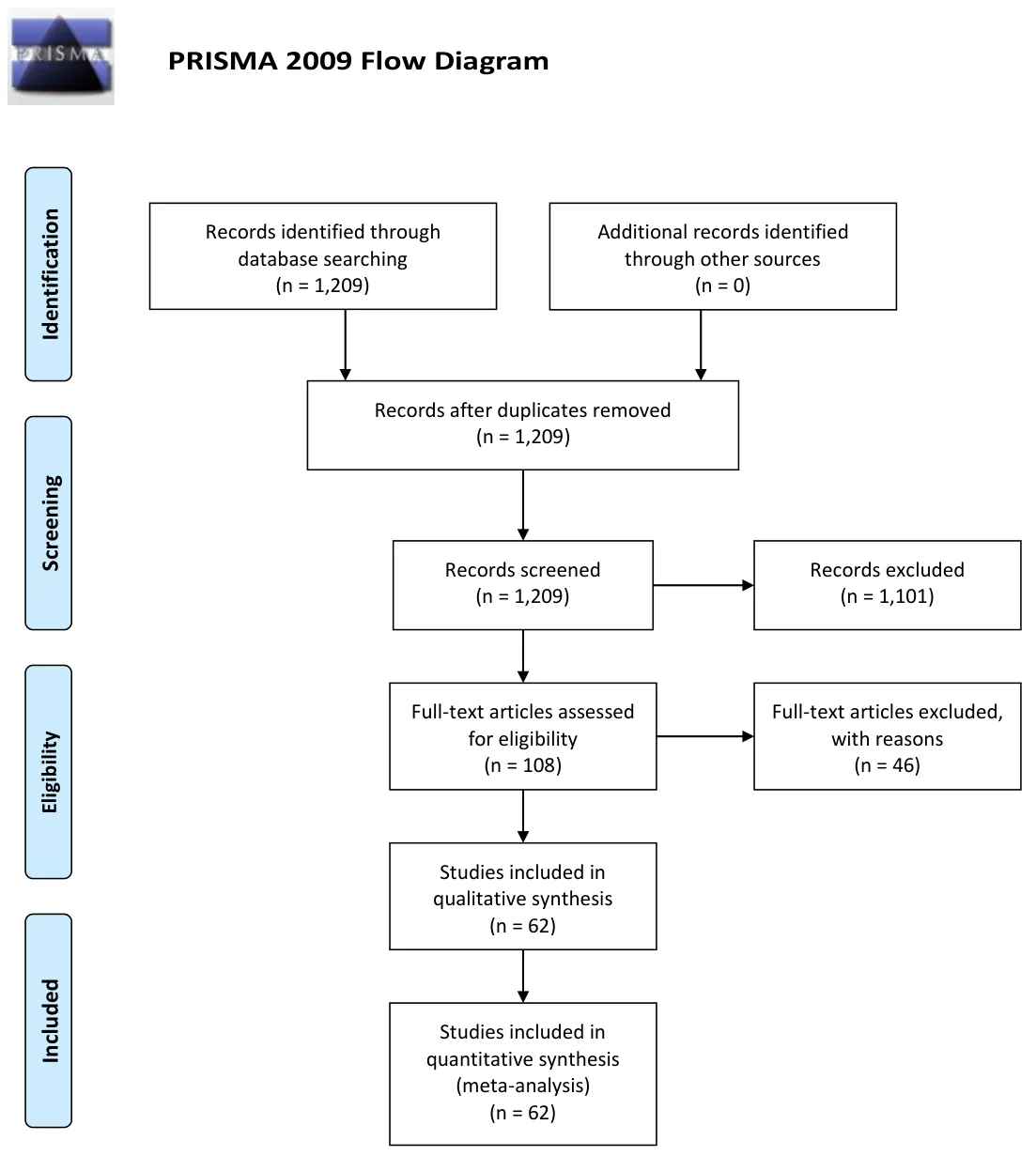
- Systematic literature review following Kitchenham and Charters, with a PRISMA flow, plus a narrative synthesis of excluded high-profile work and 2020 and 2021 publications.
- Setting
- The ACM Digital Library (ACM Full-Text Collection), queried on November 8th, 2019, with 72 keyword combinations (adjectives such as hybrid, partially distributed, virtual, video-mediated, crossed with nouns such as collaboration, meeting, team).
- Participants / data
- 1,209 results screened. 108 potentially relevant. 62 publications in the final set.
- Duration
- Publications up to November 2019 (the earliest included paper is from 1988).
- Analysis
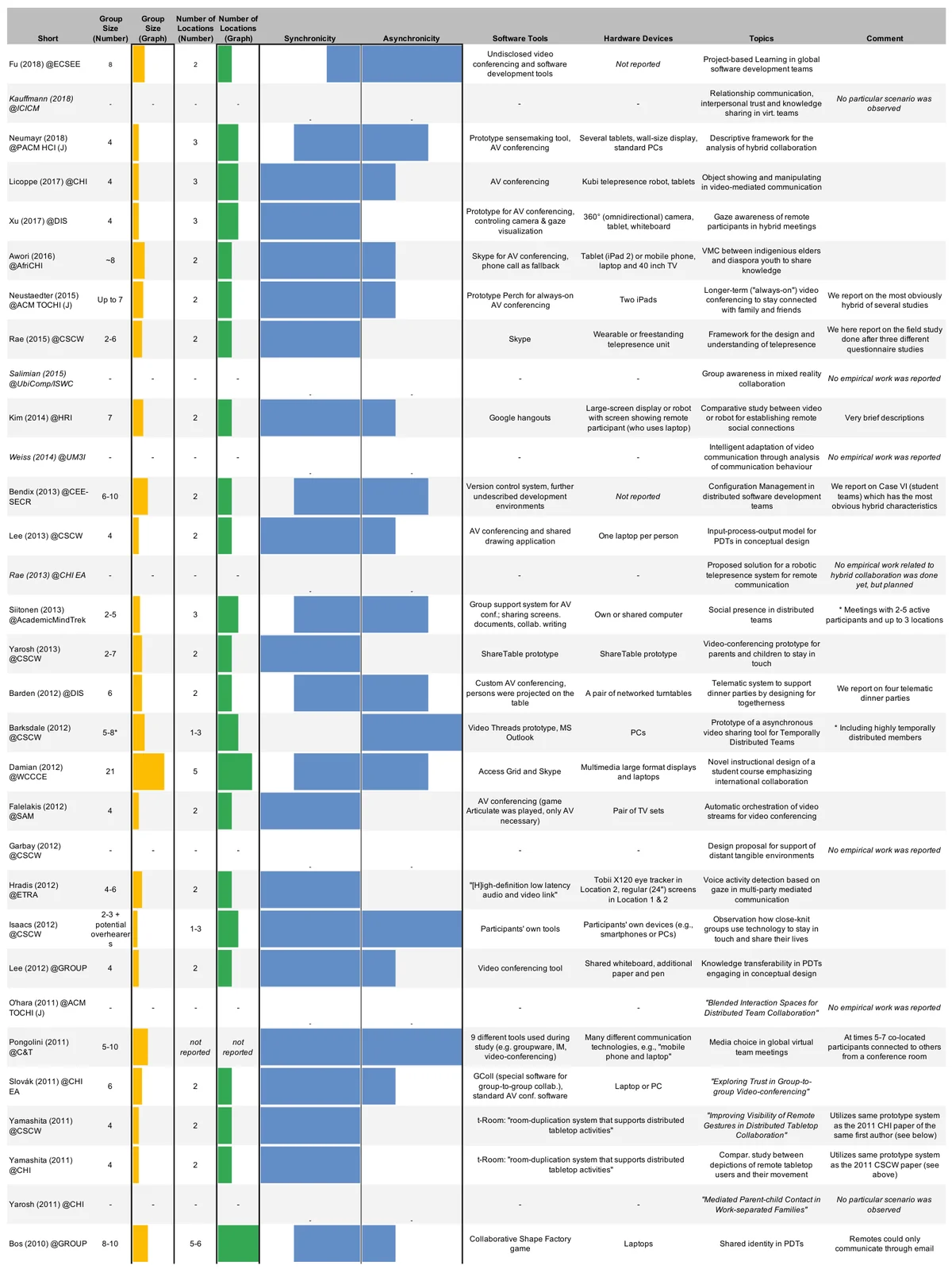
- Two main authors screened and coded papers for terms, citations, venues, authors, domains, study types, data collection and hybrid setting. Settings were classified in a taxonomy by participants' location, synchronicity and tool and device usage. Combining the SLR with additional literature, we proposed seven focal points for future work.
Findings
Many names for one thing. The review found 62 ACM papers on hybrid collaboration and meetings up to November 2019. Across them, authors used 91 different terms for the phenomenon, most of them only once. 'Hybrid' itself was rarely used before the pandemic. #
(§3.2, p. 19)Little studied, and less lately. Hybrid settings were under-researched. Only about 5% of our keyword search results were relevant, and publications declined after 2014. #
“even though tools supporting HCM have diversified and are widely available and used in many workplaces all around the world especially within the last decade”
Mostly lab experiments. More than half the papers relied only on experiments rather than studies of real work, and many included a hybrid setting without making it a focus of the research. #
(§3.6, p. 22)Small groups, two sites. The settings studied were small. Most involved two locations and groups of around ten people or fewer, and focused on real-time rather than asynchronous work. #
“in the real modern workplace today - even in the pre-COVID-19 world - HCM is done in larger crowds with more co-located and remote ends”
Key work under other names. Some essential research fell outside the keyword search, most notably work on Media Spaces (computing and video settings for unstructured collaboration across distance), which assumed mixed local and remote groups without calling them hybrid. #
(§5.1, p. 41)Informal encounters are where hybrid differs. Informal, opportunistic encounters are one case where designing for hybrid work differs from designing for fully remote work, because the asymmetry between those present and those remote is especially pronounced. An early always-on video wall linking two floors ran into privacy problems. #
“the system made people uncomfortable having private conversations in the common areas - both those who were in-person and those using the system”
Questions this paper answers
- Was there research on hybrid meetings before COVID-19?
- Yes, going back to a 1988 paper, but not much of it and rarely called 'hybrid'. Of 1,209 ACM search results up to 2019, only 62 papers studied hybrid collaboration or meetings, and publications declined after 2014. (See §3.2, p. 19; §7, p. 49.)
- Why is it hard to find research on hybrid work?
- Researchers used many different terms (91 across 62 papers), most only once. Important work such as Media Space research also assumed mixed local and remote groups without naming them, so keyword searches miss a lot. (See §3.2, p. 19; §5.1, p. 41.)
- What kinds of hybrid settings have researchers studied?
- Mostly experiments with small groups, usually around ten people or fewer, across two locations and focused on real-time interaction. Only 15 of 62 papers were purely real-world studies. (See §3.6, p. 22; §7, p. 49.)
- Is designing for hybrid work the same as designing for remote work?
- Not entirely. For the mechanics of communication, designs that support hybrid groups usually work for fully remote ones too. But informal, spontaneous encounters differ, because the gap in awareness between people in the office and those working remotely is especially pronounced. (See §6.5, p. 47.)
Quantitative results
| Measure | Result | Where |
|---|---|---|
| Search results and final corpus | 1,209 results; 62 relevant publications (5.13%; approximately 95% false positives) | §2.2, p. 16 |
| Different terms used to describe hybrid phenomena | 91 terms in 62 papers; 82 used only once | §3.2, p. 19 |
| Study types | 34 of 62 experiment-based only (21 controlled, 13 naturalistic); 15 purely real-world studies | §3.6, p. 22 |
| Hybrid setting explicit vs implicit | 26 explicit, 28 implicit, 1 both, 7 not applicable | §3.6, p. 23 |
| Focus on synchronous interaction | 32 of 45 publications categorised | §4.1, p. 27 |
| Citations of included papers (Google Scholar) | mean 100.37, median 21.5 | §3.3, p. 20 |
Contributions and implications
- The field needs a unifying vocabulary so that research becomes discoverable and comparable. (§1.4, p. 5)
- More real-world studies of hybrid meetings are needed, including in diverse and disadvantaged workplaces such as educational institutions. (§7, p. 49)
- Tools should better support spontaneous breakout of mixed local and remote subgroups in larger meetings. (§6.1, p. 44)
- Enabling opportunistic and informal encounters will be essential to the success of hybrid work. Media Space research points to the opportunities and challenges. (§6.5, p. 47)
- Future studies should report subgroup formation so the taxonomy can be extended.
Limitations
- The keyword-based selection may have missed relevant keywords and related work. (§7, p. 49)
- Only the ACM Digital Library was searched, leaving out hybrid research in fields such as business communication, tourism and education. (§7, p. 49)
- Some taxonomy ratings, mainly synchronicity and asynchronicity, are interpretative and should be read as rough indicators.
- The systematic search covers only publications up to November 2019. Later work is discussed but not systematically reviewed.
›Concepts
- Hybrid collaboration and meetings (HCM)
- Our umbrella term, reviewing collaboration and meetings together because their boundaries are fuzzy. Both are settings
where several co-located participants engage in coordinated work with remote participants
(Abstract, p. 1) - Hybrid collaboration
- It involves more than two people (who may split into subgroups) and several tools and devices at once. Above all,
Hybrid collaboration switches back and forth between all four quadrants of the time-space matrix.
(§1.1, pp. 3–4) - Hybrid meetings
- Our working definition:
we define hybrid meetings as video- or audio-based meetings among co-located and remote participants
(§1.2, p. 4) - Time-space matrix
- Johansen's classification of group activity as same or different time and same or different place. The taxonomy treats synchronicity and asynchronicity as separate continua.
- Media Space
- Stults's term for a computing and video setting for unstructured collaborative work among people separated by space and time. Deliberately not used as a search term, and discussed separately.
Media Space settings were intended to naturally and seamlessly include hybrid cohorts, so there was no need to describe them as such
(§5.1, p. 41) - Hybridity as asymmetry
- Our organising lens. We prefer 'hybrid' because it best connotes an uneven split between co-located and remote cohorts, and the literature we review mostly treats that asymmetry as a source of problems, such as social barriers between the two groups:
our goal is to unpack how hybridity matters when it confers an asymmetry on the coordination that occurs within the interrelated concepts of collaboration and meetings
(§1.4, p. 5)
Figures
How to cite
Thomas Neumayr, Banu Saatci, Sean Rintel, Clemens Nylandsted Klokmose, and Mirjam Augstein. 2021. What was Hybrid? A Systematic Review of Hybrid Collaboration and Meetings Research. arXiv. https://doi.org/10.48550/arXiv.2111.06172
This brief was prepared with AI assistance and published by Sean Rintel. It is not the authors' published text. Page numbers refer to this PDF.