Research brief
Takeaway: Working alone, people can lack the diversity of thought a group brings. AI expert personas could fill that gap, brainstorming with one person by borrowing turn-taking from conversation analysis and 'yes, and' from improv. In the YES AND prototype, each persona speaks only when confident of adding something new.
Why this matters
- What was known
- Diverse ideation leads to more creative outcomes, but individuals often cannot reach diverse colleagues, and existing AI ideation tools give long, definitive answers.
most existing multi-agent frameworks for ideation are either limited to specific domains or rely on pre-defined rules for agent interaction which can constrain creativity and serendipitous development of an idea
(§2.3, p. 2) - What this paper adds
- Instead of fixed interaction rules or long, complete answers, a deliberately simple framework in which agents decide for themselves when to speak and the user is left to develop the solution. It is built through prompt engineering rather than model training.
Our framework addresses these limitations by introducing a flexible dynamic multi-agent environment where agents autonomously generate and build on ideas while maintaining alignment with user objectives.
(§2.3, p. 3) - Who it matters to
- Professionals solving problems in organisations without ready access to diverse expertise, and, the paper suggests, ideation in healthcare, education and finance.
promote organisational efficiency and skill-building in individuals
(p. 1)
Research question
- Can a simple generative AI multi-agent framework give an individual access to diversity of thought for ideation, while keeping the user's own skills and creativity engaged rather than offloading ideation to AI?
Method and data
- Design
- Iterative system design with two versions: V1 passed the user's problem through the agents in a fixed sequence, and V2 used confidence-based turn-taking. Agent behaviour was shaped by prompt engineering in system messages, refined through trial and error.
- Prototype
- YES AND, a web chat app built with the Gradio Python library on a ChatGPT-based large language model. The user types a problem. Three agents with professional personas (a Designer, a Machine Learning Researcher and an Engineer) reply as in a group conversation, each speaker's picture shown beside the chat. For every message, each agent rates from 0 to 10 its confidence that it can contribute. The most confident speaks if it clears a threshold of 7, and may ask the user a clarifying question or nominate another agent to build on its idea, while the others just say 'hmm'. The user can interject at any time or call a fourth 'Sage' agent to summarise the discussion as a seed of an approach rather than a full solution. Compared informally with the earlier version, in which agents answered in a fixed order.
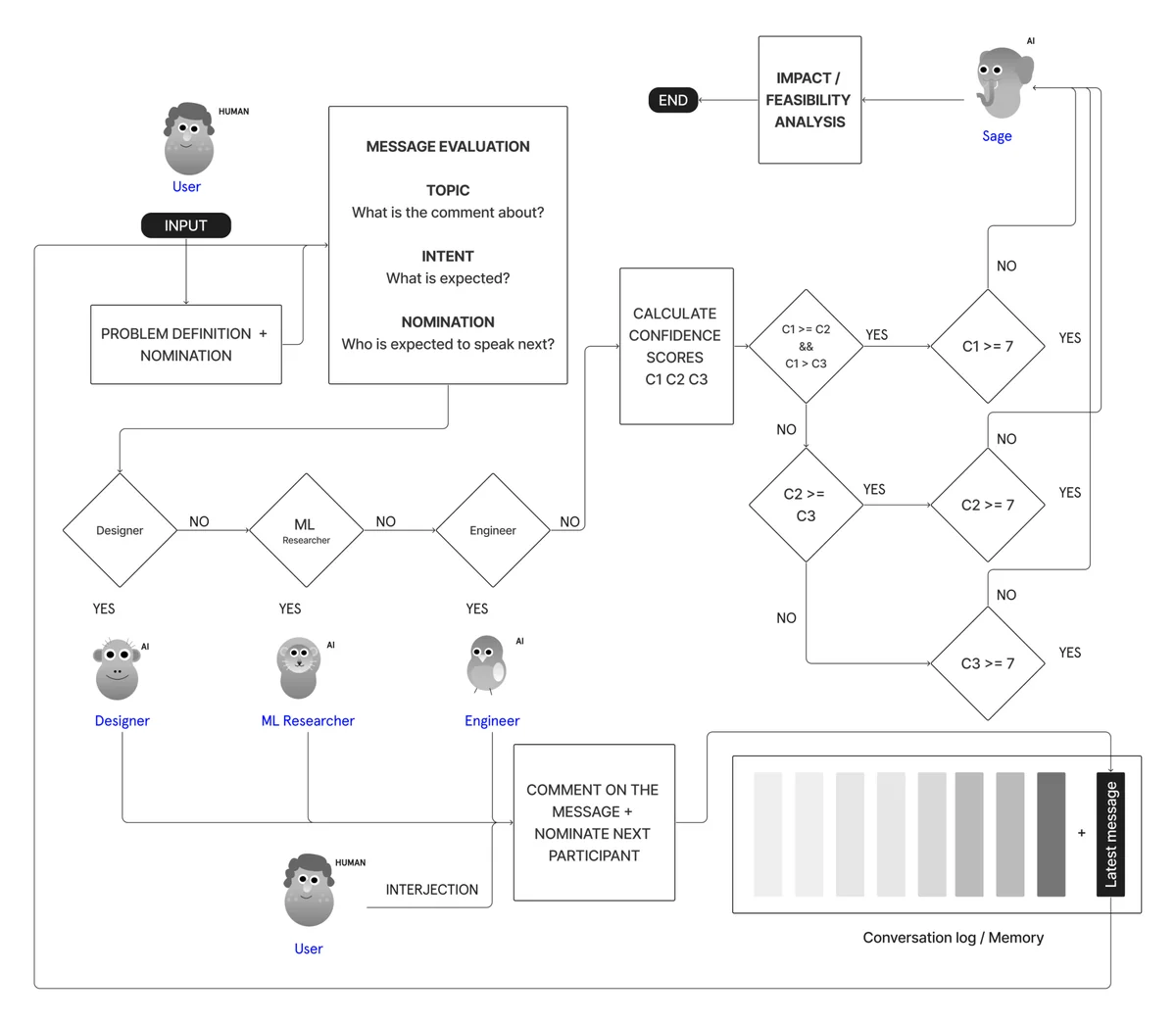
Figure 1: Conversation turn-taking architecture. From the paper, Fig. 1, p. 4. - Setting
- Example scenarios of a single user ideating on organisational problems, such as a Program Manager designing a feature to recall sent emails.
- Participants / data
- Four agents. Four example V2 chat logs and one V1 log are given in the appendix. No user study.
- Analysis
- Qualitative discussion of excerpts from the example conversations, comparing the linear and turn-taking versions.
Findings
A fixed order stifled ideas. In our first version, the user's problem passed from agent to agent in a fixed order. It worked in principle, but ideas did not develop spontaneously and the user had little say in where the discussion went. #
“Research shows that sequential flow of information restricts the spontaneous development of ideas and limits user engagement.”
Models don't know when to stay quiet. Group turn-taking requires knowing when to stay silent, which models like GPT-4 do not do on their own. Told that a button placement follows Fitts' Law, ChatGPT explained the law back at length. #
“Yes, Fitts' Law states that the time to acquire a target is a function of the distance to and size of the target.”
Self-rated confidence picks the speaker. Asked to rate its confidence that it could contribute, an agent gave the same Fitts' Law statement a low score and replied only 'hmm'. In our testing, such scores worked for choosing who should speak, though models' self-assessment is not fully precise. #
“the agent likely recognises the statement as true but determines that there is minimal value it can add to such a universally known fact”
Questions before solutions. In our example conversations with confidence-based turn-taking, agents asked the user clarifying questions instead of jumping to solutions, and built on and critiqued each other's ideas. #
“Can you clarify your use case: undoing accidental sends, editing content, or ensuring delivery control?”
The user must be able to cut in. Conversations among the agents could run on, so it mattered that the user could interject at any time to redirect them, or call the summarising agent to conclude. #
“Umm, I would like you all to think more about the implications. Forget execution”
Questions this paper answers
- Can a panel of AI personas stand in for diverse colleagues?
- Potentially, for people without ready access to diverse expertise. In example conversations, agents with different professional roles built on and critiqued each other's ideas and asked the user clarifying questions. Whether this improves creativity, and how well preset roles fit real problems, is untested. (See §3.4, p. 5; §3.4, pp. 5–6.)
- How do you stop multiple AI agents from all talking at once or rambling?
- Make each agent judge whether it has something worth adding. Having agents rate their own confidence, and letting only the most confident speak, curbed verbose, off-point replies in testing. Self-assessment is imperfect, though, and the user still needs a way to cut in. (See §3.3, p. 4; §3.4, p. 5; §3.4, pp. 5–6.)
- Is a free-flowing conversation better than having AI agents answer in a fixed order?
- It seems so. A fixed order restricts the spontaneous development of ideas and gives the user little say. In example conversations, letting agents speak when confident made ideation more interactive and iterative. Agents asked clarifying questions and built on each other's ideas. No user study has tested this. (See §3.2, p. 3; §3.4, p. 5.)
Contributions and implications
- Ideation support can leave the actual solution to the user, giving a seed of an approach rather than a complete answer, to avoid offloading ideation to AI and diminishing people's skills and creativity.
- Prompt engineering in system messages was the simplest way to create persona agents and shape their behaviour, including word limits and prompts to ask clarification questions.
The process underscores the critical role of prompt engineering in shaping interactive AI behaviour and offers practical insights for designing conversational systems.
(§3.1, p. 3) - The framework could be adapted to other domains needing diverse expertise, such as multidisciplinary team meetings in healthcare, student projects in education, and decision-making in finance.
Limitations
- Effectiveness has not been empirically validated. Controlled experiments and user studies are future work.
We acknowledge that YES AND' s effectiveness in enhancing creativity, engagement, and diverse ideation has yet to be empirically validated.
(§4, p. 6) - Agent personas are predefined and may not fit the user's problem. Diversity was limited to professional roles.
A significant limitation is in the use of predefined agent personas.
(§4, p. 6) - As conversation logs grow, it gets harder for the model to keep responses relevant.
Without robust mechanisms to manage contextual load, the agents risk delivering responses that feel disjointed.
(§4, p. 6) - The system supports only one user. Human-human collaboration with multiple users and agents is future work.
›Concepts
- Diversity of thought
- How we use the term:
this work defines diversity of thought as the variation in perspectives and opinions arising from differences in backgrounds and expertise
(§2, p. 2) - Design improv ('yes, and')
- The inspiration for the framework: accept others' ideas and build on them.
Inspired by "design improv" [19], which promotes acceptance of ideas and building upon them
(p. 1) - Conversational turn-taking
- We adopt the turn-taking model of Sacks and colleagues from conversation analysis: a speaker nominates the next speaker, others self-select, or the speaker continues. (§3.3, p. 3)
- Confidence mechanism
- Each agent rates its confidence in a message's topic and intent from 0 to 10 and speaks only above a threshold. Otherwise it just says 'hmm'.
This approach aimed to limit their responses to only situations where they believed they could confidently and meaningfully contribute to an ongoing conversation.
(§3.4, p. 4) - Persona-based agents
- AI agents given a professional role (Designer, Machine Learning Researcher, Engineer) through prompt engineering in system messages, plus a 'Sage' that summarises.
we focused only on professional role-based personas with a limited set of traits relevant to problem-solving
(§3.1, p. 3)
Figures
How to cite
Pratik Ghosh and Sean Rintel. 2025. YES AND: A Generative AI Multi-Agent Framework for Enhancing Diversity of Thought in Individual Ideation for Problem-Solving Through Confidence-Based Agent Turn-Taking. CHI EA 2025. https://doi.org/10.1145/3706599.3720142
This brief was prepared with AI assistance and published by Sean Rintel. It is not the authors' published text. Page numbers refer to this PDF.