Research brief
Takeaway: Office telepresence robots went largely unused because their value likely never outweighed the effort. Hybrid staff socialised on office days and wanted home days free for focus. Fully remote staff wanted the connection but found poor audio, few occasions to move around, and robots that couldn't join usual video meetings.
Why this matters
- What was known
- Earlier studies of mobile robotic telepresence in offices mostly reported users' experiences of temporary use.
There have not, to our knowledge, been reports on what is involved in fully implementing a real-world MRP technology roll-out in a knowledge work organisation to directly support day-to-day hybrid work.
(§1, p. 1) - What this paper adds
- A case study of the preparation for a pilot roll-out of five robots (health and safety, accessibility, security, placement, user information) and of how employees responded.
our study attempts to promote a change in the unit of analysis away from the device itself towards the device's organizational, social, situated embedding
(§2, p. 2) - Who it matters to
- Organisations designing hybrid workplaces and planning telepresence deployments, and researchers studying technology adoption at work.
so we hope that the work we present here helps others be more prepared in what to expect
(§7, p. 6)
Research questions
- Would mobile robotic telepresence robots provide enjoyable planned and unplanned encounters between remote and on-site employees, and improve connections between them?
- What is involved in making the robots available for office use, and what are the opportunities and challenges within this organisational setting?
Method and data
- Design
- Case study of an organisational pilot roll-out of mobile robotic telepresence.
- Setting
- A corporate research lab in the UK, which bought five Double 3 robots, one for each floor of its building.
- Participants / data
- 15 new users signed up. Non-adopters around the office were informally surveyed, and remote users were asked why they stopped.
- Duration
- The pilot ran for three months. Preparation tasks took several weeks.
- Analysis
- Descriptive account of the preparation work and of employees' responses, drawing on informal surveys and user comments.
Findings
Preparation took weeks, and many teams. Preparing a research lab to roll out five telepresence robots took several weeks of overlapping work with health and safety, IT, facilities and other teams. The safety assessors, who tried the robots remotely instead of visiting, rated all potential hazards as low risk. #
“The inspectors were able to see each other as robots in the office, so they saw both the perspective of a remote user and how the robot might appear to on-site users.”
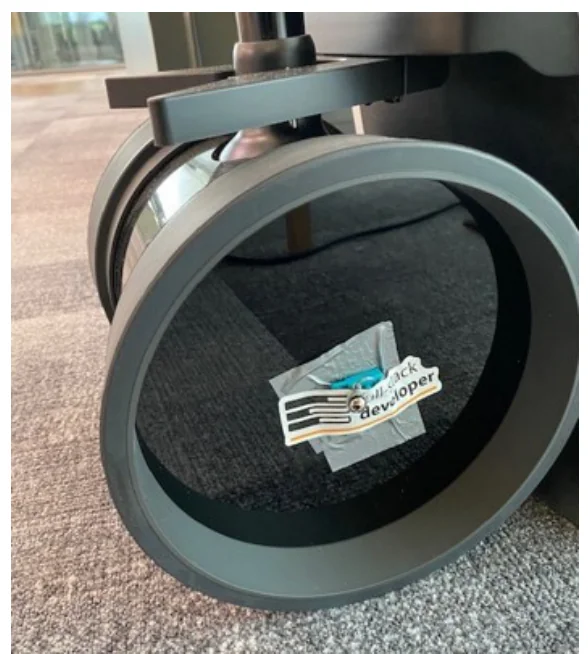
Cat bells fixed a real problem. Because the robots move almost silently, a blind employee could not tell when one was nearby. Bells taped to the wheels, which chime as they turn, solved this. #
“Moreover, sighted, on-site users have found it useful to be able to hear when a robot is approaching, as they had also previously found the stealthy movement of the robot unsettling.”
Few signed up. Fewer stayed. Despite emails, posters and presentations to teams, only 15 people signed up, and most either never used the robots or stopped after a few tries. #
“Of those, five did not actually use the robots, two used them once, and four used them a few times each but eventually stopped.”
No reason to roam, too much hassle. Non-adopters saw no reason to roam the office remotely and found sign-up complicated. Users were put off by poor audio and video, few suitable occasions, and having to run a parallel Teams meeting alongside the robot. #
“One on-site employee explained that the users' status on Microsoft Teams could let them know if their colleagues were at their desks, and available to be interrupted.”
Security could not be guaranteed. Security could not be assured to the lab's standard. The robots give remote users mobile access to a building without passing physical security, with no direct way to check who is at the remote end. #
“Even if the risk of a security breach is low, the repercussions could be very serious.”
Effort outweighed value. On balance, the effort of using the robots probably outweighed their benefits for these employees, though so little use makes this hard to say with certainty. #
“Of course, the catch-22 of technology adoption is that it requires investment without established value, but that value cannot be established without investment.”
Questions this paper answers
- Do telepresence robots work for hybrid offices?
- Not easily. They can be made safe and accessible, but adoption depends on whether the benefit justifies the effort. In a three-month research-lab pilot, most of the 15 who signed up never used them or soon stopped, and the lab discontinued them. Other settings may suit them better. (See §5, p. 4; §5, p. 4; §7, p. 7.)
- What does it take to roll out telepresence robots in an office?
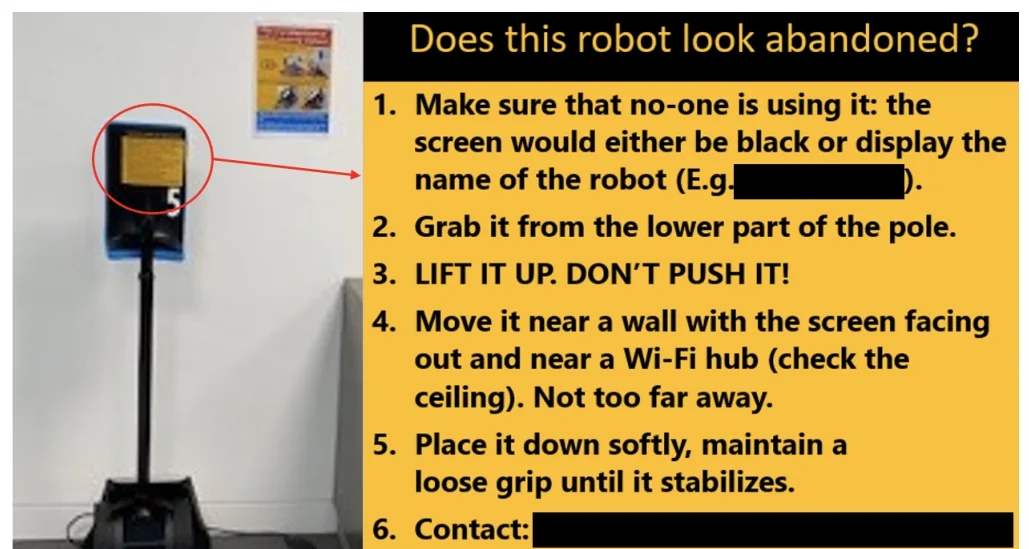
- Several weeks of work with health and safety, IT and facilities. It covered a risk assessment, accessibility fixes such as bells on the wheels, and rules for moving abandoned robots. It also covered a security group for access, careful dock placement, and written and video instructions. (See §4.1, p. 2; §4.2, p. 2.)
- Why might a workplace technology fail even when it works as designed?
- Because adoption depends on effort versus value for everyone involved. A telepresence robot needs remote and on-site colleagues, bystanders and building staff to support it. Without a culture of use, a remote user may log in and find no one to interact with and nothing to do. (See §5, p. 4; §7, p. 7.)
- Are telepresence robots a security risk for companies?
- They can be. They give a remote user mobile access to a building without passing physical security, and there is no direct way to control who is at the remote end. After a pilot, one research lab paused use until enhanced security processes exist. (See §4.4, p. 3.)
Quantitative results
| Measure | Result | Where |
|---|---|---|
| Robots purchased | five Double 3 robots | §2, p. 2 |
| New users who signed up | 15 new users in total | §5, p. 4 |
| Robot speed limit | 1.8mph | §4.3, p. 3 |
Contributions and implications
- Future deployments should reduce the effort of use, build the system into employees' collaborative and communicative routines, and consider hybrid use when designing spaces.
future deployments should aim to reduce effort required to use a system, identify specifically how it can be integrated into employees' collaborative and communicative routines, and consider hybrid implementation in the design of spaces
(§7, p. 6) - Organisations need to prioritise clearly which population needs a technology serves. Fully remote and flexible hybrid employees may value telepresence differently.
there needed to be clear prioritisation of sets of population needs within an organisation
(§7, p. 6) - Adoption needs a culture of use on both the remote and on-site side, supported by social and technical infrastructure.
For MRP technology to become a mainstream part of a hybrid office, usage will need normalization and support by the social and technical infrastructure.
(§6.2, p. 5) - Experimenting was itself valuable. A culture of experimentation helps organisations through the uncertainty of hybrid work.
For organisations to thrive in a context of uncertainty, developing a culture of experimentation is crucial.
(§7, p. 7)
Limitations
- Employees' reasons come from a brief informal survey. More rigorous study is needed.
this understanding is only from a brief informal survey and more rigorous study is needed
(§7, p. 6) - Fully remote non-adopters were hard to reach, so their views are missing.
- The case covers one organisation, whose employees were already practised in remote collaboration. Other organisations will have different friction points.
- Accessibility was assessed only for blind and low-vision people.
›Concepts
- Mobile Robotic telePresence (MRP)
- Videoconferencing on a remotely driven mobile robot, letting a remote user move around an office. (§1, p. 1)
- Effort vs. value
- Grudin's explanation for why systems for collaborative work fail:
the disparity between the work required to make a system function (and who has to do that work) and its benefits (and who receives them)
(§6.1, p. 5) - Critical mass
- Enough users for a communication technology to be adopted. For a telepresence robot, that means more than the remote user:
However it is a medium for interactions, and therefore both the remote and on-site parties need to collaborate to make it work, as well as all peripheral members such as bystanders and building management.
(§6.2, p. 5) - Non-use
- Drawing on Satchell and Dourish, the varied reasons people do not adopt a technology, from disinterest to active resistance. Why they matter:
Non-users' perspectives can teach just as much as those of users.
(§6.3, p. 6)
Figures
How to cite
Andriana Boudouraki, Joel E. Fischer, Stuart Reeves, and Sean Rintel. 2023. Your Mileage May Vary: Case Study of a Robotic Telepresence Pilot Roll-out for a Hybrid Knowledge Work Organisation. CHI 2023. https://doi.org/10.1145/3544549.3573871
This brief was prepared with AI assistance and published by Sean Rintel. It is not the authors' published text. Page numbers refer to this PDF.