Research brief
Takeaway: Text chat gives virtual meetings a second channel for participation. Women chatted more and men spoke more. Higher-level men spoke more than lower-level women, but higher-level women, unexpectedly, chatted most. Lower-level staff who felt psychologically safe chatted more, so valuing and moderating chat could widen who is heard.
Why this matters
- What was known
- Research on groups shows that status shapes who speaks, and that computer-mediated groups can be more egalitarian, but chat running in parallel with talk in work meetings had barely been studied.
there is little prior exploration of parallel chat in virtual work-related meetings despite its theoretical grounding and practical importance
(§1, p. 2) - What this paper adds
- Objective telemetry of both speaking and chat in real meetings, linked to survey data on gender, job level, and psychological safety.
Our research is one of the first to explore individual differences in both audio (i.e., spoken) and chat (i.e., written) participation in virtual meetings.
(§5, p. 15) - Who it matters to
- Organisations, leaders, meeting facilitators, and teams who want inclusive meetings, and researchers of status, psychological safety, and meetings.
organizations, leaders, and teams should actively encourage gender-inclusive communication
(§5.2, p. 18)
Research questions
- Hypothesis 1. a. Men verbally participate more often in their virtual meetings compared to women. b. Employees high in job level verbally contribute more often in their virtual meetings compared to employees low in job level.
- Hypothesis 2. a. Women send more chats in their virtual meetings compared to men. b. Employees low in job level send more chats in their virtual meetings compared to employees high in job level.
- Hypothesis 3. a. Men high in job level verbally participate in their virtual meetings compared to all other groups. b. Women low in job level send more chats in their virtual meetings compared to all other groups.
- Hypotheses 4 and 5: Does psychological safety moderate the relationships of gender and job level with verbal participation (H4a-b) and with chat frequency (H5a-b)?
Method and data
- Design
- Survey linked to three months of Microsoft Teams meeting telemetry. Not preregistered.
- Setting
- Full-time employees of a global technology company. Virtual meetings of three or more people (one-on-one meetings excluded).
- Participants / data
- 322 employees completed the survey. Final sample 291 participants, with 52,507 meeting chat posts spanning 33,812 meetings.
- Duration
- Three months of telemetry before each survey (surveys completed between April 27th and August 3rd 2023).
- Analysis
- Negative binomial regression on per-person totals of audio detected (verbal participation) and chat posts (text messages, emoji reactions, attachments), controlling for time in meetings and age. Subgroup analyses of gender by job level. Mean-centred psychological safety as moderator. Supplemental models for each chat type.
Findings
Women used the chat more. Across three months of Microsoft Teams meetings among employees of one technology company, women posted more in meeting chat than men, controlling for time spent in meetings and age. Chat posts here combine text messages, emoji reactions, and attachments. #
“Using the chat feature could reduce interruption apprehension for women, providing a way for them to ensure their contributions are not talked over by male counterparts.”
Men spoke more. Job level alone was not significant. Men had more audio detected in their meetings (our proxy for speaking) than women did. Job level on its own was not significantly related to speaking or to overall chat. #
“This finding supports prior research indicating that men tend to speak more during group discussions”
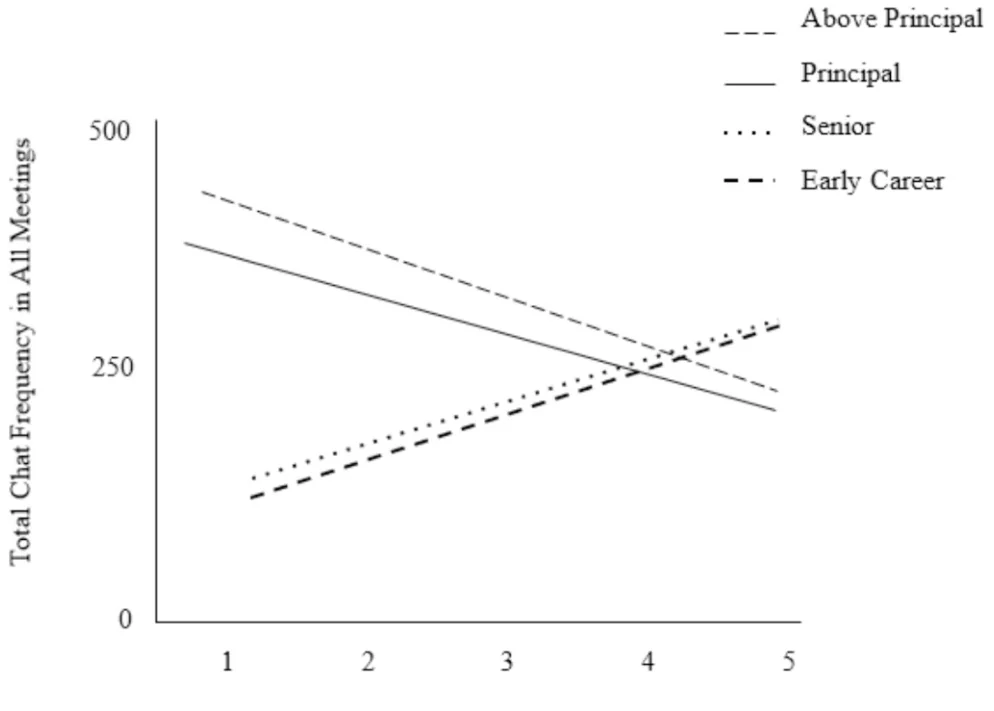
Higher-level men talked, higher-level women chatted. Job levels were combined into two bands because some gender-by-level groups were tiny. Men at principal level or above then spoke more than women at lower levels. Contrary to our hypothesis, women at principal level or above chatted the most of any group. #
“Women who have broken through barriers to reach senior positions may be more aware of the importance of inclusivity and gender diversity.”
Feeling safe went with more chat, not more speech. Psychological safety (feeling able to take interpersonal risks at work) moderated the link between job level and chat, but did not moderate speaking. Lower-level employees who felt safer chatted more, the opposite direction to our hypothesis. #
“these employees may be less concerned about being misunderstood or misinterpreted when using chat as a means of communication where they have more time to edit and refine their response or contribution”
Talkers also chat. Employees who spoke more in meetings also tended to chat more. This could mean some voices dominate both channels, or that some people use both channels to reinforce their points. #
“it could be that some individuals prefer to use multiple modes of communication to reinforce their messages or provide additional context”
Questions this paper answers
- Why might women turn to chat in online meetings?
- Status characteristics theory suggests people seen as lower status get fewer chances to speak, and earlier research finds women are interrupted more. Chat could let them contribute uninterrupted. Among 291 global technology company employees, women chatted more and men spoke more, though the data could not show why. (See §5, p. 16; §5, p. 16.)
- Does seniority decide who talks in virtual meetings?
- Not on its own. Job level alone was not significantly related to speaking, but status cues seem to combine, as status characteristics theory and intersectionality suggest. Once job levels were grouped into two bands, men at principal level or above spoke more than women at lower levels. (See §5, p. 16; §5, p. 16.)
- Does psychological safety make people speak up more in online meetings?
- Apparently not verbally. It moderated the link between job level and chat instead. Lower-level employees who felt psychologically safe chatted more, perhaps because writing gives time to refine a contribution and lowers the risk of being misunderstood. (See §5, p. 17.)
- Does meeting chat make participation more equal?
- Partly. It offers a second avenue, and women, who spoke less, used it more. But people who spoke more also chatted more, so chat may also amplify voices that already dominate. Without seeing message content, we could not tell which. (See §5, p. 16; §5, p. 17.)
Quantitative results
| Measure | Result | Where |
|---|---|---|
| Sample | 291 participants; 52,507 meeting chat posts spanning 33,812 meetings | p. 7 |
| Gender and chat participation (women vs men) | β = 0.19, p < .05 | §4.3, p. 10 |
| Gender and audio detection (women vs men) | β = −0.17, p < .05 | §4.3, p. 10 |
| Audio detection, men at principal level or above vs women at early career or senior level | β = 0.38, p < .05 | §4.3, p. 11 |
| Chat participation, women at principal level or above vs women at early career or senior level | β =0.36, p < .05 | §4.3, p. 11 |
| Correlation between chat participation and audio detection | r = 0.37; p < .01 | §4.1, p. 10 |
| Job level by psychological safety interaction on chat participation (H5b) | β = −0.28, p < .05 | §4.3, p. 12 |
Contributions and implications
- Value both spoken and written contributions, and acknowledge chat in the discussion, for example by assigning a chat moderator.
meeting leaders could assign a chat moderator to monitor the chat discussion during virtual meetings
(§5.2, p. 18) - Facilitators should actively seek input from women and lower-level employees, or rotate speaking roles, so that men's greater speaking does not silence others.
leaders should ensure that this does not inadvertently silence voices from women
(§5.2, p. 18) - Foster psychological safety so that all employees feel safe contributing both verbally and in chat, for example through training.
- Equal participation across job levels may not always be the right goal, since relevance to the meeting and experience differ.
Limitations
- For privacy, we could not see what people said or wrote, only whether audio was detected and what kind of chat action was sent.
we were unable to capture the content of the spoken or chat discussion
(§5.3, p. 18) - Audio detection is an imperfect proxy for speaking. Background noise could register as contribution.
it is an imperfect metric of verbal contribution
(§5.3, p. 19) - The sample had little racial diversity, so race could not be tested. Gender was analysed as binary.
- We could not tell who else was in each meeting, so meeting composition could not be studied. The study covers virtual, not hybrid, meetings.
›Concepts
- Parallel chat
- The meeting feature this study focuses on:
Parallel chat offers an additional means of participation during a meeting, where group members can synchronously contribute to the conversation
(§1, p. 2) - Status characteristics theory
- Our main theoretical lens, applied here to gender and job level:
Status characteristics theory suggests that performance expectations in groups are influenced by the "status" or social meaning that individuals assign to characteristics of various group members
(§1.3, p. 3) - Psychological safety
- Measured here with Edmondson's 7-item scale. In our words:
Psychological safety in the workplace promotes a nurturing and inclusive work environment where individuals can take risks, express their ideas, and contribute without the fear of adverse implications
(§1.5, p. 5) - Number of Encoded audio Frames (NEF)
- Our telemetry measure of verbal participation:
The NEF metric is normalized to approximate the proportion of the meeting during which a participant spoke.
(§2.2.4, p. 7)
Figures
How to cite
Liana Kreamer, Steven G. Rogelberg, Lev Tankelevitch, and Sean Rintel. 2024. Virtual voices: Exploring individual differences in chat and verbal participation in virtual meetings. Journal of Vocational Behavior 152. https://doi.org/10.1016/j.jvb.2024.104015
This brief was prepared with AI assistance and published by Sean Rintel. It is not the authors' published text. Page numbers refer to this PDF.